
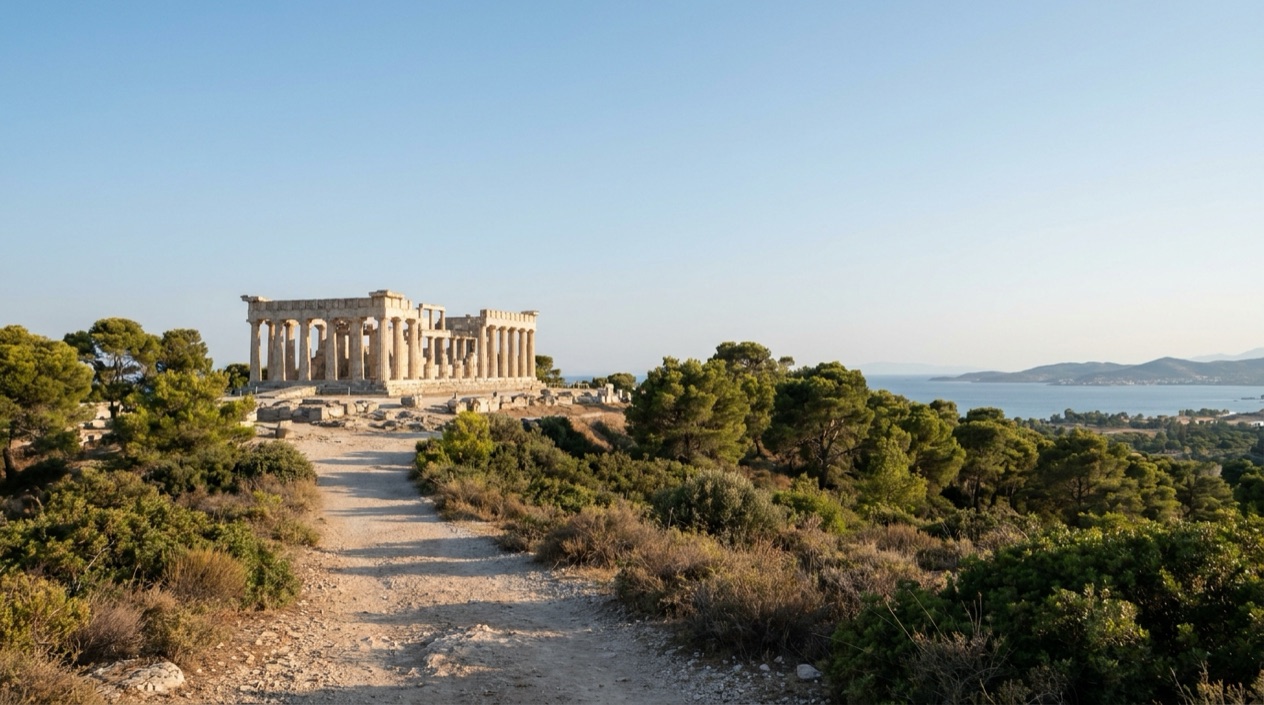
The columns of the Temple of Aphaia come into sight on the crest of a hill at the northeast point of Aegina, standing against open sky with the Saronic Gulf spread out around them. Up close, the stone has the warm, weathered look of something that has stood in sun and wind for a very long time. This is a visit to a sanctuary rather than a city of ruins: one temple, a small museum beside it, and a hilltop to walk around.
Is visiting the Temple of Aphaia on Aegina worth it?
Yes, for anyone who enjoys ancient places for their setting and their stories as much as for their size, and especially for travelers already spending a day on Aegina or staying in Athens and wanting an island outing. The temple gives you a real sanctuary on a real hilltop, with a museum that explains what the building looked like when it was new.
What sets it apart from the other ancient sites around Athens is its position and its story. The sanctuary of Aphaia was built on the top of a hill at the northeast point of the island, so the site feels like a destination reached by going somewhere, not a ruin tucked into a busy city.
Few ancient sites let you stand in the place where the building stood while the finest pieces are in another country, and the site museum helps bridge that gap with restorations and copies.
It also fits easily into a wider island day. Aegina is known for its pistachios, which carry a Protected Designation of Origin, and it was the island where the first Greek coins were minted. Pairing the temple with the main town, a pistachio treat and a harbor lunch makes a full and varied outing.
What to see at the Temple of Aphaia on Aegina
The visit has three parts: the temple on its hilltop, the museum on the site, and the story of the sculptures that traveled far away. Each rewards a slow look.
The temple on the hill
The temple is a Doric building, and what survives is a grand colonnade with its stone beams still resting on top of the columns. Walk around the whole building and notice how the columns change against the sky depending on where you stand. From the terrace around it you look out over the water of the Saronic Gulf, which is the reason the site was chosen.
Aphaia was a goddess worshipped on Aegina and linked in the old stories with Artemis. One tale says she vanished into the sea nets of fishermen while fleeing a pursuer, and the name Aphaia is often explained as meaning the one who disappeared. Keep the story in mind as you look at the hillside around the temple, because the sanctuary was a place of worship long before the stone building you see.
The museum on the site
The museum next to the temple explains what you cannot read from the ruin alone. It holds a restoration of the entablature and pediment of the earlier Archaic temple, an older building that stood here before the one that survives today. Seeing it rebuilt shows how the sanctuary changed over time.
It also contains copies of elements of the pedimental sculpture of the later temple, set into restored sections of the pediment. These let you picture the triangular gable above the columns filled with figures, which is hard to imagine when you are looking at an open sky. Some original fragments are also kept at the site itself.
The sculptures that left the island
The temple’s pedimental sculptures are on display in the Glyptothek of Munich, with some fragments in museums on Aegina and at the site. That split is part of the experience. At the temple you see the empty setting and the copies, and in Munich the originals, so a trip to Aegina leaves you with a clear sense of how much of ancient Greece is now spread across European museums.
When you stand beneath the pediment, look for the places where the figures would have stood and read the museum’s restored sections as a guide. If you are planning a longer trip through Europe, the Munich collection is the natural sequel to this visit.
How to get to the Temple of Aphaia on Aegina
The route is in two steps: a boat from Piraeus to Aegina, then a road journey across the island. The temple stands on the eastern side of Aegina, a drive by road from the main port, which is the town of Aegina.
By sea from Piraeus
Ferries to Aegina leave from Piraeus, the port of Athens. Hydrofoils take only forty minutes, while the regular ferry takes about an hour. In normal times the hydrofoils sail hourly from seven in the morning until five in the afternoon, so the hydrofoil timetable frames a day trip.
Within Piraeus port, signs direct passengers to Gate E8 for Aegina ferries, though the gate can sometimes shift to E7, so watch the signs. The operators serving Aegina are Hellenic Seaways, Blue Star Ferries and Saronic Ferries.
From Aegina town to the temple
The temple stands approximately thirteen kilometers east by road from the main port, so you need a road connection once you land. Regular bus services run from Aegina town to destinations throughout the island, such as Agia Marina. Agia Marina is a good name to know, as it is a place on the island’s eastern side that bus services reach, and it sits in the same part of the island as the sanctuary.
Beyond the bus services to named destinations, no other transfer details are set out here, so work out the last stretch to the hilltop once you reach the island.
When to visit the Temple of Aphaia on Aegina
The best moment is whichever day lets you reach the island comfortably and stay on the hilltop without hurrying. The hydrofoil timetable gives the visit its shape, since in normal times the boats leave Piraeus hourly through the morning and into the afternoon, and your return crossing is part of the plan from the start.
The temple is an open-air site on a hilltop. Treat the sky as one more feature of the site, and plan around the sun and wind rather than against them.
There is no special festival date attached to the temple in the information available, so you are not planning around an event. Instead, think of the visit as a half of a longer island outing. Pair the hilltop with the town, a walk along the harbor and a pistachio-flavored sweet, and let the ferry timetable decide the order.
If you are visiting Greece outside the summer months, keep in mind that boats and island services follow their own seasonal patterns. The hourly hydrofoil schedule is described for normal times, so confirm the timetable for the day you travel before you set your plans around it.
Tips for your visit
Bring what you would for any open hilltop: sun protection, water and comfortable shoes for walking around the terrace and the temple’s edges. The sanctuary stands high above the sea, so sky and wind are part of the experience.
Spend your time at the temple on the details. Walk the full circuit of the colonnade, then go into the museum to see the restored entablature and the copies set into the pediment. Looking at the copies first and the real building second gives you a better reading of the ruin.
Combining the temple with other stops
Kolona, an important Bronze Age archaeological site, lies northwest of Aegina town along the coast, and a museum is located there. It makes a natural companion to the temple because it shows a much earlier layer of the island’s history, before the sanctuary period.
They are sold as plain nuts, in sweets and in ice cream, and make a good souvenir to carry back to Athens. The harbor is also a pleasant place for a meal of grilled fish or a plate of meze, the small dishes Greeks share at the table, before you take the boat back to Piraeus.
For families and travelers who prefer to move slowly, the useful thing to know is that the site is a hilltop sanctuary, so expect some open ground and uneven stone around the temple. Beyond that, use the bus services to named island destinations and the ferry timetable as your anchors, and keep the rest of the day loose.
Good to know before you go
Greece uses the euro, and a small island day is easiest with a little cash for snacks and bus rides alongside a card. Keep the ferry gate in mind when you board in Piraeus, as Gate E8 can sometimes shift to E7. On the hilltop, the usual habits of an open archaeological site apply: stay on the paths around the temple, take your time in the museum and leave the stones as you found them.
Sources
- Wikipedia, Temple of Aphaea (https://en.wikipedia.org/wiki/Temple_of_Aphaea), checked October 12, 2026
- Visit Greece (GNTO), Aegina (https://www.visitgreece.gr/islands/saronic-islands/aegina/), checked October 12, 2026
- Wikipedia, Aegina (https://en.wikipedia.org/wiki/Aegina), checked October 12, 2026
- Wikivoyage, Aegina (https://en.wikivoyage.org/wiki/Aegina), checked October 12, 2026