
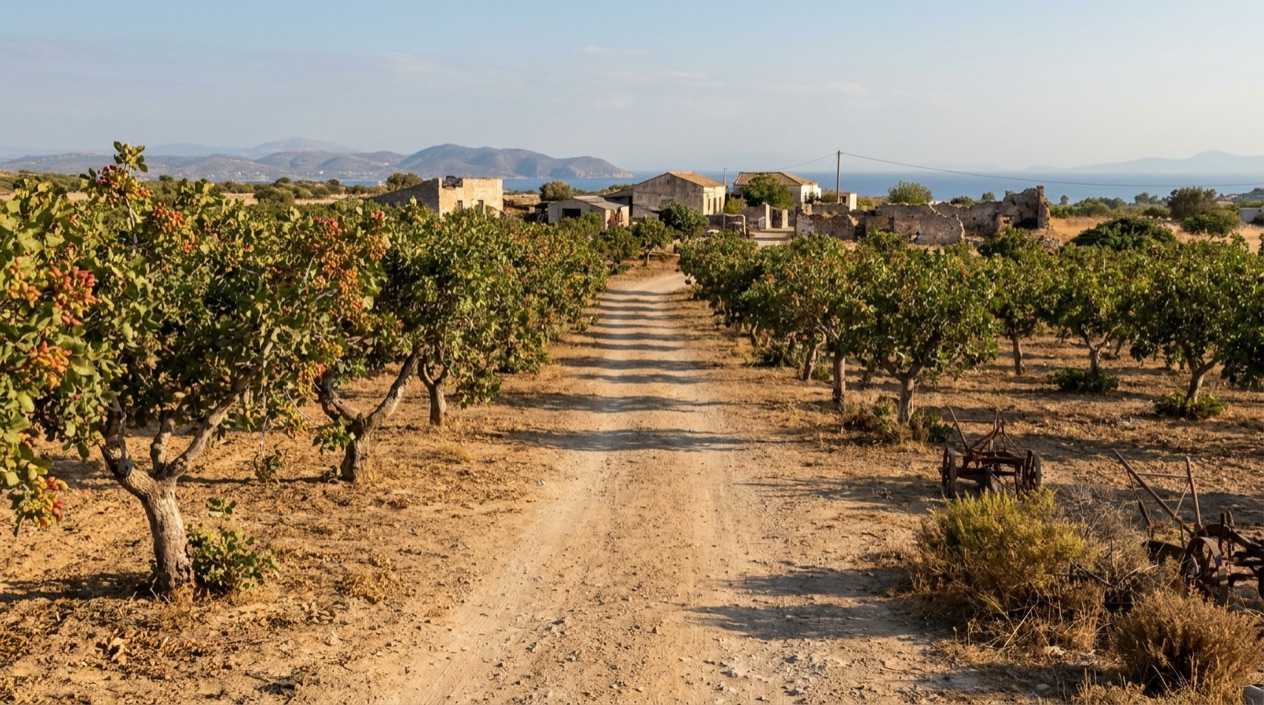
Step off the boat in Aegina town and the pistachio is everywhere before you have thought to look for it. It sits in shop windows as sweets and jars of paste, in the glass cases of ice cream counters, and in paper bags of roasted nuts that smell warm and faintly salty.
The island’s trees give this small green nut a name that travels well beyond the Saronic Gulf. This is a visit built around tasting, shopping and the island that grows them.
Is visiting Aegina pistachios worth it?
Yes, for anyone who likes to travel through their stomach and wants an island day with a flavor to it. Aegina pistachios are a product with Protected Designation of Origin, a status that ties the nut to this island and gives it international fame. Even if you never see a grove, the pistachio gives the day a thread to follow from the harbor to the village streets.
What sets this apart from other islands in the same gulf is that the attraction is a product rather than a single monument. You do not line at a gate or stand before a ruin. You taste, you compare, you buy a bag to carry home, and you find the nut turning up in unexpected places, from pastries to spoon sweets to liqueurs.
The island also gives you a great deal to add around it. Aegina sits in the Argo-Saronic Gulf, near Athens and between Athens and the Peloponnese, and it carries a long list of historic places: a temple, a Byzantine ghost town, a monastery of a recent saint, a Venetian watch tower.
You can fold a pistachio tasting into any of these outings. It is also the island where the first Greek coins were minted, a detail that makes the shopping stalls of the harbor feel like part of a very old trading story.
If you prefer a visit with a single goal, the pistachio is a good one. If you want ruins and churches first, the pistachio becomes the treat you earn between them. Either way, the nut is easy to bring home, which is more than you can say of most souvenirs.
What to see at Aegina pistachios
The Fistiki Fest
In recent years a Pistachio Festival has been organized on Aegina every year in mid-September, under the name Fistiki Fest.
Expect the nut in every form the island’s cooks and confectioners can imagine: sweets, ice cream, baked goods and savory dishes where it appears as a crust or a garnish. It is the moment when the pistachio stops being a souvenir and becomes the main character. Since the event is a recent tradition, the format can change from one edition to the next, so treat it as a seasonal bonus rather than a fixed appointment.
Pistachio sweets and shops in Aegina town
The harbor of Aegina town is where visitors meet the pistachio first. Shops sell the nuts roasted and salted in the shell, shelled and plain, ground into paste, folded into brittle and nougat, and layered into baklava-style pastries. Ice cream counters offer a pistachio scoop that tastes of the nut rather than of sugar.
Look for the label that names Aegina as the origin, which is the sign of the protected product. Tasting before buying is a normal habit in food shops across Greece, and pistachio sellers on the island are used to travelers comparing a roasted nut with a raw one. Take a few different kinds home: paste for breakfast toast, whole nuts for the plane, a sweet for the first night back.
Paliachora, the abandoned town
Paliachora is known as the Mystras of Aegina, an abandoned city that was the main settlement on the island in Byzantine and Venetian times. More than 35 churches survive among the ruins, which gives the site its character: a hillside of small chapels, many with faded wall paintings, scattered where houses once stood.
It pairs well with a pistachio day because it shows how long people have lived and farmed on this island. Bring a bag of roasted nuts and make a picnic of it, with the churches around you as scenery.
The Temple of Aphaea
The Temple of Aphaea dates from about 490 BC and is the oldest surviving temple in Greece. It was part of an equilateral holy triangle of temples that included the Athenian Parthenon and the temple of Poseidon at Sounion, a geometry that links Aegina to the best-known monuments of the region.
What you see is a ruined sanctuary with standing columns, set on the island rather than in the town. It is the heavyweight of Aegina’s sights, and the one that most often anchors a day of sightseeing before you return to the harbor for something sweet.
The monastery and the island’s lesser sights
The Monastery of Agios Nectarios is dedicated to Nectarios of Aegina, a recent saint of the Greek Orthodox Church. It is a place of pilgrimage and gives a sense of the island’s religious life beyond the ancient sites.
Other stops fill out the picture. The Tower of Markellos was probably built during the second Venetian occupation, 1687–1714, as a watch tower, and is owned by the Municipality of Aegina.
The Temple of Zeus Hellanios near the village of Pachia Rachi is a 13th-century Byzantine church built on the ruins of an ancient temple to Zeus from the 4th century BC. Colona, north of the town of Aegina, features an acropolis with the sanctuary of Apollo and a Byzantine settlement. Plans exist to restore the Orphanage of Kapodistrias as a museum.
How to get to Aegina pistachios
You reach the pistachio island by sea from Piraeus, the port of Athens. Two kinds of boat make the crossing, and the table gives the time for each.
| Boat | Route | Duration |
|---|---|---|
| Hydrofoil | Piraeus to Aegina | 40 minutes |
| Regular ferry | Piraeus to Aegina | about 1 hour |
In normal times, hydrofoils sail hourly between 07:00 and 17:00. The ferry operators serving Aegina are Hellenic Seaways, Blue Star Ferries and Saronic Ferries. Within Piraeus port, signs direct passengers to Gate E8 for Aegina ferries, and the gate can sometimes shift, so follow the signs rather than memorizing the number.
Once on the island, regular bus services run from Aegina town to destinations throughout Aegina, such as Agia Marina. That means you can taste and shop before you do anything else, then decide how much of the island to add.
Plan your order of stops around the places you want most: the temple, the abandoned town, the monastery. Leave the pistachio shopping for the town, where you can buy at the end of the day and carry your bag straight onto the boat home.
When to visit Aegina pistachios
The date that matters most is mid-September, when the Fistiki Fest has been organized every year in recent years. That is the moment when the island turns its attention fully to the nut, and when tasting stalls, sweets and local products gather around the theme. If you want the pistachio as a celebration rather than a souvenir, plan around it.
Outside that window, the shops in Aegina town still sell the product, so a visit in another month is still a pistachio visit, only quieter in its program. The nuts are sold roasted, ground and baked into sweets, and none of that depends on a festival. Since an edition of the festival is a recent tradition, confirm the dates when you plan, because a festival that began recently can shift.
The hydrofoil schedule sets the shape of a day trip: in normal times the boats sail hourly between 07:00 and 17:00, which frames how you arrange your hours on the island. Build the day backward from the boat you want to catch home, leaving time for the last purchase before you return to the harbor.
A pistachio visit has the advantage of flexibility: the shops are in the town, and the town is where the boat arrives.
Tips for your visit
Bring a bag you do not mind filling. Pistachios in the shell, jars of paste and boxes of sweets add up quickly, and a tote that closes keeps the roasted smell from reaching everything else in your luggage. Plan to taste before you buy, and ask what is roasted, what is raw and what is ground, since each suits a different use at home.
Combine the tasting with a historic stop. The Temple of Aphaea is the obvious pairing for anyone interested in ancient Greece, while Paliachora suits a visitor who likes ruins with a story of a town that was abandoned. The Monastery of Agios Nectarios adds a living religious place to the mix, and the Tower of Markellos and the Temple of Zeus Hellanios near Pachia Rachi are smaller additions for a longer stay.
Think of the island as a map of small pleasures. Sweets and ice cream in the harbor, a bus ride toward a village such as Agia Marina, a church or a ruin, then a final stop for a bag of nuts before the boat. The pistachio is portable and keeps the memory with you, which is why a few bags tend to end up as gifts.
For anyone with limited mobility, the harbor and the shops of Aegina town are the center of the experience, and the historic sites are extras you can choose among.
Combine the pistachio with the other things the island has to offer, and keep one detail in mind: the first Greek coins were minted here, so there is a long tradition of trade on this very harbor. A bag of nuts bought where the boat lands continues it.
Good to know before you go
Greece uses the euro, and shops in Aegina town price their pistachios by weight or by the box, so look at the label before you pay. Buy from the harbor shops once you have tasted, and look for the mention of the island’s origin on the package, which is the mark of the protected product.
The island is close to Athens in the Argo-Saronic Gulf, and a visit can be as short or as long as you like, from a few bags of nuts at the harbor to a day among the temple, the monastery and the abandoned town. Whichever you choose, the pistachio travels home with you.
Sources
- Wikipedia, Aegina (https://en.wikipedia.org/wiki/Aegina), checked October 12, 2026
- Visit Greece (GNTO), Aegina (https://www.visitgreece.gr/islands/saronic-islands/aegina/), checked October 12, 2026
- Wikivoyage, Aegina (https://en.wikivoyage.org/wiki/Aegina), checked October 12, 2026