
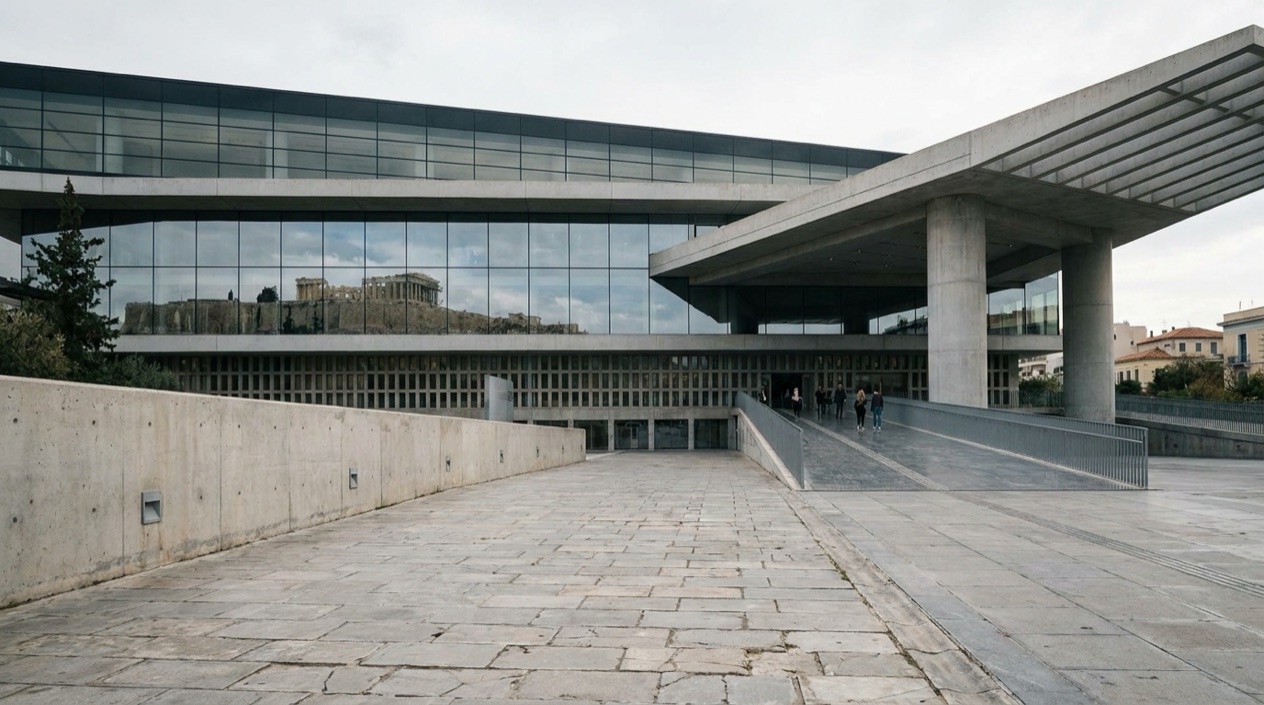
The Acropolis Museum stands at the foot of the Acropolis and tells the rock's story floor by floor, from an excavated neighborhood under your feet to the Parthenon sculptures at the top. Give it a couple of hours at least, and take the metro to Acropolis station, right outside.
What is the Acropolis Museum?
It is home to the sculptures and everyday objects unearthed on the Acropolis and during the museum's own construction. Its layout is designed to complete a visit to the rock next door. The building sits above an ancient neighborhood inhabited continuously since 4000 BC. Glass floors let you look down on its streets, houses, baths, workshops and tombs, and you can also visit the remains.
The galleries above cover the whole history of ancient Athens, through kingship, aristocracy, tyranny and finally democracy. The Parthenon Gallery on the top floor is the grand finale of the visit, positioned to mirror the temple itself. Modern design and subtle lighting flatter the marble, and from the top floor the northern windows frame a view of the Parthenon itself.
What will you see on each floor?
Start in the foyer, even before you scan your ticket. Dioramas and small models show the Acropolis at different moments in its history, including after the Persian, Roman, Venetian and Ottoman invasions. They lay out a timeline that helps you place the objects you see afterward.
The first gallery, on the ground floor, holds finds from the slopes of the Acropolis. Its path is angled to feel like climbing the Sacred Rock. Symposium vases, cosmetics and jewelry containers, and spindle-whorls fill in daily life in the homes and sanctuaries below the rock. Finds tied to the Acropolis' early history sit to the left of the broad staircase that climbs to the first floor.
The Archaic statues on the first floor were once painted in yellows, reds, greens and blues. The colors survived because the statues were buried after the Persians invaded in 480 BC, and they faded quickly once the statues were dug up. A painted copy of Kore 685 stands beside her marble original, so you can see her as the ancients did. Also here are the calf-bearer, a young man carrying a calf on his shoulders for sacrifice, carved around 570 BC from Hymettos marble, and the pediment showing the battle of gods and giants from the Old Temple. The statue of a rider, Acr. 700, is back on display in this gallery too.
The west side of the first floor holds works from Pericles' building program: the Propylaia, the Erechtheion and the Temple of Athena Nike. The larger-than-life Caryatids held up the porch of the Erechtheion. Each has her own features, capitals crown their braided hair, and the folds of their dresses turn into column fluting. An empty spot marks the sixth, which Lord Elgin took in the early 19th century and sold to the British Museum. Keep an eye out for the detailed scale model of the temple, and for Nike adjusting her sandal, a parapet relief where the flowing dress and taut muscles almost make you forget it is carved from stone.
You can walk all the way around the Parthenon frieze, a continuous low relief showing the Panathenaic procession, a grand parade held in ancient Athens to honor Athena. On the north side, three men wrestle with bulls tossing their horns. Elgin removed nearly half of the frieze, and plaster casts stand in for the pieces now in the British Museum. The surviving pediment figures, from scenes of Athena's birth and her contest with Poseidon for the city, show marble clothing that drapes like silk. A short film on this floor uses archival photos and 3D renderings to trace the monument's many phases, from church spires to minarets to war bunkers. Then the Parthenon itself appears through the northern windows.
How much time should you allow?
Plan on at least two hours to see the main galleries and highlights, and half a day can pass easily if you like to linger. A guided tour with an archaeologist is well worth it. Guided tours often last two to three hours, and you can book one through an experience provider or the Association of Licensed Tourist Guides.
Build in a break halfway through. The restaurant serves Greek and international dishes with a view of the Acropolis, and the café on the ground floor offers lighter fare. If you eat before the top floor, you'll reach the Parthenon sculptures fresh. Save a few minutes at the end for the two gift shops, both very good.
When should you go, and how do tickets work?
The museum is open year round, with shorter hours in winter. Crowds thin out early in the morning and late in the afternoon. In winter it also closes earlier on weekdays, so check the official hours before you plan a late visit. On Fridays it stays open into the evening and the restaurant stays open later still, often with a three-piece band playing while the lit-up Acropolis glows outside. Greece's archaeological sites, monuments and museums close on Easter Sunday and May Day. They open from noon to 5 p.m. on Good Friday and from 8:30 a.m. to 3:30 p.m. on Holy Saturday.
Buy tickets on the official museum website, since third-party sellers may charge more. Each ticket is for a specific date and time, and your booking time is your entry time. Show it on your phone or on paper, then use the priority lane straight to the scanners. Online tickets can't be refunded and lost tickets aren't replaced, so double-check the date and time before you pay. The museum may close some areas temporarily for security, organizational or conservation reasons, weather or special events, and this doesn't entitle you to a refund.
How do you get there?
The museum is in the Plaka area, steps from Acropolis station on the Red Line (Line 2). From the airport or Piraeus port, ride the Blue Line to Syntagma and change to the Red Line for one stop. The airport leg to Syntagma takes about 40 minutes. Airport taxis wait at the official rank outside Exit 3 of the Arrivals level, and the ride takes 35 to 40 minutes, depending on traffic. From Piraeus, a taxi takes about 30 minutes, or you can catch the X80 express bus, which links the port with the Acropolis and Syntagma. Within the city, many buses and trolley lines 1, 5 and 15 stop at Makrigianni, the nearest stop.
Is it accessible, and is it good with kids?
Access is good on all floors. You can borrow a wheelchair at the Information Desk, which also has museum maps and a short guide in Braille, in Greek and English. Guide dogs are welcome throughout.
Families do well here. Strollers can be borrowed at the bag check near the entrance, and a parents' room for babies is on the first floor. The Information Desk hands out free family backpacks with activities, including a new one on gods, heroes and mythical creatures. Near the restaurant, a kids' corner with digital games sits beside a LEGO Acropolis complete with theaters, figurines, hidden tunnels and the Parthenon.
What should you pair it with nearby?
The Acropolis itself, right next door, is the natural partner. 2026 prices: full admission €30, reduced €15. Tickets are sold on site and online. One ticket covers the Acropolis and its slopes for a single entry, so once you leave either the main site or the South Slope, you can't go back in. Admission is free on 6 March, 18 April, 18 May, the last weekend of September and 28 October.
The Acropolis closes at 5 p.m. in winter (last entrance 4:30 p.m.) and at 8 p.m. in summer (last entrance 7:30 p.m.). In the second half of October the hours shorten to 6 p.m. (last entrance 5:30 p.m.). It is closed on 1 January, 25 March, 1 May, Easter Sunday, and 25 and 26 December. For visitors with limited mobility, an elevator stands about 1,150 feet (350 meters) from the main entrance and travels about 82 feet (25 meters) up to the plateau north of the Erechtheion.
From Acropolis station, walk along Dionysiou Areopagitou Street to the Acropolis. For the South Slope, continue onto Thrasyllou Street. The neighborhoods around the rock have an island-like charm that makes for an easy stroll afterward. The Acropolis is packed most days, so get there early.
Sources
- theacropolismuseum.gr (https://www.theacropolismuseum.gr/en), checked October 18, 2026
- theacropolismuseum.gr (https://www.theacropolismuseum.gr/), checked October 18, 2026
- etickets.theacropolismuseum.gr (https://etickets.theacropolismuseum.gr/), checked October 18, 2026
- discovergreece.com (https://www.discovergreece.com/experiences/acropolis-museum-athens), checked October 18, 2026
- walksdevour.com (https://www.walksdevour.com/blog/acropolis-museum-athens/), checked October 18, 2026
- Hellenic Ministry of Culture, Odysseus (http://odysseus.culture.gr/h/3/eh355.jsp?obj_id=2384), checked October 15, 2026
- Hellenic Ministry of Culture, Odysseus (http://odysseus.culture.gr/h/3/eh355.jsp?obj_id=2488), checked October 15, 2026
- Hellenic Ministry of Culture, Odysseus (http://odysseus.culture.gr/h/3/eh355.jsp?obj_id=2485), checked October 15, 2026
- Hellenic Ministry of Culture, Odysseus (http://odysseus.culture.gr/h/3/eh355.jsp?obj_id=2402), checked October 15, 2026
- ktelmessinias.gr (https://www.ktelmessinias.gr/en/routes/athens/), checked October 15, 2026
- Hellenic Ministry of Culture, Odysseus (http://odysseus.culture.gr/h/1/eh155.jsp?obj_id=2409), checked October 15, 2026
- Visit Greece (GNTO) (https://www.visitgreece.gr/en/mainland/attica/athens), checked October 15, 2026