
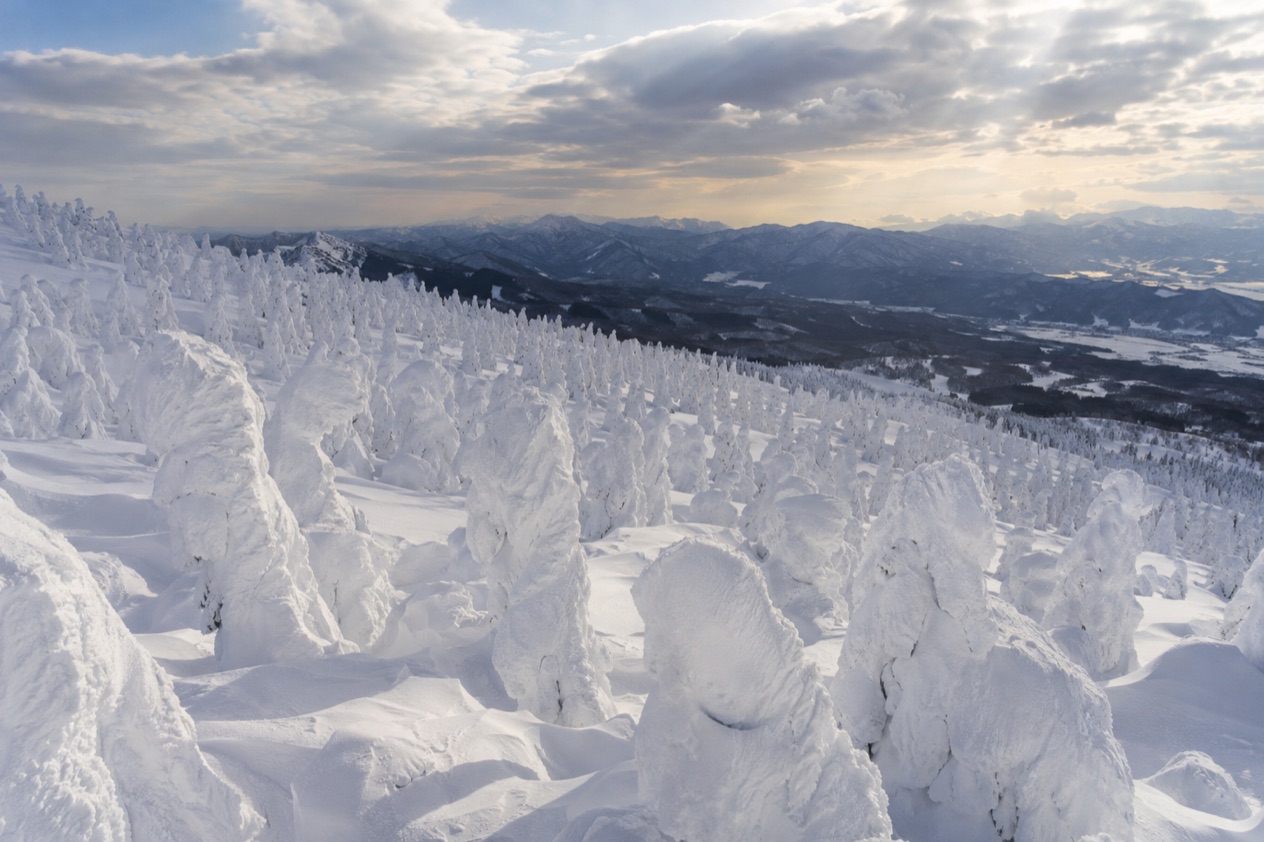
The trees appear out of the white one at a time: fir trunks swallowed by wind-packed snow and frost, with arms, shoulders and hunched backs that look like a crowd of giants standing in a blizzard. Locals call them snow monsters, and on Mount Zaō they are the reason winter visitors climb into the cold at all. This is a visit built around a strange winter landscape, with a hot spring village waiting at the bottom of the mountain.
Is visiting the Zao snow monsters worth it?
Yes, if you like winter landscapes that look unlike anything at home, and if the idea of ending a cold day in a steaming bath appeals to you. It suits travelers who come to northern Honshu in the snow season and want one image they will still talk about months later, more than people looking for a long list of sights.
What sets the monsters apart from other snowy places in Japan is that the scenery is made by the trees themselves. Cold wind drives snow and frost onto the fir branches, layer after layer, until the shape of each tree disappears under a thick white coat.
Plenty of mountains in Tohoku offer deep snow, and the region is known for its abundant powder in winter. Here the snow becomes sculpture, and no two figures look alike. Some stand alone like cloaked travelers, others lean together in rows along the slope.
The second half of the day is just as much a part of the draw. Zaō Onsen, the hot spring area on the same mountain, is known locally as the Springs of Beauty, and a soak after a morning among frozen trees is the natural counterpoint to the cold.
Pair the two and you have a full winter outing: ice and wind above, hot mineral water below. If you only want a quick photo, you may find the trip asks more than it gives. If you enjoy the whole rhythm of a mountain winter, it is a very satisfying stop.
What to see at the Zao snow monsters
The frozen fir trees
The monsters are fir trees, and what you see are shapes more than trees. Frost and snow cling to every needle and branch until a trunk becomes a swollen white column with stubby limbs sticking out at odd angles. Walking among them, you may see trees that resemble hooded figures, sleeping animals or raised arms, and the game of picking out faces is half the fun.
The scene changes with the weather. On a clear day the white shapes stand sharp against the sky and the snow glitters. In falling snow or heavy cloud the figures emerge and vanish in the mist, which many visitors find even more eerie. Wind often shapes the experience, so dress for it, and expect the mood to change from one visit to the next.
Zaō Onsen, the hot spring village
Zaō Onsen sits on the slopes of Mount Zaō in the northern part of Honshu, and it is a hot spring area with a very long history. Records of the springs reach back as far as AD 110, which makes a bath here part of a tradition that has outlasted many generations of snowfall. The locals call the place the Springs of Beauty, a name that points to the way the mineral water is spoken of as good for the skin.
There is an open-air public bathhouse in the village, where the water is a hot 113°F. That is the kind of temperature that feels sharp at first and then loosens every muscle, and it is especially welcome after hours in the cold. Bathing in an onsen follows its own habits, such as washing before you enter the shared bath, and it is part of the pleasure to learn them as you go.
The mountain and its winter setting
Mount Zaō belongs to Tohoku, the large northeastern region of Honshu made up of rural prefectures, and the region is known for its rural landscapes and its deep winters. Beyond the monsters themselves, look at the slopes around you: white ridgelines, dark stands of forest and the long, soft folds of snow that give the whole mountain its character.
The setting is part of the reward. You are in a working mountain area where the winter is the main season and the village around the springs exists because of it. Take a few minutes at the edge of the trees to simply look around before you start photographing.
Hours, tickets and rules
The snow monsters are a natural phenomenon on a mountain slope rather than a museum or a temple, so there is no single gate with a fixed schedule to describe. What you reach is the mountain itself and the village of Zaō Onsen below it, and the experience follows the season more than the clock. The village is reached by road, and the Tōhoku Expressway is the highway that leads to the hot spring area.
The one fixed number tied to the visit is the heat of the water. The open-air public bathhouse in Zaō Onsen holds its water at 113°F, which is worth knowing before you step in if you are used to milder baths at home. Plan your soak for after the cold, when the contrast is part of the pleasure.
Onsen etiquette is a set of habits that visitors pick up quickly. Bathers wash first, towels stay out of the shared water, and the baths are quiet places where people speak softly. Following what the people around you do is the simplest guide in any public bathhouse.
When to visit the Zao snow monsters
The snow monsters belong to winter. They need cold, wind and plenty of snow to take shape, so the visit makes sense in the snow season and not in summer, when the same firs stand green and bare of ice.
Within the winter, the look of the trees changes. Early on they are thinly dressed and you can still see the dark shape of the fir beneath the frost.
As the season deepens the coating grows thicker, the outlines grow rounder and stranger, and the figures become more like the monsters of the name. Because the shapes come from the weather, nobody can promise exactly what you will find on a given day, and that uncertainty is part of the appeal.
The hot spring side of the trip works in the cold months too. A bath outdoors with snow around you is one of the classic pleasures of northern Japan, and the steaming water feels best when the air is bitter. Visiting out of the snow season, the mountain is still a hot spring area, but the main sight is not there to see.
If you are planning around other seasons in the region, remember that Tohoku has a different character in summer, when it is known for outdoor activities. For the snow monsters specifically, choose the months when the mountain is truly under snow and be ready for changeable mountain weather.
Tips for your visit
Dress as if you are going to spend a long time outdoors in strong wind, because that is the likely scene. Layers, a hat, gloves, a scarf and waterproof boots with a good grip make the difference between enjoying the trees and counting the minutes until you can leave. Bring something to cover your face if the wind picks up, and keep your camera or phone somewhere it can stay warm between shots.
Plan your day in two parts: the cold landscape first, the hot water afterward. Bring a small towel and a change of dry clothes for the village, so that you can go straight from the snow to the bath and then into something warm.
Slow down in the village too. Walking the streets of an onsen town in a light cotton robe is a pleasure of its own for many travelers, and the area around the springs is built for lingering.
Think of the visit as a day in the mountains, since the weather and the terrain set the pace. Families with young children and anyone who finds snow and slopes difficult should think about how much cold and walking the day will involve, and choose the parts of the outing that suit the group. The hot spring village offers a gentler counterpart to the frozen trees for anyone who wants to skip the coldest hours.
If you have extra time in the region, remember that Tohoku is a broad area of rural landscapes and historical sites, so the mountain can sit inside a longer trip through the northeast of Honshu. Use the snow monsters as the highlight of one winter day and let the rest of the trip follow the same slow, snowy rhythm.
Good to know before you go
Mountain winter weather can change quickly, so treat the forecast as a loose guide and keep your plans flexible. Warm clothing and sturdy footwear matter more here than any other item on your list.
Many onsen and small village businesses may prefer cash, so carry some yen with you, and keep valuables in a dry pocket or bag while you bathe. Respect the trees and the snow around them, leave no trash on the slope, and let the mountain set the pace.
Sources
- Wikipedia, Zaō Onsen (https://en.wikipedia.org/wiki/Za%C5%8D_Onsen), checked October 11, 2026
- Japan National Tourism Organization, Tohoku (https://www.japan.travel/en/destinations/tohoku/), checked October 11, 2026
- Travel to Tohoku, the official tourism website (https://www.tohokukanko.jp/en/), checked October 11, 2026
To plan your stay
- Best Time to Visit Japan: Cherry Blossoms, Autumn Colors, Weather and Festivals
- Where to Stay in Japan: Ryokan, Temple Stays, Capsule Hotels and the Best Cities to Base In
- Sending Luggage from the Airport in Japan: Hands-Free Travel, Hotel Delivery and Coin Lockers
- Know Before You Go to Japan: Entry, Money, Etiquette and Getting Around