
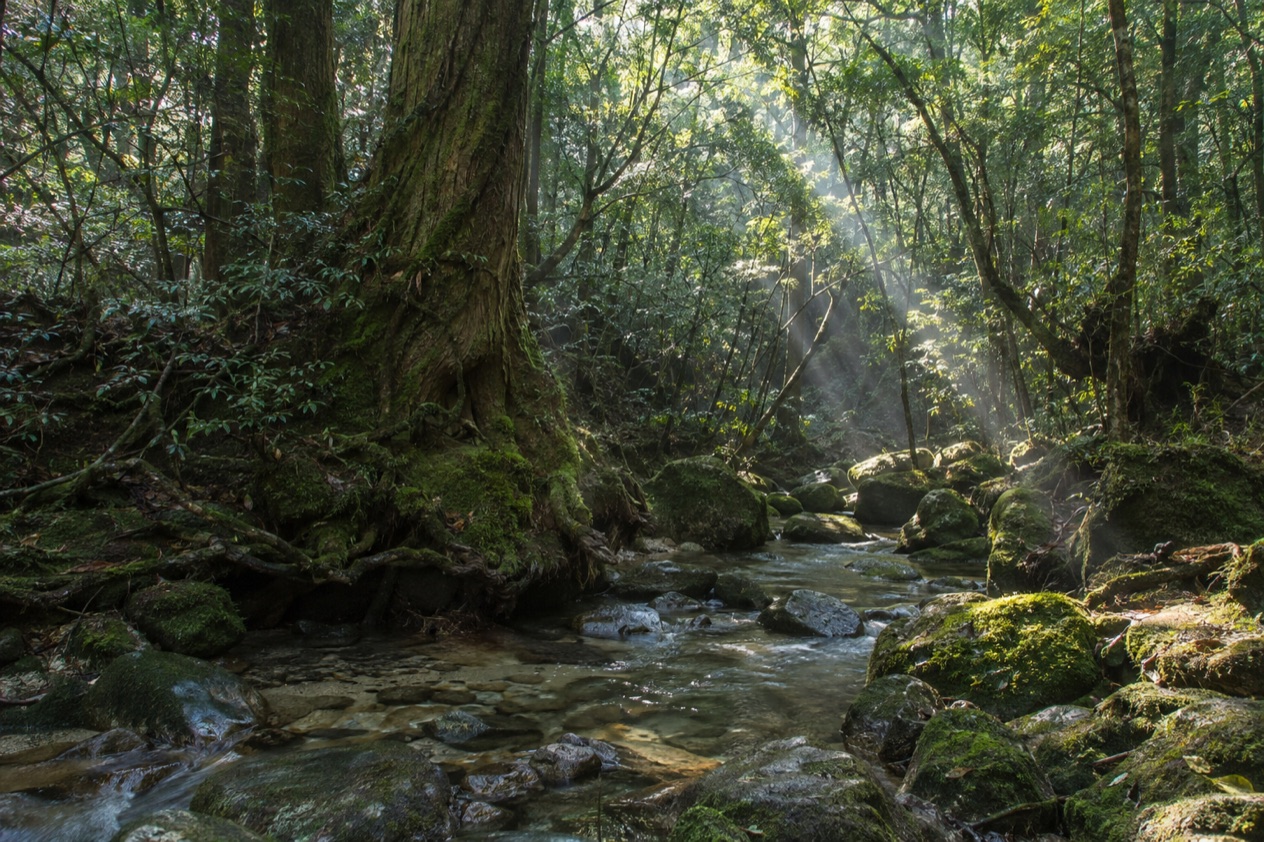
Mist slides between the trunks of cedars so wide that two people could not circle them, and every rock, root and fallen log wears a coat of moss that glows green even under a gray sky. Somewhere below, a stream you cannot see is running hard. Yakushima is an island of forest and water off the southern tip of Kyushu, built for walkers, waterfall chasers and anyone who likes their nature wet, deep and a little strange.
Where is Yakushima and what is it like?
Yakushima is one of the Osumi Islands in Kagoshima Prefecture, an island off the southeast coast of Kyushu in the East China Sea, next to Tanegashima and north of Okinawa. It is a round, mountainous island, and almost all of it is forest. Roads follow the coast, villages sit in the gaps between river mouths, and the interior belongs to the trees.
Nine-tenths of the island is mountains and forest, and a good part of it lies inside Yakushima National Park. The ancient forest has held a place on the UNESCO World Heritage list as a natural site since 1993. That recognition shapes the whole character of the island: people come here for the woods, and the pace of life around them follows.
The island rises from a warm coast, where the villages grow citrus and fish, to granite peaks that wear a different climate altogether. Mount Miyanoura, the highest mountain in Kyushu, tops out at 1,936 meters. That means a day on Yakushima can start among palms and end among cool, dripping cedars, and the weather you meet depends on how high you climb.
Yakushima suits people who like to walk, who are happy with a quiet evening after a big day outdoors, and who find rain atmospheric rather than annoying. It is less suited to those who want nightlife, shopping streets or a long list of museums. Villages are small, dinners are early and unhurried, and the main entertainment is the forest itself.
The island also has an unhurried southern feel. Wild monkeys and small sika deer turn up along forest roads, fishing boats work the coast, and the local cooking leans on the sea. It is a place to slow down, not to tick things off.
What is there to do in Yakushima?
The big reasons to come are the ancient cedars, the high mountain, the waterfalls and the quiet pleasures of the coast, from hot springs to local food. Unlike its neighbors on Kyushu, which offer cities, volcanoes and castles, Yakushima offers a single, very large natural experience that you can approach in a dozen ways.
Walking to the Jomon Sugi
The Jomon Sugi is the cedar that gives the island its fame, and it can be reached only on foot, by a hike of four to five hours. The route climbs through forest where cedars, known locally as yakusugi, stand among boulders and ferns, and where the air stays damp and cool. The tree itself is a huge, gnarled giant, and what you remember is the sense of scale around it.
Those who would rather keep things lighter can choose shorter forest walks among the same kind of trees. Wherever you go, the footing is often wet and rooty, which is part of the experience.
The forest of moss and Mount Miyanoura
Stream water runs clear over granite, roots grip the rocks like fingers, and the light turns green. Trails of different lengths wind through it, so you can choose how much of it to take in.
For a bigger goal, Mount Miyanoura rises above everything else on the island and in all of Kyushu. A climb is a serious day in the mountains, with the forest thinning to open ridges and views that stretch across the island and out to sea on clear days. In winter its upper slopes can carry snow, a surprise on a subtropical island.
Waterfalls and hot springs
Okonotaki Falls drops 88 meters and was recognized as one of Japan’s best waterfalls in 1990. With so much rain feeding the mountains, the island has other falls too, and you hear many of them before you see them. Some can be seen from a viewing point near the road, which makes them a good stop on a drive around the coast.
After a day on the trails, the island’s hot springs are a natural reward. Onsen etiquette applies as everywhere in Japan, so shoes, towels and bathing habits follow the custom of each bath.
Coast, food and wildlife
The shoreline has its own appeal. Inakahama is the beach where sea turtles come ashore to nest in the warmer part of the year, and visitors may sometimes see signs of them. Wild macaques and small deer wander the forest roads, and you will often meet them at the roadside without searching.
Meals bring the island to the table. Flying fish, either grilled or fried into fish cakes, are a local specialty, and mackerel, sweet potato shochu and tankan oranges round out the picture. Ordering a set meal at a village restaurant is an easy way to taste the place.
How many days do you need in Yakushima?
A long weekend is enough to taste the island, though a week lets you walk without watching the clock. Because weather here can change the plan, extra days are a cushion as much as a bonus, giving you room to swap a rained-out hike for a hot spring or a drive.
With a short stay, choose one big outing and keep the rest loose. Arrival and departure by ferry or plane also eat into the first and last days, so count them as half days.
With a longer stay, the island opens up. You can walk the mossy forest at Shiratani Unsuikyo on one morning, climb toward Mount Miyanoura on another, and keep a day for the coast road, stopping at beaches, fishing villages, falls and onsen. Time in the south and west of the island, away from the main ports, shows how little the island has been built over.
If you have even more time, base yourself in two places to cut down on driving, one near the northern ports and one further around the coast. Beyond Yakushima itself, neighboring Tanegashima is the next island over, and Kagoshima on the mainland makes a natural bookend to the trip, a city of volcano views and hot springs before or after the island.
Where to stay in Yakushima
Lodging on Yakushima is spread along the coast in small clusters rather than concentrated in one town, so the choice is mostly about which part of the island you want to wake up in. Miyanoura and Anbo are the two main port settlements, and staying in or near them puts you close to where ferries and planes arrive and to the shops and restaurants that exist.
Anbo has a long association with the island’s forest trade, and a stay there suits hikers who want to be near the trails that start inland. Miyanoura, near the mountain whose name it shares, is a good fit if you plan to climb or head for the Jomon Sugi. Both are small by any standard, so expect a village feel with a handful of places to eat.
Further around the coast, smaller settlements such as Hirauchi, Yudomari and Onoaida offer a different mood. These are places for people who want hot springs, sea views and the sound of the surf, with the forest as a day trip rather than the front door. They suit slower trips, couples and anyone happy to eat where they sleep.
Lodging types range from simple guesthouses and minshuku (family-run inns) to resort-style hotels and a few places built around hot spring bathing. Many serve dinner and breakfast, which matters on an island where evenings are quiet and restaurants are few. Staying in a minshuku is a good way to meet the island’s pace, with home-style meals and local conversation.
Think about the trails you want before you choose. If an early start on the mountain is the goal, sleeping near the interior roads shortens the morning. If the trip leans toward rest, onsen and sea, the coast villages are the better base.
How do you get to Yakushima and get around?
You reach Yakushima by air or by sea. Yakushima Airport has direct flights from Kagoshima, Fukuoka and Osaka Itami, and the island can also be reached by hydrofoil ferry or car ferry from the mainland. Which you choose depends on where you start and how you like to travel.
By ferry from Kagoshima
The Toppy and Rocket jetfoil ferries run from Kagoshima to Yakushima and take approximately 2 hours, depending on stops at Ibusuki and Tanegashima. The crossing puts you on the water between the mainland and the island, with the volcano country of southern Kyushu falling behind you. It is a pleasant way to feel the distance from the mainland.
Reservations for the Toppy and Rocket should be made at least the day before, as the boats can be fully booked. A car ferry also serves the island, which matters if you want to bring a vehicle across. Hydrofoils carry passengers, and the car ferry is the route for those who need their own wheels.
By air
Flying skips the sea crossing. Yakushima Airport receives direct flights from Kagoshima, Fukuoka and Osaka Itami, so travelers from the Kansai area or northern Kyushu can reach the island without a stop on the mainland. A small island airport has a very different feel from the big hubs, and you step off close to the forest.
From Tokyo or elsewhere, you would connect through one of those cities. Arriving by air can make sense when you want to protect your time on the island, while the ferry gives you the sense of crossing to somewhere set apart.
Getting around the island
A single main road circles the coast, linking the ports, the onsen villages and the roads that climb into the forest. Getting around means walking within villages and using buses, taxis or a rental car to cover the longer stretches. The distances between trailheads and lodging matter more here than in a city, so think of transport as part of the plan.
Where the road leaves the coast, you head into the trees on foot. The Jomon Sugi cannot be reached any other way, and the same goes for most of the island’s forest paths. Plan your days around where each trail begins, and let the mountain, not the map, set the pace.
When is the best time to visit Yakushima?
There is no month when the island is dry, and that is part of its charm. The rain feeds the moss, fills the streams and makes the waterfalls roar, so a visit in any season includes the chance of a wet day. What changes through the year is the temperature on the coast, the cold on the heights and the mood of the forest.
Spring and autumn bring milder days for walking, and many hikers think of them first for a trip to the cedars. Summer is warm and humid on the coast, which suits the beaches and the sea turtles that come ashore to nest, but it also brings the heat and the typhoon season that affects the whole region, so plans need room to bend. In winter the coast stays mild while the high slopes of Mount Miyanoura can turn snowy and cold.
Because the island changes so much with altitude, the month matters less than being ready for both ends of the range, from a warm shoreline to a cold, wet summit. Give yourself spare days, keep your lodging flexible if you can, and let a rain day become a hot spring day. Ferries and flights can be affected by rough weather, which is another reason to avoid tight connections on either end of the trip.
Good to know before you go
Yakushima is a place for packing sensibly and moving slowly. The forest is wet underfoot, the weather can shift within a day, and the island has far fewer shops and restaurants than the mainland, so it pays to think about meals and supplies before you leave the villages. Treat the wildlife as wild, leaving the macaques and deer to their own business.
The typhoon season can disrupt sea and air connections to the island, so keep your return flexible when you can. Hot spring bathing follows the usual Japanese customs, and the forest rewards quiet walking and a respect for the trees that have stood here for so long.
Sources
- Japan National Tourism Organization, Yakushima (https://www.japan.travel/en/destinations/kyushu/kagoshima/yakushima/), checked October 11, 2026
- Wikipedia, Yakushima (https://en.wikipedia.org/wiki/Yakushima), checked October 11, 2026
- Wikivoyage, Yakushima (https://en.wikivoyage.org/wiki/Yakushima), checked October 11, 2026