
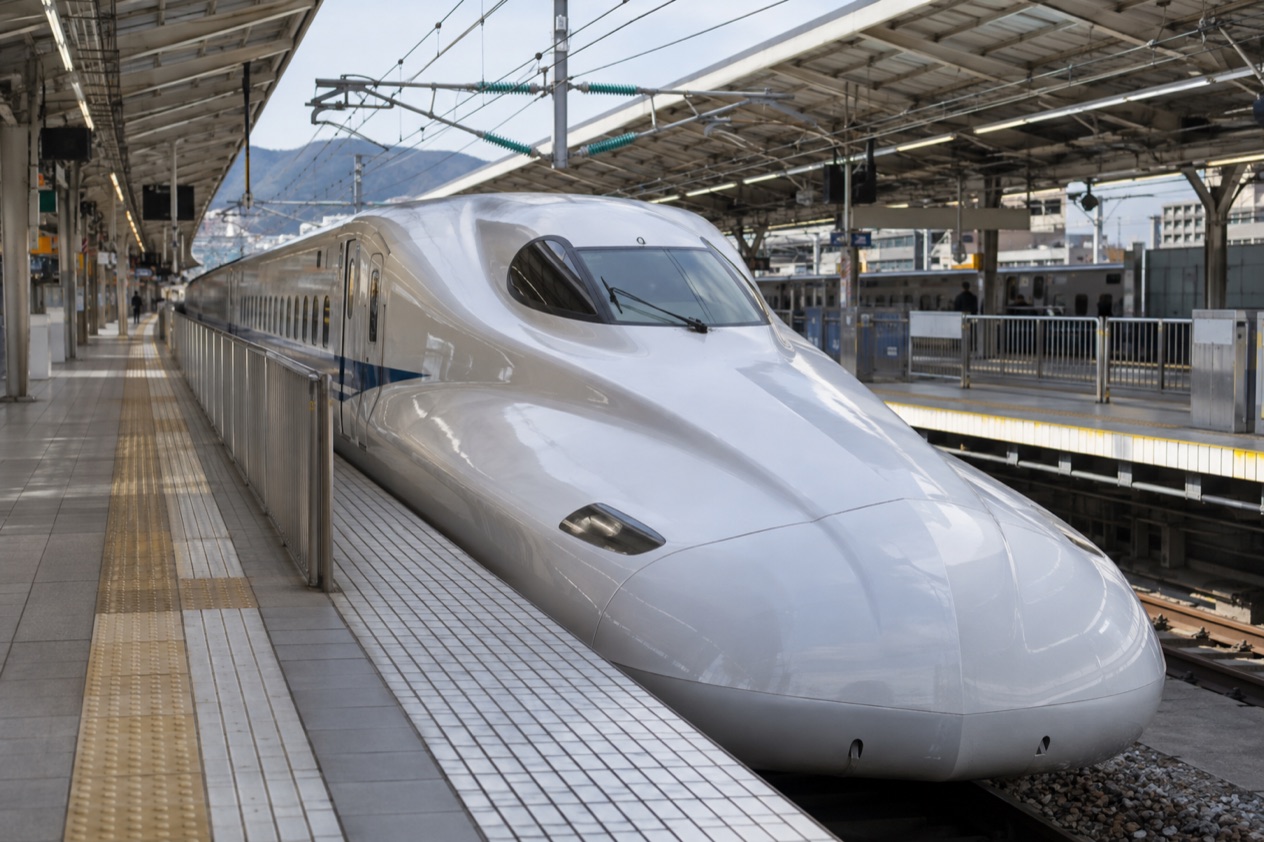
On the platforms of Tokyo Station, passengers line up behind painted marks on the floor, and a long white train with a blue stripe slides in almost without a sound. Doors open exactly where the marks promised, and a few minutes later the city is already falling away outside the window. The Tokaido Shinkansen is the bullet train line that links Tokyo with Osaka through Yokohama and Nagoya, and it is the backbone of travel between Japan’s biggest cities.
What is the Tokaido Shinkansen?
The Tokaido Shinkansen is Japan’s first high-speed rail line, a dedicated track for bullet trains running between Tokyo and Shin-Osaka station. It opened in 1964 and carries the name of the old Tokaido road that once joined the same regions on foot. Since 1987 it has been run by the Central Japan Railway Company, better known as JR Central.
The line is 320.3 miles long, and the trains currently top out at 177 miles per hour. Because the Shinkansen has its own tracks, separate from the commuter and regional lines, the trains never share a rail with a local service. That separation is what gives the ride its steady, almost floating feel, with very little sway even at full speed.
Nozomi, Hikari and Kodama
Three kinds of train share the line. Nozomi is the super-express, Hikari is the express, and Kodama stops at every station. The names show up on the departure boards and on the ticket, and they decide how many stations you pass without stopping. The line runs up to 17 trains per hour, and the split between the three services is lopsided in favor of Nozomi.
| Service | Type | Trains per hour |
|---|---|---|
| Nozomi | Super-express | 13 |
| Hikari | Express | 2 |
| Kodama | All-stop | 2 |
Japan Rail Pass holders can ride Hikari or Kodama on the Tokaido Shinkansen free of charge. Since October 2023, they can also ride Nozomi by purchasing a special supplementary ticket. These are the terms for pass holders, and they apply to this line.
Seats, luggage and life on board
The Green Car is the first-class car, with seats in a 2+2 layout and every seat reserved. The rest of the train follows the usual Shinkansen pattern of wide, reclining seats, fold-down tables and luggage racks overhead. Passengers take off their jackets, tuck bags above, and settle in quietly, since phone calls are usually taken in the vestibule between cars.
Since 2020, reservations have been required to take large pieces of luggage on Tokaido Shinkansen trains. Smaller bags travel with you as always. Onboard changes in recent years have reshaped the ride in other ways too. The trolley service was discontinued on October 31, 2023, due to falling sales and labor shortages, so the old habit of buying coffee from a passing cart is gone.
Many travelers now carry a bento box or a rice-ball snack bought in the station, a long-standing Japanese pleasure in its own right. JR Central, JR West and JR Kyushu also announced that onboard smoking rooms would be discontinued by the second quarter of 2024.
Where it fits in the wider Shinkansen network
The Tokaido line was the first of many. The Shinkansen network now includes 1834 miles of lines, with top speeds ranging from 260 to 199 miles/h depending on the route. On a stretch of the Tohoku Shinkansen, trains reach 199 miles/h, faster than anything on the Tokaido.
Shinkansen services reach most major cities on Honshu and Kyushu, and extend to Hakodate on Hokkaido. The Tokaido line is the one that joins Tokyo to the Osaka side of Honshu, which is why many first itineraries are built around it.
Which cities does it connect?
The Tokaido Shinkansen connects Tokyo, Yokohama, Nagoya and Osaka, four cities with very different characters. Tokyo sits at one end and Shin-Osaka station at the other, and the trains run between them on a single, continuous line. Each stop gives a reason to get off, or simply a different view from the window.
Tokyo and Yokohama
Tokyo Station is where the line begins, a station of brick arcades and long concourses where trains for every part of the country depart. Many travelers start here with the day’s first coffee and a bento from one of the shops lining the corridors. It is also where the ride begins to feel like a ride, with the skyscrapers of Marunouchi giving way to rooftops and rail yards.
Yokohama is the port city that the line serves next. It has a harbor front of red-brick warehouses, a Chinatown with steamed buns and sesame dumplings, and a skyline of towers over the water. Passengers who stop here are often there for a day of walking along the waterfront, then back on the rails by evening.
Nagoya
Nagoya is the line’s middle stop, a city known for its own food traditions. Miso katsu, a fried pork cutlet under a dark, rich miso sauce, is a local dish, and so is hitsumabushi, grilled eel served over rice that you eat in several stages with broth and condiments. Tebasaki, crisp fried chicken wings seasoned with pepper, show up at izakaya counters across the city.
The city also has a castle with golden dolphin ornaments on the roofline, and a morning set breakfast tradition in its coffee shops, where a drink comes with toast and a boiled egg. For a traveler crossing the country, Nagoya makes a natural pause for a meal that you will not find in the same form in Tokyo or Osaka.
Osaka and Shin-Osaka
The line ends at Shin-Osaka station, the stop for Osaka. Osaka is a city that takes eating seriously, with a motto of kuidaore, to eat until you drop. Takoyaki, grilled dough balls with octopus, and okonomiyaki, a savory pancake cooked on a hot plate, are the street-food staples, and the canal-side lights of Dotonbori are where many first evenings end.
Shin-Osaka is where the Tokaido Shinkansen stops, and from there local and regional rail carries passengers into the city itself. The Tokaido line is the one that gets you to the Osaka side of Honshu, and from this point travelers connect onward to other parts of the Kansai region.
How long do the trips take?
The fastest trip, on the Nozomi, covers Tokyo to Shin-Osaka in 2 hours and 30 minutes. That is long enough to eat a bento, watch the landscape shift, and still arrive before lunch is over. The other two services take longer because they stop at more stations along the way.
Nozomi, Hikari and Kodama on the clock
Nozomi is the service built for the end-to-end run, and it holds the 2 hours 30 minutes figure for the full route. Hikari is an express, so it makes more stops than Nozomi, and Kodama stops at every station on the line. The difference is felt most when you board: Kodama stays at platforms longer, letting faster trains pass it.
A passenger who wants to see the in-between towns might choose Kodama on purpose, while someone with a connection waiting at the other end will look for the Nozomi on the board. The three names are printed on the ticket and on the sign above the platform, so there is no mystery about which train is pulling in.
The shape of the day
The Shinkansen system shuts down between midnight and 06:00 every day for maintenance. In practice that means the day’s service has a clear start and a clear end, and the last trains of the evening leave knowing the tracks are about to be inspected and serviced. Anyone planning a late arrival into Tokyo or Osaka does well to think about that overnight gap.
Within the running day, trains come frequently, up to 17 an hour on this line. So the practical rhythm of a journey is a platform, a short wait, and a train that leaves at the minute printed on the ticket.
A faster line to come
A different kind of train is planned for the same corridor. The Chuo Shinkansen maglev line is expected to reduce travel time between Tokyo and Osaka to 67 minutes. A maglev floats above its guideway on magnetic force rather than rolling on wheels, which is what allows speeds beyond conventional rail.
For now, the Tokaido Shinkansen remains the line that carries travelers between the two cities. For comparison on another route, the Tohoku Shinkansen reduced the journey from Tokyo to Shin-Aomori to around 3 hours, over a distance of 419 miles. These are different lines with different geography, and the Tokaido figure belongs to its own corridor.
Good to know before you go
The seat reservation for large luggage, the Green Car’s all-reserved seating and the end of the onboard trolley are the practical details that shape a ride today, so it helps to bring your own snack and drink aboard. Typhoon season can affect travel in Japan, and a train line can slow or pause when weather turns severe. Station signs and boards show the day’s status for each service, in English as well as Japanese.
Sources
- Wikipedia, Shinkansen (https://en.wikipedia.org/wiki/Shinkansen), checked October 11, 2026
- Wikipedia, Tōkaidō Shinkansen (https://en.wikipedia.org/wiki/T%C5%8Dkaid%C5%8D_Shinkansen), checked October 11, 2026
To plan your stay
- Best Time to Visit Japan: Cherry Blossoms, Autumn Colors, Weather and Festivals
- Where to Stay in Japan: Ryokan, Temple Stays, Capsule Hotels and the Best Cities to Base In
- Sending Luggage from the Airport in Japan: Hands-Free Travel, Hotel Delivery and Coin Lockers
- Know Before You Go to Japan: Entry, Money, Etiquette and Getting Around