
The journey begins in a funicular that slides into the mountainside, and over the next few hours the vehicles keep changing: a bus here, a trolleybus there, then a cable car swinging high above a valley. Concrete tunnels, a great wall of dam and, in spring, corridors of packed snow taller than a building mark the way. This is a day of crossing the northern Japan Alps from Toyama to Nagano, or the other way around, by passing from one kind of transport to the next.
Is visiting the Tateyama Kurobe Alpine Route worth it?
Yes, for travelers who like their mountains reached by machinery as much as by trail, and for anyone who enjoys a journey that is itself the destination. The route is a mountain sightseeing line running between Tateyama in Toyama Prefecture and Omachi in Nagano, and you move through it in stages rather than in one long ride.
What sets it apart from a typical mountain excursion is the sheer variety of transport. Seven different services carry you across, including a funicular, buses, a trolleybus, an aerial tramway and stretches on foot. Three of the lines run through tunnels so that snow cannot stop them.
Most mountain areas give you one cable car and a viewing deck. Here you collect a whole set of ways to travel, and a dam, a snow corridor and a high station along the way.
It suits curious travelers, families who like vehicles, rail and engineering fans, and photographers. It also suits anyone who wants to link Toyama and Nagano in a single crossing instead of backtracking. The elevation change along the way is as much as 6,480 feet, and you feel it in the air and the scenery. If you would rather stay in one spot with one view, a single mountain village will serve you better.
What to see at the Tateyama Kurobe Alpine Route
Kurobe Dam
Kurobe Dam is the showpiece of the crossing. It stands 610 feet tall and is the tallest dam in Japan, a curved wall of concrete closing off a deep mountain gorge. Standing on or near it, you look down the face of the structure to the river far below and out over the reservoir held behind it.
Dams are not usually a reason to travel, but this one is part of the story of the whole route. The line was built across mountains that needed power and access, and the dam and its tunnels belong to the same effort. The Kanden Tunnel Electric Bus, run by Kansai Electric Power Company, connects the dam with Ogisawa, so the dam is also a hinge between two halves of the crossing.
Yukino-otani snow walls and Murodo
The Yukino-otani snow walls flank the road leading to Murodo Station. They are present from mid-April to June and tower 50 to 65 feet high, so buses seem to drive down a canyon cut from snow. Walking between the walls, you see the layers of the snowpack in cross-section, banded white and gray.
Murodo Station is the high point of the visit as a transfer point. It is where the road, the walls and the mountain begin to feel like one landscape. If your trip falls outside the weeks when the walls stand, the same stretch is still part of the journey, and you will see it without the white corridor.
The Tateyama Tunnel Trolley Bus and the tunnel lines
The Tateyama Tunnel Trolley Bus is the last trolleybus line in Japan. It draws its power from overhead wires like a tram but rolls on rubber tires like a bus, and it runs inside a tunnel. For anyone who follows transport history, it is the reason to look up and notice the wires.
It is one of three transport lines that go through tunnels to protect them from snow, alongside one funicular railway and a second bus line. One bus line was converted to all-electric buses in 2018. The mountain is not hidden from you for long, though. Between tunnel stretches the road and the cableway bring you back into daylight and open air.
The aerial tramway and the walking sections
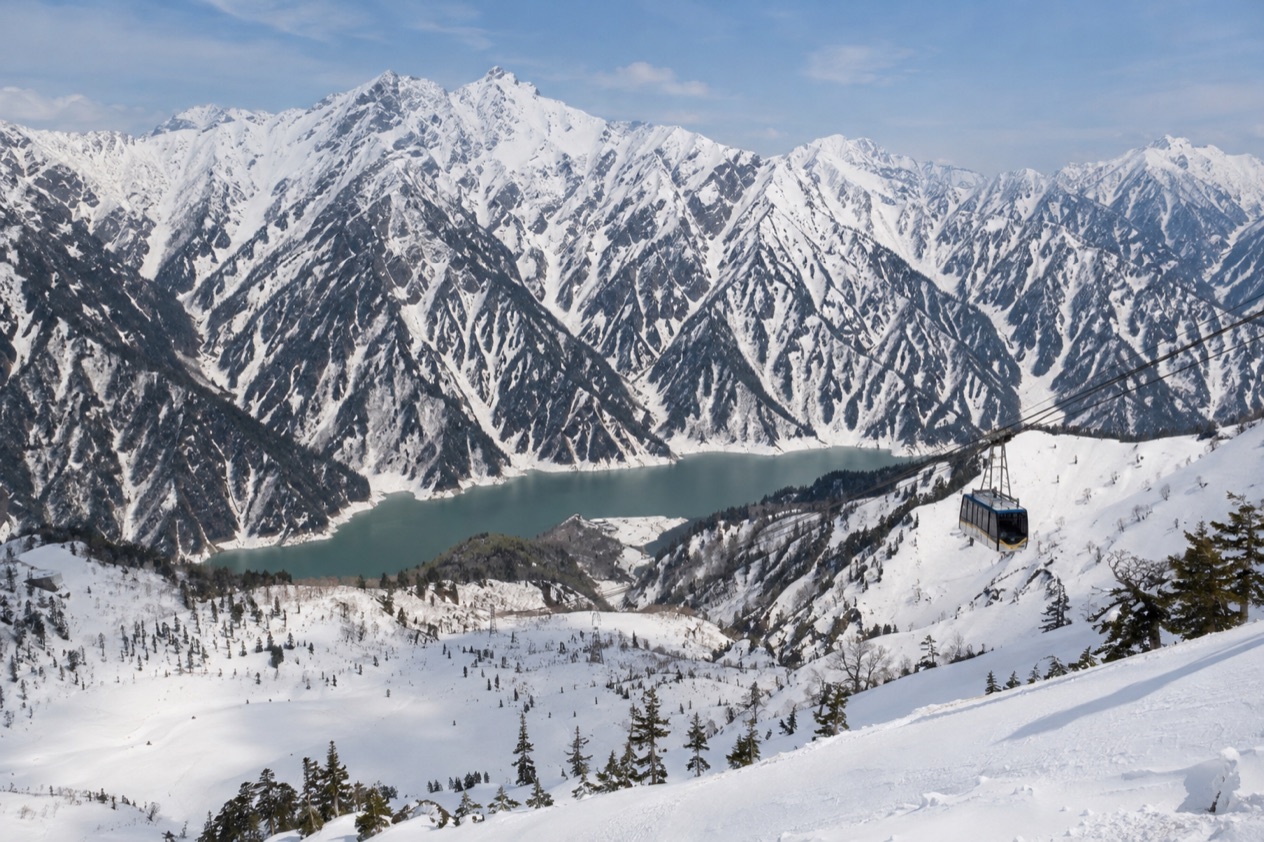
Between the machines, some parts of the crossing are on foot, notably the walk over the dam and the stretches at the stations. The aerial tramway is the part of the day that lifts you high over the valley, with the ground dropping away below the cabin. It is a different kind of ride from the tunnels, open to views and weather.
Together, the walking and the tramway turn the crossing into a rhythm of short rides and short strolls. Each change of vehicle brings a new view of the same mountains.
Hours, tickets and rules
The route is run as a set of linked services rather than a single attraction with one gate, and most of its lines are operated by Tateyama Kurobe Kanko, known as TKK. That is why there is no single opening hour or one admission fee to quote. Each segment has its own operator and its own way of being paid for.
The Kanden Tunnel Electric Bus between Kurobe Dam and Ogisawa is operated by Kansai Electric Power Company. The Omachi Alpine Line Bus between Shinano-Omachi and Ogisawa is operated by Kawanakajima Bus, Kita Alps Kotsu and Matsumoto Electric Railway. So a crossing from the Nagano side starts with a different set of operators than one from Toyama.
The route opened on June 1, 1971, and it has run as a mountain sightseeing line ever since. Some services run only in particular seasons. In summer, shuttle buses between Toyama and Murodo are available, and the snow walls stand only from mid-April to June. Nothing else in the way of rules, such as photography limits or restrictions on climbing, is set out for the route here.
How to get to the Tateyama Kurobe Alpine Route
There are two ends to the crossing, and you can start at either. On the Toyama side, the city of Toyama is the base. It sits on the coast of the Sea of Japan in the Chubu region of central Honshu, about 190 miles northwest of Tokyo, between the sea and the mountains.
From Tokyo Station, the Hokuriku Shinkansen reaches Toyama in about 2 hours, and the Japan Rail Pass covers that train. Toyama Airport has international flights to Shanghai, Seoul, Vladivostok and Dalian, plus local service to Tokyo, Sapporo and Fukuoka. Schedules change heavily with the season, so the flights available in one month can differ from another.
From Toyama, shuttle buses to Murodo are available during summer, and Murodo is the high station on the route. The rest of the journey from the Toyama side is by the route’s own services, including the tunnel trolleybus, the tramway and the funicular.
On the Nagano side, the base is Shinano-Omachi. The Omachi Alpine Line Bus connects Shinano-Omachi to Ogisawa over 11 miles. From Ogisawa, the Kanden Tunnel Electric Bus runs 3.8 miles to Kurobe Dam, and the rest of the crossing continues from there toward Murodo. Either direction covers the full route of 23 miles.
When to visit the Tateyama Kurobe Alpine Route
The one date the route is best known for is the snow wall season, which runs from mid-April to June. During those weeks the Yukino-otani walls flank the road to Murodo Station, and they are the image most people have in mind. Spring is the time for travelers who want the snow canyon, the cold bright air and the contrast with the green valleys below.
Summer has its own advantage in the shuttle buses between Toyama and Murodo, which run during that season. It also brings the route to a different look, with the snow pulled back and the rock and green slopes more visible. The dam, the tunnels and the tramway work in any of these months, because the three tunnel lines are built to protect their routes from snow.
Toyama itself gets on average 12 feet of snow each winter, almost all of it from December through March. That tells you how heavy the snow is in this part of Honshu, and why the route’s engineers placed the funicular and two bus lines in tunnels. Plan around the season you want: snow walls in spring, open summer shuttles in warmer months.
Tips for your visit
Think of the crossing as a day of changing vehicles, and bring layers, because the elevation change is as much as 6,480 feet. The air at the high station is cooler than the air in Toyama or Omachi, and the tunnels add their own chill. Comfortable walking shoes help, since parts of the route are on foot, including the walk across the dam.
A camera is worth having for the dam, the tramway and, in season, the snow walls. For families, the variety of vehicles is a draw in itself: a funicular, buses, a trolleybus and an aerial tramway keep a day varied. Children who like trains and machines tend to enjoy the way each stage brings something new.
Combine the crossing with a stay at either end. Toyama is a coastal city between sea and mountains, a good place to arrive by Shinkansen and to enjoy local seafood before or after the mountains. Shinano-Omachi, the base on the Nagano side, makes a natural starting point for a crossing in the other direction. Doing the route one way and finishing in the other prefecture links two regions of Honshu in one trip.
Because the route is a chain of services run by several operators, it helps to think of it in legs: the Toyama side, Murodo, the dam, Ogisawa and Omachi. Each leg has its own vehicle and its own scenery, and that is the pleasure of it.
Good to know before you go
The crossing is built around changing vehicles, so allow yourself a relaxed pace and keep your belongings compact for the transfers, with a warm layer within reach. Mountain weather and snow shape the season: the winter snow of the Toyama area is the reason the tunnel lines exist, and the snow walls of spring are the reward for it. Keep to marked paths and walkways at the stations and the dam, and let the route’s own services do the climbing.
Sources
- Wikipedia, Tateyama Kurobe Alpine Route (https://en.wikipedia.org/wiki/Tateyama_Kurobe_Alpine_Route), checked October 11, 2026
- Japan National Tourism Organization, Toyama (https://www.japan.travel/en/destinations/hokuriku-shinetsu/toyama/toyama-and-around/), checked October 11, 2026
- Wikipedia, Toyama (city) (https://en.wikipedia.org/wiki/Toyama_(city)), checked October 11, 2026
- Wikivoyage, Toyama (https://en.wikivoyage.org/wiki/Toyama), checked October 11, 2026
To plan your stay
- Best Time to Visit Japan: Cherry Blossoms, Autumn Colors, Weather and Festivals
- Where to Stay in Japan: Ryokan, Temple Stays, Capsule Hotels and the Best Cities to Base In
- Sending Luggage from the Airport in Japan: Hands-Free Travel, Hotel Delivery and Coin Lockers
- Know Before You Go to Japan: Entry, Money, Etiquette and Getting Around