
Arriving in Takachiho, you drive or ride into a town of rice terraces folded into the Kyushu Mountains, with mist often lying low in the valleys. The gorge sits slightly south of the town center, a deep cut in the land where a river runs beneath steep rock walls and Manai Falls drops into the green. It is a visit built around water, stone and old stories, and it works best when you let the town and its shrines fill the day around it.
Is visiting Takachiho Gorge worth it?
Yes, for travelers who like landscapes with a story attached, and who do not mind that the route in takes some planning. Takachiho Gorge is a famous tourist destination in the northernmost part of Miyazaki Prefecture, and it rewards people who want rock, river and myth more than a checklist of big-city sights. If your Japan trip has so far been temples, department stores and fast trains, this is a change of pace.
What sets it apart from other natural stops in Kyushu is how closely the scenery is tied to Japanese mythology. The town is linked in tradition with the tale of the sun goddess Amaterasu hiding in a cave, and the gorge, the shrines and the village all share that setting.
Elsewhere on the island you might come for steam and hot springs. Here you come for a river canyon and a place where the old stories are still told in local dance and ritual.
It also suits a slow visit. Takachiho has no passenger rail service, so you arrive by bus or car, and that alone filters the experience.
The town lives from agriculture, forestry and tourism, and you feel that mix in the fields, the cedar-covered slopes and the small shops and inns. Families, photographers, mythology fans and anyone chasing quieter corners of Kyushu will find a reason to come. Travelers who need a dense list of attractions in one spot may find it more modest than the big cities.
What to see at Takachiho Gorge
Manai Falls
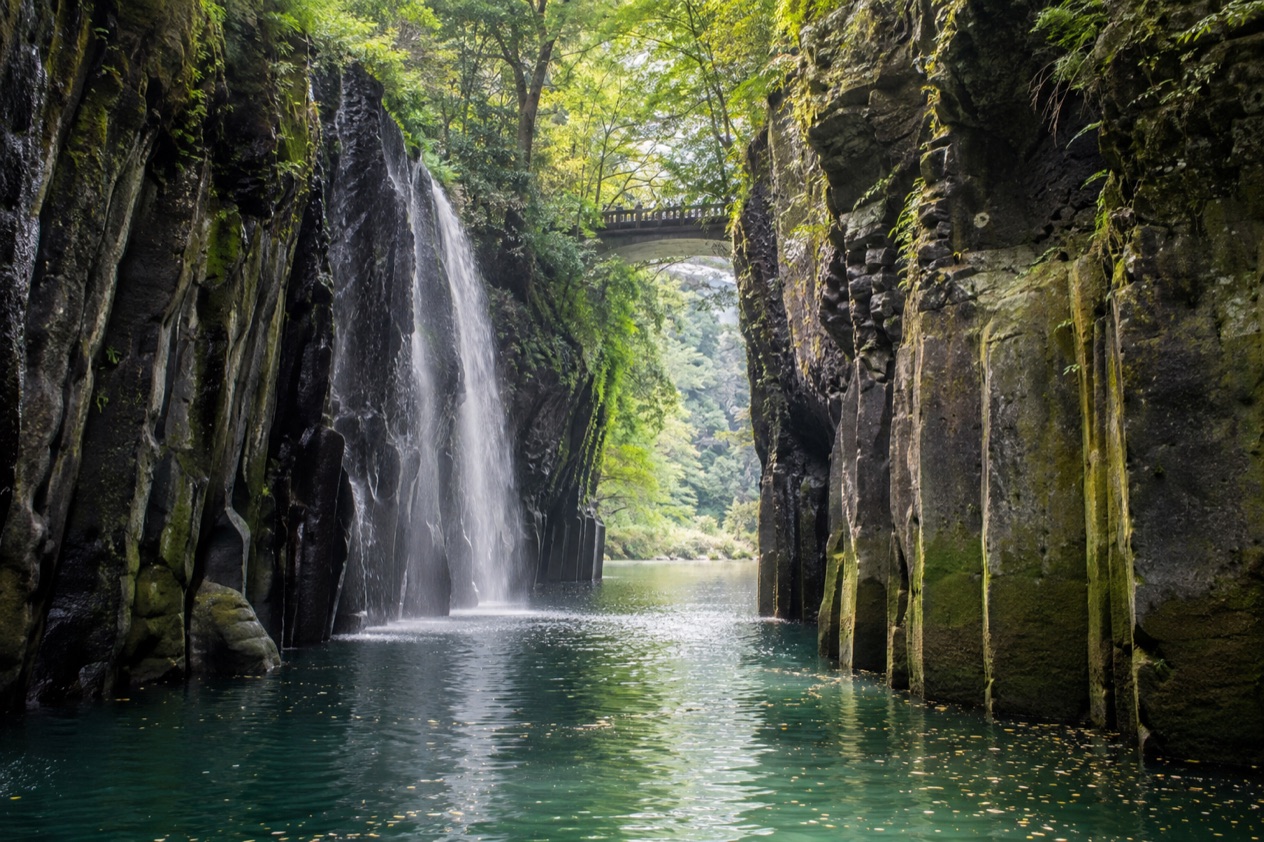
Manai Falls is the picture people carry home from Takachiho. A single ribbon of water drops into a pool framed by dark rock and thick greenery, and the sound carries well before the falls come into view. It is the feature the whole gorge is known for, and it gives the canyon a clear center.
Look for how the water meets the cliffs. After a rainy spell the falls often run fuller and louder, while in drier stretches they look thinner and the rock stands out more. Photographers tend to linger here to catch the contrast between white water and the deep green that surrounds it. Take your time and watch the light change on the spray.
The gorge walls and the river
The gorge itself is a narrow canyon cut by a river through volcanic rock. The cliffs are made of dark stone that breaks into tall, angular columns, a pattern that comes from lava cooling long ago in this part of Kyushu. Trees cling to the upper edges and ferns and moss soften the lower faces.
What you notice is the scale. The river looks small between the walls, and the place feels enclosed, with the green of the forest above and the shade below. Watch for changes with the weather, since mist, drizzle and sun each give the stone a different color. A visit here is mostly about looking up and letting the shapes sink in.
Amanoiwato-jinja and the myth of the cave
Amanoiwato-jinja is the shrine most closely tied to Takachiho’s mythology. According to the old story, Amaterasu withdrew into a cave and the world went dark until the other gods lured her out with music and dance. The shrine honors that tale, and its setting among tall trees gives it the quiet air of a place built around a legend.
Even if you know little of the myth, the shrine grounds are worth a slow circuit. Notice the torii gates, the weathered wood and the way the trees close in overhead. Together with the gorge, the shrine explains why people speak of Takachiho as a place where land and legend overlap.
Takachiho Shrine and the local dance tradition
Takachiho Shrine is another stop in town, and it is linked with kagura, the sacred dance that retells the same myths. Kagura in this part of Kyushu is a local tradition, performed with masks, drums and flutes, and it is one of the reasons the town has a cultural identity beyond its scenery.
Come to the shrine for its atmosphere and for the sense that these stories are still part of local life. If you want to see kagura itself, it is worth asking around once you are in town, since performances belong to the local calendar and you should not count on one. The shrine is a good place to slow down between the gorge and the next stop.
Kunimigaoka and the view over the land
Kunimigaoka is listed among the town’s attractions and is the place to take in the broader landscape rather than a single canyon. From here you get a sense of the Kyushu Mountains around Takachiho, the folds of ridge and valley, and the hint of mist that often settles in the low ground. It rounds out a visit by showing the setting in which the gorge sits.
Pair it with the rice terraces the town is noted for. Together they show that Takachiho is a working landscape of farms and forest as well as a destination for myth lovers.
How to get to Takachiho Gorge
You reach Takachiho Gorge by bus or by car, because the town has no passenger rail service. That single fact shapes every plan. The gorge lies slightly south of the town center, so the first goal is to reach Takachiho itself, in the northernmost part of Miyazaki Prefecture, and then head to the gorge from there.
There was once a railway. The Takachiho Railway ran from Nobeoka to Takachiho Station, but it discontinued services on September 6, 2005, after Typhoon Nabi washed away two bridges. Today the old story is a reminder of how steep and river-cut this country is, and why the town still feels set apart from the main rail network of Kyushu.
If you plan to use trains for part of the journey, the nearest stations to Takachiho are Takamori on the Minamiaso Railway Takamori Line and Tateno on the JR Kyushu Hohi Main Line. From either one, the rest of the trip is by road. Planning the onward link from the station before you leave is a good idea, since no rail line will carry you into town.
Travelers fit it into a longer loop through central Kyushu, joining it with a stay at an onsen town or a night in the mountains.
Driving suits those who like to set their own pace between the gorge, the shrines and the terraces. Bus travelers can still do all of it by keeping the plan simple and staying put in town for a night or two.
When to visit Takachiho Gorge
There is no single right month, but it helps to know that this is a wet corner of Japan. Takachiho receives an average of 92.98 inches of rain a year, and June is the wettest month. A June visit means umbrellas, damp air and a landscape that is lush and green, with the falls often running full.
Rain is part of the character here, so a gray day is not a wasted one. Mist drifting through the gorge, wet stone and glossy leaves can make the scene richer than a bright, flat sky. Still, a long soaking spell is a different matter if you want to spend hours outdoors, so keep your plan flexible and be ready to swap the gorge for a shrine or a meal indoors.
Storms matter too. The loss of the Takachiho Railway to Typhoon Nabi shows what heavy weather can do in these mountains. If your dates fall in a stretch of unsettled weather, expect that roads and plans may shift, and keep a day of margin on either end of the visit.
Because the figures for dates, hours and seasonal color are not fixed for every year, think of timing in broad terms. Outside the wettest weeks, you have a better chance of long dry spells for walking among the shrines and viewpoints. Whatever the month, plan to have the gorge as one highlight in a day that also includes the town, a meal and a slow look at the terraces.
Tips for your visit
Bring layers and something for rain, since this part of Kyushu gets a lot of it. Shoes with a good grip are sensible around damp stone and shrine grounds. A small camera bag or a phone you can keep dry will serve you better than a large pack, and a light towel is handy after a drizzle.
The gorge is one stop among several, and the town holds Amanoiwato-jinja, Takachiho Shrine, Kunimigaoka, Shonen-ji and Takachiho Onsen, so there is plenty to fill the hours. An onsen soak at the end of the day, a hot spring bath after time spent outdoors, is a natural way to close the visit.
Combine the gorge with the myth sites for a day that makes sense as a story. Start with the canyon and the falls, move on to the shrines to hear how the legends fit the landscape, and finish with the view over the terraces. If rain interrupts, the shrines and the onsen make good fallback stops.
For families and travelers with limited mobility, think about the terrain before you commit. The gorge is a deep cut in the land with rock walls and water, so it may involve steps and uneven ground.
Good to know before you go
Carry some yen for small purchases in a mountain town, and remember that the rainy months call for a flexible plan. Typhoons have shaped this valley before, so keep an eye on the forecast when the weather turns. Shoes come off at the entrance of many inns and onsen, and a quiet, respectful manner suits the shrines. Then take your time, because Takachiho is a place that opens up slowly.
Sources
- Wikipedia, Takachiho, Miyazaki (https://en.wikipedia.org/wiki/Takachiho,_Miyazaki), checked October 11, 2026
- Japan National Tourism Organization, Kyushu (https://www.japan.travel/en/destinations/kyushu/), checked October 11, 2026
- JR Kyushu, Rail passes (https://www.jrkyushu.co.jp/english/railpass/), checked October 11, 2026
To plan your stay
- Best Time to Visit Japan: Cherry Blossoms, Autumn Colors, Weather and Festivals
- Where to Stay in Japan: Ryokan, Temple Stays, Capsule Hotels and the Best Cities to Base In
- Sending Luggage from the Airport in Japan: Hands-Free Travel, Hotel Delivery and Coin Lockers
- Know Before You Go to Japan: Entry, Money, Etiquette and Getting Around