
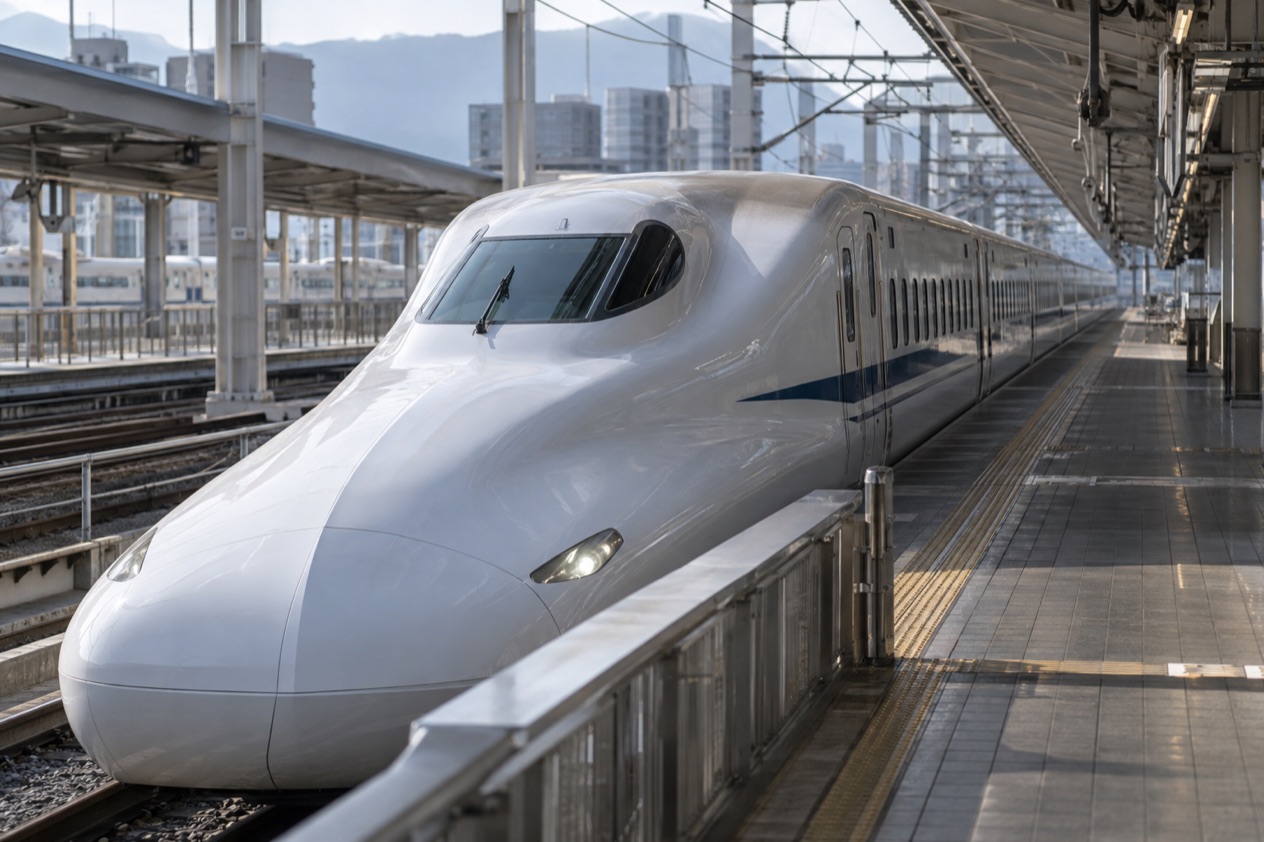
On a platform at Tokyo Station, the bullet trains slide in one after another, each with its cars marked by numbers and symbols painted along the edge of the platform. The short answer is that a reserved seat is tied to one train and one place in a car, while a non-reserved seat is not, and the category of train you ride shapes which of the two you meet.
What is the difference between reserved and non-reserved seats?
A reserved seat is a seat assigned to you on one particular train, while a non-reserved seat is one you take on the day, wherever a place is free in a car set aside for that purpose. The distinction matters most on the trains that run between cities, because those are the ones where seating is organized in this way.
The Shinkansen, the high-speed intercity network, sits at the top of that world. It is a separate class of train from the ordinary commuter and regional services, and it carries a supplement on top of the basic fare.
Limited Express and Special Express trains, the faster intercity services that run on conventional tracks, have reserved seats and typically require a supplement too. That shared feature, a faster train with a supplement, is the thread that connects the two.
What the supplement is for
A supplement is an extra charge for the speed and the seating of a faster train. It sits on top of the fare for the distance, and it is the reason the Shinkansen and the Limited Express are described as a different category from a local or a rapid service. Rapid trains skip smaller stations and do not require a supplement, so a ride on one is a plain fare from start to finish.
Express trains fall in between. They serve fewer stops than a rapid train, and a supplement may be applied, which means the rule depends on the service. When a train is described as an express in a timetable or on a sign, the word alone does not settle the question of what you pay, and it is worth reading what is posted for that particular train.
How the seat types feel in practice
A reserved seat gives you a place to settle into from the moment you board. You walk to the car printed for your seat, find the row, and put your bag overhead without scanning the aisle. For a traveler carrying luggage, or a family who wants to sit together, that sense of having a place waiting is much of the appeal.
A non-reserved seat works differently. You choose a car meant for that purpose and sit where there is room, much as you would on a commuter train, with the flexibility of boarding without having committed to one departure. Travelers like the freedom of that arrangement when their plans are loose, for example after a long day of sightseeing when the exact hour of leaving is still undecided.
A network that reaches most of the country
The Shinkansen operates on multiple lines across Japan, and its services reach most major cities on Honshu and Kyushu and extend to Hakodate on Hokkaido. The JR Group network covers the entire country, including those Shinkansen lines, and serves tourist areas such as Kyoto, Hiroshima, Kanazawa and Sendai. When you decide between a reserved and a non-reserved seat, you are choosing inside a system that is large enough to link the cities visitors want to see.
How do you reserve one?
Reserving a seat means picking a specific train, usually on one of the Shinkansen lines or a Limited Express route, and having a seat in a car assigned to you for that departure. The first decision is therefore which service you want, because the reserved seat belongs to a train and not to a day or a general route. Everything else follows from that choice.
The line you ride shapes the options. The Tokaido Shinkansen, the first line, connects Tokyo, Yokohama, Nagoya and Osaka, and it is the one visitors picture when they imagine a bullet train trip between the big cities.
Further north, the Tohoku Shinkansen carries travelers toward Shin-Aomori, and the services on the Honshu and Kyushu lines tie the rest of the network together. A seat is reserved on a train of one of these lines, so knowing the line is half of knowing the train.
Choosing the train before the seat
Start from where you are going. A trip from Tokyo to Osaka follows the Tokaido line, and a trip toward the north follows the Tohoku line, so the destination points you to a line and the line points you to its trains. Only then does the question of a seat make sense, because a seat is a feature of the train you have picked.
Timing also enters the picture in one firm way. The Shinkansen system shuts down between midnight and 06:00 every day for maintenance, so there is no overnight bullet train to reserve. A plan that depends on a very late arrival or a very early start has to fit inside those hours, and the hours when the system is running are the hours when a seat can be yours.
The lines behind the seats
| Line | What it covers |
|---|---|
| Tokaido Shinkansen | Tokyo, Yokohama, Nagoya and Osaka over 552.6 km, opened in 1964 |
| Tohoku Shinkansen | Reaches 320 km/h on a 387.5-km section, and runs Tokyo to Shin-Aomori in around 3 hours over 674 km |
| Whole network | 2,951.3 km of lines, with maximum speeds from 260 to 320 km/h |
These lines are the backbone on which seats are reserved. The Tokaido line is the oldest, the Tohoku line stretches far to the north, and the network as a whole links Honshu, Kyushu and Hakodate. A Limited Express, by contrast, runs on conventional tracks and still carries reserved seats, so the idea of an assigned seat is not limited to the bullet train alone.
Rail companies beyond JR
Not every intercity trip runs on JR tracks. Private railway companies serve many of the places travelers want to reach, and each has its own territory. Odakyu provides direct access to Hakone and Enoshima, Keisei to Narita Airport, and Tokyu and Keikyu to Yokohama and Haneda Airport. Seibu and Keio link Chichibu and Mount Takao, and Meitetsu reaches Inuyama and Centrair Airport.
In the Kansai area, Kintetsu, Nankai, Hankyu, Keihan and Hanshin provide direct access to Osaka, Kyoto, Nara and Koyasan. The point for a seat is that each company runs its own trains and its own arrangements, so a fact about one operator stays with that operator. The reserved seats of a JR Limited Express and the services of a private line are separate things, and it is the train you board that tells you which applies.
Which trains have non-reserved cars?
Local and rapid trains need no reservation at all, since they carry no supplement and no assigned seats, while the Shinkansen and Limited Express trains are the ones where the split between reserved and non-reserved seating comes into play. The more a train is built for speed and long distance, the more likely it is to have a seating system with a supplement attached.
| Train type | Stops | Supplement |
|---|---|---|
| Rapid | Skips smaller stations | Not required |
| Express | Fewer stops | May be applied |
| Limited Express and Special Express | Faster intercity travel, reserved seats | Typically required |
| Shinkansen | High-speed intercity travel on multiple lines | Applies |
Local, rapid and express trains
Local trains stop at every station, which makes them a fit for short distances, and you board them as you would a subway. Rapid trains skip the smaller stations and still ask for no supplement, so the step up from a local costs you nothing extra. These are the services of everyday movement, and they are where you will spend time on day trips close to a city.
Express trains serve fewer stops again, and a supplement may be applied. That wording is worth keeping in mind, because it means two trains with the same label can differ in what they charge. The cleanest way to think of it is as a sliding scale: the fewer the stops and the longer the distance, the more likely a supplement becomes part of the price.
Limited Express and the Shinkansen
At the faster end are the Limited Express and Special Express trains, which have reserved seats, offer quicker intercity travel and typically require a supplement. Above them are the Shinkansen, the high-speed trains that run on their own lines with the supplement already built into how they are described. In both cases the reserved seat is part of the product.
A traveler who wants to know whether a given departure has a car for non-reserved seating is asking about that departure, and the answer belongs to that train and its operator. What can be said with confidence is that the Shinkansen and the Limited Express are the categories where seating is organized around reservations, and the local and rapid trains are not.
Where the Shinkansen goes
The reach of the bullet train explains why the question comes up so often. Its services run to most major cities on Honshu and Kyushu and out to Hakodate on Hokkaido, and the JR network around it serves Kyoto, Hiroshima, Kanazawa and Sendai. A trip between any two of these cities is likely to put you in front of the choice between a reserved and a non-reserved seat.
A future line adds one more chapter to the story. The Chuo Shinkansen maglev is expected to reduce travel time between Tokyo and Osaka to 67 minutes, a reminder that the system keeps growing. For now, the question of seats is answered on the lines that already exist.
Good to know before you go
The bullet train network sleeps for part of the night, so plan your last and first departures around that gap and keep a little room in a day that ends with a long ride. The names of the lines and the companies are the best map you can carry, since a fact about one operator stays with that operator and a supplement depends on the category of the train. Rainy-season and typhoon weather can affect any rail day in Japan, so a loose schedule on those days is a comfort.
Sources
- Japan National Tourism Organization, traveling by rail (https://www.japan.travel/en/guide/traveling-by-rail/), checked October 11, 2026
- Wikipedia, Shinkansen (https://en.wikipedia.org/wiki/Shinkansen), checked October 11, 2026
To plan your stay
- Best Time to Visit Japan: Cherry Blossoms, Autumn Colors, Weather and Festivals
- Where to Stay in Japan: Ryokan, Temple Stays, Capsule Hotels and the Best Cities to Base In
- Sending Luggage from the Airport in Japan: Hands-Free Travel, Hotel Delivery and Coin Lockers
- Know Before You Go to Japan: Entry, Money, Etiquette and Getting Around