
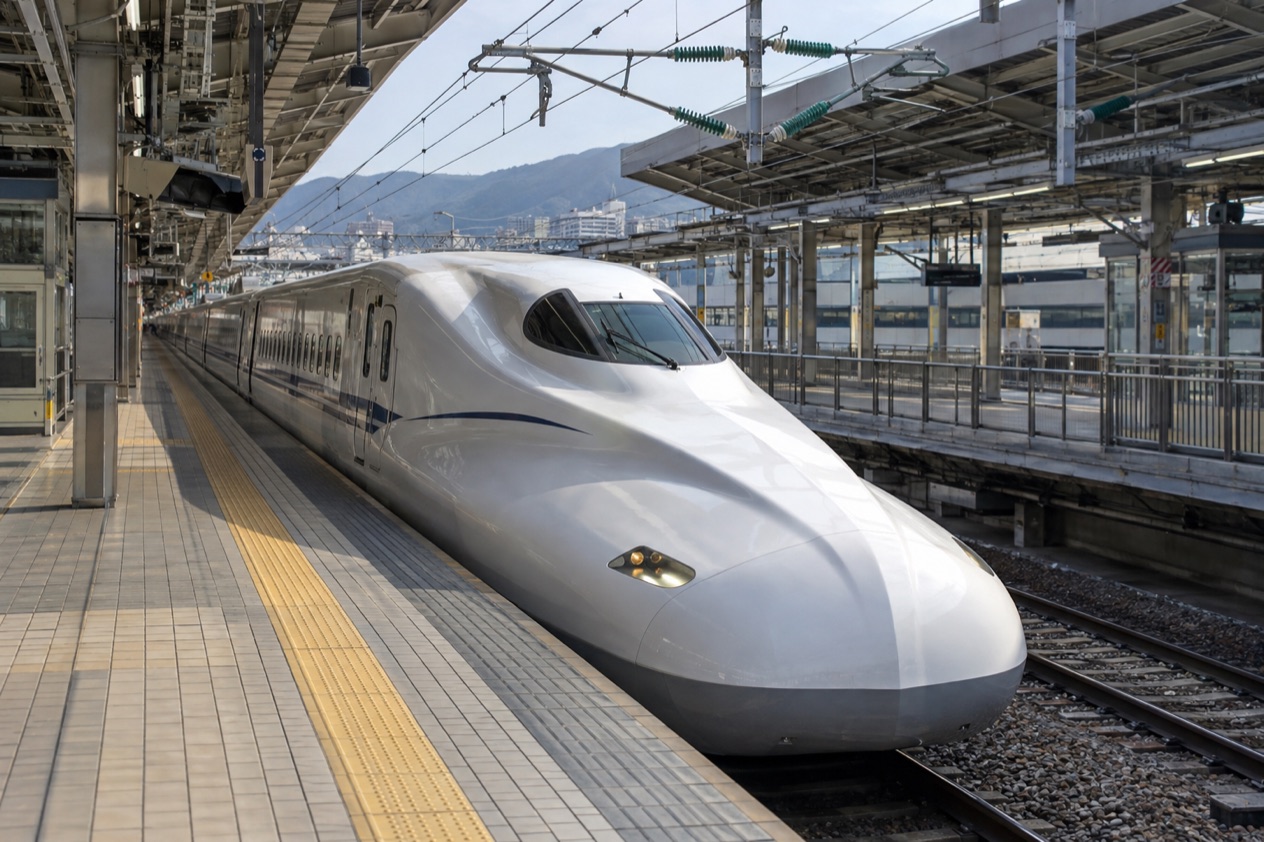
On a platform in Tokyo, a long white nose slides in without a sound, the doors open exactly where the markings on the ground promised, and a whole carload of travelers steps aboard in an orderly line. That is the shinkansen, the high-speed train that ties Japan’s big cities together. It is the way most visitors cross the country between Tokyo, Kyoto, Osaka, Hiroshima and beyond.
What is the shinkansen?
The shinkansen is Japan’s high-speed intercity train, running on several lines across the country and carrying a supplement on top of the base fare. It lets travelers cross large distances quickly and comfortably, and it belongs to the wider JR network, the Japan Railways Group, which covers the entire country and reaches tourist areas such as Kyoto, Hiroshima, Kanazawa and Sendai.
Punctuality is part of the appeal. Japanese trains have a reputation for being always on time, and the shinkansen is held up as the example: you can plan a day to the minute and, as the saying goes, set your watch by it. Seats, luggage space and a calm carriage make the ride a pleasure in itself, and on a long-distance train like this, phone calls are taken in the corridor between cars rather than at your seat.
Where the shinkansen sits among Japan’s trains
Japan sorts its trains by how many stations they skip. Local trains stop at every station and suit short distances. Rapid trains skip the smaller stations and need no supplement. Express trains serve fewer stops, and a supplement may apply. Limited Express and Special Express trains have reserved seats, offer faster intercity travel and typically require a supplement.
The shinkansen sits at the top of that ladder as the high-speed option between regions. Beyond it, private railways fill in the gaps: Odakyu runs to Hakone and Enoshima, Keisei to Narita Airport, and Tokyu and Keikyu to Yokohama and Haneda Airport. Seibu and Keio reach Chichibu and Mount Takao, Meitetsu serves Inuyama and Centrair Airport, and Kintetsu, Nankai, Hankyu, Keihan and Hanshin link Osaka, Kyoto, Nara and Koyasan.
Passes and supplements on faster trains
Some of the fastest services carry their own conditions for rail pass holders. Foreign passengers with a Japan Rail Pass must pay a supplement to use Mizuho trains on the Kyushu Shinkansen. On the Sanyo Shinkansen, pass holders are required to purchase a special ticket to use the express Nozomi or Mizuho services.
Those two cases are specific to their lines and trains. Other services are not covered here, so the useful habit is to look at the name of the train before you board and to remember that the named service, not just the line, decides what you pay.
Which lines are there?
Each has its own operator, its own named trains and its own character, from a tunnel under the sea to a ski-resort branch in winter. The times in the table are the fastest or end-to-end journeys for each route.
| Route | Journey time |
|---|---|
| Tokyo to Shin-Hakodate-Hokuto (Hokkaido Shinkansen) | 3 hours 57 minutes |
| Tokyo to Tsuruga (Hokuriku Shinkansen) | 3 hours 8 minutes |
| Tokyo to Niigata (Joetsu Shinkansen) | 90 minutes |
| Shin-Osaka to Kagoshima-Chuo (Kyushu Shinkansen, Mizuho) | 3 hours 45 minutes |
| Hakata to Kagoshima (Kyushu Shinkansen) | About 1 hour 20 minutes |
| Tokyo to Hakata (Nozomi, Sanyo and Tokaido) | 5 hours |
Hokkaido Shinkansen
The Hokkaido Shinkansen is operated by JR Hokkaido and connects Aomori Prefecture on Honshu with Hokkaido through the Seikan Tunnel. The line runs 92 miles from Shin-Aomori to Shin-Hakodate-Hokuto, and its first section opened on 26 March 2016.
Two kinds of service run here. The express Hayabusa trains link Shin-Hakodate-Hokuto and Shin-Aomori, with through services to Tokyo or Sendai, while the local Hayate trains cover the same stretch, with some continuing to Morioka.
Through the dual-gauge section that includes the Seikan Tunnel, speed is limited to 99 miles/h because the shock wave of a shinkansen at full speed could destabilize a narrow-gauge freight train passing the other way. In holiday periods since 2024, JR Hokkaido raises that limit to 162 miles/h. In winter, snow can build up on the trains and cause delays, and the line’s occupancy dropped to a low of 19% in January and February.
Hokuriku Shinkansen
The Hokuriku Shinkansen connects Tokyo with Tsuruga in the Hokuriku region and is jointly run by JR East and JR West. It first opened between Takasaki and Nagano on 1 October 1997, ahead of the 1998 Nagano Winter Olympics, then reached Kanazawa on 14 March 2015 and Tsuruga on 16 March 2024.
Four types of service run on it: Kagayaki, Hakutaka, Tsurugi and Asama. The trains are 12-car E7 and W7 series sets, built to cope with the country’s 50 Hz and 60 Hz electrical boundary, which the line crosses three times. With the extension, the limited express Thunderbird stopped running between Tsuruga and Kanazawa on 15 March 2024.
Joetsu Shinkansen
Operated by JR East, the Joetsu Shinkansen links Niigata in the north with Omiya in the south, with through service to Tokyo via the Tohoku Shinkansen. Regular service began on 15 November 1982, and the whole line has been upgraded to 171 miles/h.
The Toki is the limited-stop train between Tokyo and Niigata, and the Tanigawa stops at every station between Tokyo and Echigo-Yuzawa. In winter, Tanigawa trains continue along the short Gala-Yuzawa Line to Gala-Yuzawa Station and its ski resort.
Kyushu Shinkansen
The Kyushu Shinkansen is operated by JR Kyushu and runs 160 miles between Hakata and Kagoshima-Chuo, with a top speed of 162 miles/h. It cut the Hakata to Kagoshima journey from 4 hours to about 1 hour and 20 minutes.
Three services run, in order of speed: Mizuho, Sakura and Tsubame. All trains stop at Hakata, Kumamoto and Kagoshima-Chuo. Sakura runs once per hour through the day between Shin-Osaka and Kagoshima-Chuo, Mizuho makes two round trips in the morning and two in the evening, and Tsubame is the all-stations shuttle between Hakata and Kumamoto, once to twice per hour.
Sanyo Shinkansen
The Sanyo Shinkansen, run by West Japan Railway Company, connects Shin-Osaka with Hakata in Fukuoka over 344 miles, at up to 186 miles/h for most of the way. The first segment, Shin-Osaka to Okayama, opened on March 15, 1972, and the rest followed on March 10, 1975.
JR West has announced that the 500 Series trains are being phased out, with four trainsets retired by 2026 and the last two by 2027. The line has carried 3 billion riders to date.
How do you ride one?
You ride the shinkansen like any other JR train, as a ticketed journey with the supplement included, so the first step is knowing which line and which named train your route uses. Route apps such as Japan Travel by NAVITIME, Japan Transit Planner by Jorudan and Google Maps let you find routes and calculate fares easily.
Before the platform: IC cards and stations
Around the stations, an IC card makes everything else simpler. You can use it to pay in many vending machines, stores and station coin lockers. The deposit for most IC cards is 500 yen, returned if you hand the card back at the counter at the end of your stay.
Welcome Suica is a deposit-free card for tourists visiting certain parts of the Kanto region and is valid for up to 28 days. Mobile IC cards (PASMO or Suica) on a smartphone do not work on all smartphones, so it is worth knowing whether yours is compatible.
Getting to the right station
Big cities have several operators sharing the ground. Tokyo has Japan Railways trains, Tokyo Metro lines and Toei Subway lines, among others, while Osaka has JR, Hankyu Railway, Hanshin Electric Railway and Keihan Railway. Taking the metro in Japanese cities is a quick and easy way to get around, and it is how many travelers reach the station where a shinkansen begins.
Where the shinkansen does not go, other options fill in. Taxis are clean and reliable, but carry cash because not all of them accept cards.
On the buses that connect
If a bus takes you on to a final stop, one type works this way: you enter through the rear, take a numbered ticket and pay when leaving through the front, with the fare depending on where you board and alight. On a bus that does not charge a flat rate, putting in more than the exact fare means you will not get change back.
Good to know before you go
Japan is a long way from home, and the shinkansen is the part of the trip where the distance feels most manageable. Winter snow can slow trains on the Hokkaido line, and the Kyushu line was reopened with reduced speed and service frequency on April 27, 2016, after the Kumamoto earthquakes that year. Keep a little cash for taxis and for buses where the fare is paid on exit, and an IC card in your pocket for everything else.
Sources
- Japan National Tourism Organization, trains and buses (https://www.japan.travel/en/guide/how-to-travel-by-train-and-bus-in-japan/), checked October 11, 2026
- Japan National Tourism Organization, traveling by rail (https://www.japan.travel/en/guide/traveling-by-rail/), checked October 11, 2026
- Japan National Tourism Organization, getting around Japan: trains, subways, buses, taxis (https://www.japan.travel/en/plan/getting-around/), checked October 11, 2026
- Wikipedia, Hokkaido Shinkansen (https://en.wikipedia.org/wiki/Hokkaido_Shinkansen), checked October 11, 2026
- Wikipedia, Hokuriku Shinkansen (https://en.wikipedia.org/wiki/Hokuriku_Shinkansen), checked October 11, 2026
- Wikipedia, Jōetsu Shinkansen (https://en.wikipedia.org/wiki/J%C5%8Detsu_Shinkansen), checked October 11, 2026
- Wikipedia, Kyushu Shinkansen (https://en.wikipedia.org/wiki/Kyushu_Shinkansen), checked October 11, 2026
- Wikipedia, Sanyō Shinkansen (https://en.wikipedia.org/wiki/Sany%C5%8D_Shinkansen), checked October 11, 2026
To plan your stay
- Best Time to Visit Japan: Cherry Blossoms, Autumn Colors, Weather and Festivals
- Where to Stay in Japan: Ryokan, Temple Stays, Capsule Hotels and the Best Cities to Base In
- Sending Luggage from the Airport in Japan: Hands-Free Travel, Hotel Delivery and Coin Lockers
- Know Before You Go to Japan: Entry, Money, Etiquette and Getting Around