
Over a plate of okonomiyaki at a counter in Osaka, the cook flips the cabbage pancake, sauce hisses on the griddle, and the traveler next to you asks how you made it all the way from the Pacific Northwest. The short answer is Kansai International Airport, the airport that serves Osaka. The carriers named for it here are Hawaiian Airlines, which links it with Honolulu, and StarFlyer, which links it with Tokyo Haneda.
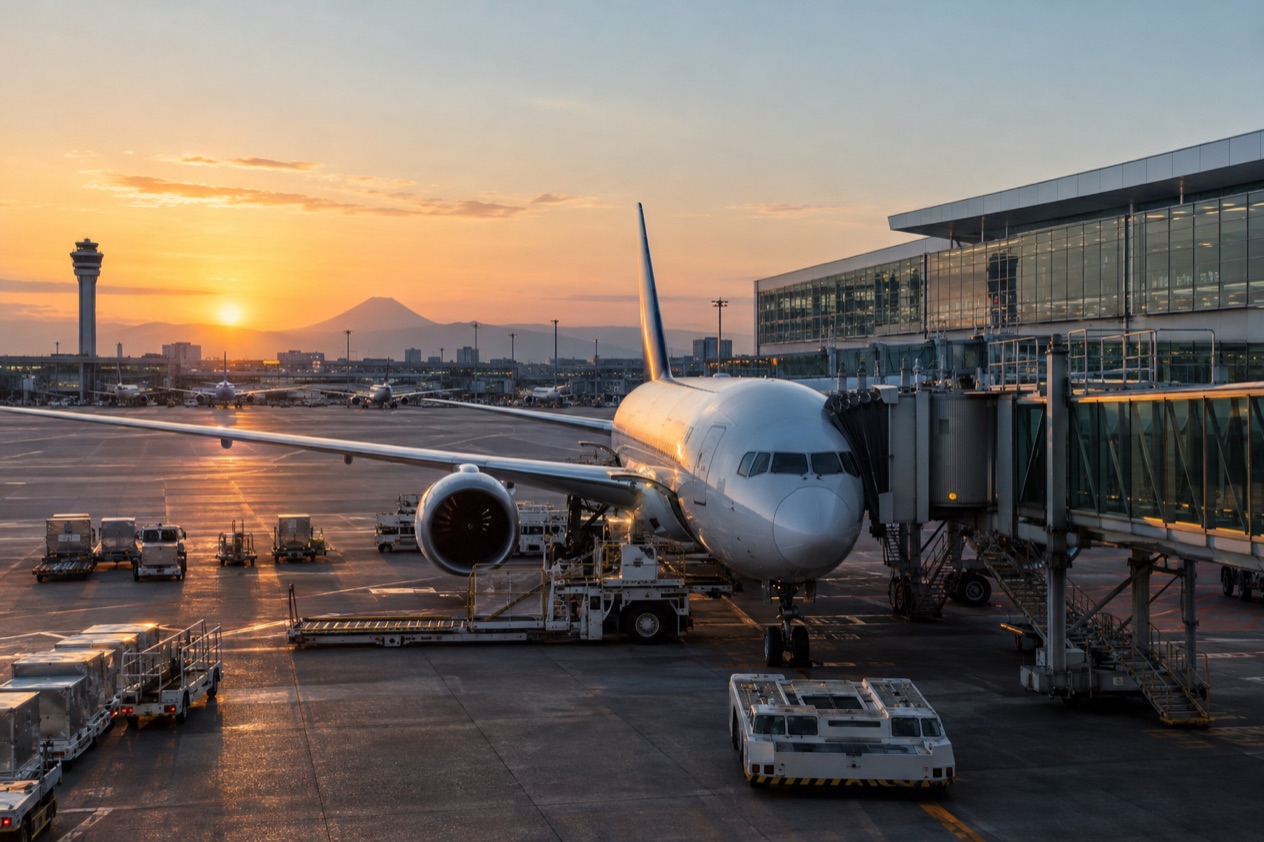
Which airlines fly from Seattle to Osaka?
Which airlines fly from Seattle to Osaka? Those two routes show the two directions a trip through Osaka can take. One runs back across the Pacific by way of Hawaii, the other runs on inside Japan.
Kansai is the airport that lets you visit Japan without going through Tokyo. That matters for a traveler whose plans center on Osaka, Kyoto and Nara, because the trip can start in the west and stay there. You walk out of the arrivals hall already in the region of takoyaki stands, canal-side neon and old castle walls.
Hawaiian Airlines and the Honolulu link
Hawaiian Airlines flies nonstop between Kansai and Honolulu. Hawaiian Airlines flies nonstop between Kansai and Honolulu.
It also changes how the trip feels. You arrive in Osaka after a Hawaii leg rather than in one stretch, and the first thing you want is a bowl of ramen or a plate of kushikatsu skewers, not a map.
StarFlyer and the hop to Haneda
StarFlyer is a Japanese carrier that flies nonstop from Kansai to Tokyo–Haneda. It is a domestic route, so it is not the one that brings you across the ocean. It matters when an Osaka stay is one chapter of a longer Japan trip, with Tokyo as the next one.
Haneda is the airport of Tokyo city, and international flights can now arrive there directly in the heart of the capital. A traveler who ends a week in Osaka with a flight to Haneda lands on the Tokyo side of the trip without having to cross the city from another airport. That is a pleasant way to close a loop, with the temples and food of Kansai behind you and the big-city districts ahead.
Reading an itinerary that mixes airports
Japan has several international gateways, and an itinerary can use more than one. Narita serves most major international destinations and many domestic airports. Nagoya’s Centrair is the airport hub for flights to and from cities in Asia and Japan. Kansai serves Kyoto, Osaka, Nara and Wakayama.
When you compare options, look at which airport each leg uses before you look at the airline. A ticket into one airport and out of another is a common way to see Japan without doubling back. The Osaka and Kyoto side of the country then becomes a single arc, with food in one city, temples in the next and a castle town after that.
Where do you land?
For Osaka, you land at Kansai International Airport, known as KIX, the gateway to western Japan. It serves Kyoto, Osaka, Nara and Wakayama, so one arrival covers the whole cluster of cities that most first visits to the region include.
| From Kansai International Airport to | Rail time |
|---|---|
| Shin-Osaka high-speed train station | About 50 minutes |
| Kyoto Station | 1 hour 15 minutes |
Kansai, the airport for Osaka, Kyoto and Nara
Shin-Osaka is the station where the high-speed trains stop, and Kyoto Station is the doorway to the old capital’s temples and tea houses. Both are reached from the airport by rail, with times in the table. For a first night, travelers head toward the lights of Dotonbori, the canal strip lined with giant signs of crabs, pufferfish and runners.
Nara and Wakayama come into play on day trips or on a longer loop. Nara has deer wandering around its temple grounds, and Todai-ji houses a great bronze Buddha. Wakayama brings a different mood, with its coast and mountain religious sites. Having Kansai as the landing point keeps all of these within reach from one base.
Tokyo airports if the trip starts there
Some itineraries begin in Tokyo and reach Osaka later. Haneda is the airport of Tokyo city. Narita is one of the two airports serving the capital, with both international and domestic destinations. It sits in Chiba Prefecture, 1 hour by express train from Tokyo.
Three rail lines serve Narita: the Narita Sky Access line, the Keisei line and the JR line. Each terminal has its own station connection, so you work out which terminal your airline uses before you pick a platform.
| Narita terminal | Station | Walk |
|---|---|---|
| Terminal 1 | Narita Airport Station | 5 minutes |
| Terminal 2 | Narita Airport Terminal 2・3 Station | 5 minutes |
| Terminal 3 | Narita Airport Terminal 2・3 Station | 10 minutes |
Haneda on arrival
At Haneda, travelers can search for routes, departure and arrival times and fares for trains, monorails and buses to their destination from the passenger terminal. That is useful when your hotel is in a neighborhood you have never visited, since the search starts from where you are standing.
Taxis at Haneda come in two kinds of stands, general stands and stands for app-dispatched or reserved taxis. A passenger who arranged a ride through an app or by phone uses the dedicated stand for reserved taxis. Parking lots P2 through P5 can be reserved in advance, which matters for anyone meeting a traveler by car.
What do you need for the trip?
What you need most is a clear picture of where each leg lands and how you get from the runway to your bed. The flights are the first piece, and the ground connections are the second, so settle both before you think about what to pack.
A plan for the first hours in Osaka
A flight into Kansai ends with a rail ride into the city, and it helps to know which station you want. Shin-Osaka suits a traveler who will soon board a high-speed train, and Kyoto Station suits one whose first night is in the old capital. Decide which before you leave the airport, since the two lead in different directions.
Osaka rewards an appetite. Street food runs from takoyaki, the grilled octopus balls, to okonomiyaki and kushikatsu, and the city has a reputation among Japanese travelers for eating well and eating a lot. Give the first evening to a stroll and a meal rather than a schedule, because the jet lag will catch up with the sights anyway.
If your route passes through Honolulu
A Honolulu stop adds a leg to the trip, and with it a second set of arrivals and departures to keep straight. Keep the order of cities in your notes, including the airport code for each end, so no connection surprises you.
The plus side of a stop is a change of pace. You can spend time on the island before the Japan portion begins, then land in Osaka ready for a different kind of energy, with neon signs, trains and the clatter of a griddle.
If you continue to Tokyo
At Haneda, the route search for trains, monorails and buses helps you reach your hotel, and the taxi stands are split between general and reserved. If you plan to be picked up or to use a ride app, go to the dedicated stand.
If you arrive instead at Narita, plan for the rail lines and the terminal walks in the table. Narita Sky Access, Keisei and JR all stop there, so your choice depends on where in Tokyo you are headed. Whichever airport you choose, the city waits with its own food halls, shrines and neighborhoods.
Good to know before you go
The U.S. State Department rates Japan Level 1: Exercise Normal Precautions.
Japan runs on the yen, and a day in Osaka is full of small purchases, from a skewer at a stall to a ticket on a local train, so it helps to have the currency in your pocket. The country has a rainy season and a typhoon season, and a trip in those months can bring wet days.
Pack a light rain jacket and keep a covered arcade or a department store food hall in mind as a backup. Osaka has plenty of both.
Sources
- Wikipedia, Kansai International Airport, airlines and destinations (https://en.wikipedia.org/wiki/Kansai_International_Airport#Airlines_and_destinations), checked October 11, 2026
- U.S. Department of State, Japan travel advisory (https://travel.state.gov/content/travel/en/traveladvisories/traveladvisories/japan-travel-advisory.html)
- Japan National Tourism Organization, how to reach the city from each international airport (https://www.japan.travel/en/plan/airport-access/), checked October 11, 2026
- Japan National Tourism Organization, how to get to Japan, airports, airlines (https://www.japan.travel/en/plan/getting-to-japan/), checked October 11, 2026
- Narita International Airport, Access by rail (https://www.narita-airport.jp/en/access/train/), checked October 11, 2026
- Haneda Airport Passenger Terminal, Access (https://tokyo-haneda.com/en/access/index.html), checked October 11, 2026
To plan your stay
- Best Time to Visit Japan: Cherry Blossoms, Autumn Colors, Weather and Festivals
- Things to Do in Japan: Kyoto Temples, Onsen, Street Food and Day Trips
- Where to Stay in Japan: Ryokan, Temple Stays, Capsule Hotels and the Best Cities to Base In
- Know Before You Go to Japan: Entry, Money, Etiquette and Getting Around