
The sliding door closes behind you, your shoes sit lined up at the entrance, and a staff member in a kimono sets down a pot of tea on a low table. Your room smells faintly of straw, and a cotton robe is folded and waiting. At a ryokan, a traditional Japanese inn, the etiquette is a handful of simple habits: shoes off, a robe on, a shared hot spring bath, and dinner served at a set time.
What are the rules at a ryokan?
The rules are few and mostly explained to you on arrival, because ryokan staff walk guests through the customs, including removing shoes indoors, bathing in the onsen and wearing the yukata. Nobody expects you to arrive knowing everything. What helps is understanding the logic of the place: it is built around tatami, sliding doors, bedding laid on the floor and a bath shared with other guests.
Ryokan are traditional inns, and for many travelers a night in one is the highlight of a trip to Japan. They turn up in very different settings: prestigious ones in Nara and Kyoto, mountain villages and onsen towns in Nagano, and contemporary ones in Tokyo, though in Tokyo they are hard to find because many cost much more than modern hotels and hostels. Traditional ryokan are more common where natural hot springs flow, as in Beppu Onsen.
Shoes, tatami and sliding doors
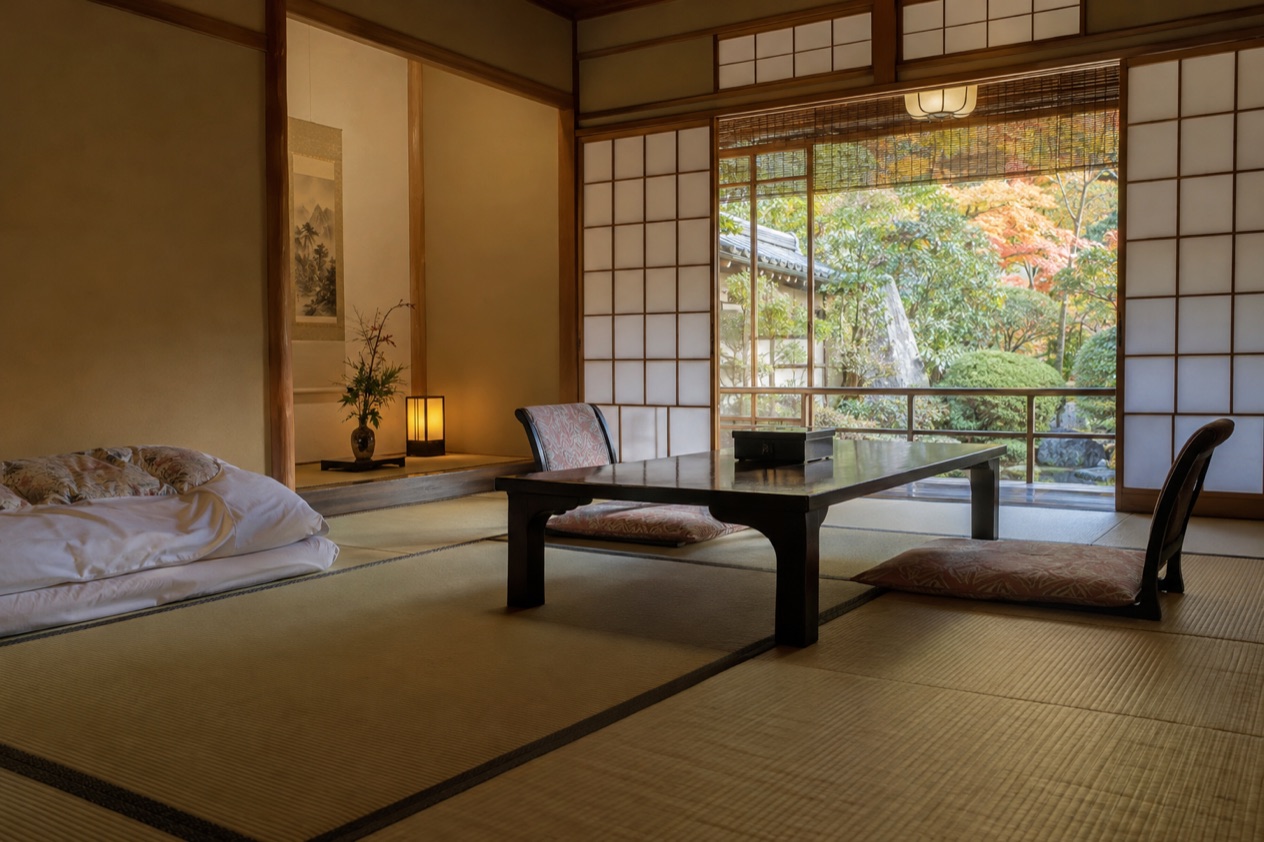
Shoes come off at the entrance, and you step up into the building in slippers or bare feet. Guest rooms have tatami flooring, the woven straw mats that give the room its scent, and the doors slide rather than swing. Tatami is treated gently, so the habit is to walk on it without outdoor footwear of any kind.
The room is simple. A low table, floor cushions and a view toward the garden are typical. There is no bed frame, because the bedding is a futon spread out on the tatami floor, usually while you are at dinner or the bath.
The bath: ofuro and onsen
Almost all ryokan have common bathing areas called ofuro, usually separated by gender, and they use hot spring water when an onsen is nearby. Most ryokan have an onsen along with a Japanese garden, and some also have private baths, sometimes outdoors. The onsen is part of the stay rather than an extra.
Staff explain the bathing customs when you arrive, and that explanation is worth listening to, since the order of things in a Japanese bath differs from a hotel pool or spa. Ask about anything that is unclear and follow what the inn tells you.
Booking and who is welcome
Some ryokan hesitate to take non-Japanese guests, especially those who do not speak Japanese. Others cater specially to international travelers, and there are websites that list such ryokan and help with booking.
Prices are quoted per person per room and typically include meals. The average stay costs around 15,000 yen per night, with higher prices at upscale inns. Some ryokan do offer meal-free stays, although the culinary side is a big part of the experience and worth keeping.
What happens at check-in and dinner?
Check-in comes in the late afternoon, dinner follows soon after, and the evening runs on a schedule rather than the loose rhythm of a hotel. Ryokan usually operate on a fairly strict timetable, and you are expected to arrive by 17:00. That timing exists because the kitchen and the staff are preparing your dinner around your arrival.
Arriving and settling in
You leave your shoes at the entrance and are shown to your room, where tea is often waiting. This is when staff explain the customs of the house, from where the baths are to how the yukata works. Take your time with it, because the rest of the evening flows from it.
Many ryokan also have a garden worth a look before dark. Gardens may include stone arrangements, water features, carefully placed plants and shrubs, and sometimes a Japanese tea house. Guests are invited to stroll there in geta or zori sandals and a yukata.
Kaiseki dinner
Dinner is kaiseki, a traditional multi-course meal of a dozen or more small dishes made from carefully chosen seasonal ingredients. The cooking leans on local and regional specialties, so a mountain inn and a coastal inn will not serve the same table. Each dish arrives in its own small bowl or plate, and the pleasure lies in the sequence.
Depending on the ryokan, the meal is served either in a common dining room or in your own room. In either case, ryokan stress punctuality, and most ask you to confirm what time you want to eat. Being on time keeps the courses arriving as the kitchen planned them.
Evening and breakfast
After dinner, the bath is the usual next step, and by the time you return the futon is often laid out on the tatami. Breakfast the next morning is a traditional Japanese one, again served according to the inn’s arrangement. A stay generally includes both meals, which is why the price per person covers more than a bed.
A few inns offer stays without meals. The meals carry so much of what makes a ryokan distinct, though, that skipping them means missing a good part of it.
What do you wear?
You wear a yukata, a light cotton robe the ryokan provides, and you change into it soon after arriving. Typically ryokan also supply geta, wooden sandals, that guests can borrow for strolls outside. The yukata is the everyday dress of the stay, for the corridors, the garden and often dinner.
How to wear the yukata
The one rule that matters is the fold. Place the left lapel over the right when closing the robe. Right over left is a faux pas, because that is how the dead are dressed for burial.
If you are unsure about the sash or the fit, ask the staff, who explain how to wear the yukata as part of the welcome. It is a very ordinary request and they are used to it.
Geta, zori and the garden
For a walk in the garden, guests are invited to put on geta or zori sandals along with the yukata. The wooden clatter of geta on stone paths is part of the atmosphere of an onsen town in the evening. Zori are flatter and softer underfoot.
Together, the robe and the sandals mean you can step out of your room and into the garden without changing. It is worth taking a slow turn past the stones, the water and the plantings, and the tea house if the inn has one.
What to keep in mind
Dress at a ryokan is about comfort and a shared way of doing things. You still remove shoes indoors, and the yukata is what you move around in between room, bath, dinner and garden. Anything else you pack stays in your room.
If you want to know whether a particular inn expects the yukata in the dining room, ask when you arrive. Houses differ in small ways, and the staff are the ones who set the tone.
Good to know before you go
Ryokan rates are given per person per room, so a quoted price for two people reads differently from a hotel rate, and it usually covers dinner and breakfast. Plan your day so that you reach the inn by the arrival time, and let the staff know when you want to eat. Some of the oldest inns in Japan are ryokan, including Nishiyama Onsen Keiunkan in Yamanashi Prefecture and Hoshi Ryokan, which gives the custom real depth even when the building around you is new.
Sources
- Japan National Tourism Organization, ryokan stays, what is included, etiquette (https://www.japan.travel/en/guide/japanese-ryokan/), checked October 11, 2026
- Wikipedia, Ryokan (https://en.wikipedia.org/wiki/Ryokan), checked October 11, 2026
- Wikivoyage, Ryokan (https://en.wikivoyage.org/wiki/Ryokan), checked October 11, 2026
To plan your stay
- Best Time to Visit Japan: Cherry Blossoms, Autumn Colors, Weather and Festivals
- Where to Stay in Japan: Ryokan, Temple Stays, Capsule Hotels and the Best Cities to Base In
- Sending Luggage from the Airport in Japan: Hands-Free Travel, Hotel Delivery and Coin Lockers
- Know Before You Go to Japan: Entry, Money, Etiquette and Getting Around