
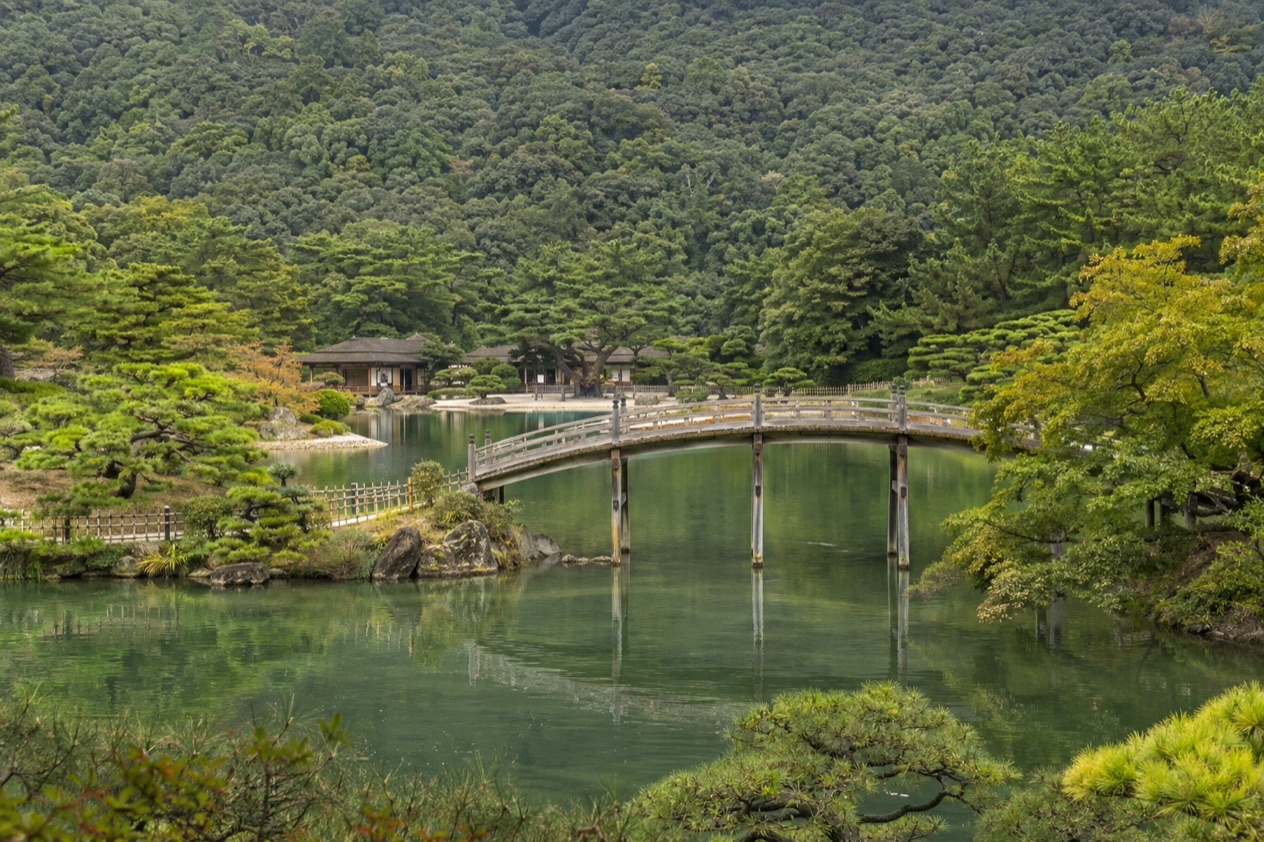
You step in from the streets of Takamatsu and the city drops away behind rows of sculpted black pines, with a wooded mountain filling the horizon beyond the water. Paths curl around ponds where koi drift under stone bridges, and a small teahouse sits at the edge of a lake. Ritsurin Garden is a visit built for walking slowly, looking at the trees, and stopping for a bowl of matcha.
Is visiting Ritsurin Garden worth it?
Yes, if you like gardens that unfold as you walk, and especially if Takamatsu is already on your Shikoku route. Ritsurin was laid out as a strolling garden for local feudal lords, so it is made to be seen from a path, a bridge or a boat rather than from a single viewpoint. It suits travelers who enjoy trimmed pines, still water, tea and the slow reveal of a new scene around each bend.
What sets it apart from the better-known gardens of Kyoto is its sheer scale and its setting. The garden lies in a former river bed on the east side of Mt. Shiun, so the mountain stands behind the ponds like a painted backdrop, and the garden covers about 190 acres.
Japanese garden designers like to make a space feel larger than it is, with sudden changes in the direction or width of a path and layered views. Here the space really is large, and the same tricks of design are applied across it. Instead of a single temple courtyard of raked gravel, you get lakes, hills, tea pavilions and a long list of small scenes to discover.
The government recognized this in 1953, when the garden was designated a Special Place of Scenic Beauty. Travelers who prefer a dry stone garden for meditation will find a different mood here, with water at the center of nearly every view.
What to see at Ritsurin Garden
The pines and the artificial hills
The black pines called Hakomatsu are the first thing visitors photograph. Their branches, twigs and needles are trimmed into geometric shapes and figures, so each tree reads as a small sculpture. Look at how the gardeners have shaped the crowns into layered clouds and rounded forms, and how the trees are set against water or lawn to frame a view.
Two artificial mountains, Hiraiho and Fuyo-ho, give the garden its changes of level. Climbing or viewing them is a matter of what the paths allow, but even seen from below they show the designers’ idea of a landscape in miniature, with rises and hollows arranged around the ponds. The real mountain behind adds a larger scale to the picture.
Sai-ko and Nan-ko, the two lakes
Water is the structure of the garden. Sai-ko, the Western Lake, and Nan-ko, the Southern Lake, anchor the walk, and streams and smaller ponds link them. Water flow is often central to the structure and mood of a Japanese garden, and here you see it in every direction, from open lake views to narrow channels crossed by stone bridges.
The ponds and streams are full of koi, and visitors sometimes feed them. Stop on a bridge and watch the fish gather and turn. The sound of water and the rustle of leaves are part of the design, so this is a garden to listen to as much as to look at.
Kikugetsu-tei, the Moon Scooping Pavilion
In the southern section stands the historic teahouse Kikugetsu-tei, whose name means Moon Scooping Pavilion. It was built around 1640 and sits beside the water, with open views across the pond toward pines and hills. The idea is that you sit and take in the scene with a bowl of tea in hand.
Visitors can enjoy matcha in the tea house, the powdered green tea whipped to a froth and often served with a small sweet. It is a good place to pause midway through the walk and let the garden come to you. Gardens like this one were historically used for gatherings, with guests invited to poetry and Noh performances, and the pavilion still gives you a sense of that setting.
A boat ride and the Wild Duck Hunting Moat
You can ride a traditional boat with a guide’s commentary, which gives you the garden from the water’s level, with pines leaning over the banks and bridges overhead. It is a gentle change of perspective after walking the paths and a way to hear the stories of the place from someone who knows it.
The garden also holds a Wild Duck Hunting Moat, a reminder that these grounds were the private estate of a feudal lord before they opened to the public. Look at the shape of the water and its edges to picture how the lords used the space for leisure and sport.
Hours, tickets and rules
Ritsurin Garden has been open to the public since March 16, 1875, after nearly two and a half centuries as a lord’s private retreat. Today the visit centers on walking the paths, riding the traditional boat with a guide’s commentary, and taking matcha in the tea house.
The experiences on offer are simple and linked to the water and the teahouse. The boat ride comes with commentary from a guide, and the matcha is served in the tea house, so a visit can combine movement and a pause in the same outing. Feeding the koi is something visitors sometimes do, and the fish are used to crowds gathering on the bridges.
The garden is a protected landscape, a Special Place of Scenic Beauty, and it is one of the large historic gardens of the country. Treat the pines, the lawns and the stone edges of the ponds as part of a designed work, and move through it as you would through any historic site.
How to get to Ritsurin Garden
Ritsurin Garden lies in Takamatsu, the capital of Kagawa Prefecture in northern Shikoku, and two railways serve it. Which one you take depends on where you are staying and which line you are already using.
By JR Shikoku
The garden can be reached from JR Shikoku’s Kotoku Line at Ritsurin-Koen-Kitaguchi Station. The name of the station, with Kitaguchi meaning north entrance, tells you that it serves the garden’s entrance on that side. If you are traveling around Shikoku on JR lines, this is the stop that connects the garden to your route.
By Kotoden
The Takamatsu-Kotohira Electric Railroad, known as Kotoden, stops at Ritsurin-Koen Station, which also gives access to the garden. Kotoden is the local private railway of the area, so it may fit well if you are staying in Takamatsu and moving around the city by its trains.
Either way, plan your day around the station you choose and walk in from there. Once inside, the paths are yours to follow at your own pace, and you can leave from whichever gate suits your next stop in the city.
When to visit Ritsurin Garden
Spring and autumn are the seasons the garden is known for. It is spectacular in spring during cherry blossom season and in autumn with its vivid colors, when the leaves around the ponds turn and are reflected in the water. The pines stay green through both, so the colors play against a constant backdrop of dark, sculpted trees.
In spring, the pale petals against the black pines and the water make for the garden’s softest scenes, and blossoms floating on the ponds add to the picture. In autumn, reds and golds frame the bridges and the tea pavilion. Because the exact timing of blossoms and leaves shifts from one year to the next, treat a visit in these seasons as a chance to catch them rather than a certainty.
Summer is a different garden. July and August can be quite warm in Takamatsu, so the shade of the pines and the sight of water become the main pleasures, and a bowl of matcha in the tea house makes a natural break.
Winter is the quietest-looking season for color, though the trimmed pines and the clean lines of the ponds show the bones of the design. January and February are the coldest months, with occasional nighttime freezing temperatures, so a warm layer helps on a winter walk.
Each season shows a different side of the same layout. Spring and autumn bring color, summer brings greenery and water, and winter shows structure. If you can only come once, choose the season that matches what you want from a Japanese garden.
Tips for your visit
Treat Ritsurin as a place to wander. The garden covers a large area, and the pleasure is in following a path to see where it leads, crossing a bridge, then turning to look back at a pine you passed. Designers of Japanese gardens use changes in the width and direction of paths to reveal views in stages, so the scene you see after a turn is often not the one you expected.
Give the tea house a place in your plan. Matcha there, taken at the water’s edge, turns a walk into a pause, and it connects you to the tradition of gardens as places for gatherings. Pairing a boat ride with tea gives you two views of the same landscape, one from the water and one from the pavilion.
Bring comfortable shoes for the paths, and a layer suited to the season. In summer that means something light for the warm days, and in the coldest months it means something warmer. Take your time at the ponds, and watch the koi from the bridges.
What to combine nearby
Takamatsu offers other stops that pair well with the garden. Takamatsu Castle is known for using seawater in its moat, and its restored keep is open for public viewing, which gives you a contrast between a lord’s fortress and his garden. Yashima Temple, in the Yashima area of the city, is free to enter.
Together, the garden, the castle and the temple make a varied day in Takamatsu, with water, stone and trees in different forms. If you enjoy comparing gardens, the famous examples in Kyoto, from the dry stone garden of Ryoanji Temple to the stones, ponds and waterfall of Sanboin, show other approaches to the same art.
Good to know before you go
Ritsurin Garden rewards unhurried walking, and the weather shapes the experience, with warm days in July and August and cold spells in January and February. The garden has stood since construction began in 1625 under the feudal lord Ikoma Takatoshi, and it was finished in 1745, so what you see is the work of generations of gardeners who kept shaping the pines and the ponds. Walk it with that in mind, and give the water, the trees and the teahouse the time they were designed to receive.
Sources
- Japan National Tourism Organization, Japanese gardens (https://www.japan.travel/en/see-and-do/japanese-garden/), checked October 11, 2026
- Wikipedia, Ritsurin Garden (https://en.wikipedia.org/wiki/Ritsurin_Garden), checked October 11, 2026
- Japan National Tourism Organization, Takamatsu (https://www.japan.travel/en/destinations/shikoku/kagawa/takamatsu-area/), checked October 11, 2026
- Wikipedia, Takamatsu, Kagawa (https://en.wikipedia.org/wiki/Takamatsu,_Kagawa), checked October 11, 2026
- Wikivoyage, Takamatsu (https://en.wikivoyage.org/wiki/Takamatsu), checked October 11, 2026
To plan your stay
- Best Time to Visit Japan: Cherry Blossoms, Autumn Colors, Weather and Festivals
- Where to Stay in Japan: Ryokan, Temple Stays, Capsule Hotels and the Best Cities to Base In
- Sending Luggage from the Airport in Japan: Hands-Free Travel, Hotel Delivery and Coin Lockers
- Know Before You Go to Japan: Entry, Money, Etiquette and Getting Around