
Maybe you have tattoos, maybe you are traveling with a partner or with children, or maybe you simply prefer a soak without strangers. A private onsen answers all of that, and in Japan it comes in two main forms: the reservable family bath and the bath attached to a ryokan room.
What is a private onsen?
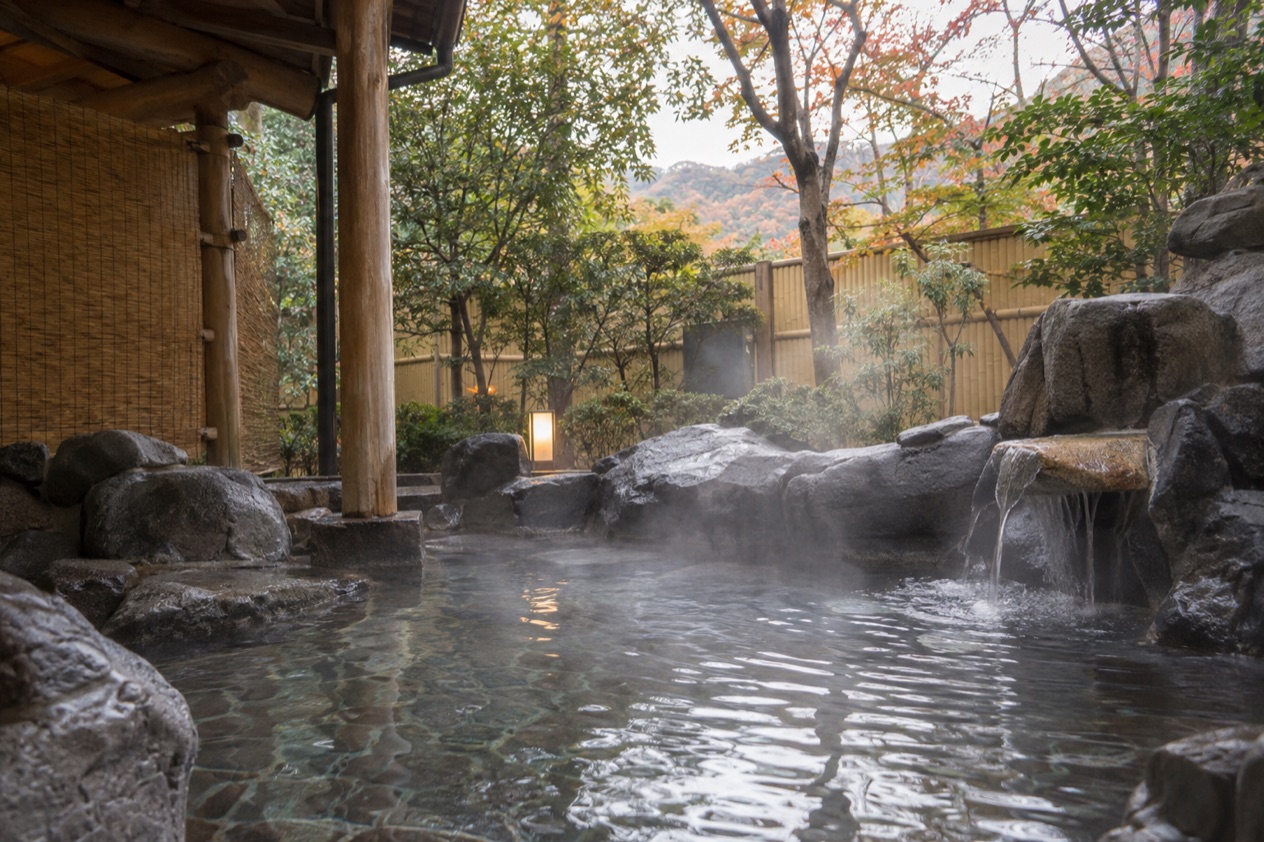
A private onsen is a hot spring bath that you use alone or with your own group, instead of sharing a gender-separated bath with other guests. Hot spring sources and the bathing facilities built around them are called onsen in Japanese, and the private version simply closes the door on everyone else. In practice you will meet it in two shapes, the family bath and the in-room bath.
Family baths (kazokuburo)
Private onsen called family baths, or kazokuburo, can be found in many locations throughout Japan. You reserve them and use them for mixed bathing, so a couple, a parent with children or a group of friends can soak together instead of splitting between the men’s and women’s sides.
Some ryokan also have reservable family baths for a group, and some of these allow bathing suits. That detail matters if nudity with your companions feels awkward, because the usual rule in public baths is that everyone bathes naked. Whether a particular family bath allows swimsuits is something the facility decides, so it is worth asking when you reserve.
Private baths in ryokan rooms
Many luxury ryokan offer private onsen in the rooms, which makes them a favorite for a romantic getaway. A ryokan is a traditional Japanese inn, and most have an onsen and build the stay around it. You soak on your own schedule, step out onto the tatami in a yukata (a light cotton robe) and fall into the rest of the evening without dressing again.
Staying in a ryokan also lets you taste local cuisine and visit tourist sites at your own pace. The bath is the center of the stay, and the meal, the futon and the slow morning all follow from it.
Why people choose private baths
Tattoos are the most common reason. Some onsen have a policy prohibiting tattoos, and by 2015 around 56% of onsen operators had banned bathers with tattoos. More onsen now allow them than before, and you may be able to enter a no-tattoo onsen if you cover the ink with a sticker or patch, but check with the facility beforehand. A private bath removes the question.
Two towns are known for many tattoo-friendly onsen that do not require guests to cover up: Kinosaki Onsen in Hyogo and Beppu Onsen in Oita. Children are another reason. Young children can accompany a parent of the opposite gender, but older children, around 5 years old or elementary school age, must use the correct side of a public bath. In a family bath the whole group stays together.
Habits that still apply in private
Even alone, the bath follows its own logic. You wash yourself and rinse off all foam before entering, because the water is reused by the next person. Swimsuits are not allowed in the baths or showers at ordinary onsen, and towels stay out of the water. It is against the rules to dip a towel in the bath, so people fold it and set it on the edge or on their head.
The water itself changes from region to region. A whiff of rotten egg and a milky white color point to sulfur in the water, which surprises first-timers and delights regulars. Electric baths, called denki-buro, run a small electric current and should be avoided by anyone with a pacemaker or heart condition.
Where can you book one?
You can book a private onsen at a ryokan or hotel with an in-room bath or a reservable family bath, and at onsen towns where family baths are offered in many locations. Japan has approximately 25,000 hot spring sources, and approximately 3,000 onsen establishments use naturally hot water from them, so the choice is wide.
Ryokan with a bath in the room
The surest way to have a private soak is to choose a ryokan whose rooms include their own onsen bath. Many luxury ryokan do, and in those the bath is part of the room, not a separate reservation. Onsen within ryokan or hotels are generally kept open 24 hours a day, or are only closed for a brief daily cleaning period, so an in-room bath lets you soak late at night or before breakfast without a schedule.
Because ryokan focus on the onsen aspect of the stay, the experience extends beyond the tub. Dinner is local cuisine, the room is tatami, and the day is paced around the bath. It suits couples especially, and anyone who wants the hot spring without negotiating rules about tattoos or nudity.
Family baths at ryokan and in onsen towns
If your room has no bath of its own, ask whether the ryokan has a reservable family bath. Some do, and some of them allow bathing suits. Onsen within ryokan or hotels are typically available only to guests, though they may offer certain hours when outsiders can purchase day passes to enter. That makes a family bath at a place you are not staying a question to put to the facility directly.
Family baths turn up in many locations across the country, so an onsen town you already plan to visit may have one. The towns of Kinosaki Onsen and Beppu Onsen are both known for tattoo-friendly baths, which makes them natural places to look if ink is your concern. Among the oldest onsen in Japan are considered to be Dogo Onsen in Ehime Prefecture, Shirahama Onsen in Wakayama Prefecture and Arima Onsen in Hyogo Prefecture, if you want your soak tied to a long history.
What to ask when you reserve
- Whether swimsuits are allowed in the family bath, since some allow them and many bathe nude.
- Whether tattoos are accepted, or whether a cover sticker or patch is enough.
- Whether the bath is natural hot spring water, and what the water is like, such as sulfur and its milky color.
- Whether children of the ages in your group can bathe with you.
Alternatives exist if a private bath is not available. Public foot baths, called ashiyu, are usually separate from the main onsen facilities and are typically free. Only your feet and lower legs go in, so you stay fully clothed. In remote areas there are also free publicly maintained onsen baths with minimal facilities but often stunning views.
What does it cost?
The cost of a private onsen depends on where you take it, and the amounts are set by each ryokan or facility, so no single price applies across Japan. What can be said is how the options differ, and where the soak costs nothing at all.
| Option | What it is |
|---|---|
| In-room onsen at a ryokan | Private bath in the guest room, found in many luxury ryokan |
| Reservable family bath | Private bath for a group, used for mixed bathing |
| Day pass at a ryokan or hotel onsen | Offered during certain hours for outsiders |
| Ashiyu (foot bath) | Foot and lower leg soak, fully clothed |
| Remote public onsen | Publicly maintained, minimal facilities |
Where the money goes
At a luxury ryokan with an in-room bath, the private onsen is built into the price of the room, which also covers the setting, the local cuisine and the traditional inn experience. You are not paying separately for the soak, you are choosing a kind of stay. That is why it suits a special occasion more than a casual stop.
A reservable family bath is a different logic, because it is booked for your group instead of for one room. Think of it as paying for the door that closes, and the facility sets how that works. Asking the ryokan or onsen directly is the only reliable way to learn the amount.
Cheaper and free ways to soak
If a private bath is beyond the budget, the day pass is a route into a ryokan or hotel onsen that is normally for guests only. Those hours are limited, and the bath will be shared, so it does not solve tattoo or nudity concerns by itself. In tattoo-friendly towns such as Kinosaki Onsen and Beppu Onsen, though, many onsen do not require guests to cover up.
The free options are worth knowing for their atmosphere. A foot bath lets you sit with your legs in hot water in your everyday clothes, and the remote public baths trade comforts for views. Neither is private in the family-bath sense, but both give you the hot spring without a bill.
Good to know before you go
Look for the hiragana ゆ or the steam emoji, and the kanji 女 and 男 on the doors of shared baths, which tell you which side is which. Bathing etiquette is about awareness and consideration of the people around you, and it applies even when the bath is yours alone.
If you have a pacemaker or a heart condition, skip the electric baths. Onsen water is hot, with the hottest Japanese spring, at Obama Onsen in Nagasaki Prefecture, reaching 221 °F, so ease in slowly wherever you are.
Sources
- Japan National Tourism Organization, wellness and onsen (https://www.japan.travel/en/guide/wellness-travel-in-japan/), checked October 11, 2026
- Japan National Tourism Organization, onsen: what it is, etiquette, famous areas (https://www.japan.travel/en/see-and-do/onsen/), checked October 11, 2026
- Wikipedia, Onsen (https://en.wikipedia.org/wiki/Onsen), checked October 11, 2026
- Wikivoyage, Onsen (https://en.wikivoyage.org/wiki/Onsen), checked October 11, 2026
To plan your stay
- Best Time to Visit Japan: Cherry Blossoms, Autumn Colors, Weather and Festivals
- Where to Stay in Japan: Ryokan, Temple Stays, Capsule Hotels and the Best Cities to Base In
- Sending Luggage from the Airport in Japan: Hands-Free Travel, Hotel Delivery and Coin Lockers
- Know Before You Go to Japan: Entry, Money, Etiquette and Getting Around