
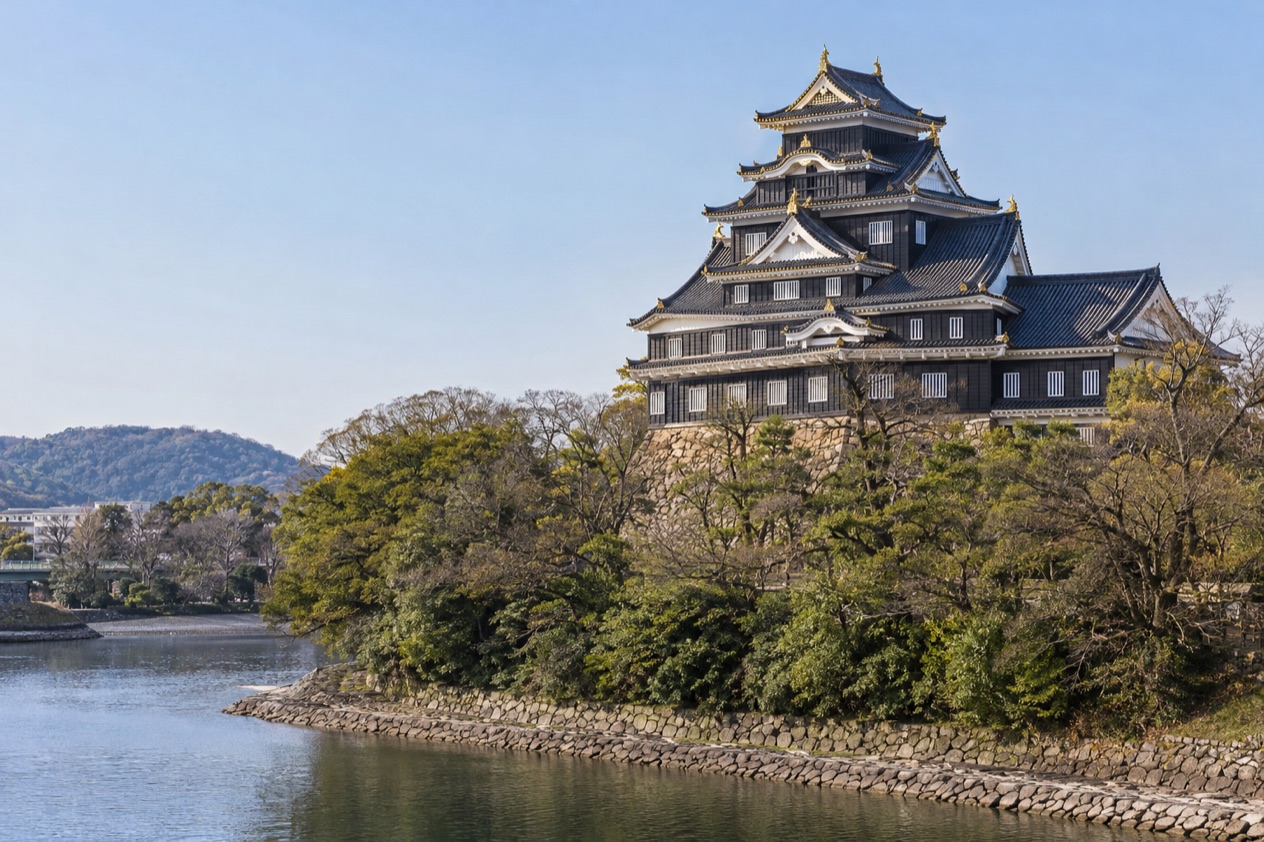
The keep of Okayama Castle is black, and it stays in the eye long before you reach the gate. Dark walls, gilded roof ornaments that catch the light and a stone base that holds the whole thing down: the castle looks like a crow settled on a wall. It is a visit built around story and contrast, an old silhouette with a modern interior, in a city that serves as a crossroads of western Japan.
Is visiting Okayama Castle worth it?
Yes, for travelers who like castles for their look and their history more than for original interiors, and for anyone passing through Okayama who wants one clear reason to step off the train. The castle is ranked among the best 100 Japanese castles, and its black exterior makes it easy to tell apart from the white keeps of other cities.
That color is the whole identity of the place. Okayama Castle is nicknamed Crow Castle, or the castle of the black bird, because of its dark walls. Before the Battle of Sekigahara the main keep also wore gilded roof tiles, which earned it the older name of Golden Crow Castle. So the castle has carried two crow nicknames, one for gold and one for black, and the story of how it went from one to the other is part of the pleasure of walking up to it.
What sets it apart from other castles you may see on a trip through western Japan is its mix of layers. Two watch towers came through the 1945 bombing and are listed as Important Cultural Properties by Japan’s Agency for Cultural Affairs. The keep itself is a reconstruction in concrete.
You get a real survivor, a rebuilt giant and a city garden that shares the same story, all in one outing. Visitors who want a hand-carved wooden interior will find something different here, while those who like clear displays, a climb by elevator and a good photo of a black keep will be happy.
What to see at Okayama Castle
The black main keep
The dark exterior gives it a heavy, graphic look against the sky, and the gilded gargoyles on the roof add a flash of gold along the ridgelines. Those ornaments were gilded in 1996 as part of the 400th anniversary celebrations, a nod to the golden roof tiles of the castle’s earlier life.
Inside, the keep is a concrete building with air-conditioning and elevators, and its floors hold displays documenting the castle’s history with a focus on the Ikeda era. Reconstruction of the keep and gate began in 1964 and was finished in 1966, which is why the interior feels like a modern museum inside an old shape. Expect exhibits about the lords who lived here and the world that surrounded them rather than a maze of original beams.
The two surviving watch towers
These are the oldest parts of the story still standing. Both watch towers came through the 1945 bombing that destroyed so much else, and today they are listed as Important Cultural Properties. They are worth a slow look because they are the survivors, small and weathered next to the big reconstructed keep.
Seeing them next to the rebuilt keep tells the castle’s history better than any display panel. One piece got through the war and the other was rebuilt later from the plan of the original. Look at the plain walls, the narrow openings and the way the towers sit along the lines of the old defenses, and you can picture how the castle once worked as a fortified home.
The inner sanctuary grounds
The grounds around the keep are where the visit opens up. The stone walls, the paths between the buildings and the angles that frame the black tower make this a pleasant place to walk and take photographs, whatever you decide about going inside. Access to the inner sanctuary is free, so a wander here fits easily around other plans in the city.
Take your time on the stone foundations. The castle’s black walls look different from every side, and the gilded ornaments are easiest to spot when you step back and let the roofline fill your view. Children tend to enjoy finding the golden details, and the open space around the keep gives everyone room to stop and look.
Korakuen Garden and the castle’s setting
The castle is part of a pairing. Korakuen Garden in Okayama is considered one of the three most beautiful traditional gardens in Japan, and it belongs to the same story of lords, landscape and city life that the castle tells. Travelers treat the two as one outing, the castle for its black silhouette and the garden for its lawns, ponds and carefully arranged views.
Even if you only have time for the castle, the garden is why Okayama appears on so many routes through the region. Seeing both gives you the fortress and the pleasure ground of the same city, a contrast of defense and leisure that is a common thread in Japanese castle towns.
How to get to Okayama Castle
The city is the capital and largest city of Okayama Prefecture, on the coast of the Seto Inland Sea facing Shikoku Island to the south. Visitors arrive by Shinkansen or by air, and the castle is in the city itself.
By Shinkansen from Tokyo
Nozomi trains leave Tokyo at 20-minute intervals between 6:00 and 20:30, and they reach Okayama in as little as 3 hr 13 min. That makes Okayama a realistic stop for a day on a route west, or a base for the castle, the garden and the wider prefecture.
From the station you continue into the city to the castle. Plan the rest of your day around the keep and the grounds, and pair them with the garden if you have time, since both belong to the same part of the city’s story.
By air to Okayama Momotaro Airport
Okayama Momotaro Airport offers flights to and from Tokyo (Haneda), Sapporo and Okinawa. It also has direct international flights to Hong Kong, Seoul, Shanghai, Kaohsiung and Taipei. For travelers combining Okayama with another part of Japan or with a trip elsewhere in East Asia, the airport is a useful way into the region.
From the airport, the city is your next stop, and from the city the castle is part of an easy day. Travelers arriving by plane can fit the keep and the grounds into a first afternoon or a last morning before they fly out.
When to visit Okayama Castle
The black keep rewards a visit in any season, because its look depends on the light and the sky around it more than on any one date. On a bright day the dark walls and gilded roof ornaments stand out sharply against blue, and under gray cloud the castle takes on a moodier, heavier look that suits its crow nickname.
Spring and autumn bring the colors that people travel in Japan for, and the castle grounds and the neighboring Korakuen Garden share in the change of seasons. Summer is the time when the keep’s air-conditioning is welcome, a small but real comfort for anyone climbing through the floors on a warm day. Winter strips the scene back to its shapes, and the black keep reads even more strongly against pale skies.
Plan the visit around your own pace rather than a perfect hour. The grounds can be enjoyed on their own, and the interior is climate-controlled with elevators, so a rainy day does not ruin the outing. If a day turns wet, the displays on the Ikeda era give you plenty to take in while you wait for the weather to ease, and the grounds are better for a walk once the rain stops.
Travelers fit Okayama in as a stop between larger destinations, so the real question is often which half of the day you have free. Treat the castle and the garden as a single outing and give yourself room to stroll between them rather than rushing from one to the other.
Tips for your visit
Read up a little before you go. Little information at Okayama Castle is available in English, so the displays on the Ikeda era will mean more if you arrive already knowing the broad outline: the black walls, the golden past, the wartime loss and the rebuilding in the 1960s. With that in mind, the exhibits become a series of details rather than a puzzle.
Bring a camera and a little patience for angles. The black keep is the star, and the gilded gargoyles on the roof are easiest to appreciate when you can see them clearly from the grounds. The watch towers repay a close look too, since they are the survivors of the wartime bombing and the oldest pieces of the site.
Combining the castle with the garden
The natural partner for the castle is Korakuen Garden, known as one of the top three traditional gardens in Japan. The castle gives you the fortress and its story, and the garden gives you a slower, greener companion for the rest of the day.
If you are building a longer route, Okayama also works as a base because it is a hub for western Japan and sits on the Seto Inland Sea facing Shikoku. The castle is the quick introduction to the city, and the rest of the prefecture opens up from there.
Families and mobility
The keep has elevators, which helps anyone who prefers not to climb stairs through the floors, and its air-conditioning makes the interior comfortable in warm weather. Children can look for the gilded roof ornaments and the black walls that give the castle its crow nickname, which is a simple game that keeps a visit lively.
Keep in mind that the interior is a modern museum inside a rebuilt shape, so the experience is more about stories and views than about exploring old wooden rooms.
Good to know before you go
Okayama Castle is a calm, easy-to-fit stop within a larger itinerary, and the main practical point is that English explanations are limited, so a little reading beforehand goes a long way. Typhoon season and the rainy season can bring wet days to western Japan, and the keep’s interior with its air-conditioning and elevators gives you a dry place to spend part of the visit.
| Fee | Amount | Who pays |
|---|---|---|
| Inner sanctuary access | Free | All visitors |
Sources
- Wikipedia, Okayama Castle (https://en.wikipedia.org/wiki/Okayama_Castle), checked October 11, 2026
- Japan National Tourism Organization, Okayama (https://www.japan.travel/en/destinations/chugoku/okayama/okayama-and-around/), checked October 11, 2026
- Wikivoyage, Okayama (https://en.wikivoyage.org/wiki/Okayama), checked October 11, 2026
To plan your stay
- Best Time to Visit Japan: Cherry Blossoms, Autumn Colors, Weather and Festivals
- Where to Stay in Japan: Ryokan, Temple Stays, Capsule Hotels and the Best Cities to Base In
- Sending Luggage from the Airport in Japan: Hands-Free Travel, Hotel Delivery and Coin Lockers
- Know Before You Go to Japan: Entry, Money, Etiquette and Getting Around