
ST. AUGUSTINE · FLORIDA · THE SAFETY FILE
The hazards people pack for in a Spanish-founded beach town and the ones that send a trip sideways are rarely the same list. The Atlantic does most of the work here: it decides which flag flies on the sand, it sets the surf on a beach morning, and for six months a year it fills a calendar with names. The walking, the evenings and the fort queues behave like any small coastal town in Florida.
Two of Florida’s eleven National Park Service units stand in this one place, Castillo de San Marcos and Fort Matanzas, and both publish rules that double as safety rules: last admission at the Castillo is 5:00 p.m. and everyone exits at 5:15, and the Matanzas ferry needs a free boarding pass per person, whatever their age. The risks worth planning around in St. Augustine are written down, dated and free to read.
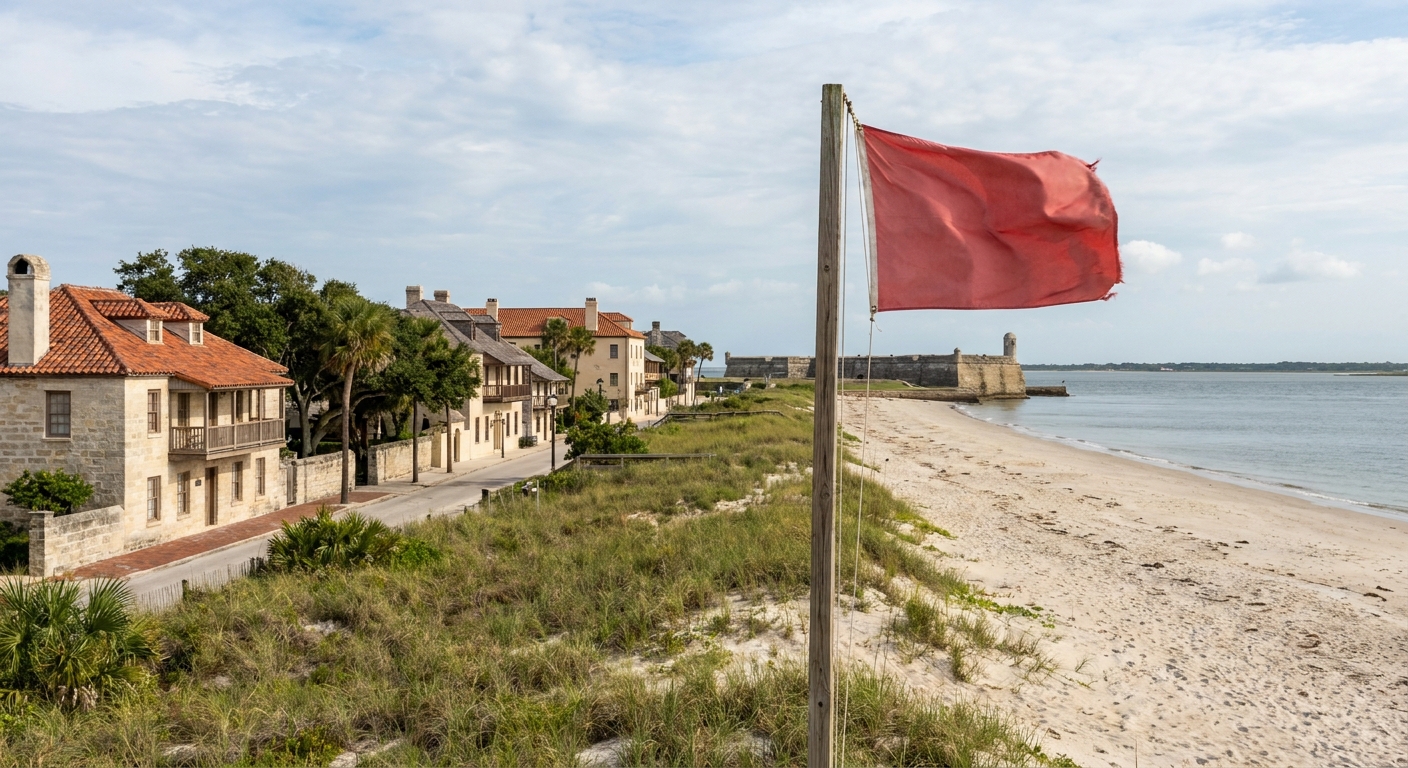
THE SAFETY FILE · ST. AUGUSTINE
The water, the weather season and the road are the real hazards here, and all three are published in advance: read the flag on the sand, the NOAA season dates, and the posted closing times before you build a day around them.
HURRICANE SEASON JUN 1 – NOV 30 · PEAK SEPT 10 · NO LAW REQUIRES A BEACH FLAG · EASTERN TIME
Go for: a coast where the dangerous parts are legible in advance, from the flag colors set out in state statute to a hurricane calendar with a published peak date.
Think twice before: swimming off an unstaffed stretch with a bare pole. No Florida law compels a beach to fly any flag, so a missing flag is missing information.
Flags: Fla. Stat. s. 380.276 · Access: s. 163.035 · Season: NOAA · Time: 49 CFR 71.5(f)
On this page
- Is St. Augustine safe?The sea, the weather season, the road
- Beach warning flag colors in FloridaDouble red, red, yellow, green, purple
- Private dry sand and public beach accessStatute 163.035 and the high-water line
- Hurricane season dates for St. AugustineJune 1 to November 30, peak Sept 10
- What time zone is St. Augustine in?Eastern, by the Apalachicola line
- Safety rules that apply across FloridaThe statewide safety guide
Every climate figure here comes from NOAA’s 1991-2020 normals at station USW00013889, Jacksonville International Airport, the nearest long-record station, and not from a gauge on the seawall. Sea-surface averages are drawn from a 2015-2024 marine model as means of daily maxima, so they read a shade warm against a full 24-hour average. Month-level detail sits in the best time to visit.
Is St. Augustine safe?
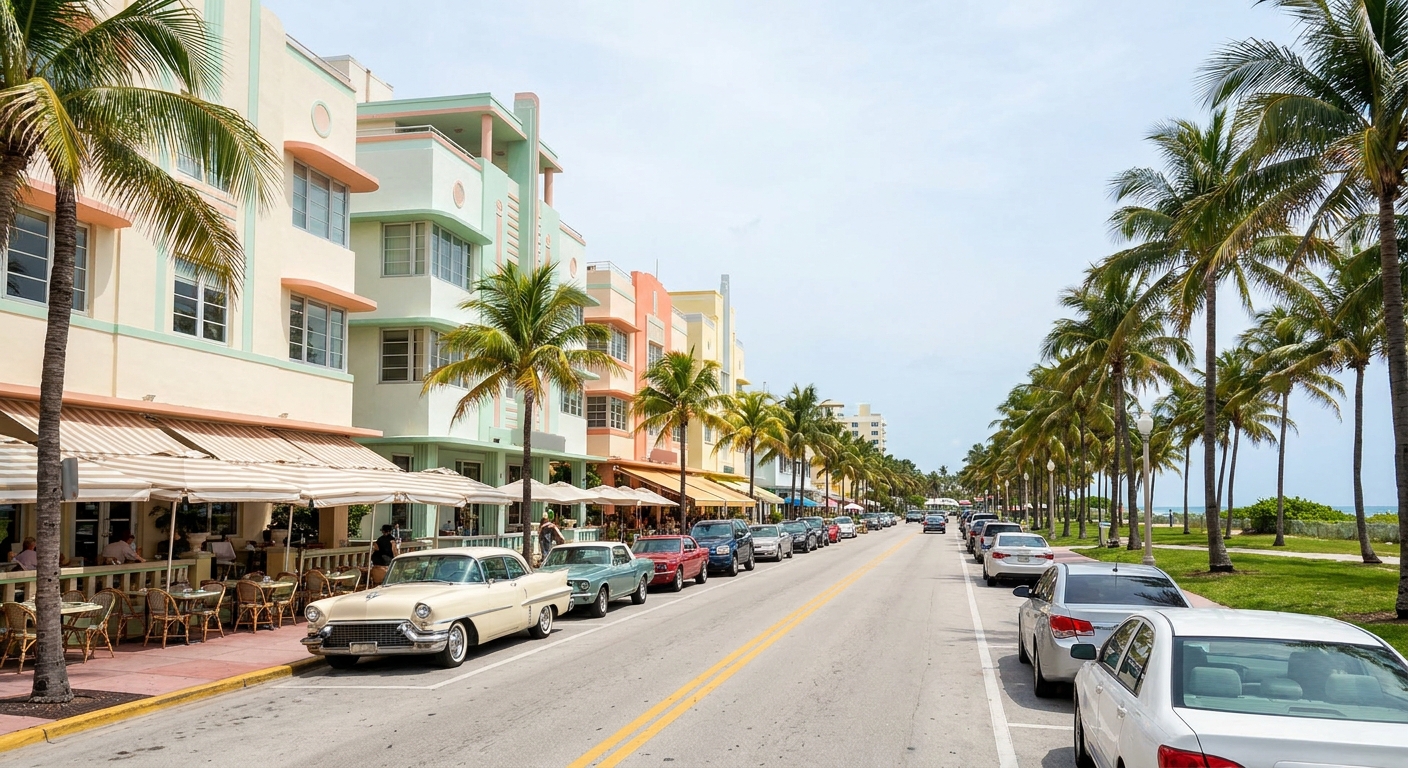
Frankly, the ruined days on this coast cluster around water, weather and traffic. Surf that looks flat from the dune line still moves. July normals run to a 91.9°F average high with 6.77 inches of rain over the month, which is a heat-and-thunder combination that shortens outdoor plans. Beach parking and A1A do the rest. None of it asks for nerve. It asks that you read the flag before you swim and the forecast before you commit a non-refundable week.
You will not find a crime figure here. No local data on it has been verified for these pages, so no number is printed, and a reassuring number pulled from nowhere would be worse than the silence. The same reserve covers lodging: no hotel, room rate or restaurant in town has been checked, so none is named. For street-level detail on a specific block, ask your front desk and the St. Johns County sheriff’s office once you arrive.
Rules that run the length of the state, from rental cars to alligators to the emergency line, belong to the Florida safety guide and are not repeated here. What follows the state’s lead but changes locally is the flag on St. Johns County sand, the customary use statute above the tide line, the Atlantic season and the clock. In any emergency, the statewide number is the first call, before the hotel and before the app.
Beach warning flags in Florida
Florida uses one flag vocabulary from Pensacola to here. Green is low hazard, and it still carries the words exercise caution. Yellow is medium hazard. Red is high hazard. The colors sit in Florida Statutes s. 380.276 and are the same ones county beach safety programs raise every morning.
Double red has a single meaning: the water is closed. It is not a strong version of red and not a matter of confidence in your swimming. Two red flags on one pole take the ocean off the menu for the day, and the beach itself stays open around it.
Purple is the color travelers misread. It says nothing about current, surf or closure. Purple marks dangerous marine life, and it flies alongside another flag rather than replacing it, so purple over green is a real and consistent pairing: calm water, something in it worth knowing about.
Flags appear where a county beach safety program staffs the sand, and that coverage is not continuous along the coast. No Florida law obliges any beach to fly one. An empty pole on a quiet access point tells you nothing about the water that morning, which is the argument for choosing a staffed stretch on your first day and saving the lonely ones for later in the trip.
Beach access in Florida: what the customary use law says
Florida Statutes s. 163.035(2) bars a local government from adopting or keeping a rule based on customary use of any beach above the mean high-water line without a judicial declaration first. Below that line, the wet sand is public. Above it, dry sand can be private property, and the distinction is a legal one rather than a matter of local habit.
Walking the wet strip at low tide is public passage the whole way. Setting up a chair, a cooler or an umbrella on the dry sand behind it may not be, and a posted sign up there can carry weight. The practical wrinkle is the tide: the line moves, so the public corridor narrows as the water rises and a comfortable morning perch can end the afternoon on someone’s property.
Hurricane season in St. Augustine
The Atlantic hurricane season runs June 1 to November 30 and peaks on September 10, with most activity falling between mid-August and mid-October. On the other side of the calendar, the statewide dry season covers November through April. Those dates apply to the whole basin, not to one town, and they describe likelihood rather than any particular week.
Sitting on the ocean side changes what a distant system does to a beach plan. Surf and flags can shift days ahead of anything approaching land, which is the version of the season most visitors meet. Fort Matanzas is on the water too: its ferry service year runs October 1 to September 30, the daily departure times could not be read at the source, and the free boarding pass is issued at the Fort Matanzas Visitor Center rather than the city one.
A September trip is not a canceled trip. It simply lands inside the busiest stretch, so book refundable, keep an indoor half to each day ready, and treat the beach as the movable part. The Castillo takes its last admission at 5:00 p.m. and clears the fort at 5:15, adults 16 and over pay $15.00 for seven consecutive days, and under-16s enter free with an adult. Compare months in the Florida calendar.
For the official picture, watches and warnings come from NOAA’s National Hurricane Center. Closures at the two federal sites are posted by the National Park Service on their own pages, which is also where a suspended ferry would show up. Evacuation zones and local orders come from St. Johns County. Those three sources, in that order, outrank any rebooking hotline.
No page can tell you whether your specific week gets a storm. The shape of the season is known months out. Its content is decided about five days ahead, which is why refundable bookings between mid-August and mid-October are worth more than any long-range outlook you will read in June.
Is St. Augustine on Eastern time?
Yes. St. Augustine runs on Eastern time, and the boundary that decides it in Florida is the Apalachicola River, written into 49 CFR 71.5(f). Everything east of that river, this town included, shares a clock with Orlando, Tampa and Miami.
The question comes up because Florida is cut in two: the western Panhandle keeps Central time, so a drive in from that direction hands you an hour on arrival. It matters whenever a plan ends at a posted time. Last admission at the Castillo is 5:00 p.m. with exit at 5:15, and the St. Augustine Lighthouse sells its last ticket at 5:30 p.m. from October 1 to February 28 and at 6:00 p.m. from March 1 to September 30. All of those are Eastern.
Sources & data for this guide
- Beach warning flag colors, and the absence of any legal duty to fly them · Florida Statutes s. 380.276 and Volusia County Beach Safety · checked Sep 10, 2026
- Customary use and the mean high-water line · Florida Statutes s. 163.035(2) · checked Sep 10, 2026
- Hurricane season dates, September 10 peak, mid-August to mid-October activity, statewide dry season · NOAA · checked Sept 6 and 7, 2026
- Eastern time and the Apalachicola River boundary · 49 CFR 71.5(f) · checked Sep 10, 2026
- Castillo de San Marcos hours and fees · National Park Service · checked Sep 10, 2026
- Fort Matanzas free entry, boarding pass location and ferry service year · National Park Service · checked Sep 10, 2026
- Lighthouse hours and last ticket times · St. Augustine Lighthouse & Maritime Museum · checked Sep 10, 2026
- January and July normals · NOAA NCEI 1991-2020, station USW00013889, Jacksonville International Airport · checked Sep 10, 2026
- Reserves we are keeping: the Fort Matanzas ferry departure times and the lighthouse general admission price could not be read at their sources, so neither appears here. Ask the Fort Matanzas Visitor Center and the lighthouse ticket desk.
- No local crime data, hotel, room rate or restaurant has been verified for this page, so none is named. Flag colors and statutes change · confirm with the county and the operators when you book.