
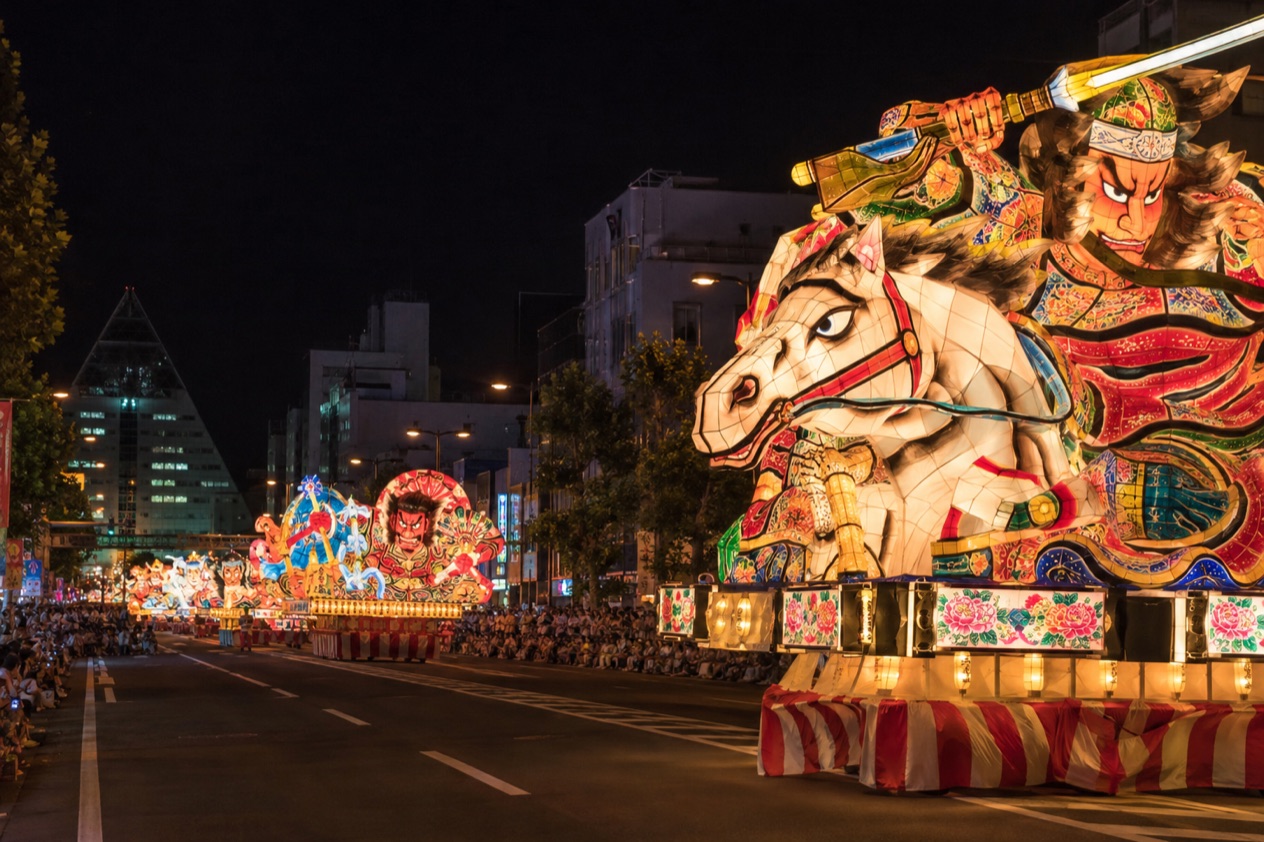
A drumbeat arrives before the light does. Then a float the size of a house turns the corner, glowing from the inside, a painted warrior with a fierce face and flowing robes, while dancers in bell-trimmed costumes leap around it shouting “rasse, rasse.” This is the Aomori Nebuta Matsuri, the summer festival at the northern tip of Honshu. It is a night-time visit built around standing at the curb, watching, and, if you want, joining the dance.
Is visiting the Nebuta Festival worth it?
Yes, if you like your festivals loud, bright and physical, and it suits travelers who would rather feel a parade than read about it. The floats are enormous lanterns, the drums are in your chest, and nobody expects you to stay a spectator: anyone, tourists included, can dance in the processions as a haneto, as long as the proper costume is worn.
What sets it apart from other summer festivals in the region is the mix of scale and participation. Elsewhere in Aomori Prefecture, the Hirosaki Cherry Blossom Festival is about trees, quiet walks and petals. Nebuta is about noise, paper, light and dancing in the street. Japan has recognized this: the festival was designated an Important Intangible Folk Cultural Property in 1980, and the sound of it, the flutes, drums and shouts, was named one of the 100 Soundscapes of Japan by the Ministry of the Environment in 1996.
It also ends in a way few festivals do. On the last night the float is carried into the sea while fireworks go off, a farewell that turns a city parade into something closer to a send-off. If your idea of Japan includes lanterns, taiko drums and a crowd that is part of the show, this is one of the clearest places to find it.
What to see at the Nebuta Festival
The Nebuta floats
The floats are the reason to come. Each is a wire frame covered in paper, painted in bold black outlines and saturated reds, blues and golds, and lit from within so the whole figure glows against the night. The subjects are warriors, heroes and figures from legend and kabuki, caught in mid-action with raised swords, bared teeth and swirling clothes.
Look at the details as each one passes: the expressions, the way the painted lines carry the light, the small figures tucked into the design. The floats are carried through the city in the evening during the first part of the festival, which is when the paper looks most alive. Walking alongside a float, you notice how much it sways with the people carrying it.
The haneto dancers
Around every float, haneto dancers hop, spin and chant. Their costume is a flowered cotton outfit hung with small bells and topped with a flower-decked hat, and the dance is a series of springing steps timed to the flutes and drums. The chant of “rasse, rasse” rises and falls in waves along the route.
Visitors can take part. Haneto costumes can be rented at some places along the processional route in Aomori City, and the proper costume is what allows you to join any of the processions. Even if you stay on the sidelines, watching the dancers is half the pleasure, since each group has its own rhythm and its own energy.
The final day: daytime parade, fireworks and the sea
The last day changes the pattern. Instead of the evening, the float is carried during the daytime, so you see the colors and the paper in full light, and the faces look different without the glow. Then, in the evening, a fireworks show is held while the float is carried into the sea.
This is the emotional close of the festival. The drums, the dancers and the lights all gather at the water, and the fireworks go up over Mutsu Bay, on which the city sits. It is a good moment to stand a little back and take in the whole scene.
The Nebuta Museum Wa Rasse
If you are not in Aomori during the festival, or you want a closer look at how the floats are made, the Nebuta Museum Wa Rasse opened in 2011 and offers an experience of the festival all year round. Its name borrows the dancers’ shout, a hint at its aim: to let you feel the festival, not just look at it.
Seen up close and in daylight, the construction becomes clear: the frame, the paper skin, the brushwork. It is a useful complement to the street experience, because at night on the route you see the effect and here you see the craft behind it.
Hours, tickets and rules
The processions are street events, with the floats carried in the evening for most of the festival and in the daytime on the final day. The fireworks belong to the last evening, alongside the float’s journey into the sea. The Nebuta Museum Wa Rasse welcomes visitors all year round, and the Aomori Gyosai Center, a stop for a morning visit, keeps its own hours and a weekly closing day.
| Site | Open |
|---|---|
| Nebuta processions | Evenings, August 2 to 6; daytime, August 7 |
| Final-night fireworks and float carried into the sea | Evening, August 7 |
| Nebuta Museum Wa Rasse | All year round |
| Aomori Gyosai Center | 07:00 to 16:00, closed Tuesdays |
The one rule stated for taking part is about costume: anyone, tourists included, may dance in any of the processions as a haneto, as long as they wear the proper costume, which can be rented at some places along the route in Aomori City. Beyond that, the festival is a gathering in the streets, and the best approach is to watch how the crowd and the dancers behave and follow their lead.
When to visit the Nebuta Festival
The festival is held every year in the first week of August, from the 2nd to the 7th. That makes it a high-summer event, and the whole calendar of your trip to northern Honshu can be built around it. Most of the run is an evening affair, with the floats carried through the city after dark, and this is when the lanterns are most dramatic.
The last day is different and worth planning for on its own terms. The float is carried in the daytime, and then, in the evening, the fireworks show begins while the float is carried into the sea. If you want to see the floats in plain daylight and also the sea farewell, the final day gives you both in one go.
Outside the festival dates, the street parade is not there, but the city does not go dark on the subject. The Nebuta Museum Wa Rasse keeps the festival on show all year round, so a visit in another season still lets you stand beside the floats. Aomori and its surroundings are known for having the heaviest snowfall in the world, which makes the museum a warm and colorful stop on a winter trip.
Nebuta floats also travel. They have been invited every year to Shibuya in Tokyo, where a festival has taken place annually in September since 2005. It is a taste of the spectacle if you cannot reach Aomori in early August, though the setting, the sea and the final night belong to Aomori.
Tips for your visit
Aomori sits at the northern tip of Honshu, on Mutsu Bay, and the JR Tohoku Shinkansen runs regular services from Tokyo to Shin-Aomori. The bus company Konan operates several daytime and overnight services between Ueno Station in Tokyo and Aomori Station. Both routes put you in the festival city, so you can choose by the kind of trip you like.
Think about whether you want to dance. If so, rent a haneto costume at one of the places along the processional route, and plan to be in it with the group when the floats pass. If not, pick a spot along the route and let the floats come to you. Either way, bring a camera for the colors, but keep an eye on the dancers, who move quickly around the floats.
Combine the evenings with daytime visits. The Nebuta Museum Wa Rasse is a good way to understand how the floats are built, and the Aomori Gyosai Center is a morning stop, open from early in the day and closed on Tuesdays. Between them and the processions, a day in Aomori has a natural rhythm: craft and food by day, light and drums after dark.
If you are building a longer trip in the region, Hirosaki, also in Aomori Prefecture, is known for its cherry blossoms, with 2,600 trees, some over 300 years old. It makes a contrast of seasons and moods more than a summer pairing, but it shows how varied the prefecture’s festivals are. Other Japanese festivals, such as Sapporo’s snow festival in early February, follow their own calendars.
Good to know before you go
Nebuta is a festival of the street, so plan for standing, walking and a lot of sound. Dancing in costume is physical, and the drums and chanting carry far down the route. The memory most visitors take home is the sight of a lit float in the dark, the dancers around it, and the fireworks at the sea on the last night.
Sources
- Japan National Tourism Organization, festivals and events (https://www.japan.travel/en/see-and-do/festivals-and-events/), checked October 11, 2026
- Wikipedia, Nebuta (https://en.wikipedia.org/wiki/Nebuta), checked October 11, 2026
- Japan National Tourism Organization, Aomori (https://www.japan.travel/en/destinations/tohoku/aomori/aomori-city-and-around/), checked October 11, 2026
- Wikipedia, Aomori (city) (https://en.wikipedia.org/wiki/Aomori_(city)), checked October 11, 2026
- Wikivoyage, Aomori (https://en.wikivoyage.org/wiki/Aomori), checked October 11, 2026
To plan your stay
- Best Time to Visit Japan: Cherry Blossoms, Autumn Colors, Weather and Festivals
- Where to Stay in Japan: Ryokan, Temple Stays, Capsule Hotels and the Best Cities to Base In
- Sending Luggage from the Airport in Japan: Hands-Free Travel, Hotel Delivery and Coin Lockers
- Know Before You Go to Japan: Entry, Money, Etiquette and Getting Around