
The question usually arrives at a laptop late in the evening, when two fares to Tokyo sit side by side and the only difference is a three-letter code at the end. One is HND, the airport that belongs to Tokyo city.
The other is NRT, out in Chiba. Haneda puts you in the capital itself, while Narita is the airport for specific airlines, routes and late-night plans, and the right pick depends on what you fly and where you go next.
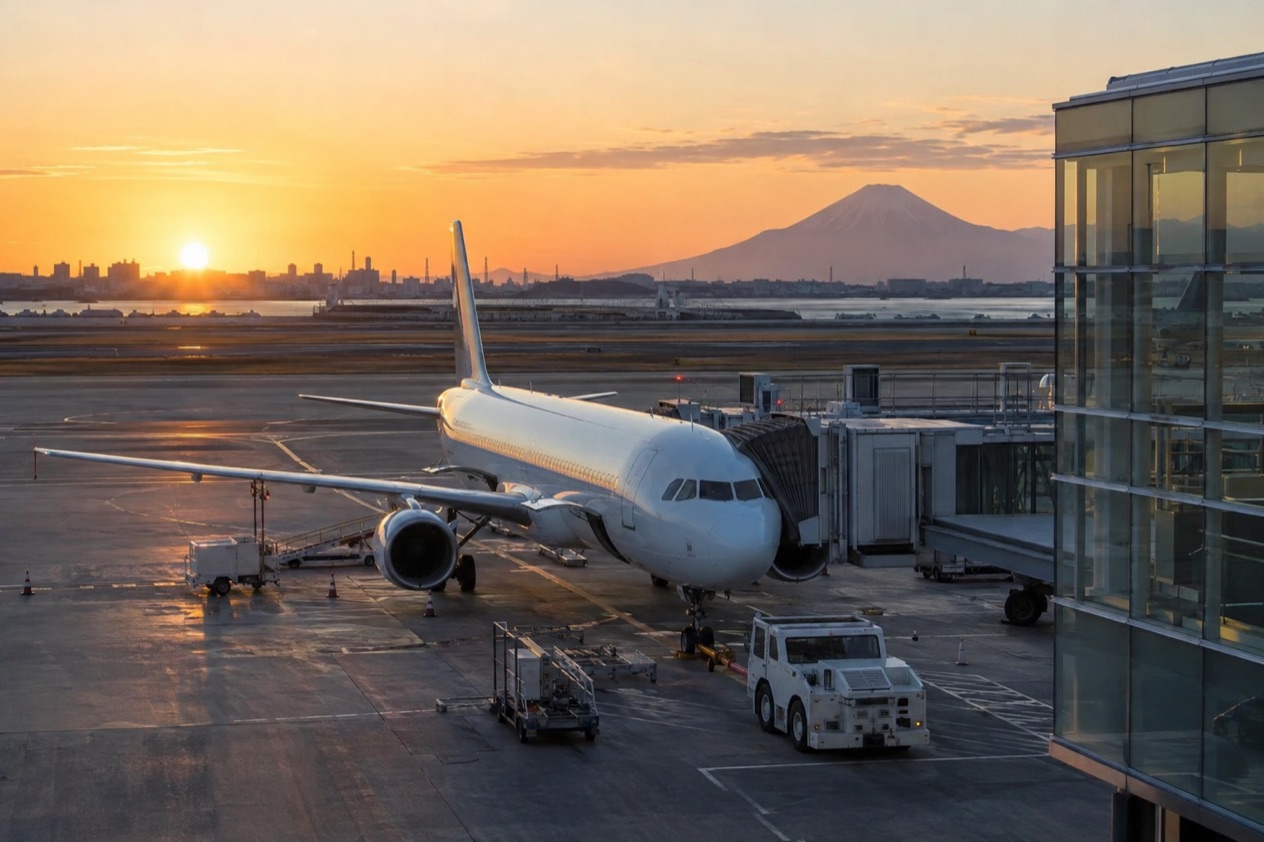
How do Narita and Haneda differ?
They differ in where they sit, which airlines fly there and how each terminal is organized. Haneda is the airport of Tokyo city, and international flights now land there directly in the heart of Tokyo. Narita serves international and domestic destinations as one of the two airports of the capital, and it works on a larger, more spread-out scale.
Narita is a big airport with a main runway of 13,000 feet, among the longest in Japan, and it is still expanding. Haneda is built around three passenger terminals with jet bridges at every gate. Both airports are linked to their cities by express trains, buses and taxis, and both generally have car rental services.
Terminals at Narita
Narita has three terminals, and each has its own character. Terminal 1 and Terminal 2 are the large traditional buildings, and between them they hold most of the gates. Terminal 3 was built for low-cost carriers, and it has a 24-hour food court, the largest airport food court in Japan.
The reason for Terminal 3 is cost. Using it cuts facility costs by around 40% on international flights, and by around 15% on domestic ones, which is why budget airlines gather there. Skytrax voted it the best terminal for low-cost airlines in Asia in 2024. Check which terminal your airline uses before you plan the morning of your flight, because the buildings are separate.
Terminals at Haneda
Haneda has three passenger terminals, and the split is practical. Terminal 2 is where All Nippon Airways, Air Do and Solaseed Air operate their domestic flights, so a traveler connecting to Sapporo or Kagoshima often passes through it. Terminal 3 and the international area of Terminal 2 handle the flights from overseas.
Moving between buildings is simple on the landside. An underground walkway connects Terminals 1 and 2, and a free inter-terminal shuttle bus links all the terminals. If you land in one and your onward flight leaves from another, you have a walk or a bus ride rather than a trip out of the airport.
Gates and opening hours
| Airport and terminal | Open |
|---|---|
| Narita Terminal 1 | Not tied to a closing time; aircraft operations stop from midnight to 6 a.m. |
| Narita Terminal 2 | Not tied to a closing time; aircraft operations stop from midnight to 6 a.m. |
| Haneda Terminal 1 | 5:00 am to 12:00 am |
| Haneda Terminal 2 (domestic area) | 5:00 am to 12:00 am |
| Haneda Terminal 2 (international area) | 24 hours |
| Haneda Terminal 3 | 24 hours |
The difference in the last column matters at night. Narita has a mandatory curfew that prohibits aircraft operations between those hours. Haneda keeps its Terminal 3 and the international area of Terminal 2 open around the clock, while its Terminal 1 and the domestic area of Terminal 2 close for a short stretch after midnight.
Which is closer to central Tokyo?
Haneda is closer, because it is the airport of Tokyo city itself. Narita lies approximately 37 miles east of central Tokyo, in the town of Narita in Chiba. The two airports therefore feel different the moment you land: one drops you into the city, the other starts the trip with a ride across the Kanto plain.
Arriving at Haneda
International flights now reach Haneda directly, and that is the heart of its appeal: you arrive in Tokyo rather than near it.
For a traveler staying in the city, this changes the shape of the first day. A late arrival also fits, since the international areas of Haneda stay open at all hours.
Arriving at Narita
Narita sits in Chiba, so the way into Tokyo is a real journey, and you plan it as one. Express trains, buses and taxis all connect the airport to the capital, and car rental is generally available. The ride gives you a first look at the countryside and suburbs east of the city before the towers appear.
The distance suits some trips better than others. If your plans start outside central Tokyo, or if you are connecting to another flight inside Japan, the position matters less. If you are heading to a hotel in the city after a long flight, expect the trip in from Chiba to be a separate stage of the day.
Other airports for other trips
Tokyo is not the only gateway. Kansai International Airport makes it possible to visit Japan without going through Tokyo at all, and Nagoya’s Central Japan International Airport, known as Centrair, is a hub for flights to and from cities in Asia and Japan. If your trip is built around Osaka, Kyoto or the Alps, these airports belong in the comparison.
Elsewhere, the pattern repeats. Fukuoka Airport lets you reach Hakata, in the heart of Fukuoka, by train in five minutes after collecting your baggage. Most domestic flights from the main island to Hokkaido land at Chitose Airport in southern Hokkaido, and Okinawa can be reached only by air from the major Japanese cities.
Which one should you choose?
Choose Haneda if you want to land in Tokyo itself or connect to many cities in Japan, and choose Narita if your airline, your fare or your onward flight points there. In practice the airline often decides for you, so start with where your carrier lands and work backward to the hotel.
Flying from the United States
Both airports have nonstop service from American cities, and the lists differ. From Haneda, Delta flies to Atlanta, Detroit, Honolulu, Los Angeles, Minneapolis/St. Paul and Seattle/Tacoma. American flies to Dallas/Fort Worth, Los Angeles and New York–JFK, and United flies to Chicago–O’Hare, Guam, Los Angeles, Newark, San Francisco and Washington–Dulles.
From Narita, All Nippon Airways flies nonstop to Chicago–O’Hare, Honolulu, Los Angeles and San Francisco, with seasonal service to Vancouver. Zipair Tokyo flies to Honolulu, Houston–Intercontinental, Los Angeles, San Francisco and San Jose, with charter flights to Orlando. The routes listed here include Houston and San Jose service to Narita, and Atlanta and Detroit service to Haneda.
Connecting to other cities in Japan
Haneda is a domestic hub. Air Do serves Asahikawa, Hakodate, Kushiro, Memanbetsu, Obihiro and Sapporo–Chitose. Skymark Airlines flies to Fukuoka, Kagoshima, Kobe, Naha, Sapporo–Chitose and Shimojishima. Solaseed Air serves Kagoshima, Kumamoto, Miyazaki, Nagasaki, Naha and Oita, and StarFlyer flies to Fukuoka, Kitakyushu, Osaka–Kansai and Ube.
Narita has a domestic network too, and it leans toward low-cost carriers. All Nippon Airways flies to Nagoya–Centrair, Osaka–Itami and Sapporo–Chitose, and Japan Airlines flies to Nagoya–Centrair and Osaka–Itami. Spring Japan flies to Hakodate, Hiroshima and Sapporo–Chitose, which is a useful list if Hiroshima is your next stop.
Narita offers low-cost domestic links, including Jetstar Japan and Peach flights to destinations across Japan. Peach flies to Amami Oshima, Fukuoka, Ishigaki, Kagoshima, Kushiro, Miyazaki, Nagasaki, Naha, Oita, Osaka–Kansai and Sapporo–Chitose. For islands such as Ishigaki and Amami Oshima, that list is the reason to look at Narita.
Late arrivals, early starts and a quick rule
Think about the clock. Narita does not allow aircraft operations from midnight to 6 a.m., so a plan that depends on the small hours does not belong there.
A simple rule covers most trips. Pick Haneda when the priority is arriving in Tokyo, staying within the city or joining a domestic flight across a wide choice of destinations. Pick Narita when your nonstop from the States, your low-cost flight to Naha or Ishigaki, or your fare points there.
Good to know before you go
Whichever airport you choose, you are not locked into Tokyo for the whole trip. Most Japanese prefectures have at least one airport, and low-cost carriers make it possible to reach almost anywhere in the country at a reasonable price.
A flight into one airport and out of another, such as Haneda in and Kansai out, is a way to avoid backtracking. Airports in major Japanese cities are served by express trains, buses and taxis.
Sources
- Japan National Tourism Organization, how to reach the city from each international airport (https://www.japan.travel/en/plan/airport-access/), checked October 11, 2026
- Wikipedia, Haneda Airport, airlines and destinations (https://en.wikipedia.org/wiki/Tokyo_International_Airport#Airlines_and_destinations), checked October 11, 2026
- Wikipedia, Narita International Airport, airlines and destinations (https://en.wikipedia.org/wiki/Narita_International_Airport#Airlines_and_destinations), checked October 11, 2026
- Wikipedia, Tokyo International Airport (https://en.wikipedia.org/wiki/Tokyo_International_Airport), checked October 11, 2026
To plan your stay
- Best Time to Visit Japan: Cherry Blossoms, Autumn Colors, Weather and Festivals
- Things to Do in Japan: Kyoto Temples, Onsen, Street Food and Day Trips
- Where to Stay in Japan: Ryokan, Temple Stays, Capsule Hotels and the Best Cities to Base In
- Sending Luggage from the Airport in Japan: Hands-Free Travel, Hotel Delivery and Coin Lockers