
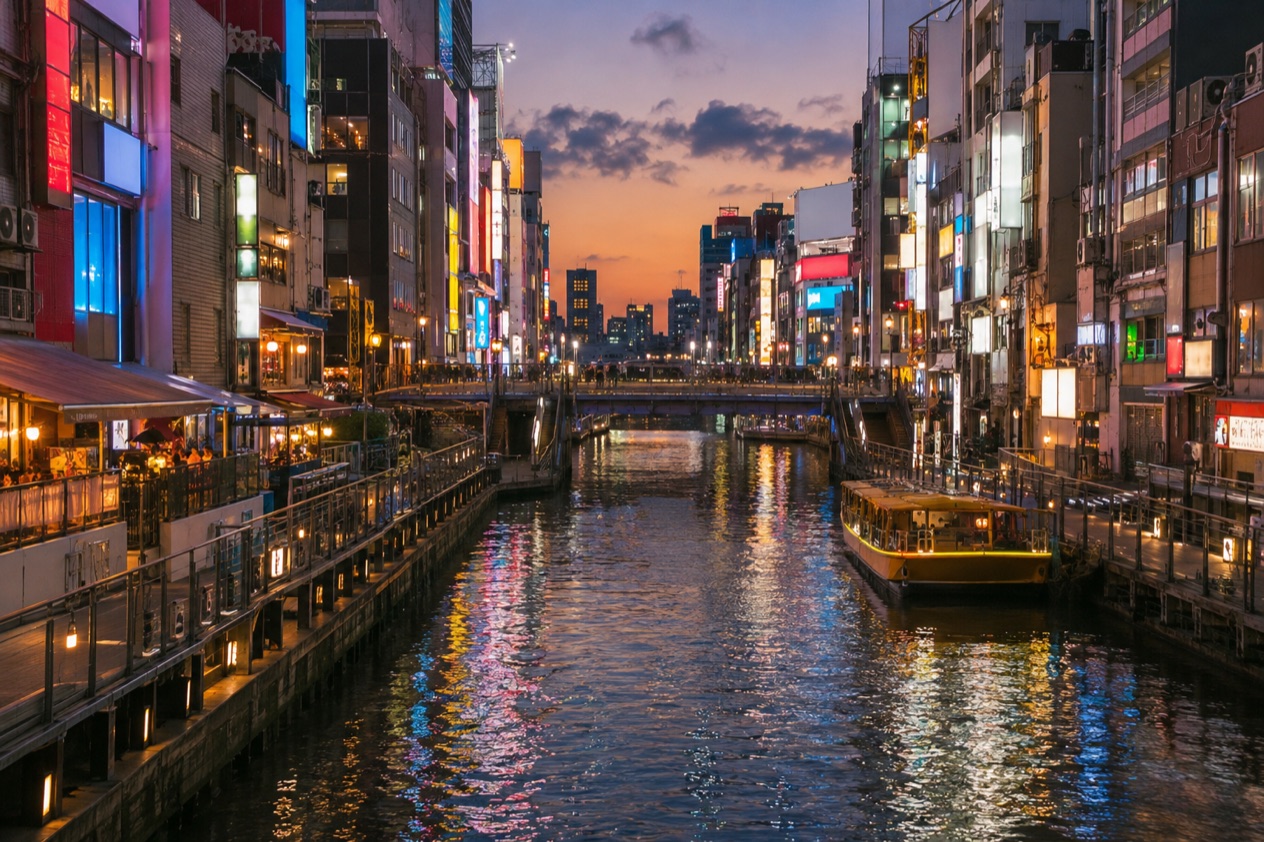
Steam rises off a tray of takoyaki, the octopus batter balls flipped by hand on a griddle, while the lit signs along the Dotonbori canal flash over the crowd. Someone is photographing the running man above the water, someone else is deciding between a kushikatsu counter and an okonomiyaki grill. Namba is the part of Osaka where eating, shopping and theater run into one another, and it suits travelers who want to be in the middle of the city’s appetite.
What is Namba like?
Namba is the entertainment and shopping heart of southern Osaka, a district of covered arcades, canal-side restaurants, theaters, electronics shops and several connected train stations. It lies in Chuo and Naniwa wards and is regarded as the center of Minami, the ‘South’ of the city, which stretches from Semba to Namba station and counts as the largest commercial area in Osaka.
The name has a story. Namba comes from a variation of Naniwa, the former name of Osaka, so the district carries the older identity of the whole city in its title. That history is easy to forget among the signs, but it explains why Namba feels like the place where Osaka talks about itself: loudly, with humor, and usually with food in hand.
Osaka is known for its food, its entertainment and its nightlife, and Namba concentrates all three. It rewards people who like to wander without a plan, ducking into side alleys, eating small things at several counters and ending up somewhere they did not expect. Travelers who prefer temples and gardens will find those elsewhere in the city, but Namba works well as the lively end of a day.
Food lovers, night walkers, families who like to watch cooks at work and anyone who enjoys the theater of a busy street tend to take to it. Others come for the shops, from department stores to the camera, game and electronics stalls of Nipponbashi.
Things to do in Namba
Dotonbori and Hozenji Yokocho
Dotonbori is the canal and the street beside it, lined with restaurants whose signs take the shape of crabs, pufferfish, dragons and giant gyoza. You can reach it by staying on the Midosuji Line until Namba Station. Walking the canal bank and crossing its bridges is the whole activity, and the reflections of the lit signs on the water are what people come to see.
A turn off the main street brings you to Hozenji Yokocho, a narrow stone-paved lane around a small temple. A moss-covered statue of Fudo Myo-o stands there, and visitors pour water over it as they pass. After the noise of Dotonbori the lane feels like a different place, with lanterns and small restaurants close on both sides.
Kuromon Market
On the edge of Namba, Kuromon Market is a covered food street where stalls sell seafood, skewers, pickles, fruit and sweets.
It works as a place to graze rather than sit. Walk the length of the arcade once to see what looks good, then go back for the stalls that caught your eye. Visitors treat it as a first lunch before the afternoon in the arcades and shops.
Nipponbashi, Den Den Town and the National Bunraku Theater
Nipponbashi is the district of Namba’s southern edge that mixes electronics stores, manga and anime shops, figure stalls and retro game dealers. The streets here have a hobbyist feel, with shopfronts stacked with cables, cards, models and toys, and maid-costumed staff handing out flyers on weekends.
The National Bunraku Theater also stands in Nipponbashi. It is one of the last places where bunraku, an intricate puppet theater from the Edo period, can be seen live. Each puppet is worked by several visible handlers while a chanter and a shamisen player carry the story. Transcripts are in Japanese, and synopses in English are provided.
Namba Yasaka Shrine
Tucked among office buildings and apartment blocks, Namba Yasaka Shrine is known for a stage built in the shape of an enormous lion’s head, with an open mouth that serves as the opening of the hall. It is a short pause from the arcades, a place to look at the carving and the red and white offerings that hang near it.
Shrines like this one are local, used by neighbors and office workers, and give a sense of how the district lives away from the shopping streets. A visit is a matter of looking at the lion and walking around the grounds. Within reach of Namba lie Shinsaibashi, the shopping arcade district beside Dotonbori, and Osaka Bay, where Universal Studios Japan stands, with the Wizarding World of Harry Potter among its attractions.
Eating and drinking in Namba
Eating is the reason people come to Namba, and the district is organized around it. Counters, standing bars, grills, noodle shops and sit-down restaurants line the arcades and the canal, and many offer the dishes Osaka is known for. A plan helps less than appetite: pick a street and walk until something smells right.
Takoyaki comes first for visitors. The crisp round balls hold pieces of octopus, are brushed with sauce, and are topped with mayonnaise, bonito flakes and seaweed. They arrive too hot to eat quickly, which is part of the fun. Okonomiyaki, the savory pancake of cabbage and other ingredients cooked on a griddle, is the sit-down counterpart, often with the grill at your table or in front of you.
Kushikatsu is the third classic: skewers of meat, vegetables and seafood coated in breadcrumbs and deep fried, then dipped in a shared pot of sauce. Shared sauce is the reason for the old etiquette of dipping once only. Beyond these, expect gyoza, ramen, udon, sushi counters and grilled meat restaurants, plus kissaten, the old-style coffee shops with thick toast and syphon coffee.
Street food and stand-up eating
Many stalls and small shops around Dotonbori and Kuromon Market serve food meant to be eaten on the spot. Grilled skewers, fried snacks, crepes and fish cakes change hands over a counter, and a sensible approach is to sample several small things rather than commit to one meal.
Drinks follow the same pattern. Izakaya, the Japanese pub-style restaurants, serve beer, sake and highballs with a long list of small plates meant for sharing. In the evening the canal side and the alleys behind it fill with groups settling into those tables, and the lit signs make the whole district look like a stage.
Staying in Namba
Namba suits travelers who want food, nightlife and transport on the doorstep. Staying here means you step out of the hotel into arcades and restaurants, and the district’s stations connect to several railways, so day trips begin close to where you sleep. First-time visitors to Osaka who care more about atmosphere than about quiet often choose it as a base.
The lodging is mostly urban: business hotels, larger city hotels, hostels and apartment-style stays among the towers and arcades. Rooms tend to be compact in the Japanese city manner. The streets around Dotonbori and the entertainment blocks remain active into the evening, so travelers who want a still night may prefer a room on a higher floor or on a side street away from the main strip.
Compared with the neighboring areas, Namba is a base for lively evenings, while Umeda and Namba are both served by the Midosuji Line, which connects them with Shin-Osaka. Shinsaibashi sits right beside Dotonbori and shares the shopping mood. Tennoji is reached by JR West services from JR Namba Station.
When comparing hotels, check whether Namba, JR Namba or Osaka-Namba is closest, since each serves different rail lines. When comparing options, look at which of the stations a property sits closest to, because that decides which railway is nearest the door.
Getting to Namba
Namba is a rail hub, and the station complex is really three stations linked together: Namba, JR Namba and Osaka-Namba. Each belongs to different operators, which matters when you plan an arrival or a day trip.
From Tokyo, the Tokaido-Sanyo shinkansen runs to Shin-Osaka Station, a journey of about two and a half hours. The Midosuji subway line then connects Shin-Osaka and Umeda to the city center, and staying on it until Namba Station brings you to the district. From Shin-Osaka you can also take the JR local line to Osaka Station and continue from there.
The stations and their lines
Osaka Metro serves Namba with the Midosuji Line (M20), the Yotsubashi Line (Y15) and the Sennichimae Line (S16). The Nankai Electric Railway’s Nankai Line and Koya Line also use Namba Station. JR Namba Station is on the JR West Kansai Main Line, also known as the Yamatoji Line.
Osaka-Namba Station serves the Kintetsu Namba Line, with through service to the Nara Line, and the Hanshin Railway Namba Line. From JR Namba, JR West runs services to Tennoji, Nara and Horyuji. Kintetsu runs from Osaka-Namba to Nara, Ise, Shima, Yokkaichi and Nagoya, and Hanshin to Amagasaki, Ashiya, Nishinomiya and Sannomiya in Kobe.
Buses
Long-distance buses leave from terminals in the Namba area, each with its own ticket office. The windows keep these hours:
| Ticket office | Open |
|---|---|
| Namba Highway Busterminal | 09:00 to 20:00 |
| OCAT Bus Terminal (Kintetsu Bus) | 07:30 to 22:00 |
| Nihon Kotsu Bus | 06:30 to 22:50 |
Good to know before you go
Namba is a district for walking, and the main streets are full of signs, shops and people moving in every direction, . Because the three stations are separate, leave time to find the right one when you change railways, and check which operator your train belongs to before heading down the stairs.
Many restaurants and market stalls take payment in yen, so carry some with you when you plan to graze through Kuromon Market or the street food of Dotonbori.
Sources
- Wikipedia, Namba (https://en.wikipedia.org/wiki/Namba), checked October 11, 2026
- Wikivoyage, Osaka/Minami (https://en.wikivoyage.org/wiki/Osaka/Minami), checked October 11, 2026
- Japan National Tourism Organization, Osaka (https://www.japan.travel/en/destinations/kansai/osaka/), checked October 11, 2026
To plan your stay
- Best Time to Visit Japan: Cherry Blossoms, Autumn Colors, Weather and Festivals
- Where to Stay in Japan: Ryokan, Temple Stays, Capsule Hotels and the Best Cities to Base In
- Sending Luggage from the Airport in Japan: Hands-Free Travel, Hotel Delivery and Coin Lockers
- Know Before You Go to Japan: Entry, Money, Etiquette and Getting Around