
The streetcars of Nagasaki rattle along between hillsides stacked with houses, and somewhere above the harbor a bell rings from a church that survived centuries of hiding. Steam rises from bowls of champon in small restaurants, and the smell of sweet castella cake drifts out of old shopfronts.
This is a port city at the western end of Kyushu, where Portuguese, Dutch and Chinese traders left their marks on the food and the streets, and where the memory of the atomic bombing shapes a thoughtful visit. It suits travelers who like history, good eating and hillside views.
What are the best things to do in Nagasaki?
The best things to do in Nagasaki are to spend time at its memorials to the atomic bombing, walk through the old foreign trading quarters, climb a hillside for a view over the harbor, and eat the dishes that grew out of centuries of contact with the outside world. The city rewards a slow approach. Its sights sit between steep lanes, stone stairways and streetcar stops, so each one comes with a bit of the city around it.
What follows is the short list. Each of these gets more room in the sections after it, along with the smaller stops that fill in a day.
- Nagasaki Peace Park, because it is where the city remembers the bombing of August 9, 1945 and where its wish for peace is most visible.
- Glover Garden, because the Glover Residence is the oldest surviving Western-style house in Japan and the terraces look out over the port.
- Dejima, because the former artificial island is where the Dutch traded with Japan for more than two centuries.
- Oura Church and the Hidden Christian story, because the region’s Christian heritage is recognized by UNESCO and runs through the whole area.
- Chinatown and Megane Bridge, because the Chinese influence on Nagasaki shows in lanterns, stone bridges and the food on every corner.
- A bowl of champon or a plate of sara udon, because the city’s best-known dishes are noodle dishes shaped by Chinese cooks.
- The night view from the hills, because the harbor and the city lights below make an evening worth planning around.
- A day trip out of the city, because the coast and the mountains of the prefecture are within reach by train and bus.
Getting here is part of the plan. Nagasaki Airport sits in the nearby city of Ōmura, and buses carry passengers from it to the Shinchi bus terminal in the center. Rail travelers arrive at Nagasaki Station, the end of the Nagasaki Main Line and of the Nishi Kyushu Shinkansen, both run by JR Kyushu.
Sights and landmarks in Nagasaki
The landmarks of Nagasaki fall into three stories that overlap: the atomic bombing and the city’s rebuilding, the long period of trade with Portugal, the Netherlands and China, and the quiet survival of Christianity. You can follow all three in a couple of days, moving between memorial parks, a restored island, hillside gardens and churches. The streetcar network ties many of the stops together, and the hills give almost every visit a view.
Nagasaki Peace Park
Nagasaki Peace Park commemorates the bombing of the city on August 9, 1945, and it opened on April 1, 1955. The park is laid out as a long open space with fountains, monuments and the large Peace Statue, whose raised hand points to the sky as a warning and whose outstretched hand speaks of peace. Origami cranes, folded by schoolchildren and visitors, hang near several of the monuments.
Plan this stop for the start of a day, when you want to give it time. Visitors pair it with the Atomic Bomb Museum and the memorial marking the hypocenter, which together tell what happened and what came after. The mood is reflective, and visitors move through it without hurry. The Peace Park also holds a ceremony each August 9, when the city gathers to remember.
Glover Garden
Glover Garden is a hillside park of preserved Western houses from the era when foreign merchants settled above the harbor. Its centerpiece is the Glover Residence, completed in 1863 by Hidenoshin Koyama of Amakusa island, and it is described as the oldest Western-style house surviving in Japan and Nagasaki’s foremost tourist attraction. The house has a wide veranda, a stone-paved garden and rooms that show how a trader lived.
The paths wind from house to house, and the outlook from the upper terraces takes in the harbor and the ships below. Ponds, flowerbeds and small lanterns give the grounds a gardened look. It suits anyone interested in the port’s international past, and it is also a good place to take photographs of the red-tiled roofs and the water beyond them.
Dejima
Dejima was an artificial island that served as a trading post for the Portuguese from 1570 to 1639 and then for the Dutch from 1641 to 1858. It was small, measuring 390 feet by 246 feet, and for the Dutch it was the single doorway through which Western goods, books and ideas entered Japan. Much of that knowledge, from medicine to astronomy, spread out from this tiny stage.
Today the site is a restored district of merchant houses and warehouses, with exhibits on daily life among the traders. It helps to picture the island as a walled stage of storerooms and offices, with the Dutch confined to it and Japanese interpreters crossing a small bridge each day. The visit is a good fit for readers who enjoy the details of how trade actually worked.
Churches, temples and the Chinese quarter
Oura Church stands near Glover Garden and is a white Gothic-style building tied to the story of Christians who emerged after long years of hiding. The Hidden Christian Sites in the Nagasaki Region are on the UNESCO World Heritage list, and this church gives a first sense of that heritage before you go further. Urakami Cathedral, rebuilt after the bombing, carries the story of the community that lived through both persecution and war.
Elsewhere, Sofuku-ji is a Chinese-style temple with a bright red gate and a deep link to the Chinese community of old Nagasaki. Suwa Shrine climbs a long flight of stone steps and is the center of the city’s autumn festival, Kunchi, held in early October with dragon dances and floats. Megane Bridge, the Spectacles Bridge, owes its name to the way its arches reflect in the river to form a pair of round lenses.
Outdoor things to do in Nagasaki
Nagasaki is built on hillsides around a deep harbor, so most outdoor time here means climbing: up stone stairways between houses, onto viewpoints, and through gardens that lean down toward the water. Even a short stretch outside tends to come with a view of ships, rooftops and the mountains that frame the city. Comfortable shoes matter more here than almost anywhere else on a Kyushu trip.
Mount Inasa and the harbor views
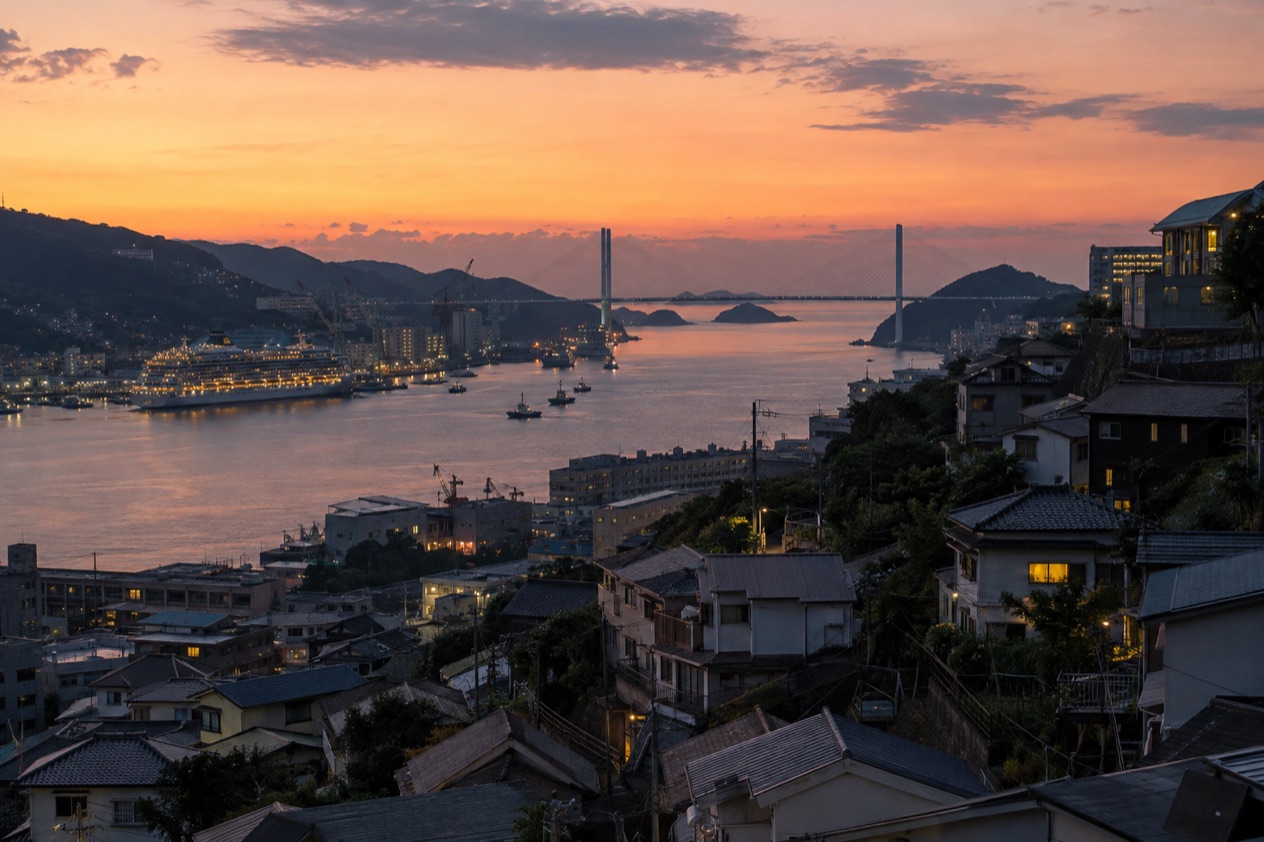
Mount Inasa is the hill that people head for when they want to see the whole city at once. From the observation deck, the harbor opens like a funnel between ridges, with houses climbing the slopes and the bridges and ships laid out below. Visitors get up there by ropeway or by road, and the deck looks over the city and the sea beyond.
The view works in daylight, when you can pick out Glover Garden, the Peace Park and the shipyards, and again after dark, when the city lights spread across the hills. It suits photographers and anyone who likes to get their bearings before exploring. Wear a jacket for the wind on the deck, since exposed hilltops are often cooler than the streets below.
Glover Garden and the Oura slope
Glover Garden is as much an outdoor visit as a sightseeing stop. Its terraces step down the hillside past ponds and flowerbeds, and the paths link the old merchant houses through shaded corners and open lookouts. Plan a slow loop and stop at the benches for views of the port.
The streets around Oura Church are lined with small shops and tea rooms where you can rest between slopes. It is a good area for wandering without a fixed plan, since the lanes bend, split and climb in ways that reveal a new view at every turn.
Parks, markets and the riverside
Beyond the big sights, Nagasaki has quieter outdoor corners. The grounds of Suwa Shrine offer shade and stone steps, and the Peace Park gives open lawns and fountains for sitting and thinking. The streetcar line passes along the river and through old districts, so a ride is itself a way of seeing the city outdoors.
Along the waterfront the port is always in view, with ferries, fishing boats and larger vessels moving through the bay. Street food stalls and open-air shops appear around Chinatown, especially where lanterns hang over the lanes. A walk here ends naturally with a snack and a seat on a bench by the water.
Day trips from Nagasaki
Nagasaki Prefecture is made of peninsulas, islands and mountains, and the day trips reflect that: a Dutch-style theme park on one bay, a volcanic peninsula on another, and a harbor town in the northwest tied to early contact with Europe. Rail and bus connect the city to Fukuoka as well, so some visitors combine Nagasaki with the larger city on Kyushu. For those coming from Fukuoka Airport, buses depart for Nagasaki every hour and a one-way trip takes about 2 hours 30 minutes.
Huis Ten Bosch
Huis Ten Bosch is a theme park near Sasebo that recreates a Dutch town, with canals, windmills, brick buildings and flower fields. It reflects the long link between Nagasaki and the Netherlands that began at Dejima, and it turns that history into rides, gardens, museums and seasonal light displays.
The park is known for its tulips and for illuminations that transform the canals into long ribbons of light. Boats run along the waterways, and restaurants serve Dutch-inspired meals alongside Japanese dishes. Plan the day around a few favorite areas rather than trying to see everything, and leave the evening for the lights.
Unzen and the Shimabara Peninsula
The Shimabara Peninsula is a volcanic landscape of hot springs, steaming vents and farmland, with Unzen as its center. Hot spring towns here have drawn bathers for a long time, and the surrounding mountains give walks through woodland and over rocky terrain. The area also holds the traces of a past eruption and the historic castle town of Shimabara.
This is a good fit for travelers who like a day of scenery and a soak in an onsen, a Japanese hot spring bath. The peninsula suits a slower trip with a stop at a viewpoint or two and a meal of local specialties. Bring a swimsuit only if you know the bath’s rules, since many onsen are bathed in without clothing.
Hirado and the northwest coast
Hirado is a harbor town that was among the first Japanese ports to receive European ships, and the story of those early arrivals is still part of its character. Church spires rise over rooftops, and old trading sites and a hilltop castle mark the town’s past. The mix of Christian and Buddhist landmarks reflects the history of the wider Nagasaki region.
It suits visitors who care about the Hidden Christian heritage and want to see more of it than the city offers. The coast around the town is made of small bays and islands, and the pace is that of a fishing community. Go with an open schedule, since the best moments tend to be unplanned stops along the shore.
Other short outings
Smaller outings fill in the picture. Boat cruises around the harbor show the shipyards and the port from the water, and some excursions head out to the islands that dot the bay. Fukuoka sits on the other end of the Kamome Limited Express line from Hakata, and some travelers combine the two cities in one trip.
What to eat in Nagasaki
Eating in Nagasaki means noodles, sweet cakes and a long tradition of cooking that blends Chinese, Portuguese and Dutch influences with local seafood. The port opened the city to ingredients and techniques that reached the rest of Japan more slowly, and the result is a cuisine with its own character. Many dishes are hearty, designed for working people and sailors, and they suit a day of walking steep streets.
Champon and sara udon
Champon is the dish the city is known for: thick noodles in a milky pork and chicken broth, loaded with seafood, cabbage, bean sprouts and sliced fish cake. It was created to feed students from China, and it still tastes of the harbor, rich and filling. A bowl arrives steaming and heaped, and one is usually enough for lunch.
Sara udon is its crisp cousin. Thin fried noodles are piled on a plate and covered in the same kind of seafood and vegetable topping in a thick gravy, so the bottom stays crunchy while the top softens. Try both for a comparison, since the two dishes share ingredients but feel entirely different on the tongue.
Castella and sweets
Castella is a soft, moist sponge cake brought by the Portuguese and perfected in Nagasaki over generations. It is sold in long loaves at old shops, often with samples set out on the counter, and it makes a common gift to carry home. The cake has a golden crust, a fine crumb and a sweetness that goes well with green tea.
Other sweets reflect the city’s history of trade, including confections made with sugar, an expensive import in earlier centuries. Tea houses and cafés near the main sights serve cake with a drink, which makes them handy stops between hillside visits. Look for shops where the loaf is cut to order and the smell of baking fills the doorway.
Shippoku, turkey rice and other local plates
Shippoku is a banquet-style meal that arrives as a series of shared dishes on a round table, mixing Japanese, Chinese and Western influences. It reflects the cosmopolitan table of old Nagasaki and is a meal for sitting down with company. Dishes may include soups, stewed pork, fish and sweets, brought out in turn.
Turkey rice, a plate of pilaf, a cutlet and spaghetti served together, is a casual local favorite in cafés. Fresh fish from the surrounding waters appears as sashimi and grilled plates, and small seafood shops sell fish cakes and other snacks. Around Chinatown, steamed buns and other street food make easy snacks between sights.
Things to do in Nagasaki at night
Nagasaki evenings revolve around the harbor lights, the lit-up hillsides and good food, rather than around loud nightlife. The city’s slopes glow after dark, and the streetcars keep rolling through lit streets while restaurants fill with diners. It is a good place for a long dinner followed by a walk or a view, and for people who prefer a relaxed night to a late one.
The night view from the hills
After dark, Mount Inasa and other high points turn the city into a spill of lights around the black water of the harbor. Ships, bridges and house windows trace the shape of the bay, and the hillsides look as if they were scattered with lanterns. It is the evening activity visitors plan around, and it needs nothing more than a clear spot at the railing.
Bring a layer, since open lookouts feel cooler and windier than the streets below. Photographers should bring a steady surface, since the best frames come from keeping the camera still. Take your time at the top, because the view changes slowly as the last light fades from the sky.
Dinner, izakaya and the lantern lanes
An izakaya, a casual Japanese pub, is the standard evening stop, with small plates of fish, grilled skewers and local drinks in a lively room. Nagasaki’s version leans on its seafood and on dishes like champon, so a night out can mean a bowl of noodles alongside a round of beer or sake. Neighborhoods near the center have lanes of small bars and restaurants where you can drift from place to place.
Chinatown is hung with lanterns, and around the Lunar New Year the Nagasaki Lantern Festival fills the streets with glowing displays. At other times of year the lanes still carry a warm, lit-up feel. The streetcars run through the center, which makes a ride past lit buildings a pleasant end to the evening.
Quieter ways to end the day
If you want a calm evening, a stay at a ryokan, a traditional inn, or a hot spring hotel offers a bath and a multi-course meal in a tatami room. Tea houses and cafés near the center serve late desserts, including castella, and some bars focus on local sake and shochu. A stroll along the waterfront after dinner takes in the lit ships and the reflections on the bay.
The memorial sites are reflective by nature, and travelers keep their visit to the Peace Park for daylight and spend the evening with food and views instead. For a quiet moment, find a bench on a hillside lane and look down at the lights. The city asks very little of you after dark beyond a good dinner and an unhurried walk.
Things to do in Nagasaki with kids
Children in Nagasaki do best with a mix of animals, open space and hands-on history, with the heavier memorial sites handled according to their age. The city has places built for young visitors, and the streetcars alone give a small adventure. The main thing to keep in mind is the terrain, since stairs and slopes appear almost everywhere.
Animals and aquariums
The Nagasaki Penguin Aquarium is a favorite with young visitors, with penguins of many species and a close-up look at their daily routines. Nagasaki Bio Park is another animal stop, where capybaras, flamingos and other animals live in open settings and some can be seen up close. Both give children a break from sightseeing and let them burn off energy.
Pack snacks and drinks, and plan on slow movement between exhibits, since small children set their own pace. Outdoor areas can feel hot in summer and chilly in winter, so dress in layers. These stops work well as a reward after a morning at a museum or a memorial.
Huis Ten Bosch and open-air fun
Huis Ten Bosch is the biggest draw for families, with rides, canals, flower fields and shows set in a replica Dutch town. The evening lights are a highlight, and older children often enjoy them most.
In the city itself, the open lawns of the Peace Park give room to stretch out, and a ride on the streetcar is an outing in itself. Glover Garden has ponds and paths where children can explore, though its slopes need sturdy shoes. Keep expectations modest and let the day follow your child’s energy.
History for young visitors
Dejima gives children a concrete way into history, since its restored buildings show how traders and interpreters lived and worked on a tiny island. Models, rooms and displays hold attention better than long explanations. The story of an island where foreigners were confined, and where goods and ideas passed through a small bridge, often catches a child’s imagination.
The atomic bombing is a heavy subject, and parents often choose how much to share depending on a child’s age. The Peace Park, with its statue, fountains and paper cranes, offers a gentle way to introduce the idea of peace without going through every exhibit. Take breaks, talk afterward, and let children ask questions in their own time.
Good to know before you go
Nagasaki is the capital of Nagasaki Prefecture, on the western end of Kyushu, and it is reached by air, rail or bus. Nagasaki Airport is in Ōmura, with buses running to the Shinchi bus terminal in the center, and the Kamome Limited Express connects Hakata in Fukuoka to Nagasaki Station. Streetcars and buses carry visitors around the city, and the hills mean comfortable shoes are worth packing.
Sources
- Japan National Tourism Organization, Nagasaki (https://www.japan.travel/en/destinations/kyushu/nagasaki/nagasaki-city-and-around/), checked October 11, 2026
- Wikipedia, Nagasaki (https://en.wikipedia.org/wiki/Nagasaki), checked October 11, 2026
- Wikivoyage, Nagasaki (https://en.wikivoyage.org/wiki/Nagasaki), checked October 11, 2026
- Wikipedia, Dejima (https://en.wikipedia.org/wiki/Dejima), checked October 11, 2026
- Wikipedia, Glover Garden (https://en.wikipedia.org/wiki/Glover_Garden), checked October 11, 2026