
Hakata Station never really sleeps. Commuters stream through the ticket gates, bento boxes are lined up in the shops, and somewhere above the concourse a train bound for the far west of Kyushu is already waiting.
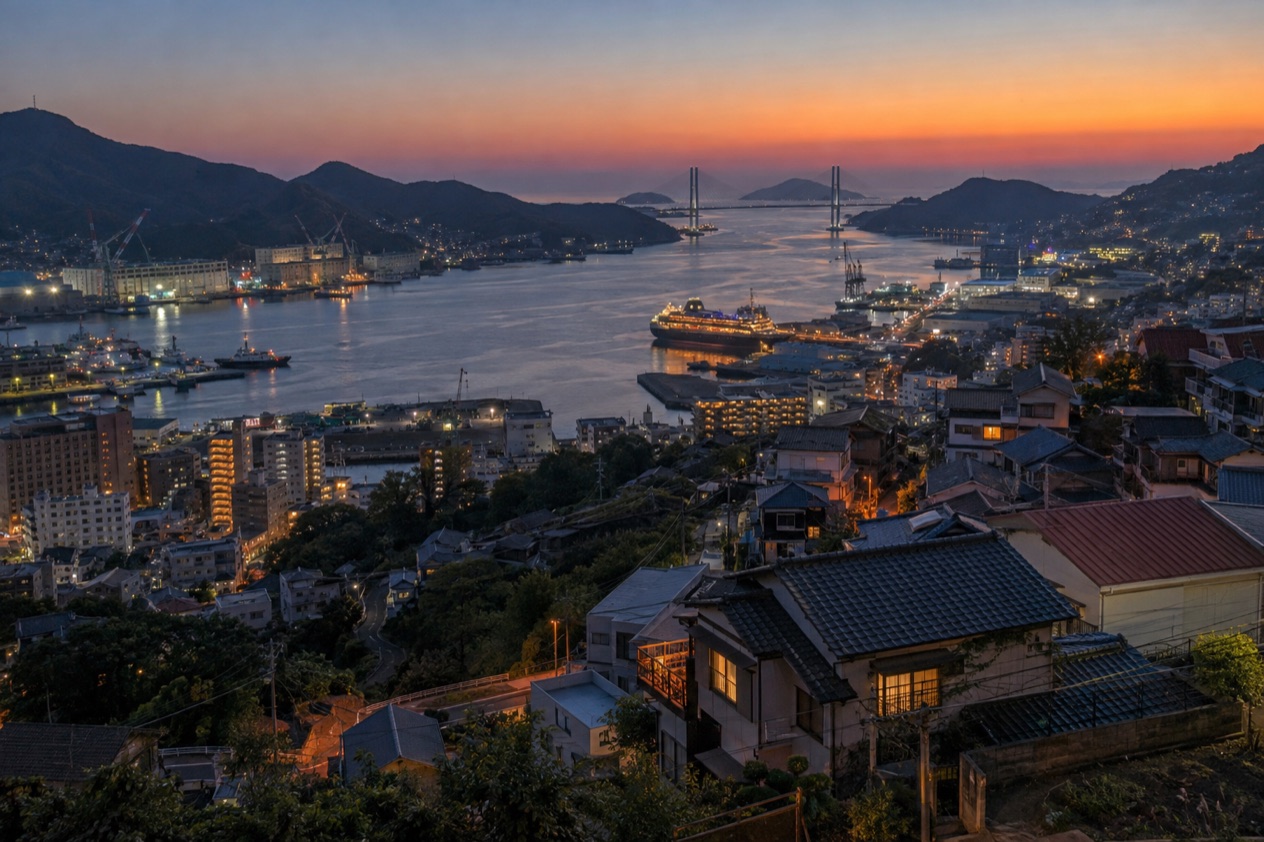
A few hours later the landscape has changed: hillsides crowd a deep harbor, a streetcar rattles past, and the air smells faintly of the sea and of sweet castella cake. Going from Fukuoka to Nagasaki means crossing the island to its western edge, by rail or by road.
How do you get to Nagasaki from Fukuoka?
You go by train from Hakata Station, changing at Takeo-Onsen, or you take the bus from Fukuoka Airport, a one-way ride of about 2 hours 30 minutes with departures every hour. Both reach Nagasaki without any need to go back through another big city, and both drop you at the western end of Kyushu, where the city sits around its harbor.
The train works in two parts. The Relay Kamome, a limited express, runs from Hakata to Takeo-Onsen along the Kagoshima, Nagasaki and Sasebo lines. At Takeo-Onsen you meet the Kamome Shinkansen, which carries on to Nagasaki on the Nishi Kyushu Shinkansen.
That section opened on 23 September 2022, and before that date the Kamome name belonged to a single limited express that ran the full distance between Nagasaki and Hakata. Today the name belongs to the Shinkansen, and the Relay Kamome is the link that feeds it.
What decides between the two is mostly where you start and what you carry. Hakata Station is the largest and busiest railway terminal in Kyushu, with JR Kyushu, JR West and the Fukuoka City Subway all under one roof, so it suits anyone who is staying in the city center or arriving on the San’yo Shinkansen from Osaka.
The airport bus suits someone who has just landed and would rather stay seated than head into town first. A third factor is the rail pass: if you already hold a JR Kyushu pass, the train is the natural way to use it.
Nagasaki Station is the terminal of the Nagasaki Main Line, and it is also where the Nishi Kyushu Shinkansen ends. That matters for planning, because arriving by rail puts you in the city itself, while the airport serving Nagasaki sits in the nearby city of Omura and sends its buses into the center.
None of this requires deep research. Japanese trains have a reputation for being on time, so connections such as the one at Takeo-Onsen are planned to the minute, and the signs in the stations make the change straightforward to follow.
Ways to get to Nagasaki from Fukuoka
Relay Kamome and Kamome Shinkansen
This is the rail route, and it starts at Hakata Station, in Hakata-ku. The Relay Kamome limited express takes you to Takeo-Onsen. There you change to the Kamome Shinkansen, which uses N700S-8000 series trains and is operated by JR Kyushu. Most Kamome services stop at every station between Takeo-Onsen and Nagasaki, though some pass through Ureshino-Onsen and a few stop only at Isahaya, so a glance at the departure board tells you how many stops lie ahead.
Some Midori limited express services also run in conjunction with the Relay Kamome, branded as Midori (Relay Kamome). If the train on the board has that name, you are still on the same route. The Relay Kamome will keep running between Takeo-Onsen and Hakata until the Shinkansen is extended all the way to Hakata, so for now the change at Takeo-Onsen is part of the trip.
This route suits travelers who like watching the country go by from a train window and who want to arrive directly at Nagasaki Station, in the middle of the city. A useful habit: keep your onward plans loose on the day, since the change adds a step that a direct bus does not have.
Bus from Fukuoka Airport
Buses leave Fukuoka Airport for Nagasaki every hour, which makes them an option for anyone who arrives by plane and wants to skip the trip into the city. The ride is a single seat from start to finish, with no change of platform and no connection to catch. You watch Kyushu pass by on the road, and you arrive in a city that is built around slopes and water.
It suits travelers with luggage, groups who would rather not juggle transfers, and anyone landing in Fukuoka with a Nagasaki hotel already booked. On the other hand, someone staying in central Fukuoka will find the train more natural, since the bus starts at the airport rather than at Hakata Station.
Arriving by air at Nagasaki Airport
Nagasaki has its own airport, and it lies in the nearby city of Omura rather than in Nagasaki itself. From there, buses run to the Shinchi bus terminal in the city center. It is worth knowing about if your journey reaches Kyushu by a different route, or if you are building a trip that enters at one end of the island and leaves at the other.
For a trip that begins in Fukuoka, the rail and the road are the routes described above. The airport is mentioned here so that the bus into Shinchi will not be a surprise when you see it on a map or a schedule.
JR Kyushu Rail Pass
The JR Kyushu Rail Pass is a ticket for foreign visitors that allows travel between several cities in Kyushu. It comes in two versions, the All Kyushu pass and the Northern Kyushu pass, each for a set number of consecutive days. Children pay half the adult price.
| Pass | Days | Adult | Child |
|---|---|---|---|
| All Kyushu | 3 | 22,000 yen | 11,000 yen |
| All Kyushu | 5 | 24,000 yen | 12,000 yen |
| All Kyushu | 7 | 26,000 yen | 13,000 yen |
| Northern Kyushu | 3 | 15,000 yen | 7,500 yen |
| Northern Kyushu | 5 | 17,000 yen | 8,500 yen |
Options compared
| Option | Best for | What to know |
|---|---|---|
| Relay Kamome plus Kamome Shinkansen | Travelers starting at Hakata Station who want to arrive at Nagasaki Station | Change at Takeo-Onsen. The Shinkansen section has run since 23 September 2022 |
| Bus from Fukuoka Airport | Travelers who have just landed and prefer one seat | Departures every hour. It ends in the city center area at the Shinchi bus terminal link, not at the station |
| Nagasaki Airport and bus | Travelers whose trip reaches Nagasaki by air | The airport is in Omura. Buses run to the Shinchi bus terminal in the city center |
Put side by side, the choice is simpler than it looks. The train gives you a rail journey with one change, and it ends at Nagasaki Station, a short step from the streetcar lines that fan out through the city. The bus gives you a single seat and a clear hourly rhythm, and it is the sensible pick if your day began at the airport.
Think about the end of the trip as well as the start. If you plan to continue south or return to Fukuoka the same evening, the station is the point where Nagasaki’s rail lines gather, and that tends to make a rail arrival the more flexible choice.
If you are heading somewhere nearby with a car or a hotel shuttle, the bus may fit better. In both cases, the departure board in Hakata or the airport timetable settles the details of the day.
Making a day of it
Reaching Nagasaki is a pleasure in itself, because the city rewards a slow wander. Start with the places that tell its story. The Peace Park and the Atomic Bomb Museum recall August 1945, and many visitors spend a quiet, reflective hour among the memorials.
Dejima, the former trading island where Dutch merchants lived for generations, shows how Nagasaki was Japan’s window to the outside world. Glover Garden climbs a hillside with views over the harbor, and the Hidden Christian Sites of the Nagasaki Region, recognized by UNESCO, add a deeper layer for anyone with time.
Then eat. Champon, a bowl of noodles piled with pork, seafood and vegetables in a milky broth, was born in the city’s Chinese community, and sara udon, crispy fried noodles under a thick, glossy sauce, comes from the same tradition.
Castella, a golden sponge cake brought by Portuguese traders, is sold in boxes in shops across town. Kakuni manju, a soft bun filled with braised pork belly, makes a good walking snack. The Chinatown area is the place to look for several of these in one stroll.
Getting around the city itself is part of the fun. Streetcars run through the center, and many of the sights lie along or near their lines, so you can ride from one stop to the next rather than plan a long walk. The hills are steep in places, which means comfortable shoes are worth wearing and a light bag is better than a heavy one.
If you have a night or two, you can slow the pace. Evenings in Nagasaki are for harbor views, a table of local seafood and a drink in a small bar. If you return to Fukuoka the same day, travel light, keep your return plan in mind, and let the harbor be the last thing you see before you head back to the station or the bus stop.
A detour is possible on the rail route. Takeo-Onsen, where you change trains, is a hot spring town, and Ureshino-Onsen is another name on the Shinkansen line, though some services pass through without stopping. Neither is a promise of a long visit, but both are worth a look at the map if you enjoy onsen towns and have time to spare.
Good to know before you go
Japanese trains are known for running on time, so the change at Takeo-Onsen is built to work without fuss. Local trains stop at every station and rapid trains skip the smaller ones without a supplement, but the Relay Kamome and the Kamome Shinkansen are the services for this journey.
In Nagasaki, keep some yen in coin for streetcars and small shops, and remember that the hills can be slippery when it rains. The rainy and typhoon seasons can disturb travel in Kyushu, so a flexible plan helps.
Sources
- JR Kyushu, Rail passes (https://www.jrkyushu.co.jp/english/railpass/), checked October 11, 2026
- Wikipedia, Hakata Station (https://en.wikipedia.org/wiki/Hakata_Station), checked October 11, 2026
- Wikipedia, Kamome (train) (https://en.wikipedia.org/wiki/Kamome_(train)), checked October 11, 2026
- Wikipedia, Kyushu Shinkansen (https://en.wikipedia.org/wiki/Kyushu_Shinkansen), checked October 11, 2026
- Japan National Tourism Organization, Nagasaki (https://www.japan.travel/en/destinations/kyushu/nagasaki/nagasaki-city-and-around/), checked October 11, 2026
- Wikipedia, Nagasaki (https://en.wikipedia.org/wiki/Nagasaki), checked October 11, 2026
- Wikivoyage, Nagasaki (https://en.wikivoyage.org/wiki/Nagasaki), checked October 11, 2026
- Japan National Tourism Organization, trains and buses (https://www.japan.travel/en/guide/how-to-travel-by-train-and-bus-in-japan/), checked October 11, 2026
- Japan National Tourism Organization, traveling by rail (https://www.japan.travel/en/guide/traveling-by-rail/), checked October 11, 2026
- Japan National Tourism Organization, getting around Japan: trains, subways, buses, taxis (https://www.japan.travel/en/plan/getting-around/), checked October 11, 2026