
Rain taps on the tiles of a long earthen wall, and the water in a narrow canal runs clear beside a stone-paved lane. Behind the wall, a gate opens onto a garden where moss and maple leaves hold the wet light. Nagamachi is the old samurai quarter of Kanazawa, a neighborhood to wander slowly if you like history, gardens and the feel of a town that once served a powerful clan.
What is Nagamachi like?
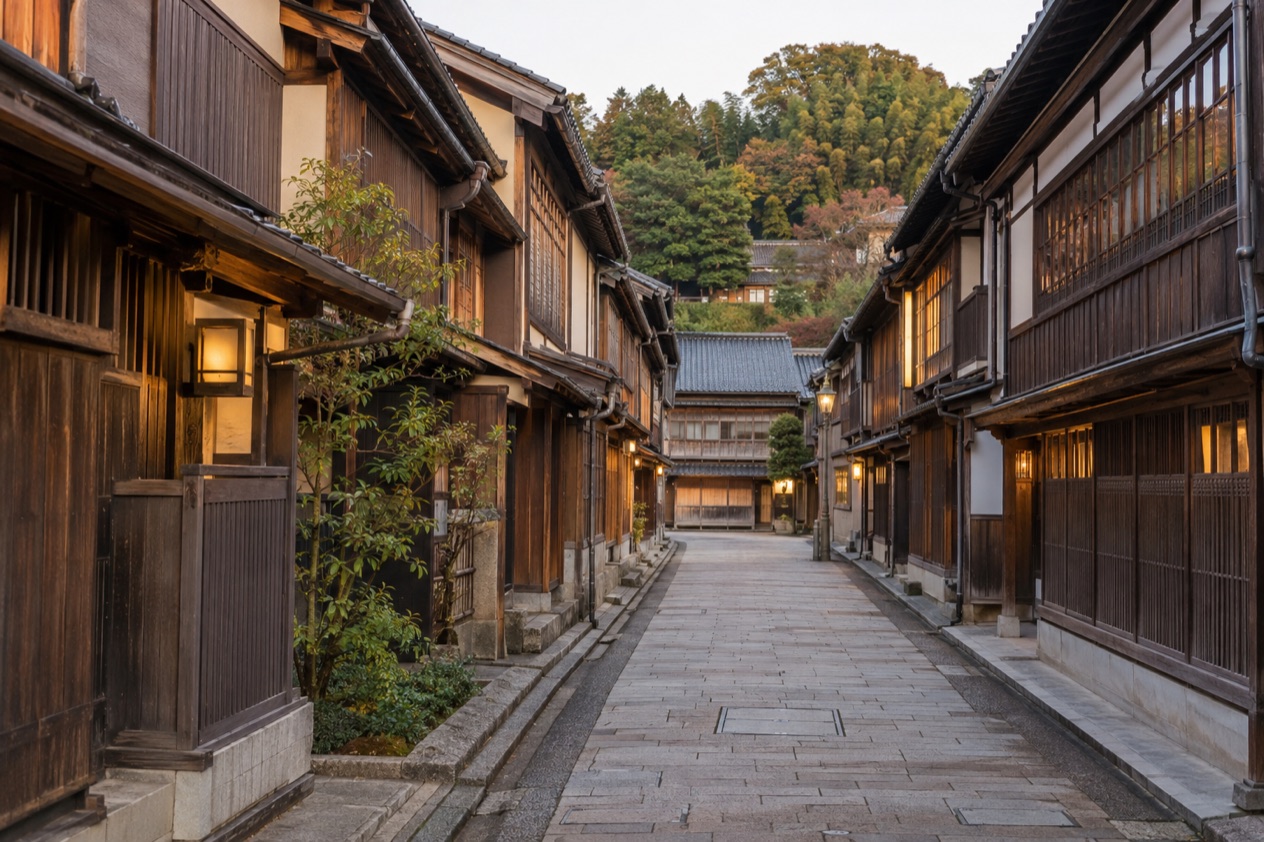
Nagamachi is a residential quarter of lanes, walls and canals where the retainers of the Maeda clan once lived, and it still reads that way at street level. The earthen walls, the gates and the small waterways set the tone, and the pace is closer to a stroll through a village than to a sightseeing district.
The story behind it is the story of Kanazawa Castle. The castle was the headquarters of Kaga Domain, ruled by the Maeda clan for 14 generations until the Meiji Restoration in 1871, and the samurai who served the domain lived in the streets around it. During the Edo period Kanazawa was one of the most important cultural and artistic centers in Japan, and the craft traditions of the city, from gold leaf to dyed silk, grew out of that world of patrons and retainers.
Today people live in Nagamachi, which is part of its character. Many gates stay closed, and what you see from the lane is often a wall, a roofline and a glimpse of a pine. In winter, straw mats are often hung along the earthen walls to shield them from snow, a sight that photographers and architecture lovers seek out.
The district suits travelers who like details: the pattern of a stone path, the sound of water, the way a sliding door frames a garden. It suits history readers, couples on a slow day and anyone who wants Kanazawa away from the market crowds. Kanazawa gets a lot of rain, and the city is nicknamed the Seattle of Japan, so wet lanes are part of the picture rather than a spoiler.
Things to do in Nagamachi
The samurai lanes
The best sight in Nagamachi is the district itself. Walk the lanes between the earthen walls, look over the low canals and notice how the entrances to former residences are set back behind wooden gates. The plaster is the color of dry earth, the roofs are tiled, and the stone underfoot gives the lanes a soft, muted look, especially under rain.
There is no single spot to find. The pleasure comes from turning down the side lanes and letting the walls and water lead you. Bring a camera and an umbrella, and give the corners time, since the view changes with every bend.
Nomura House
The Nomura House is open to the public inside the Nagamachi Samurai District, and it is the clearest way to see how a retainer’s family lived. You move through tatami rooms and look out on a small garden with a pond, set so that each room frames its own view. Wood, paper screens and polished corridors show how a household of rank was arranged.
Take your time at the garden side of the house, where the view is the point. Take your time at the garden side of the house, where the framed views are the point.
Kanazawa Castle Park
Kanazawa Castle belongs to the same story as Nagamachi, since this was the seat of the Maeda clan whose retainers lived in the district. Most of the buildings you see are reconstructions based on how the castle looked in the 1850s, and the park is a large green space with stone walls, gates and turrets. The Ishikawa Gate, built in 1788, is among the structures that survive from the old castle, along with the Sanjukken Nagaya and the Tsurumaru Storehouse.
The long storehouse called the Gojikken Nagaya was restored in 2001 with traditional construction methods, and you can step inside. Work on the Ninomaru Palace, once the administrative center of the domain, has begun as part of a restoration that Ishikawa Prefecture plans to carry out over several years. The park is also illuminated at night.
| Site | Admission |
|---|---|
| Nomura House | ¥500 |
| Gojikken Nagaya, Kanazawa Castle | ¥320 |
Within reach of Nagamachi
Kenrokuen Garden lies next to the castle and once formed its outer garden. In winter its trees wear yukitsuri, ropes set in a cone to hold up branches under heavy wet snow. Across the Asano River, the Higashi Chaya District keeps its Edo period geisha houses, and the Shima House there is open to visitors. Omicho Market, covered today and mostly given over to seafood shops, is another stop that fits into the same day.
Eating and drinking in Nagamachi
Food in Nagamachi is a matter of small, tucked-away places rather than a restaurant street. You tend to find tea rooms, little cafés in converted houses and lunch counters in the lanes, and eating here follows the slow pace of the walk. Kanazawa sits on the Sea of Japan, and seafood sets the table across the city.
Omicho Market is where the city’s seafood is gathered. Its shops mostly sell fish and shellfish, and the market dates back to the Edo period. It began as an open-air market and is covered today.
A bowl of rice topped with sliced raw fish, a skewer of grilled seafood or a plate of sushi is the kind of meal to look for there. Counters and small dining rooms in and around the market serve fish at its freshest.
Back in the samurai quarter, think tea and sweets. A bowl of matcha with a seasonal wagashi, the small confection made to match the month, fits a pause after a garden visit.
Kanazawa is also the source of 99% of Japan’s high-quality gold leaf, and the city likes to put it in places you would not expect, so look for sweets, soft serve and drinks flecked with gold. It makes a curious souvenir to eat.
For the evening, kinds of places include small izakaya, the casual Japanese pubs where you order a few dishes to share along with sake or beer, and quiet counters serving a set meal. Kaiseki, the multi-course meal built around the season, is the form of dining that matches the old-house setting. Take lunch as the main meal if the day is rainy, and let the evening be a smaller affair.
Staying in Nagamachi
Nagamachi suits travelers who want to sleep inside the atmosphere of old Kanazawa, in a district of lanes and walls rather than in a block of hotel towers. It is a base for people who plan to spend their days on foot, with the castle park, Kenrokuen and the samurai houses all close to the same story of the city.
Lodging in a district like this tends toward small guesthouses and modest inns, with a few larger hotels in the surrounding city. If you want the shape of a traditional stay, with tatami rooms and futon bedding laid out for the night, look for a ryokan, the Japanese inn that often serves a set dinner and breakfast. A hotel, by contrast, gives you a bed, a desk and the freedom to eat out.
Compared with the neighboring areas, Nagamachi is where the samurai past is. Higashi Chaya, across the Asano River, is the district of the former geisha houses and the one to choose if the tea houses and their lattice facades draw you.
The area around Omicho Market suits those who care most about the morning seafood and the city’s food counters. Kenrokuen and the castle park sit at the edge of the story and give the days a green backbone. Choosing Nagamachi means choosing the old residential feel above all.
Getting to Nagamachi
Most visitors arrive in Kanazawa by train. Since March 14, 2015, the Hokuriku Shinkansen has served the city, which shortened the trip from Tokyo to around two and a half hours. The nearest airport is Komatsu Airport, in the city of Komatsu, for those coming by air.
Once in Kanazawa, the tourist bus loops around the main sights in 15 minutes and costs ¥200 per trip or ¥500 for a daily pass. It is one of the ways to link the districts of the city, from the old geisha quarter to the castle and the garden.
Kanazawa also has a bicycle share program called Machi-Nori, where e-bikes can be rented at various points and returned to any compatible port. That suits a day that links several districts, since you can leave the bike at a different port from the one where you began.
Within the district itself, the lanes are for walking, and the details that make Nagamachi worth the trip are the ones you see at a walking pace. Rain is common in Kanazawa, so plan on wet stone and an umbrella in hand when you set out. The city area is large, so the district fits best as one stop among the castle, the garden and the geisha quarter rather than as a place to cross the whole city for.
Good to know before you go
Nagamachi is a place where people live, so the habit is to walk quietly, to take photographs of the walls and lanes without stepping into private entrances, and to keep voices low near the closed gates. Kanazawa gets a lot of rain, and wet stone and a gray sky are part of the look of the district, so a day here works in any weather.
Rain turns the earthen walls a darker brown and brings out the color of the moss, and many travelers find that the district looks its best on such days. In winter, the straw mats on the walls and the ropes on the trees in the nearby garden show how the city prepares for snow.
Sources
- Kanazawa Tourism, official guide (https://www.kanazawa-tourism.com/en/), checked October 11, 2026
- Wikipedia, Kanazawa (https://en.wikipedia.org/wiki/Kanazawa), checked October 11, 2026
- Wikivoyage, Kanazawa (https://en.wikivoyage.org/wiki/Kanazawa), checked October 11, 2026
- Japan National Tourism Organization, Kanazawa (https://www.japan.travel/en/destinations/hokuriku-shinetsu/ishikawa/kanazawa-and-around/), checked October 11, 2026
- Kanazawa Tourist Information Guide (https://www.kanazawa-tourism.com/), checked October 11, 2026
To plan your stay
- Best Time to Visit Japan: Cherry Blossoms, Autumn Colors, Weather and Festivals
- Where to Stay in Japan: Ryokan, Temple Stays, Capsule Hotels and the Best Cities to Base In
- Sending Luggage from the Airport in Japan: Hands-Free Travel, Hotel Delivery and Coin Lockers
- Know Before You Go to Japan: Entry, Money, Etiquette and Getting Around