
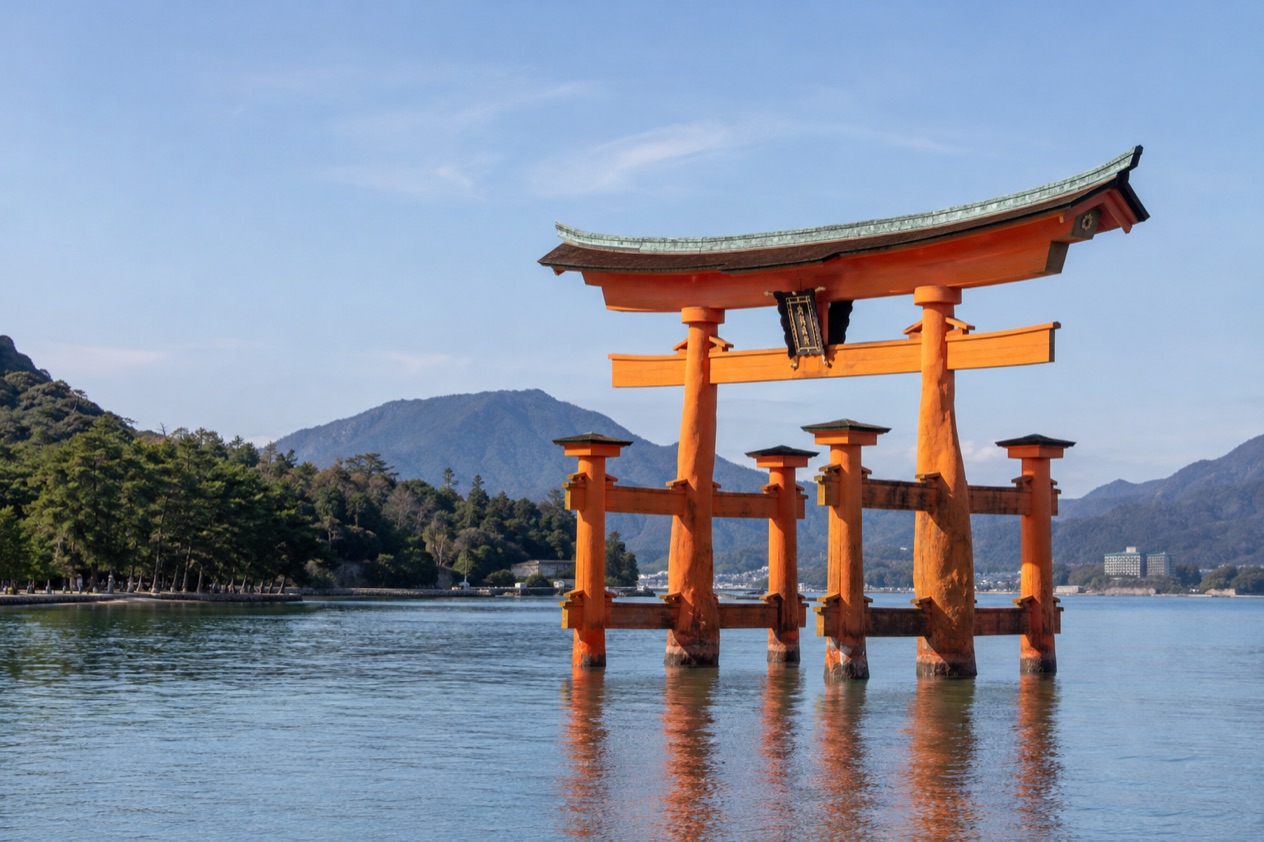
Leaving Hiroshima in the morning, you trade the clang of streetcars for the slap of ferry wake and the cry of gulls. Across the water, a forested island rises behind a red torii gate that seems to stand in the sea itself. Getting to Miyajima means a rail line, a short boat ride and, on the island, deer that look you over as you step off the pier.
How do you get to Miyajima from Hiroshima?
You reach Miyajima from Hiroshima by taking a JR West train on the Sanyo Main Line to Miyajimaguchi Station in the city of Hatsukaichi, then boarding a ferry from the pier beside it. There is also a second way, an express passenger ferry that links the island with Hiroshima harbour and runs hourly. Either way, the last stretch is by water, because Miyajima is an island off the coast of Hiroshima and the crossing is part of the trip.
The island’s real name is Itsukushima, and Miyajima is the nickname that means Shrine Island. You will see both on signs, maps and ferry boards, and they mean the same place. Itsukushima belongs to the city of Hatsukaichi, which is why the mainland station that serves it carries the name Miyajimaguchi, roughly the mouth, or gateway, of Miyajima.
What decides between the two routes is mostly where you want to arrive. The train route ends at a station with a ferry pier right beside it, and two companies run boats from there: JR Miyajima Ferry and Miyajima Matsudai Kisen.
The express boat leaves from the harbour side of Hiroshima and lands you on the island without a rail leg at all. If your day includes the Peace Memorial area or you are staying near the harbour, that second option fits naturally. If you are already riding JR West lines, the station route keeps everything on one network.
A few other things shape the choice. The ferries from Miyajimaguchi are described as frequent, which suits a loose morning with no timetable in hand.
The hourly rhythm of the express boat asks for a little more planning, since you build the day around its departures. Japanese trains have a reputation for running exactly on time, so a plan built to the minute tends to hold, and that helps when you are fitting a train and a boat together.
Ways to get to Miyajima from Hiroshima
JR West local and rapid trains to Miyajimaguchi
The line that serves Miyajimaguchi is the JR West Sanyo Main Line, and the station is run by West Japan Railway Company. It has one ground-level side platform and one island platform, plus a Midori no Madoguchi, the staffed JR ticket office, for questions or tickets you would rather buy from a person than a machine.
Two kinds of service matter here. Local trains stop at every station, which makes them a good fit for short distances and lets you watch the towns go by. Rapid trains skip the smaller stops and carry no supplement, so you pay the ordinary fare and still skip some of the pauses. The stations line up along a coast where the Seto Inland Sea shows up between buildings and hills.
This route suits anyone who wants the plain, rail-only way to the pier. From the station, the ferry landing is next door, so there is no second ticket office to hunt for before you board. Travelers carrying a Japan Rail Pass should know that the pass needs a special ticket for the express Nozomi and Mizuho services on the Sanyo Shinkansen, a detail worth remembering if the bullet train is part of the plan.
The Sanyo Shinkansen and onward connections
The Sanyo Shinkansen is the high-speed line that links Shin-Osaka with Hakata Station in Fukuoka, and West Japan Railway Company operates it. Trains run at a top speed of 186 miles per hour for most of the way between Hakata and Osaka, and the whole line can be ridden between those two ends in two and a half hours. Through Nozomi trains also connect with the Tokaido Shinkansen, so the trip from Tokyo to Hakata takes five hours without a change.
If you are arriving from the Osaka side or from the Fukuoka side, this is the line that carries you along the western part of Honshu toward Hiroshima. From there the JR West local line to Miyajimaguchi takes over. The bullet train belongs to the approach to the city, and the last stage to the island stays slow and close to the water.
The express ferry from Hiroshima harbour
An hourly express passenger ferry joins Itsukushima and Hiroshima harbour. Because the boats leave once an hour, the day takes on a pleasant rhythm, with a departure to aim for rather than a platform to rush toward.
This way suits travelers who like the idea of arriving by sea the way pilgrims once did, with the island growing larger on the horizon. It also works for anyone staying near the water in Hiroshima. Bring a camera for the approach, because the shoreline and the forested slopes behind the shrine come into view before the pier does.
Streetcars and buses around Hiroshima
Inside Hiroshima, the local streetcars and buses belong to Hiroshima Electric Railway, known as Hiroden, which operates in and around Hiroshima Prefecture. Its tram network is the longest in Japan, and the company is nicknamed The Moving Streetcar Museum because its trams were built in Japan and in Europe. Riding one is a small attraction in itself.
The streetcars make the most sense as the way you move around the city before or after the island. In spring 2025 the company replaced its PASPY smart card with a QR code ticketing system called MOBIRY DAYS, so expect a phone-based ticket rather than the old card. After the atomic bombing of Hiroshima, the system started running again within three days, a fact the city remembers with some pride.
Options compared
| Option | Line or operator | Best for | What to know |
|---|---|---|---|
| Local or rapid train plus ferry | JR West Sanyo Main Line to Miyajimaguchi, then JR Miyajima Ferry or Miyajima Matsudai Kisen | Travelers who want one rail network and a pier next to the station | Local trains stop at every station, rapid trains skip small ones with no supplement, and the ferry crossing takes about ten minutes |
| Express passenger ferry | Hourly service between Hiroshima harbour and Itsukushima | Arriving by sea without a rail leg | Runs once an hour, so the day is built around departures |
| Shinkansen into the region | Sanyo Shinkansen between Shin-Osaka and Hakata | Reaching the area from the east or west | Japan Rail Pass holders need a special ticket for Nozomi and Mizuho |
| Streetcar or bus in the city | Hiroden | Moving around Hiroshima itself | Ticketing is QR code based under MOBIRY DAYS |
The two ways that actually put you on the island are the train with the short ferry and the hourly express boat. They differ less in what they cost in effort than in what they give you to look at: the train route offers a stretch of Japanese rail suburb and then a quick boat hop, while the express ferry gives you a longer view of the water and the island coming closer.
Pairing the two is a fair way to plan the day. Travelers like to go out one way and come back the other, which means seeing both the rail line and the water without repeating anything.
The shinkansen is a separate matter, because it is the line that brings you into the wider region and then hands you to the local trains. Pick the leg you care about most, and let the others fall into place around it.
Making a day of it
The shrine is open from early morning, with a closing time that moves earlier in winter, so the table is worth a glance when you decide when to cross.
| Site | Open |
|---|---|
| Itsukushima Shrine, March to October | 06:30 to 18:00 |
| Itsukushima Shrine, November | 06:30 to 17:30 |
| Itsukushima Shrine, December | 06:30 to 17:00 |
| Itsukushima Shrine, January to February | 06:30 to 17:30 |
The shrine, the torii and the shoreline
From the ferry pier you walk along the shore toward the shrine, past stone lanterns and the paths that the deer treat as their own. The great torii gate rises from the bay, and what you see of it changes with the water. At high tide it looks as if it floats, and at low tide the sand around its base lets people walk closer.
The shrine itself is built over the shore, so its corridors and halls stand above the tidal flats. Spend time here without hurrying, because the details reward a slow look: the lanterns, the vermilion beams, the way the light bounces off the water under the walkways. Leave room afterward for the streets nearby, where shops sell momiji manju, maple-leaf cakes filled with sweet bean paste, and where grilled oysters and conger eel are common island specialties.
Mount Misen and the island’s forest
Behind the shrine, the forested peak of Mount Misen is the highest point on the island, at 1,755 feet. Even if you do not climb it, the green slopes frame every view of the shrine from the pier, and they give the island its quiet, wooded look. If you plan to go up, allow generous time in your day and pack water and a layer, since you cannot count on the weather at the top matching the shore.
Visitors treat the mountain as the day’s second half, with the shrine and the shoreline in the morning and the slopes after lunch. It suits anyone who wants to see the island from above, with the inland sea spread out beyond the trees.
Deer, food and when to head back
The deer wander freely and they are willing to root around bags and backpacks for food, even while you are wearing them. Keep snacks sealed and closed inside your bag, and do not hold paper maps or tickets loosely in your hand. They are curious rather than aggressive, but they are quick, and a bag left open on a bench disappears into a muzzle.
Plan your return around the ferries and the shrine’s closing time, which is earlier in winter than in summer. Boats leave from the pier regularly toward Miyajimaguchi, and the express service runs back toward Hiroshima harbour once an hour. Eat before you leave, because the island’s lunch counters and sweets shops are a part of the visit, and the walk back along the water is the last thing to savor.
Good to know before you go
Pack light and keep your bag zipped, because of the deer, and bring a small layer for the ferry deck, where the sea air can feel cooler than the town. Carry whatever you use for tickets on a phone, since Hiroden now sells its rides through QR code tickets.
Treat the shrine hours as the clock for the day, especially from November through February, when closing comes earlier. The crossing from Miyajimaguchi is brief, so there is no need to leave the mainland before you have had a proper breakfast.
Sources
- Wikipedia, Hiroden (https://en.wikipedia.org/wiki/Hiroden), checked October 11, 2026
- Wikipedia, Miyajimaguchi Station (https://en.wikipedia.org/wiki/Miyajimaguchi_Station), checked October 11, 2026
- Wikipedia, Sanyō Shinkansen (https://en.wikipedia.org/wiki/Sany%C5%8D_Shinkansen), checked October 11, 2026
- Wikipedia, Itsukushima (https://en.wikipedia.org/wiki/Itsukushima), checked October 11, 2026
- Wikivoyage, Miyajima (https://en.wikivoyage.org/wiki/Miyajima), checked October 11, 2026
- Japan National Tourism Organization, trains and buses (https://www.japan.travel/en/guide/how-to-travel-by-train-and-bus-in-japan/), checked October 11, 2026
- Japan National Tourism Organization, traveling by rail (https://www.japan.travel/en/guide/traveling-by-rail/), checked October 11, 2026
- Japan National Tourism Organization, getting around Japan: trains, subways, buses, taxis (https://www.japan.travel/en/plan/getting-around/), checked October 11, 2026
- Wikipedia, Shinkansen (https://en.wikipedia.org/wiki/Shinkansen), checked October 11, 2026
- Wikipedia, Tōkaidō Shinkansen (https://en.wikipedia.org/wiki/T%C5%8Dkaid%C5%8D_Shinkansen), checked October 11, 2026