
In May, carp-shaped streamers flap from poles over rivers, rooftops and observation towers, and the drums of a neighborhood shrine festival carry down a Tokyo side street. The cherry blossoms are long gone from the main islands, and the hills have turned a bright new green.
Okinawa is already warm and humid, and Hokkaido is only now getting its own spring. May is the month when Japan swaps flower viewing for festivals, wisteria and long, mild days.
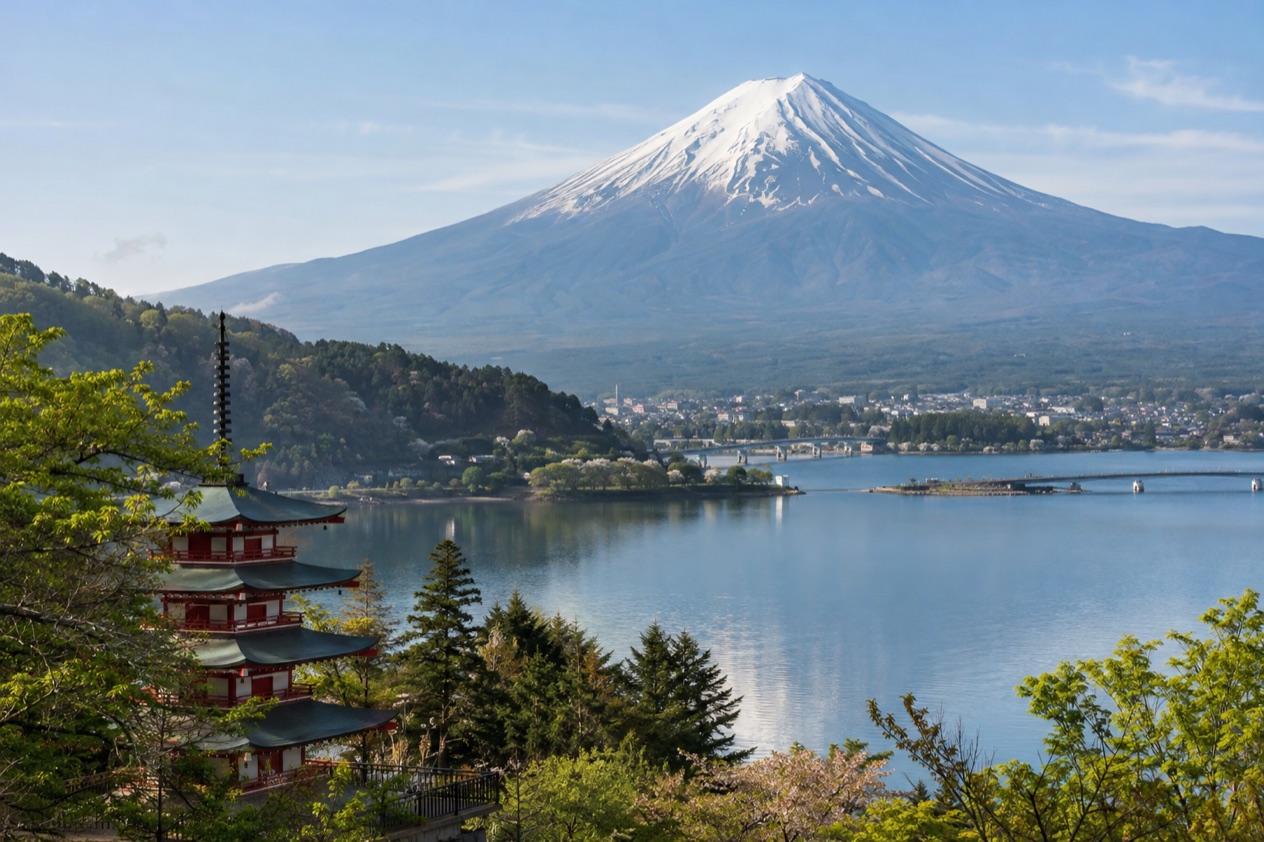
What is the weather like in Japan in May?
May is mild to warm across the main islands, noticeably cooler in Hokkaido and already muggy in Okinawa, so the weather depends on where you stand.
| Place | Average high (°F) | Average low (°F) | Precipitation (in) | Daylight on the 15th (hours and minutes) |
|---|---|---|---|---|
| Tokyo | 74.5 | 58.3 | 5.50 | 14 h 01 min |
| Kyoto | 77.2 | 58.1 | 5.96 | 13 h 58 min |
| Osaka | 76.8 | 60.8 | 5.37 | 13 h 57 min |
| Sapporo | 64.2 | 48.2 | 2.19 | 14 h 37 min |
| Okinawa (Naha) | 80.6 | 71.8 | 9.66 | 13 h 25 min |
| Fukuoka | 75.9 | 61.0 | 5.26 | 13 h 52 min |
| Kanazawa | 72.1 | 56.5 | 5.43 | 14 h 05 min |
| Hiroshima | 75.9 | 59.2 | 6.69 | 13 h 56 min |
Tokyo, Kyoto, Osaka, Fukuoka and Hiroshima sit in the same comfortable band, with warm afternoons that suit a day of walking and evenings cool enough for a light layer. Rain falls on about ten days in Tokyo and nearly as many in Kyoto and Osaka, while Fukuoka and Hiroshima see it on fewer days.
Hiroshima is the sunniest city of the group, with 211 hours of sunshine. Kanazawa, on the Sea of Japan side, runs a few degrees cooler than the others and gets plenty of bright hours too.
Sapporo plays by different rules. Afternoons feel like early spring in the lower 60s, nights call for a jacket, and snow has all but vanished, with a flurry possible on about a tenth of a day in an average May.
Okinawa is the opposite: Naha is the warmest and the wettest place in the table, with rain on 11.4 days, the least sunshine and humidity near 78 percent. The sea off Naha averages 76.8°F this month.
Where to go in Japan in May
Tokyo and the Kanto region
Tokyo in May is a city of open-air festivals and long, mild evenings. Daylight lasts past 6:30 p.m. in the middle of the month, so there is time for a temple in the afternoon and a stroll along a river before dinner. The cherry blossoms are over, but the fresh green of the park trees takes their place, and the holiday atmosphere of the first week lingers in the neighborhoods.
This is the month for Tokyo’s shrine festivals. Sanja Matsuri, held at Asakusa Shrine, is one of the three largest Shinto festivals in the city, and Kanda Matsuri, which grew out of a celebration of Tokugawa Ieyasu’s victory at Sekigahara, honors the kami of Kanda Myojin.
Children’s Day brings carp streamers to Tokyo Tower and to Tokyo Skytree Town. Outside the city, Ashikaga Flower Park in Tochigi holds the largest wisteria in Japan, a vine dated to around 1870, which makes it a plausible day trip for garden lovers.
Tokyo suits first-time visitors who want a city with plenty of events and moderate weather. Rain comes in showers on about one day in three, so pair outdoor plans with museums, department stores and covered shopping streets. The humidity is moderate rather than heavy, which keeps long walks comfortable.
Kyoto, Osaka and the Kansai region
Kyoto in May is a city of new leaves. Maples that blaze red in autumn are now a bright, tender green, moss gardens look their softest, and the warm afternoons are the warmest of the main cities in this stretch.
The Aoi Matsuri, a court procession in old costume that usually takes place in mid-May, brings a little pageantry to the streets. The Gion Matsuri is a July event, so it does not belong to this trip.
Takoyaki, okonomiyaki and kushikatsu (skewers dipped in batter and fried) taste right on a mild evening, and Osaka gets a lot of sun, over 200 hours in an average May. Rain on nine or ten days is the main thing to plan around, so keep an umbrella handy and keep a covered arcade or a castle interior as the fallback for a wet afternoon.
Kansai suits travelers who like gardens, temples and food in one trip. Hiroshima and Fukuoka, farther along the same belt of mild weather, bring similar temperatures and a lot of sunshine for those extending a route to the west.
Hokkaido and Sapporo
Hokkaido is where spring arrives in May. In Sapporo the cherry blossoms start opening around the first of the month and reach full bloom around May 6, then the front of blossoms moves on to northern and eastern Hokkaido by the middle of the month. Odori Park, in the center of the city, turns to lilacs, and the Sapporo Lilac Festival is usually held in late May.
Days are long here, with more than fourteen hours of daylight in mid-May, and the air is dry compared with the south. Hokkaido suits travelers who find the south too sticky and who like a cool day with a sweater. Pack for chilly nights and for the odd cold gust.
Okinawa
Okinawa is the one place in Japan where May feels like summer. Afternoons are hot, nights stay warm, and the sea around Naha is warm too. It is also the cloudiest and wettest spot, so days here mix bright spells with showers and a sticky feel in the air.
Plan around the weather by pairing the outdoors with Okinawan food, which is worth the trip on its own: goya champuru (a stir-fry of bitter melon), soki soba and sata andagi, the round fried doughnuts. Naha’s Kokusai-dori is a good spot for an unhurried evening. Okinawa suits travelers who want heat and are happy to adapt plans when a shower rolls in.
What to do in Japan in May
Golden Week and Children’s Day
Golden Week runs from April 29 to May 5 and strings together several public holidays: Showa Day on April 29, Constitution Memorial Day on May 3, Greenery Day on May 4 and Children’s Day on May 5. When a holiday falls on a Sunday, the next working day becomes a holiday as well, and a day between two holidays also becomes one.
Children’s Day is when the carp streamers, the koinobori, fly. At Tokyo Tower, 333 of them are displayed, matching the tower’s height in meters, and at Tokyo Skytree Town more than a thousand flutter above the plaza. In houses, families set out samurai helmets and eat kashiwa mochi, rice cakes wrapped in oak leaves.
Shrine festivals
Sanja Matsuri at Asakusa Shrine is the big one, and Tokyo’s festival calendar also includes Kanda Matsuri. Both bring portable shrines, drums and crowds in happi coats through the old streets. Elsewhere, Kurayami Matsuri has events every evening from May 3 with many stalls, and on May 5 Kachiya Matsuri sends an impressive procession of samurai through the streets to Katori-jinja Shrine.
In Kyoto the Aoi Matsuri processes in mid-May in Heian-era dress. Festival days are good for food stalls, so come hungry: grilled squid, yakisoba and candied fruit are the usual fare.
Wisteria, blossoms and green
May belongs to the wisteria. Ashikaga Flower Park in Tochigi holds the largest wisteria in Japan, and long purple clusters hang from trellises in shrine and temple gardens elsewhere. The cherry blossoms of Tokyo, Kyoto and Osaka are over, but Hokkaido is still in bloom, and in Sapporo it falls in the first days of the month.
For visitors who like gadgets and craft, the Japan Hobby Show at Tokyo Big Sight is an annual showcase of handmade objects. It makes a good rainy-day alternative in the capital.
Is Japan busy in May?
May has a busy calendar, especially in its first week, when Golden Week brings a run of public holidays and a lot of events. The rest of the month settles into a rhythm of festivals, with Sanja Matsuri and Kanda Matsuri drawing people to Tokyo’s old neighborhoods.
Towers and plazas with Children’s Day displays are the places that fill with families around May 5. Kyoto’s Aoi Matsuri brings spectators along the route of the procession. Hokkaido has its own moment with the cherry blossoms at the start of the month and the lilacs at the end.
Okinawa is in a wetter stretch, with the most rain and the least sun in the table, so its days feel different from the dry spells of Sapporo. Shops in urban areas are generally open from 10:00 a.m. to 8:00 p.m. every day, while in rural areas they often close earlier, sometimes as early as 6:00 p.m. A countryside outing should be planned around that.
What to pack for Japan in May
Layers are the answer. A light jacket or a simple sweater is enough for most of the main islands, but Sapporo asks for something warmer and Okinawa asks for lighter clothes, plus rain gear in every region.
- A light jacket or sweater, for mild days and cooler evenings on the main islands.
- A compact umbrella or rain jacket, because showers fall on roughly one day in three in many cities.
- A warm layer for Sapporo, where nights stay chilly.
- Breathable clothes for Okinawa, where the air is humid.
- A sun hat and sunscreen for the bright days in Hiroshima, Osaka and Fukuoka.
- Comfortable walking shoes for festival streets and temple grounds.
Good to know before you go
May falls before the summer heat sets in on the main islands, though humidity creeps up as the month goes on, and Okinawa is already damp. Golden Week brings public holidays on April 29 and May 3, 4 and 5, so plan the first days of the month with that in mind.
Days are long, with daylight lasting about fourteen hours in Tokyo and more in Sapporo. Urban shops generally keep long hours, while rural ones often close earlier.
Is May a good time to visit Japan?
May suits travelers who want mild weather, green landscapes and festivals, and the main islands from Tokyo to Hiroshima are the strongest choice, with Hokkaido a good pick for those chasing late spring blossoms. Okinawa suits those who like heat and can accept showers.
Compared with April, May is warmer. Tokyo’s afternoons climb from the mid-60s in April to the mid-70s, and Kyoto follows a similar path, while Sapporo’s days gain more than ten degrees. Compared with June, May is drier and cooler: Tokyo reaches 79.0°F in June and Kyoto 82.6°F, and rain totals rise too.
What is special about May is the mix. Carp streamers fly above the rivers, portable shrines sway through Asakusa, wisteria hangs in purple clusters at Ashikaga, and in Sapporo the last of the cherry blossoms give way to lilacs in Odori Park.
Sources
- Japan Meteorological Agency (JMA), Normal values 1991-2020, monthly (https://www.data.jma.go.jp/stats/etrn/view/nml_sfc_ym.php?prec_no=44&block_no=47662), station Tokyo, elevation 25 m, checked October 11, 2026
- Computed from the date and the latitude of the place (sunrise equation, solar elevation -0.833 degrees), October 11, 2026
- Japan Meteorological Agency (JMA), Normal values 1991-2020, monthly (https://www.data.jma.go.jp/stats/etrn/view/nml_sfc_ym.php?prec_no=61&block_no=47759), station Kyoto, elevation 41 m, checked October 11, 2026
- Japan Meteorological Agency (JMA), Normal values 1991-2020, monthly (https://www.data.jma.go.jp/stats/etrn/view/nml_sfc_ym.php?prec_no=62&block_no=47772), station Osaka, elevation 23 m, checked October 11, 2026
- Japan Meteorological Agency (JMA), Normal values 1991-2020, monthly (https://www.data.jma.go.jp/stats/etrn/view/nml_sfc_ym.php?prec_no=14&block_no=47412), station Sapporo, elevation 17 m, checked October 11, 2026
- Japan Meteorological Agency (JMA), Normal values 1991-2020, monthly (https://www.data.jma.go.jp/stats/etrn/view/nml_sfc_ym.php?prec_no=91&block_no=47936), station Naha, elevation 28 m, checked October 11, 2026
- Open-Meteo Marine API, average 2015-2024, checked October 11, 2026
- Japan Meteorological Agency (JMA), Normal values 1991-2020, monthly (https://www.data.jma.go.jp/stats/etrn/view/nml_sfc_ym.php?prec_no=82&block_no=47807), station Fukuoka, elevation 2 m, checked October 11, 2026
- Japan Meteorological Agency (JMA), Normal values 1991-2020, monthly (https://www.data.jma.go.jp/stats/etrn/view/nml_sfc_ym.php?prec_no=56&block_no=47605), station Kanazawa, elevation 6 m, checked October 11, 2026
- Japan Meteorological Agency (JMA), Normal values 1991-2020, monthly (https://www.data.jma.go.jp/stats/etrn/view/nml_sfc_ym.php?prec_no=67&block_no=47765), station Hiroshima, elevation 4 m, checked October 11, 2026
- Japan National Tourism Organization, shop and attraction hours, national holidays (https://www.japan.travel/en/plan/business-hours-and-holidays/), checked October 11, 2026
- Wikipedia, Golden Week (Japan) (https://en.wikipedia.org/wiki/Golden_Week_(Japan)), checked October 11, 2026
- Wikipedia, Public holidays in Japan (https://en.wikipedia.org/wiki/Public_holidays_in_Japan), checked October 11, 2026
- Japan National Tourism Organization, flowers by season: cherry blossom, plum, wisteria, hydrangea, where and when (https://www.japan.travel/en/see-and-do/flowers/), checked October 11, 2026
- Wikipedia, Wisteria (https://en.wikipedia.org/wiki/Wisteria), checked October 11, 2026
- Japan Meteorological Agency, sakura2020.pdf (https://www.data.jma.go.jp/sakura/data/sakura2020.pdf), checked October 11, 2026
- Japan National Tourism Organization, spring in Japan (https://www.japan.travel/en/guide/spring-guide/), checked October 11, 2026
- Wikipedia, Kanda Matsuri (https://en.wikipedia.org/wiki/Kanda_Matsuri), checked October 11, 2026
- Wikipedia, Sanja Matsuri (https://en.wikipedia.org/wiki/Sanja_Matsuri), checked October 11, 2026
- Japan National Tourism Organization, festivals and events (https://www.japan.travel/en/see-and-do/festivals-and-events/), checked October 11, 2026
- Wikipedia, Gion Matsuri (https://en.wikipedia.org/wiki/Gion_Matsuri), checked October 11, 2026
- GO TOKYO, best things to do and see in Tokyo in May (https://www.gotokyo.org/en/story/guide/may/index.html), checked October 11, 2026
- Japan Meteorological Agency, Emergency Warnings (https://www.jma.go.jp/jma/en/Emergency_Warning/ew_index.html), checked October 11, 2026
- Japan National Tourism Organization, autumn in Japan (https://www.japan.travel/en/guide/autumn-guide/), checked October 11, 2026
- Japan Meteorological Agency, cherry blossom first-bloom dates 2021-2026 and 1991-2020 normal (https://www.data.jma.go.jp/sakura/data/sakura003_07.html), checked October 11, 2026
- Japan Meteorological Agency, cherry blossom full-bloom dates 2021-2026 and 1991-2020 normal (https://www.data.jma.go.jp/sakura/data/sakura004_07.html), checked October 11, 2026
- Wikipedia, Climate of Japan (https://en.wikipedia.org/wiki/Climate_of_Japan), checked October 11, 2026
To plan your stay
- Things to Do in Japan: Kyoto Temples, Onsen, Street Food and Day Trips
- Where to Stay in Japan: Ryokan, Temple Stays, Capsule Hotels and the Best Cities to Base In
- Sending Luggage from the Airport in Japan: Hands-Free Travel, Hotel Delivery and Coin Lockers
- Know Before You Go to Japan: Entry, Money, Etiquette and Getting Around