
Steam rises from the ground in Beppu, a bowl of milky tonkotsu broth arrives at a lantern-lit stall in Fukuoka, and across the bay in Kagoshima a volcano keeps its slow watch over the city. Kyushu is the southernmost of Japan’s four main islands, a place of onsen towns, smoking mountains, port cities with long outside connections and some of the country’s most devoted eating. It suits travelers who like to move from town to town and let each one change the mood of the trip.
What are the best things to do in Kyushu?
The best things to do in Kyushu start with its heat: soaking in the hot springs of Beppu and Yufuin, looking at the volcanoes, and eating your way through the island’s ramen, seafood and regional cooking. Around those three, the cities add their own layers, from a castle in Kumamoto to the harbor history of Nagasaki.
- Soak in Beppu, where steam vents and boiling ponds shape the whole town, and the hot springs are the reason to come.
- Walk through Yufuin Onsen, a hot spring town where some baths take day visitors and many are kept for overnight guests.
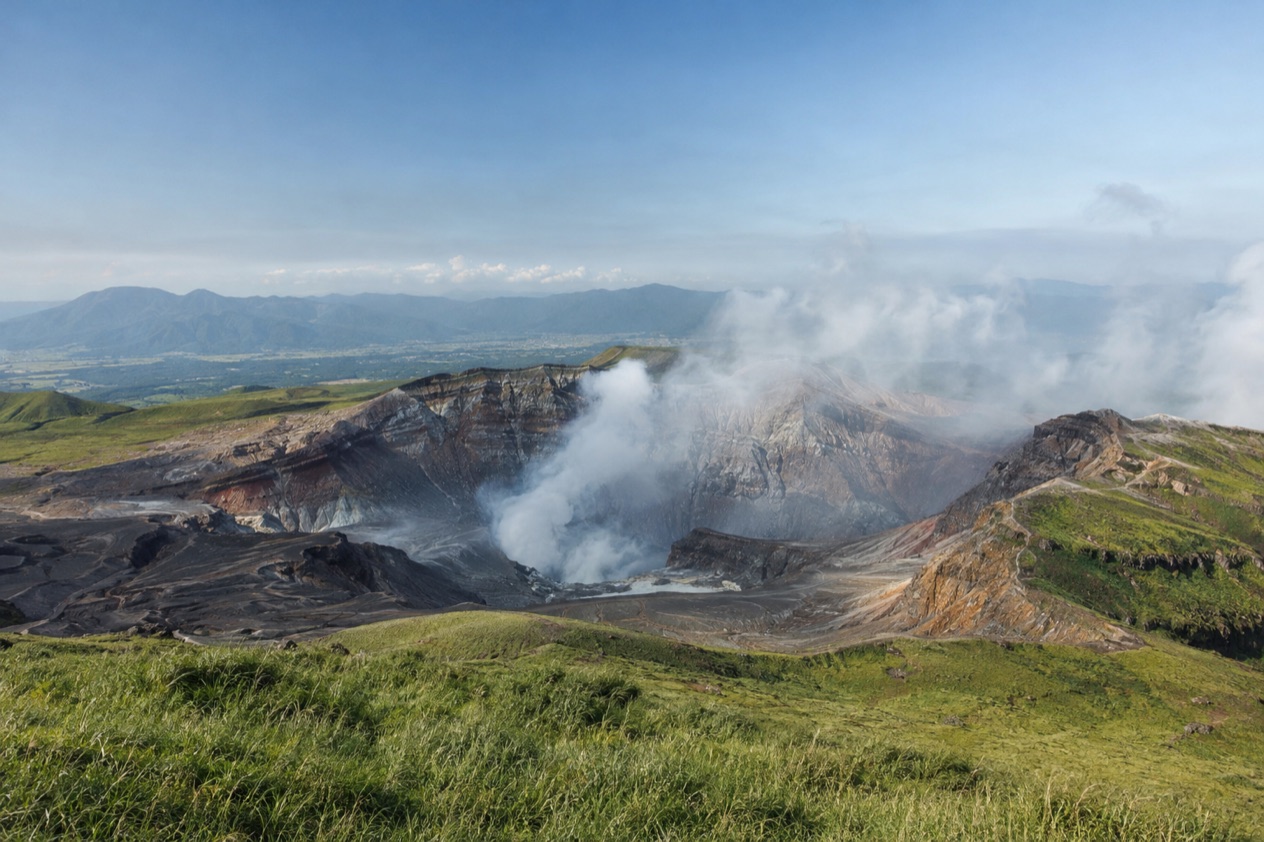
- Look up at Mount Aso, Japan’s largest active volcano, and the wide landscape of central Kyushu around it.
- Take in Sakurajima from Kagoshima, a city that sits in the shadow of an active volcano and has been compared to Naples.
- Eat tonkotsu ramen and food-stall dinners in Fukuoka, a city the food press has singled out.
- Follow the story of Nagasaki, a port at the western edge of the island with Hidden Christian Sites on the UNESCO list.
- Visit Kumamoto, the capital of the prefecture nicknamed the Land of Fire.
- Walk into Takachiho Gorge, deep in the Kyushu Mountains, for a day among cliffs and old shrine stories.
A good trip rarely tries all of these. Kyushu is the third largest island of Japan, and its towns reward a slower pace, a night or two in each, with the volcanoes and onsen setting the rhythm of the days in between.
Rail links the main cities, and the Kyushu Shinkansen ties the south together, so a route that runs from Fukuoka down through Kumamoto to Kagoshima forms a natural spine for the trip. Beppu and Yufuin make a second branch on the east side, and Nagasaki a third on the west. Takachiho sits apart, in the mountains, and asks for a dedicated day.
Sights and landmarks in Kyushu
Kyushu’s landmarks are scattered across its cities, each with a different story to tell, from a harbor that looked outward for centuries to a castle town and a volcano that shapes daily life.
Nagasaki: harbor, hillsides and Hidden Christian Sites
Nagasaki lies at the western extremity of Kyushu, and its hills fall steeply toward a working harbor. The city’s past as a port open to the wider world is written in its stone churches, its Western-style houses on the slopes and the Chinese influences in its food. The Hidden Christian Sites in the Nagasaki region are on the UNESCO World Heritage list, and they tell of communities that kept their faith quietly across generations.
The city also carries the memory of the atomic bombing, and the Peace Park and the museum beside it invite quiet reflection. Streetcars rattle along the central streets, which is a pleasant way to move between neighborhoods. From Nagasaki Airport, buses run to the Shinchi bus terminal in the city center, so you arrive near the Chinatown streets.
Kumamoto: the castle town
Kumamoto is the capital of its prefecture, and its great castle, with black walls and sweeping stone ramparts, is what draws people. The stonework curves upward in a way that looks almost like a sail, and walking around the outer grounds gives a sense of how large the fortress once was.
Beyond the castle, the city has a relaxed, regional feel. Shopping arcades run through the center, the mascot Kumamon turns up on shop windows and souvenirs, and the Suizenji garden, shaped around a pond, offers a place to sit. Kumamoto can be reached by high-speed train from Fukuoka and Kagoshima, and from farther away.
Kagoshima and Sakurajima
Kagoshima sits on a bay and has been nicknamed the Naples of the Eastern world for its warm climate and the emblematic volcano across the water. Sakurajima is active, and it is part of the city’s everyday life, with a plume of smoke sometimes visible from the waterfront and ash a fact of local weather. The Kyushu Shinkansen connects Kagoshima to Kumamoto in 42 minutes.
In town, the streets have a samurai-era past that the locals are proud of, and the city’s museums and old residences reflect it. Palm trees line some avenues, which gives Kagoshima a southern, almost seaside look compared with the cities farther up the island.
Fukuoka and Dazaifu
Fukuoka is a port city on the north coast of Kyushu and a city of growing energy, with the fastest population growth of any city in Japan. Its Hakata district holds the old temple streets and the train station, while Tenjin and the riverside Nakasu island hold the shopping and the night scene. Ohori Park, with its large pond, is a place for a long walk.
Travelers add a visit to Dazaifu Tenmangu, a shrine dedicated to a scholar-god, where students come to pray before exams.
Outdoor things to do in Kyushu
Kyushu’s outdoors is shaped by fire and water: volcanoes, steaming ground, gorges and the hot springs that flow from them. Even a city stroll here often ends beside something geological, whether a plume above a bay or a hillside giving off steam.
Mount Aso and the Kirishima mountains
Mount Aso is Japan’s largest active volcano, rising to 5,220 feet in central Kyushu, and the land around it is among the island’s great open landscapes. Wide grassy slopes, a vast crater rim and hot springs around the volcano give a day of looking and soaking. Roads wind through the highlands, and the views across the caldera change as the clouds move.
Farther south, the Kirishima mountains hold Mount Karakuni among their peaks. This is a country of volcanic ridges, crater lakes and hiking routes, and it rewards anyone who wants to be on foot rather than looking at it from a car window.
Beppu’s steaming hells
Beppu is the largest hot spring resort in western Japan, and the town is crossed by steam. It has eight major hot spring zones with about 3,000 steam vents, so plumes rise from rooftops, between houses and along hillsides. The so-called hells are boiling ponds colored red, blue or milky white by minerals.
Walking between them is a lighter, odd-and-wonderful kind of sightseeing. Steam-cooked snacks, such as eggs and vegetables, are sold in the vicinity, and the smell of sulfur follows you from one stop to the next. Beppu sits on the east shore of the island.
Takachiho Gorge and Yufuin’s lanes
Takachiho Gorge lies slightly south of the town center of Takachiho, in the northernmost part of Miyazaki Prefecture in the Kyushu Mountains. It is a famous tourist destination, with steep cliffs and a river far below, and the green of the surrounding forest closes in around the walkways. The area is steeped in myth, and shrines in the town tell of gods and their stories.
Yufuin is a different kind of outing, an extensive hot spring system in the city of Yufu with a lake, small shops and a mountain backdrop. Some onsen in Yufuin welcome day tourists while many are strictly for overnight guests, so a stroll through the lanes is a pleasure even when you do not bathe.
Day trips from Kyushu
The day trips people take on Kyushu are really trips between its cities, because the island is built around a handful of hubs with rail between them. Fukuoka and Kumamoto make good bases for outings that stretch toward the hot springs and the volcano.
Beppu and Yufuin
Beppu and Yufuin together make a classic hot spring outing. In Beppu, you wander between steaming ponds and soak in public baths, while Yufuin offers a quieter setting with a lake, small art shops and cafés. The two towns lie in Oita Prefecture, and a rail itinerary built around Kyushu’s hot springs links them.
The trip suits anyone who wants a taste of onsen culture without committing to an overnight stay. Since some baths in Yufuin are open to day tourists and many are not, choose a bath that accepts visitors and plan the rest of the day around the shops and the walk.
Takachiho
Takachiho is a town in the northernmost part of Miyazaki Prefecture, in the Kyushu Mountains, and its gorge sits slightly south of the center. The day centers on the gorge, with its rock walls and waterfall, and on the shrines in the town that carry the old myths of the region. Night performances of sacred dance are part of local tradition.
This is a trip for people who prefer scenery and folklore to city sights. Wear shoes that grip, bring a camera and give yourself a long, unhurried day in the hills.
Sakurajima from Kagoshima
The volcano of Sakurajima sits across the bay from Kagoshima, and a day devoted to it lets you see how a city lives beside an active peak. You look at lava fields, lookouts and the smoking summit, and people end the day with a foot bath or a bath in a local onsen.
The view back across the water to Kagoshima is worth the effort on its own.
Smaller outings by rail
Kagoshima and Kumamoto are joined by the Kyushu Shinkansen, so those two cities can be paired in a single day if you wish. The Kyushu Rail Pass, for visitors on tourist visas, covers JR Kyushu lines and both Kyushu Shinkansens.
What to eat in Kyushu
Kyushu is world-famous for its tonkotsu ramen, a pork-bone broth cooked until it turns cloudy and rich, served with thin, firm noodles. It is the dish that most defines eating here, and you can follow it from city to city, finding small differences in the broth and the toppings.
Fukuoka: ramen and the yatai
Fukuoka City was selected in the Food category of Lonely Planet’s Best In Travel 2023, and its Yatai, the food stalls of Hakata, were chosen for The New York Times’ 52 Places to Go in 2023. In the evening the stalls open along the streets and the river, with benches under awnings and steam from the pots. You sit shoulder to shoulder and eat what the cook is making.
Beyond ramen, look for mentaiko, spicy cod roe, eaten with rice or folded into dishes, and motsunabe, a hot pot of beef offal in a savory broth. Gyoza and skewers of grilled meat turn up at the stalls as well, and a small glass of shochu suits the setting.
Nagasaki, Kumamoto and Kagoshima plates
Nagasaki’s port past shows up on the table in champon, a noodle dish loaded with seafood and vegetables, and in sara udon, with crisp noodles under a thick sauce. Castella, a soft sponge cake, is a sweet reminder of the city’s long contact with outsiders.
Kumamoto is known for karashi renkon, lotus root stuffed with mustard and fried, and for basashi, thin slices of raw horse meat. Kagoshima is known for black pork and for sweet potato shochu, a spirit that shows up on nearly every table. In Miyazaki, chicken nanban, fried chicken with a tangy sauce, is a local comfort dish.
Onsen cooking in Beppu
In Beppu, the steam that rises from the ground is also used for cooking. Vegetables, eggs, seafood and more are steamed in vents, and the results are simple and tasty, with a mineral note from the heat. It is a kind of meal that exists only in a place with so many vents.
Pair it with a cold drink on a bench, and the afternoon becomes a snack crawl between baths. It is one of the more memorable ways to eat in Kyushu.
Things to do in Kyushu at night
Evenings in Kyushu begin with food, and the best of it happens outdoors in Fukuoka, where the yatai stalls light up and fill with people after work. From there the night can go anywhere, toward a riverside bar, a quiet bath or a walk beneath the lights.
Fukuoka after dark
The Nakasu area, on an island between two river channels, glows with signs and holds a large share of the city’s nightlife. Izakaya, small pubs serving dishes to share, fill the side streets of Tenjin and Hakata, and the food stalls stay at the center of the night. Walking the riverbank between meals is a pleasant way to take in the lights.
For a gentler evening, Ohori Park by the pond is a place to stroll in the dark, and the cafés and bars around the stations give you somewhere to rest. Fukuoka’s growth shows in how people are out and about.
Evenings in the onsen towns
In Beppu and Yufuin, the night belongs to the bath. Soaking after dinner, with steam rising into the cool air, is the quiet center of an evening in an onsen town. Many onsen in Yufuin are strictly for overnight guests, which makes staying the night part of the experience rather than an extra.
A ryokan, a traditional inn, usually serves a multi-course dinner in your room or a dining hall, and guests often wear a yukata, a light cotton robe, as they walk between the bath and the table. Afterwards the lanes are hushed, and the only sound may be a trickle of water.
Nagasaki and Kagoshima nights
In Nagasaki, the hillsides are covered in lights after dark, and the view down to the harbor is one of the city’s best-loved sights. Evenings in the center are for a bowl of champon or a drink in the small bars near the streetcar lines.
In Kagoshima, the silhouette of Sakurajima across the bay is part of the evening, and the city’s izakaya serve black pork and sweet potato shochu. The mood is warm and unhurried, and the volcano remains a dark shape against the sky.
Things to do in Kyushu with kids
Children in Kyushu tend to be drawn to things that move, steam or smoke, and the island has plenty of those. Boiling ponds, volcanoes, trains and friendly mascots give a trip many moments that need no explanation.
Steam, volcanoes and trains
In Beppu, the colored boiling ponds and the steam rising from town are the draw, and children enjoy the steam-cooked eggs sold nearby. Mount Aso, with its huge crater and grassy slopes, gives a sense of scale that is hard to forget. The Kyushu Shinkansen is part of the fun for children who love trains, and a ride between Kumamoto and Kagoshima is a trip in itself.
Keep the ground in mind near hot springs and vents, where heat and steam are part of the landscape, and keep an eye on little ones near the edges of the boiling ponds.
Cities, castles and mascots
Kumamoto’s castle, with its towering stone walls, appeals to children who like forts, and Kumamon, the city’s bear mascot, shows up on souvenirs and in the shops. In Fukuoka, Ohori Park has a pond and paths for a stroll, and the evening stalls let families sit down for a bowl of noodles.
In Nagasaki, the streetcars are a small adventure, and the harbor views reward a climb up the hillside. The Peace Park and the museum are serious places, and parents can decide how much to share depending on the age of their children.
Pacing the island
Kyushu is large, so plan fewer bases and more time in each. Rail makes the moves comfortable, and the Shinkansen lines cover much of the main route.
A private bath at a ryokan can make bathing easier for families. Build in a quiet afternoon between big outings.
Good to know before you go
Rail is the backbone of travel on Kyushu. The San’yo Shinkansen runs from Osaka to Fukuoka, stopping at Kokura and Hakata, and the Kyushu Shinkansen carries on south.
The JR Pass is accepted on Sakura trains between Osaka and Kagoshima but not on Mizuho trains, while the Kyushu Rail Pass, for visitors on tourist visas, covers JR Kyushu lines but not the San’yo Shinkansen to Hakata.
| Fee | Amount | Who pays |
|---|---|---|
| All Kyushu pass, 3 consecutive days | 22,000 yen | Adult |
| All Kyushu pass, 3 consecutive days | 11,000 yen | Child |
| All Kyushu pass, 5 consecutive days | 24,000 yen | Adult |
| All Kyushu pass, 5 consecutive days | 12,000 yen | Child |
Sources
- Japan National Tourism Organization, Kyushu (https://www.japan.travel/en/destinations/kyushu/), checked October 11, 2026
- JR Kyushu, Rail passes (https://www.jrkyushu.co.jp/english/railpass/), checked October 11, 2026
- Wikipedia, Kyushu (https://en.wikipedia.org/wiki/Kyushu), checked October 11, 2026
- Wikipedia, Regions of Japan (https://en.wikipedia.org/wiki/Regions_of_Japan), checked October 11, 2026
- Wikivoyage, Kyushu (https://en.wikivoyage.org/wiki/Kyushu), checked October 11, 2026
- Wikipedia, Takachiho, Miyazaki (https://en.wikipedia.org/wiki/Takachiho,_Miyazaki), checked October 11, 2026
- Japan National Tourism Organization, Fukuoka (https://www.japan.travel/en/destinations/kyushu/fukuoka/fukuoka-city/), checked October 11, 2026
- Fukuoka City official tourist guide (https://yokanavi.com/en/), checked October 11, 2026
- Japan National Tourism Organization, Nagasaki (https://www.japan.travel/en/destinations/kyushu/nagasaki/nagasaki-city-and-around/), checked October 11, 2026
- Wikipedia, Nagasaki (https://en.wikipedia.org/wiki/Nagasaki), checked October 11, 2026
- Japan National Tourism Organization, Kumamoto (https://www.japan.travel/en/destinations/kyushu/kumamoto/kumamoto/), checked October 11, 2026
- Wikipedia, Kumamoto (https://en.wikipedia.org/wiki/Kumamoto), checked October 11, 2026
- Japan National Tourism Organization, Kagoshima (https://www.japan.travel/en/destinations/kyushu/kagoshima/kagoshima-and-around/), checked October 11, 2026
- Wikipedia, Kagoshima (https://en.wikipedia.org/wiki/Kagoshima), checked October 11, 2026
- Japan National Tourism Organization, Beppu (https://www.japan.travel/en/destinations/kyushu/oita/beppu-and-yufuin-around/), checked October 11, 2026
- Wikipedia, Beppu, Ōita (https://en.wikipedia.org/wiki/Beppu,_%C5%8Cita), checked October 11, 2026
- Wikipedia, Yufuin (https://en.wikipedia.org/wiki/Yufuin), checked October 11, 2026