
After dark in Hakata, the yatai stalls light up along the street and the smell of pork-bone broth drifts between the lanterns. Diners sit elbow to elbow on stools, bowls steaming under the awnings. Kyushu is the southern island of Japan, a place of volcanoes, hot springs, port cities and forests, and it suits travelers who want to eat well, soak often and see a landscape that is still visibly alive.
Where is Kyushu and what is it like?
Kyushu is the southernmost of Japan’s four main islands, the third largest of them, and it sits at the far end of the rail line that runs down from Osaka. Fukuoka is its port city on the north coast, Nagasaki lies at the western extremity, Beppu faces the east shore, and Kagoshima and Kumamoto anchor the south and the center. Okinawa is usually counted as part of the Kyushu region on Japanese maps, though it is a very different place and sometimes gets treated as a region of its own.
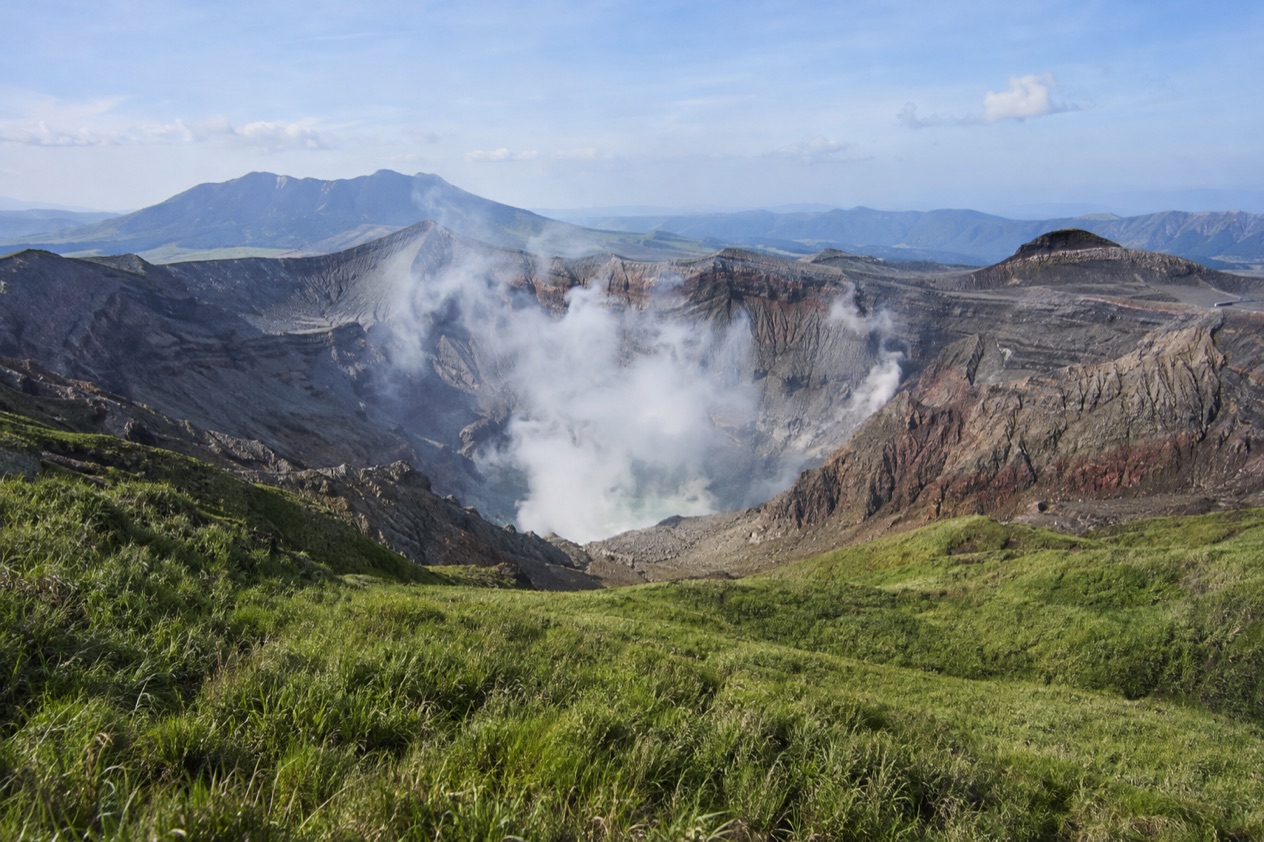
The island covers a land area of 14,202 square miles, and much of that is mountain. The Kyushu Mountains run through the interior, Mount Aso is Japan’s largest active volcano at 5,220 feet, and Sakurajima keeps smoking above Kagoshima Bay as one of the most active volcanoes in the country.
Kumamoto Prefecture carries the nickname Land of Fire for exactly this reason. The same heat underground feeds the steam vents and baths that give the island its reputation for onsen, the Japanese hot springs.
The character of Kyushu changes from city to city. Fukuoka is a port city with the fastest population growth of any city in Japan, and it feels young and busy around its food stalls.
Kagoshima has been called the Naples of the Eastern world for its bay, its warm climate and its volcano. Nagasaki carries a long history of contact with the outside world, and Beppu and Yufuin put the baths at the center of the day.
It is a place for travelers who like to eat, soak and watch a landscape smoke and steam. If you would rather tick off a single great temple district, Kyushu spreads out more than that. Its pleasures are scattered between cities, mountains and islands, and linking them is part of the trip.
What is there to do in Kyushu?
The big reasons to come are food, hot springs, volcanoes and history, and Kyushu stands apart from the rest of Japan because it puts all four within one island. Honshu has the old capitals. Kyushu has ramen counters, steaming towns and a crater you can look into.
Fukuoka and the food stalls
Kyushu is world-famous for its tonkotsu ramen, the cloudy, rich pork-bone soup with thin noodles, and Fukuoka is where visitors first slurp a bowl. Fukuoka City was selected in the Food category of Lonely Planet’s Best In Travel 2023, and the Hakata yatai, the open-air food stalls, were chosen for The New York Times’ 52 Places to Go in 2023. The stalls set up at dusk, each with a handful of stools and a short menu.
Beyond ramen, a night here often means grilled skewers, gyoza, mentaiko (spiced cod roe) and sips of local shochu, the distilled spirit of the south. Fukuoka also works as a gateway to the rest of the island, since the San’yo Shinkansen from Osaka ends at Hakata Station. It suits anyone who plans a trip around meals and likes city evenings outdoors.
Beppu, Yufuin and the hot springs
Beppu is the largest hot spring resort in western Japan, with eight major hot spring zones and about 3,000 steam vents. Plumes rise from the town itself, and the eight boiling sources, the famous jigoku or hells, are the sights people come to see. Some are colored sources you look at rather than bathe in, and the town also has public baths and sand baths.
Yufuin Onsen, in the city of Yufu, is another system of springs in Oita Prefecture. Some of its baths admit day visitors, but many are strictly for overnight guests, which shapes how you plan a visit. Around Mount Aso in central Kyushu the springs are of a different kind, set among grassland and crater walls, and they suit travelers who want to soak between hikes.
Volcanoes: Sakurajima, Aso and Kirishima
Sakurajima rises beside Kagoshima City, and the city lives with its plume in view. Mount Aso is a wide caldera in central Kyushu, and the Kirishima mountains hold Mount Karakuni among their peaks. Walking, driving and looking across these craters is a large part of what makes the island different from its neighbors.
These are active landscapes, and what you can reach on a given day depends on the volcano. Look at the mountain, the steam and the ash-dusted slopes, then follow it with a bath, since the two go together here.
Nagasaki, Kumamoto and Yakushima
Nagasaki, at the western extremity of the island, is a hillside port city. The Hidden Christian Sites in the Nagasaki Region have been recognized and included in the UNESCO World Heritage Sites list, and they tell the story of believers who kept their faith through a long ban. From Nagasaki Airport, buses run to the Shinchi bus terminal in the city center.
In Kumamoto, the castle’s keep and many other structures were severely damaged in the 2016 earthquake, and the castle has been closed since then, with restoration expected to last until the 2030s. Yakushima, an island in the East China Sea, is 90% covered by mountains and forests, and its ancient forest has been a natural UNESCO World Heritage Site since 1993. Its trails reward walkers who want moss, cedars and mist rather than city streets.
How many days do you need in Kyushu?
A week gives you a real loop of the island, while a long weekend is enough for one city and one hot spring town. Kyushu is spread out, so the question is less how much there is and more how much ground you want to cover.
Fukuoka makes a good start for the stalls, the harbor and a night of ramen, and from there you can reach Beppu on the east shore for a morning in the steam. Or stay in Nagasaki, where the slopes, the harbor and the stories of the Christian communities fill a short stay on their own.
With a week, you can link the north, center and south. A route might run from Fukuoka down to Kumamoto and then to Kagoshima, with the Kyushu Shinkansen connecting the last two in 42 minutes. In Kumamoto you can see what remains of the castle area and the city, and in Kagoshima you are close to Sakurajima, which makes a natural volcano day.
Longer stays open the places that sit away from the rail line. Takachiho, a town in the northernmost part of Miyazaki Prefecture in the Kyushu Mountains, is a quiet detour into the highlands.
Beppu and Yufuin can fill several nights if you want to soak slowly, and Yakushima deserves its own block of time, since its forest walks are the reason to go and not an add-on. Okinawa belongs to the Kyushu region on paper, but treat it as a separate trip.
Where to stay in Kyushu
Fukuoka suits first-time visitors and food lovers best, because the stalls, the harbor and the rail connections are all around Hakata. It is also the city where the Shinkansen from Osaka arrives, which makes it a practical starting base. Evenings revolve around eating outdoors, so staying close to the yatai means you walk home after dinner.
Beppu suits travelers who want to wake up to steam. The town has eight major hot spring zones, and a night here is built around baths. Yufuin is the choice for a ryokan stay, the traditional inn with tatami rooms and its own bath. Since many onsen in Yufuin are strictly for overnight guests, sleeping in town is how you get into those baths, while day visitors have only some of them.
Kagoshima suits anyone who wants the volcano outside the window. It sits close to Sakurajima, and its bay setting gave it the Naples nickname. Kumamoto works as a base for the center of the island, with Mount Aso and the Land of Fire landscapes within reach and a city that is rebuilding its castle. Nagasaki, with its hillsides and harbor, is a good place to stay for the Hidden Christian Sites and the port itself.
For wilder stays, Yakushima is an island in the East China Sea where the forest is the reason to sleep, and Takachiho sits in the highlands of northern Miyazaki. Each of these asks for a night or more rather than a day visit.
How do you get to Kyushu and get around?
You can reach Kyushu by Shinkansen from Honshu, since the San’yo Shinkansen runs from Osaka to Fukuoka and all its trains stop at Kokura Station in Kitakyushu and Hakata Station in Fukuoka. Sakura trains continue the journey from Osaka to Kagoshima in 4 hours, and the Japan Rail Pass is accepted on Sakura trains but not on Mizuho trains. Nagasaki has its own airport, and buses from there go to the Shinchi bus terminal in the city center.
Within the island, the Kyushu Shinkansen connects Kumamoto with Kagoshima and Fukuoka, and the high-speed trains run on to farther places as well. The JR Kyushu Rail Pass is a ticket for foreign visitors that allows travel between several cities in Kyushu. It gives unlimited travel on JR Kyushu’s lines, including both Kyushu Shinkansens, but it does not cover the San’yo Shinkansen to Hakata.
| All Kyushu pass | Adult | Child |
|---|---|---|
| 3 consecutive days | 22,000 yen | 11,000 yen |
| 5 consecutive days | 24,000 yen | 12,000 yen |
| 7 consecutive days | 26,000 yen | 13,000 yen |
Beyond the rail line, Kyushu spreads into places where the schedule is of the bus, the car or the boat. Yakushima is an island, so reaching it means leaving the mainland. Takachiho and the Aso area lie in the mountains, and you will plan those around the local transport that serves them.
Inside Fukuoka and most of the island’s cities, much of the sightseeing is on foot between stops. Sakurajima, Beppu’s steam zones and the old quarters of Nagasaki are the sort of places where wandering is the plan. Plan each leg of the trip around its own timetable.
When is the best time to visit Kyushu?
Spring and autumn are the seasons travelers choose for Kyushu, since they suit the walks, crater views and long train days that fill an island trip. Summer here is hot and humid, which shifts the days toward early starts and cooler forest air on Yakushima. Winter is the season for onsen, when a bath after a cold day is the point of the trip.
Festivals add their own reasons to pick a month. Hakata Dontaku takes over Fukuoka’s streets in early May, around Golden Week, and the Hakata Gion Yamakasa festival brings teams carrying heavy floats through the city in July. Nagasaki holds its Kunchi festival in October and a lantern festival around the Lunar New Year, when the harbor streets are strung with lights.
The volcanoes and onsen themselves do not follow a calendar, so Beppu’s steam and Sakurajima’s plume are there in every season. Pick the month by what else you want: yatai stalls and festivals in warm weather, soaking and rail days in the cooler months. Allow for the Golden Week holiday period in early May and the summer travel season when you plan rooms and trains.
Good to know before you go
Kyushu is an active volcanic island, and that shapes small things on the ground. Sakurajima is one of the most active volcanoes in Japan, so ash and plumes are part of daily life around Kagoshima. Kumamoto Castle remains closed for restoration, and many Yufuin onsen are for overnight guests only, so plan baths and sights with those limits in mind.
Money, bus and train details change from city to city, so treat each place as its own trip. The rail pass prices above are for foreign visitors, with lower child fares. Beyond that, take your time, since the pleasures of the island come in the pauses between stops.
Sources
- Japan National Tourism Organization, Kyushu (https://www.japan.travel/en/destinations/kyushu/), checked October 11, 2026
- JR Kyushu, Rail passes (https://www.jrkyushu.co.jp/english/railpass/), checked October 11, 2026
- Wikipedia, Kyushu (https://en.wikipedia.org/wiki/Kyushu), checked October 11, 2026
- Wikipedia, Regions of Japan (https://en.wikipedia.org/wiki/Regions_of_Japan), checked October 11, 2026
- Wikivoyage, Kyushu (https://en.wikivoyage.org/wiki/Kyushu), checked October 11, 2026
- Wikipedia, Takachiho, Miyazaki (https://en.wikipedia.org/wiki/Takachiho,_Miyazaki), checked October 11, 2026
- Japan National Tourism Organization, Fukuoka (https://www.japan.travel/en/destinations/kyushu/fukuoka/fukuoka-city/), checked October 11, 2026
- Fukuoka City official tourist guide (https://yokanavi.com/en/), checked October 11, 2026
- Japan National Tourism Organization, Nagasaki (https://www.japan.travel/en/destinations/kyushu/nagasaki/nagasaki-city-and-around/), checked October 11, 2026
- Wikipedia, Nagasaki (https://en.wikipedia.org/wiki/Nagasaki), checked October 11, 2026
- Japan National Tourism Organization, Kumamoto (https://www.japan.travel/en/destinations/kyushu/kumamoto/kumamoto/), checked October 11, 2026
- Wikipedia, Kumamoto (https://en.wikipedia.org/wiki/Kumamoto), checked October 11, 2026
- Japan National Tourism Organization, Kagoshima (https://www.japan.travel/en/destinations/kyushu/kagoshima/kagoshima-and-around/), checked October 11, 2026
- Wikipedia, Kagoshima (https://en.wikipedia.org/wiki/Kagoshima), checked October 11, 2026
- Japan National Tourism Organization, Beppu (https://www.japan.travel/en/destinations/kyushu/oita/beppu-and-yufuin-around/), checked October 11, 2026
- Wikipedia, Beppu, Ōita (https://en.wikipedia.org/wiki/Beppu,_%C5%8Cita), checked October 11, 2026
- Wikipedia, Yufuin (https://en.wikipedia.org/wiki/Yufuin), checked October 11, 2026
- Japan National Tourism Organization, Yakushima (https://www.japan.travel/en/destinations/kyushu/kagoshima/yakushima/), checked October 11, 2026
- Wikipedia, Yakushima (https://en.wikipedia.org/wiki/Yakushima), checked October 11, 2026