
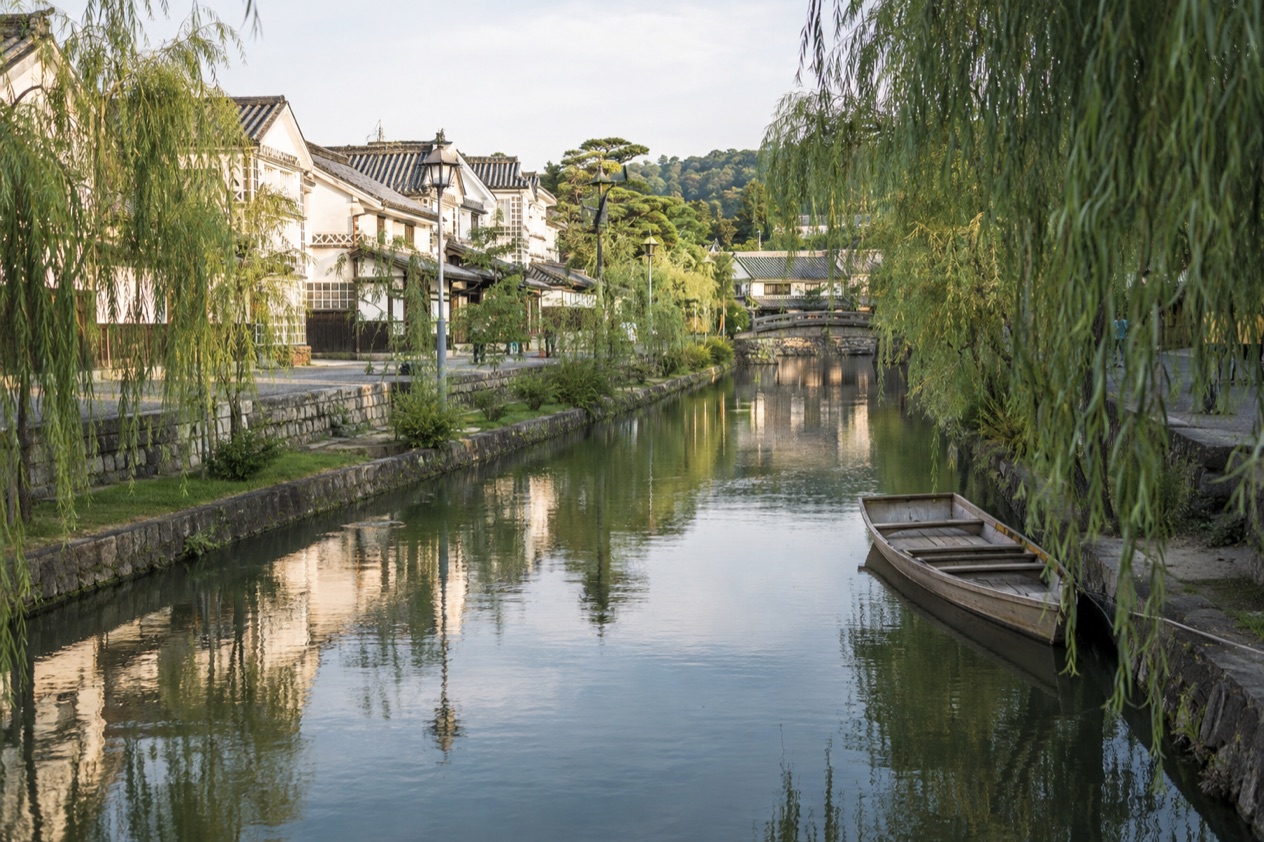
Willow branches trail over a slow canal, and the white walls of old storehouses ripple in the water beside them. Someone in indigo trousers, perhaps made right here, leans on the stone embankment to look at the reflections. Kurashiki is a merchant town on the Seto Inland Sea side of Okayama Prefecture, a place of canals, black-tiled roofs, art museums and denim, suited to travelers who like to wander slowly and look closely.
Where is Kurashiki and what is it like?
Kurashiki is a city in the south-central part of Okayama Prefecture, where the Takahashi River flows through on its way into the Seto Inland Sea, and it sits 30 minutes west of Okayama. That position tells you a lot about its history. A town with a river, a sheltered sea and a flat plain behind it became a place where rice and goods were stored and traded, and the storehouses that held them are what visitors come to see today.
The old merchant quarter is called the Bikan historical area. Its wooden warehouses, many of them from the 17th century, are painted white and topped with traditional black tiles, and they line a canal.
Many of the original storehouses, mills and shops still stand in beautiful condition and are open to visitors. The feel is of a town that kept its working buildings and gave them new lives as museums, shops, cafés and galleries, rather than a set built for tourists.
The character of Kurashiki is a mix of two things. One is the preserved Edo and Meiji atmosphere of the canal, with its stone edges, lanterns and bridges. The other is a modern town of rail lines and shopping streets around the station, where the pace is that of an ordinary Japanese city. The two meet at the edge of the historic district, which is a 10-minute walk from Kurashiki Station.
Kurashiki rewards people who enjoy architecture, crafts, art and small details such as the pattern of tiles or the way a shop curtain is dyed. It also fits travelers who want a break from the larger cities of the region and are happy to spend a day or two on foot. If your idea of a trip is nightlife, big mountain scenery or long hikes, the town will feel gentle and compact in spirit, so it works best as a chapter in a longer route rather than the whole story.
What is there to do in Kurashiki?
The big reasons to come are the canal quarter, the art, the denim and the food of the Okayama region, and what sets Kurashiki apart from its neighbors is that so much of this sits together in one compact historic center. You can spend a day moving between storehouses without needing a plan.
The Bikan Historic Area
This is the heart of the visit. You walk beside the canal under willow trees, past white-walled warehouses with black tiles, and cross small stone bridges that frame the same view from different angles. Many former storehouses, mills and shops are open to visitors, and they now hold galleries, craft shops, tea rooms and places for a sweet or a coffee.
The district is reached on foot from the station, and the walk itself takes you from shopping streets into the older quarter. Wander down the side lanes as well as along the canal, because the lattice windows, wooden signs and tiled eaves are easiest to appreciate on the narrower streets. A tourist information office in the area can answer questions and hand you a map.
| Site | Open |
|---|---|
| Bikan Historic Area tourist information office | 09:00 to 17:00 |
The Ohara Museum of Art
Kurashiki is home to Japan’s first museum for Western art, founded in 1930 by Magosaburo Ohara. Its collection includes paintings by El Greco, Monet, Matisse, Gauguin and Renoir, which is an unexpected thing to find in a canal town in western Japan. The story behind it is that of a local businessman who wanted to bring European art to his own community.
A visit suits anyone who likes painting, but also those who simply want a cool, indoor pause in the middle of a day of walking.
Denim and local crafts
Kurashiki is known as Japan’s denim capital, and that identity shows in the shops. Look for jeans, jackets, bags and small goods dyed in deep indigo, along with other textiles and handmade items in the old storehouses. Even if you are not buying, it is fun to see how a regional industry became part of the town’s image.
Browsing makes a good rhythm between the quarter’s museums. Go in with curiosity about how things are made, ask about the cloth, and notice the details in stitching and color. A small piece of indigo-dyed fabric is a lighter souvenir than a pair of trousers, if you are packing carefully.
Eating around the canal
Okayama Prefecture is well known in Japan for its fruit, especially peaches and grapes, and for a regional style of sushi in which seafood and vegetables from the nearby sea and fields are laid over seasoned rice. In the canal quarter you will find cafés and sweet shops that use that local fruit, as well as small restaurants serving regional dishes.
Treat a meal as part of the sightseeing. A pause in an old storehouse turned café, with timber beams overhead and a view onto the water, is as much a memory of Kurashiki as any museum. Ask what is local that day and let the menu guide you.
How many days do you need in Kurashiki?
With a day, you can walk from the station into the Bikan area, spend time along the canal, visit the Ohara Museum of Art, browse the denim and craft shops, and have a meal in one of the old buildings.
If you stay a night, you get a slower pace. The same streets feel different when the day-trip crowds have left, and you can return to a corner you liked rather than rushing on. Two days lets you add a second museum or gallery visit, a long lunch, more time for shopping and room for rain, which can reshape a day in this part of Japan.
Because Kurashiki is 30 minutes west of Okayama by train, travelers pair the two. Okayama gives you a larger city with more hotels and a base for the surrounding region, and Kurashiki makes a calm contrast. With more time in the region, add other stops in Okayama Prefecture and along the Seto Inland Sea side, using Okayama or Kurashiki as a hub.
A good rule of thumb is to fit Kurashiki to your wider route. If you love museums and crafts, give it two days and enjoy the details.
Where to stay in Kurashiki
The most practical area is around Kurashiki Station, because the historic district is a 10-minute walk away and the station links you to Okayama on the Sanyo Line. Staying here puts the canal quarter within reach on foot and keeps train connections close. It suits travelers with luggage, those arriving late and anyone who wants to make easy use of the rail network.
If you want to be as close to the atmosphere as possible, look for lodging in or near the Bikan area itself. Waking up near the canal means you can step out before the town is fully awake, and walk back at the end of the day without a second thought. Such places give you the most of the old-town feel, and they suit couples and travelers who value setting over convenience.
Shin-Kurashiki Station is a different case. The Kodama Shinkansen stops there, and it lies about 5 miles west of downtown, two stops away on the JR San’yo Main Line. That makes it a point of arrival rather than a place to stay for the sights, though it can matter if your route follows the Shinkansen.
A final option is to base yourself in Okayama and visit Kurashiki as an outing. With the town 30 minutes away by train, this suits travelers who want a wider choice of hotels and restaurants, or who are exploring several places in the prefecture. The tradeoff is that you will not see the canal in the hours after the day visitors have gone.
How do you get to Kurashiki and get around?
Visitors arrive by train. From Okayama Station, you take the Sanyo Line to Kurashiki Station, and that trip is covered by the Japan Rail Pass. Kurashiki lies 30 minutes west of Okayama, so it fits easily into a day of regional travel.
If you are coming on the Shinkansen, note that the Kodama stops at JR Shin-Kurashiki Station rather than at Kurashiki Station itself. Shin-Kurashiki is about 5 miles west of downtown Kurashiki, two stops away on the JR San’yo Main Line, so you continue by local train to reach the town.
Once you arrive, the main way to see the sights is on foot. The historic district is a 10-minute walk from Kurashiki Station, and the Bikan area itself is made up of canal paths and narrow lanes that you explore at your own pace. The tourist information office in the Bikan Historic Area is open from 09:00 to 17:00, which is useful for maps and questions.
The streets near the canal reward comfortable shoes and a willingness to turn down side lanes. Bring a light bag, since shops and museums invite browsing, and leave time to stop when something catches your eye. For longer trips beyond the quarter, such as returning to Okayama or going on to other places in the region, the train is the link, with Kurashiki Station as your starting point.
When is the best time to visit Kurashiki?
Kurashiki has a humid subtropical climate, which means warm to hot, damp summers and cooler winters, and the best months for walking outdoors are the ones in between. Spring and autumn are the natural choices for a visit centered on strolling the canal, because you spend hours outside and the weather is gentler on the body than the heat of high summer.
Rain is worth planning around. September is the wettest month in Kurashiki, so a trip then can mean gray days and umbrellas along the canal, though the Ohara Museum of Art and the indoor shops give you somewhere to go. Summer brings humidity that makes long walks tiring, and a typhoon can sometimes affect travel in the region, so keep your schedule flexible if you come in late summer or early autumn.
Winter has its own appeal, with a stripped-down look to the canal and a good excuse to warm up in a café, while spring and autumn suit those who want to linger outdoors. Whatever the season, the town’s museums and shops give you options if the weather changes.
Good to know before you go
Yen is the currency in Kurashiki as everywhere in Japan, and a day in the canal quarter is mostly about small purchases in shops and cafés. Bring comfortable shoes for the stone paths and bridges, and a light rain layer, since showers can arrive in any wet month and September in particular is rainy.
Kurashiki also has a story of change worth knowing. A theme park called Tivoli, modeled after the park of the same name in Copenhagen, opened near Kurashiki Station in 1997 and closed in 2008, after ten years of operation. Today the draw is the historic quarter, and the best use of your time is on the canal, in the museum and among the shops.
Sources
- Japan National Tourism Organization, Kurashiki (https://www.japan.travel/en/destinations/chugoku/okayama/kurashiki/), checked October 11, 2026
- Wikipedia, Kurashiki (https://en.wikipedia.org/wiki/Kurashiki), checked October 11, 2026
- Wikivoyage, Kurashiki (https://en.wikivoyage.org/wiki/Kurashiki), checked October 11, 2026
To plan your stay
- Best Time to Visit Japan: Cherry Blossoms, Autumn Colors, Weather and Festivals
- Where to Stay in Japan: Ryokan, Temple Stays, Capsule Hotels and the Best Cities to Base In
- Sending Luggage from the Airport in Japan: Hands-Free Travel, Hotel Delivery and Coin Lockers
- Know Before You Go to Japan: Entry, Money, Etiquette and Getting Around