
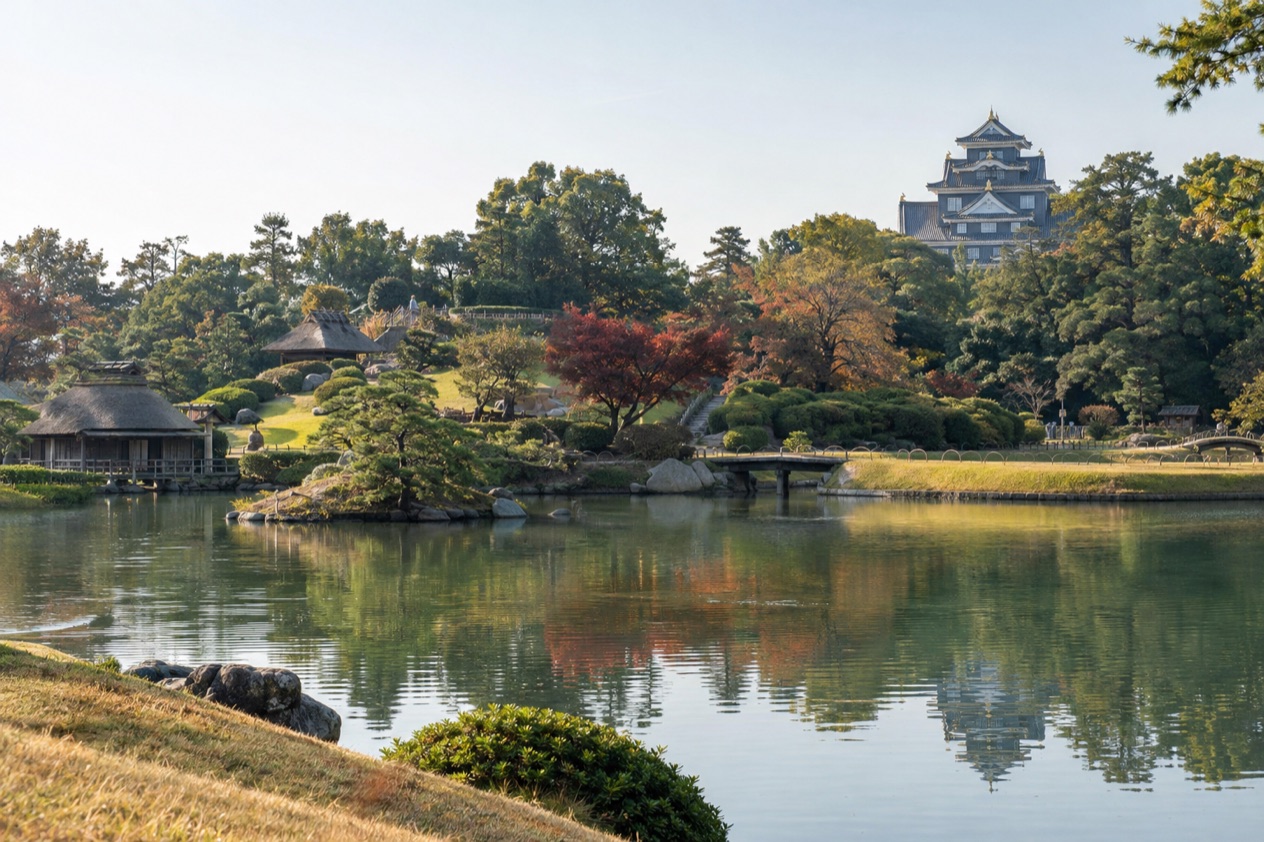
You cross onto an island between the Asahi River and the city, and the noise of Okayama drops away as lawns, pines and water open out ahead of you. The path bends, a pond appears, then a hill, then another stretch of grass, and each turn gives you a different picture. Korakuen is one of the Three Great Gardens of Japan, and the visit is a slow, wandering walk with plenty of stopping places.
Is visiting Korakuen Garden worth it?
Yes, for anyone who likes to walk without a fixed goal, who enjoys gardens as designed landscapes, or who is already in Okayama and wants one place that explains the city’s past. Korakuen is counted among the three most beautiful traditional gardens in Japan, alongside Kenroku-en and Kairaku-en, and it rewards a slow pace more than a checklist.
What sets it apart from the famous gardens of Kyoto is its form. Many Kyoto gardens are small, enclosed and meant to be studied from a single spot, like the stone garden of Ryoanji, a karesansui that uses sand and stones to suggest water. Korakuen is built in the kaiyu style, a scenic promenade that presents a new view at every turn of the path.
It is a garden you move through, with open lawns, a large pond and a hill, and it was laid out by a feudal lord as a place for strolling, not only for contemplating. That makes it a good match for travelers who want fresh air and space after the dense streets of a station city.
It also sits next to Okayama Castle, known as the Crow Castle for its black walls. The two were conceived together, since the garden was first called Koen because it was built after the castle. Seeing both gives you the lord’s residence and his place of leisure in one outing.
What to see at Korakuen Garden
The kaiyu promenade
The whole garden is the first thing to see, and its logic is the path. In the kaiyu style the route is arranged so that scenery keeps rearranging itself: a clump of pines gives way to open grass, a stream slips under a small bridge, and a view you passed a minute ago is suddenly reframed from another angle.
Japanese garden designers often make a space feel larger than it is, using sudden changes in the direction or width of a path and layered perspectives. Notice where the path narrows or turns away just as a view starts to open.
Those are deliberate choices, and they explain why a garden this size holds your attention for so long. Stop now and then and look back along the way you came, because the view behind you is often a different garden.
Sawa-no-ike, the central pond
Water is the center of the garden. The pond called Sawa-no-ike, the Marsh Pond, holds three islands said to echo the scenery around Lake Biwa near Kyoto. Water is often the structural heart of a Japanese garden, and here it gives the lawns and hills a mirror to be seen in.
Walk the edge and let the islands slide in and out of view behind trees and stone lanterns. Listen as well as look, because flowing water and rustling leaves are part of how these gardens are meant to be experienced. If the day is bright, the surface doubles every pine, and if it is gray, the pond turns pale and quiet and the greens deepen.
The story behind the garden
Korakuen began in 1687, when the daimyo Ikeda Tsunamasa ordered Tsuda Nagatada to start construction. The garden was completed in 1700 and reached its modern form in 1863. Its first name, Koen, changed to Korakuen in 1871, and in 1884 ownership passed to Okayama Prefecture and the garden opened to the public.
In 1952 it was designated a Special Scenic Location under the Cultural Properties Protection Law. Historically, Japanese gardens like this hosted guests for poetry and Noh performances, so as you walk you are following a path made for gatherings of a lord and his invited friends. Picture the lawns as a stage for conversation and the pond as the backdrop.
Hours, tickets and rules
Korakuen has been a public garden since 1884, when the prefecture took it over from the family that had kept it for generations. Before that, entry was a privilege of the lord’s household and guests, so the simple fact of walking in as a visitor is part of the garden’s history.
Today it is run as a protected scenic landmark. Its status as a Special Scenic Location under the Cultural Properties Protection Law is one of the reasons the layout of lawns, pond and hill has survived into the present with so little change.
The garden occupies an island on the north bank of the Asahi River, set between the river and a developed part of the city. That setting means the grounds have clear edges. You step from a city street into a landscape that was designed to be seen as a whole, with its own paths, lawns and water. As a cultural property, the garden is meant to be walked gently, the way gardens in Japan are generally appreciated: following the paths, listening to the water and taking in the views without hurry.
How to get to Korakuen Garden
Visitors reach Korakuen through the city of Okayama, a major transit hub for western Japan on Honshu island. Okayama is the capital and largest city of Okayama Prefecture, on the coast of the Seto Inland Sea facing Shikoku, and the garden lies on an island in the Asahi River on the north bank.
By Shinkansen from Tokyo
Nozomi trains leave Tokyo at 20-minute intervals between 6:00 and 20:30, and they reach Okayama in as little as 3 hr 13 min.
Okayama is a gateway to the Chugoku region, so the city is also a base for other stops in the area. The garden belongs among them as the sight in the city itself, next to the castle.
By air
Okayama Momotaro Airport offers flights to and from Tokyo (Haneda), Sapporo and Okinawa, as well as direct international flights to Hong Kong, Seoul, Shanghai, Kaohsiung and Taipei. Travelers already in Japan can arrive from those domestic cities, and visitors based elsewhere in East Asia have direct routes of their own.
Once you are in the city, the garden and the castle are the two landmarks to look for on a map, both on the river side. The black walls of the Crow Castle are the easiest sign that you are close.
When to visit Korakuen Garden
Korakuen is a garden of changing views, and the same path feels different from one season to the next. Japanese garden culture has always paid attention to the seasons, with leaves, light and water giving each visit its own mood. Because the kaiyu layout shows something new at each turn, the garden holds up on a return trip in another month.
Lawns look freshest in green seasons, the pond holds reflections on bright days, and gray weather softens everything into quiet tones. Whatever the month, pick a day when you have time to follow the whole path without watching the clock, and give the pond its own stop. The soundscape of water and leaves is part of the visit, and it comes through best when you are not hurrying.
If you are planning around other sights, remember that the garden and Okayama Castle sit together, so a clear day suits both. Rain does not ruin the garden, since wet stone and dark pines are part of how Japanese gardens have long been admired. Choose the season by the mood you want, then walk slowly and let the path do the work.
Tips for your visit
Wear shoes you are happy to walk in for a long stretch, since the garden is a promenade and the pleasure is in covering the whole path. Bring something to drink and a camera, and keep your pace loose. A visit here is not a race between viewpoints, and the best moments are often the ones you find by simply following the next bend.
Pair it with Okayama Castle
Okayama Castle, the Crow Castle with its black walls, is ranked among the best 100 Japanese castles. Because the garden was built after the castle and first named Koen for that reason, the two make a natural pair on the same outing. Go to one for the lord’s seat of power and to the other for the place where he relaxed.
Consider walking the garden first, then looking at the castle’s dark walls as a counterpoint to the soft greens you have just seen. The contrast is part of the pleasure, and it gives the day a clear shape.
Think like a garden visitor
Take advantage of the design. Pause where a path bends, look for the three islands in Sawa-no-ike, and listen for water. In Japanese gardens, flowing water and stone basins called tsukubai add a soothing sound, and the same attention to small sounds applies here.
Compare it with the dry stone gardens you may have seen in Kyoto. Where those ask you to sit and contemplate, Korakuen asks you to wander. Keeping that difference in mind helps you enjoy it for what it is, a large, open garden made for walking with friends.
Good to know before you go
Korakuen is a historic landscape, so treat it as one: keep to the paths, speak softly near the pond and take your time. Okayama is a city with a full range of places to eat and stay, which makes it easy to build a leisurely day around the garden and the castle, and then continue along the Chugoku region by rail or by air.
Sources
- Japan National Tourism Organization, Japanese gardens (https://www.japan.travel/en/see-and-do/japanese-garden/), checked October 11, 2026
- Wikipedia, Kōraku-en (https://en.wikipedia.org/wiki/K%C5%8Draku-en), checked October 11, 2026
- Japan National Tourism Organization, Okayama (https://www.japan.travel/en/destinations/chugoku/okayama/okayama-and-around/), checked October 11, 2026
- Wikipedia, Okayama (https://en.wikipedia.org/wiki/Okayama), checked October 11, 2026
- Wikivoyage, Okayama (https://en.wikivoyage.org/wiki/Okayama), checked October 11, 2026
To plan your stay
- Best Time to Visit Japan: Cherry Blossoms, Autumn Colors, Weather and Festivals
- Where to Stay in Japan: Ryokan, Temple Stays, Capsule Hotels and the Best Cities to Base In
- Sending Luggage from the Airport in Japan: Hands-Free Travel, Hotel Delivery and Coin Lockers
- Know Before You Go to Japan: Entry, Money, Etiquette and Getting Around