
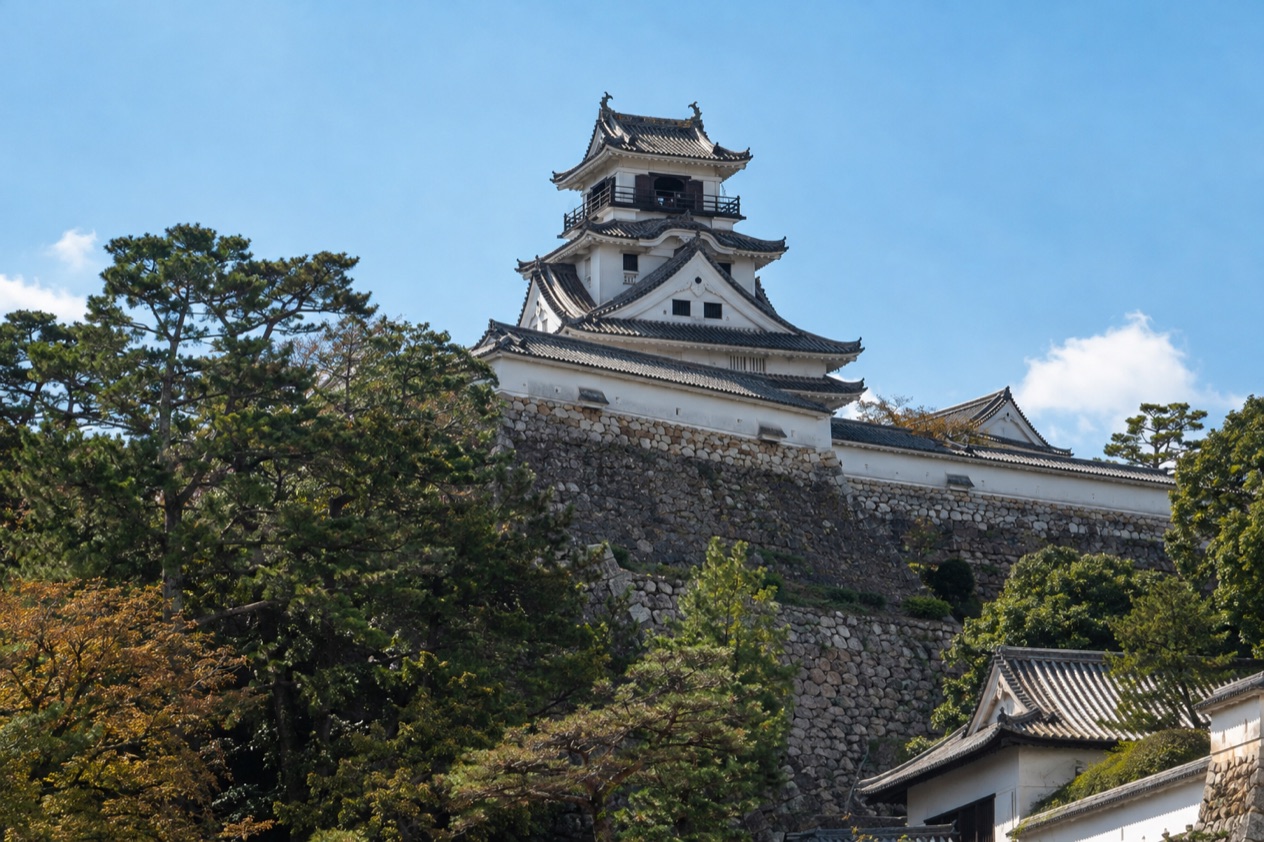
You walk up through the stone-walled slopes of a hilltop park, and the white keep of Kochi Castle slowly comes into view above the pines and the old walls. Wooden beams, steep stairs and a palace of tatami rooms wait inside. This is a visit for travelers who like to touch the real thing, a castle that still looks the way feudal Shikoku built it.
Is visiting Kochi Castle worth it?
Kochi Castle is the only castle in Japan to keep both its historical tenshu, the main keep, and its palace, the residence of the local daimyo. That pairing is the reason to come.
Many castles across Japan are concrete reconstructions, handsome from a distance and modern once you step inside. Here the structure is one of the few in the country that still has its original wooden frame, dating from the early 18th century. You feel it in the creak of the floors, the dark grain of the posts and the narrow, steep way up through the keep.
The castle also came through history in an unusual way. It escaped any damage during the Boshin War, and it was exempted from the orders after the Meiji restoration to destroy all remaining feudal fortifications.
The Japan Castle Foundation placed it on its list of Top 100 Castles, and the site is a National Historic Site. For a traveler, all of that adds up to a castle with real continuity, set in a city on the Pacific coast of Shikoku, far from the better-known castle circuits of Honshu.
What to see at Kochi Castle
The visit has two heart buildings, the keep and the palace, joined by a hilltop park of stone walls, gates and trees. Take them in as a walk through different layers of castle life: the lookout of the lord’s soldiers and the rooms where the lord himself lived.
The tenshu on Otakasa Hill
The main keep rises five stories on top of Otakasa Hill and commands an extensive view over Kochi city. From the outside it reads as a stack of white-plastered walls and dark wooden trim, with gently curved gables stepping up toward the roof. The keep is the picture people carry home, and the wooden frame behind those walls is the old one.
Inside, look at the heavy beams, the worn wooden stairs and the small windows that once served as lookouts. The top floor opens onto a surrounding balcony with a railing, where the view spreads across the rooftops of the city. It is a place to stop and trace the streets below, imagining how the castle once watched over the town that grew at its foot.
The Kaitokukan palace
The Kaitokukan is what makes Kochi Castle rare. Inside the central area, this palace holds eight traditional rooms ranging in size from three to twelve tatami, along with a tearoom, a genkan (the entrance hall where shoes come off) and a latrine. It was the residence of the local daimyo, and it shows how a lord’s household was arranged around the keep.
Look at the way the rooms differ: the small ones feel like private corners, while the larger ones with their wide tatami floors suggest receptions and ceremony. Sliding doors, wooden ceilings and the soft light of paper screens set the mood. The tearoom is a reminder that a castle was also a place of manners and hospitality, not only defense.
Stone walls, gates and the castle grounds
The grounds are now a public park, and the approach is part of the pleasure. Stone walls rise at angles along the slopes, and the gates, with their heavy timbers and tiled roofs, frame the path up the hill. Near the main gate you will find statues of figures tied to the castle’s story, including a rider on horseback who recalls the clan that built the place.
In spring the park is a popular spot for hanami, the custom of gathering under cherry blossoms. Blossoms soften the dark stone and the white walls of the keep, and families spread out on the lawns beneath the trees. Outside the blossom days, the grounds are still a good place to walk slowly and look at the stonework from different angles.
How to get to Kochi Castle
From the center of Kochi, the castle is reached on foot: it is a 20-minute walk from JR Shikoku Kochi Station. That puts it within the city itself, so you can include it in a day of wandering without planning a separate excursion. The route leads you from the station toward the hill, and the keep appears above the trees as you get close.
Kochi is a city on the Pacific Ocean in Shikoku, and it is the capital of Kochi Prefecture. To reach the city from the main island, take the Tokaido-Sanyo Shinkansen to Okayama Station. From the west side of Okayama Station, a JR Shikoku bus runs to Kochi. Once in town, you can walk to the castle from the station.
If you are staying in the city, the walk is a way to see Kochi on the way: streets, shops and the changing mood of a Shikoku provincial capital.
When to visit Kochi Castle
Spring is the season the castle is known for, because the grounds are a popular location for hanami. When the cherry trees bloom, the park fills with pink and white against the stone walls and the keep above.
Outside spring, the castle keeps its appeal because its main attractions are the buildings themselves. The keep and the palace stand in every season, and the stone walls and gates look different as the trees around them change. Summer brings deep green to the park, and the cooler months leave the lines of the walls and rooflines more visible against the sky.
A rainy day does not cancel the visit. The palace rooms and the interior of the keep give you plenty to see under a roof, and the sight of wet stone and dark timber can suit a castle of this kind. Opening hours are not part of what is confirmed here, so plan the day around the walk up the hill and the time you want to spend inside the two buildings.
Tips for your visit
Wear shoes that suit stairs and slopes, and ones you can slip off and on again, since a palace of tatami rooms is a place where shoes come off at the entrance. The grounds are a hilltop park with stone walls and stairs, so expect to climb. The keep has five stories, and moving between them means taking the old wooden stairs.
Give the visit a slow pace. The keep and the palace each reward lingering: look at the beams, the sliding doors, the tearoom and the small windows. Then walk the grounds and look back at the keep from the lower walls.
Combine the castle with a stroll through Kochi, since it sits in the city and the walk from the station already carries you through town. Kochi is a city on the Pacific coast, and its food is part of a day out: seafood is a local pride, and a meal after the castle fits the rhythm of the visit. Families can turn the park into a picnic stop in the right season.
Good to know before you go
Carry some yen for small purchases around town, and keep a light layer or rain jacket in your bag, since a hilltop walk can bring changes in weather. As in any Japanese city, a few habits help: keep your voice low in the palace rooms, take shoes off where asked and follow any signs posted inside the buildings.
Sources
- Wikipedia, Kōchi Castle (https://en.wikipedia.org/wiki/K%C5%8Dchi_Castle), checked October 11, 2026
- Japan National Tourism Organization, Kochi (https://www.japan.travel/en/destinations/shikoku/kochi/kochi-and-around/), checked October 11, 2026
- Wikipedia, Kōchi, Kōchi (https://en.wikipedia.org/wiki/K%C5%8Dchi,_K%C5%8Dchi), checked October 11, 2026
- Wikivoyage, Kochi (https://en.wikivoyage.org/wiki/Kochi), checked October 11, 2026
To plan your stay
- Best Time to Visit Japan: Cherry Blossoms, Autumn Colors, Weather and Festivals
- Where to Stay in Japan: Ryokan, Temple Stays, Capsule Hotels and the Best Cities to Base In
- Sending Luggage from the Airport in Japan: Hands-Free Travel, Hotel Delivery and Coin Lockers
- Know Before You Go to Japan: Entry, Money, Etiquette and Getting Around