
The plane banks over Osaka Bay and the runway seems to rise straight out of the water, because the airport sits on an island built for it. Kansai International Airport, known by its code KIX, is the gateway to western Japan, and it lets a traveler begin a trip in Osaka and Kyoto without ever passing through Tokyo. What follows covers the terminals, the airlines you will meet there and the train that links the island to both cities.
What is Kansai International Airport?
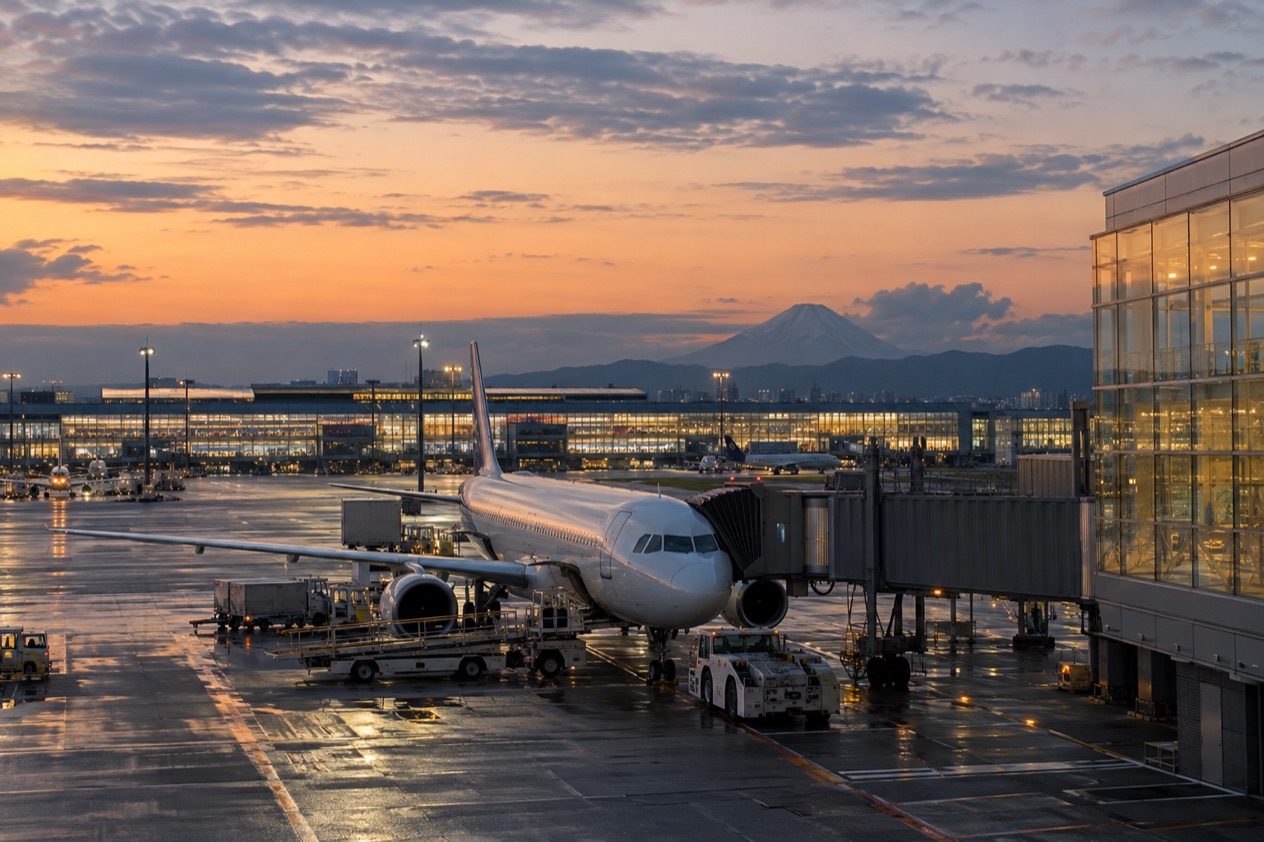
Kansai International Airport is the main international gateway of the Osaka and Kyoto region, built on an artificial island in Osaka Bay, 24 miles southwest of Osaka Station. Japan’s national tourism organization presents it as the way to visit the country without going through Tokyo, an alternative to Haneda and Narita, the two airports that serve the capital. For a trip that centers on Kyoto, Osaka, Nara or Kobe, that is the practical appeal: you land close to where you are going.
The airport opened on September 4, 1994, and it was the first airport in Japan to operate around the clock. A second runway followed on August 2, 2007, and it stretches 13,120 feet. The island setting gives the place its look: long glass buildings, open water on every side and planes rising and falling over the bay.
Terminal 1, a very long building
Terminal 1 is the longest airport terminal in the world, 1.1 miles from end to end. It is the main hall of the airport, and most of the airlines you will fly are based there. Because the building is so long, you notice the distances as soon as you walk off the plane, so it helps to keep an eye on the signs for your gate and your exit.
There is also a small pleasure for anyone with children or a long layover. In Terminal 1, a game area called Nintendo Check In offers free play on Nintendo Switch consoles. It is a very Japanese way to pass an hour between flights, and it costs nothing.
Terminal 2 and the free shuttle buses
Terminal 2 is a separate building used exclusively by three carriers: Peach, Spring Airlines and Jeju Air. If you hold a ticket with one of them, you will check in there rather than in the main hall. Free shuttle buses link Terminal 1 and Terminal 2, and they also connect Terminal 2 with the railway and ferry stations.
So the shuttle matters mostly to travelers on those three airlines, and to anyone arriving in Terminal 2 who then needs to find the train. Read the terminal printed on your booking before you leave for the airport, since the two buildings are not next to each other.
A busy airport for travelers from abroad
In calendar year 2025 the airport handled 34.1 million passengers, and 27.5 million of them were on international flights. In other words, most of the people moving through the halls are travelers heading to or from another country. Freight is a big part of the story too, with 786,814 tonnes passing through in the same year.
Other regional airports play similar roles for other parts of the country. Nagoya’s Centrair is a hub for flights to and from cities in Asia and Japan, Fukuoka Airport is a few minutes by train from Hakata, and Hokkaido’s domestic flights mostly land at Chitose. Kansai is the one that opens the door to Osaka, Kyoto and the area around them.
Which airlines fly there?
Many carriers use Kansai International Airport, and the ones you can name from what is known are Hawaiian Airlines, StarFlyer, Peach, Spring Airlines and Jeju Air. Each tells you something about how the airport is used: a Pacific route, a domestic hop to Tokyo and three low-cost carriers sharing one terminal. The full list of airlines changes with the schedules, so the airline you book is the best guide to what you will find.
Hawaiian Airlines and the Pacific link
Hawaiian Airlines flies nonstop from Kansai International Airport to Honolulu. For an American traveler this is the route that ties the airport to the Pacific, and it gives the trip a natural end in Hawaii for anyone who wants to stop there on the way home.
It also shows how a trip to Japan can be shaped differently from the usual loop through the capital. You can arrive in one city and leave from another, and a flight out of Osaka can be part of that plan.
StarFlyer to Tokyo-Haneda
StarFlyer flies nonstop from Kansai International Airport to Tokyo-Haneda. Haneda is the airport of Tokyo city itself, and it now receives international flights that arrive directly in the heart of the capital. A domestic flight is one of the ways to connect Osaka and Tokyo, along with the rail network that runs through the country.
A traveler who lands at Kansai and wants to finish the trip in Tokyo can pair the two airports with this connection. Which way to go is a matter of taste and of the route you have in mind, so it belongs to your own plan rather than to a rule.
Peach, Spring Airlines and Jeju Air in Terminal 2
Three low-cost carriers share Terminal 2: Peach, Spring Airlines and Jeju Air. No other airline uses that building, so a ticket with one of them points you straight to it. Low-cost carriers are also how travelers reach other parts of Japan, since most prefectures have at least one airport and these airlines make it possible to reach almost anywhere in the country at a reasonable price.
Kansai can be a starting point for that kind of onward flight, and Terminal 2 is where several budget airlines are based.
How do you get to Osaka and Kyoto?
The train called the Haruka is the link the airport is known for, running from Kansai International Airport to Kyoto with stops in Osaka on the way. Airports in Japan’s major cities are well served by express trains, buses and taxis, and most have car rental services, so you have several ways to leave the island. The Haruka is the one that reaches Kyoto Station directly.
| Haruka | Detail |
|---|---|
| Daily return workings per direction | 30 |
| Frequency | Every half hour through most of the day |
| Kyoto Station to Kansai International Airport | 1 hour 20 minutes per way |
| Main stops in Osaka City | Shin-Osaka, Osaka and Tennoji |
Riding the Haruka
The Haruka runs about every half hour for most of the day, and a typical trip between Kyoto Station and the airport takes 1 hour 20 minutes each way. In Osaka City it primarily stops only at Shin-Osaka, Osaka and Tennoji, though some trains make extra stops during the early morning or evening rush hours. So for Kyoto you stay on the train, and for Osaka you get off at one of those three stations.
Since the revised timetable began on March 18, 2023, all Haruka services stop at Osaka Station, using the new Umekita underground platforms. On board there is free public Wi-Fi, and all cars are non-smoking. The trains have also run in a special Hello Kitty wrapping since January 29, 2019, and those themed trainsets are expected to stop running in the middle of 2027.
Paying with an ICOCA card or a Japan Rail Pass
An ICOCA card can be used as the fare ticket for non-reserved travel on the Haruka. The limited express ticket is then bought from the conductor on board the train. That is how the card and the extra ticket work together on this service, and it is specific to the Haruka.
Foreign passengers traveling with a Japan Rail Pass pay no extra charge for the Haruka. That statement belongs to this one train, so it tells you nothing about other lines or companies.
Buses, taxis and the other ways in
Besides the train, the airport has bus and taxi services, and a car rental counter is among the services that Japan’s major city airports generally offer. These options exist for travelers whose hotel is not on the Haruka line, or who simply prefer a ride that runs door to door. The terminal you arrive in will point you toward the right stop.
If you arrive at Terminal 2, the free shuttle bus takes you to the railway station. That small step is what puts a traveler on Peach, Spring Airlines or Jeju Air on the same trains as everyone else.
What may change on the line
JR West and Kyoto City have announced that Haruka services now ending at Kyoto Station will be extended to Yamashina Station from fiscal 2029. Until then, Kyoto Station is where the train ends. Anyone planning a stay in Kyoto should know the line could reach a station beyond it in the years ahead.
None of this changes the trip today. The Haruka remains the train that takes you from the airport island into the cities of the Kansai region.
Good to know before you go
Kansai International Airport sits in open water, and weather can reach it. After Typhoon Jebi on September 4, 2018, all flights were canceled until September 6 of that year, a reminder that storms can disrupt a flight in and out of the island. Leave some slack in your plans if a typhoon is in the forecast on the days you travel.
The airport runs around the clock, so an arrival or a departure at an unusual hour is still part of its normal rhythm. Keep your ICOCA card handy if you hold one, and note the terminal on your booking before you set off.
Sources
- Japan National Tourism Organization, how to reach the city from each international airport (https://www.japan.travel/en/plan/airport-access/), checked October 11, 2026
- Wikipedia, Haruka (train) (https://en.wikipedia.org/wiki/Haruka_(train)), checked October 11, 2026
- Wikipedia, Kansai International Airport, airlines and destinations (https://en.wikipedia.org/wiki/Kansai_International_Airport#Airlines_and_destinations), checked October 11, 2026
To plan your stay
- Best Time to Visit Japan: Cherry Blossoms, Autumn Colors, Weather and Festivals
- Things to Do in Japan: Kyoto Temples, Onsen, Street Food and Day Trips
- Where to Stay in Japan: Ryokan, Temple Stays, Capsule Hotels and the Best Cities to Base In
- Know Before You Go to Japan: Entry, Money, Etiquette and Getting Around