
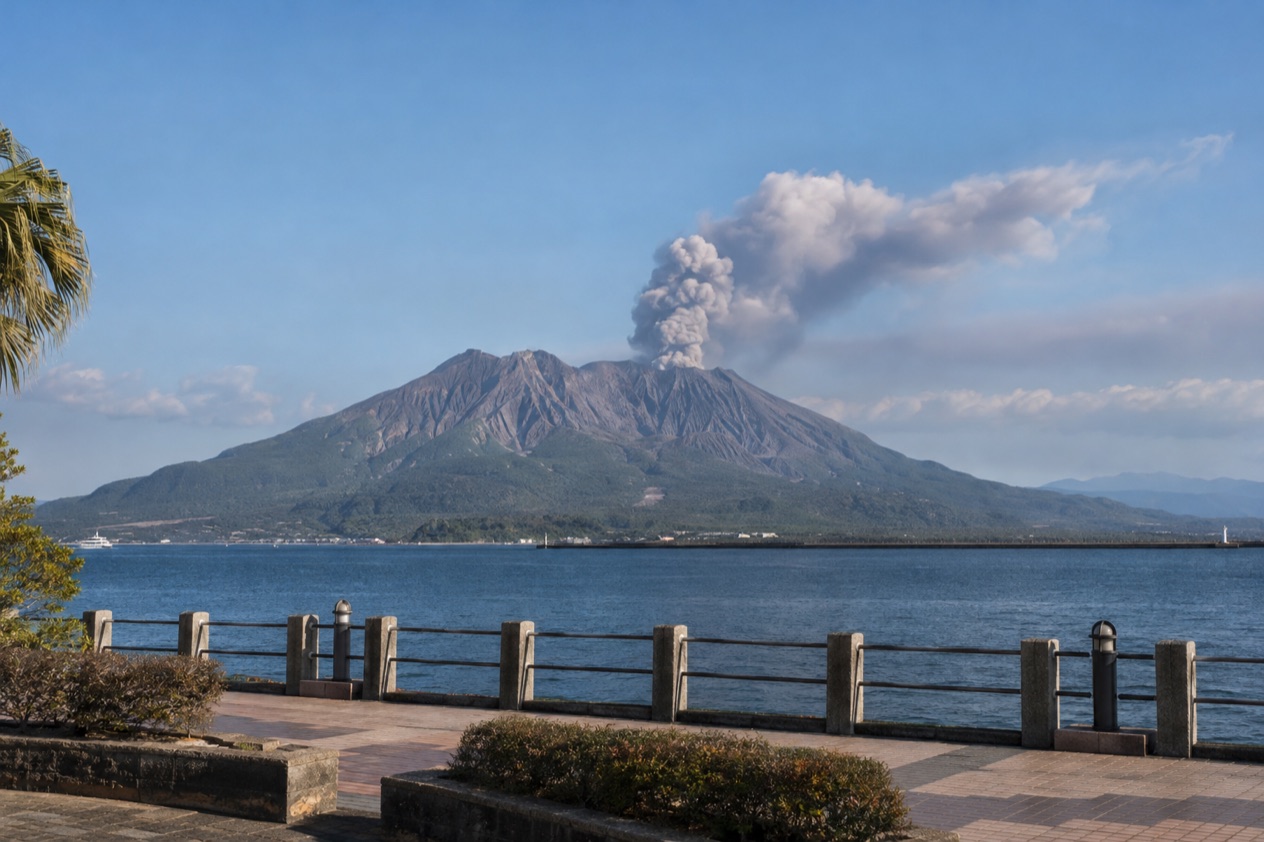
Leaving Fukuoka in the early hours, with the city still switched off behind you, the day turns on a single idea: by the time you arrive, a volcano will be sitting at the end of the street. In Kagoshima, Sakurajima puffs over the bay, ash settles on parked cars, and schoolchildren walk to class in helmets.
How do you get to Kagoshima from Fukuoka?
It links Kagoshima with Kumamoto in 42 minutes, which gives you a feel for the rhythm of the line, and Kumamoto is one of the stops you pass through on the way south.
What decides your choice is mostly what you want from the morning. straight run, where trains have a reputation for keeping to the minute, so you can plan an afternoon in Kagoshima with confidence.
Slower trains turn the trip into a journey through Kyushu towns, stopping at every station and letting you watch the island change outside the window. A flight is a different kind of trip, with an airport that sits outside the city. Each option has its own character, and the sections that follow lay them out so you can match one to your mood and your luggage.
Your rail pass matters too. Japan Rail Pass holders can ride Kyushu Shinkansen services at no charge, except on Mizuho trains. If you hold a pass, that detail steers you toward certain trains. If you do not, the choice comes down to the experience you want at either end of the day.
At the end of the line you arrive in a city that locals and visitors alike have compared to Naples, for its bay, its warm climate and the stratovolcano that dominates the view. Kagoshima is the capital of Kagoshima Prefecture, on the island of Kyushu, and it is a place where you plan the day around the mountain.
Ways to get to Kagoshima from Fukuoka
Kyushu Shinkansen
The Kyushu Shinkansen is the bullet train that serves Kagoshima, and it is the way to travel if you want the trip to feel like part of the day instead of a chore. You sit in a spacious car, watch Kyushu’s towns, hills and rice fields slide by, and step off in the city with the whole afternoon ahead. Its stop at Kumamoto, 42 minutes from Kagoshima, is a landmark on the way and a useful place to remember if you want to break the trip.
Rail pass holders have a particular reason to like it. Japan Rail Pass holders ride Kyushu Shinkansen services at no charge, except on Mizuho trains, so if you are carrying a pass, check the train name before you board. The line suits travelers who like a station-to-station rhythm, with a bento from the platform for lunch and a window seat facing the scenery.
Local and rapid trains
Local trains in Japan stop at every station, which makes them ideal for short distances. Over a trip as long as this one, they are really a choice for people who enjoy the slow version of travel, getting off at small platforms, buying a drink from a vending machine, and watching schoolchildren and commuters come and go. They suit a traveler with time and curiosity, and they make the most sense as a way of reaching one town along the line instead of the whole journey in one go.
Rapid trains skip the smaller stations and do not require a supplement, so they sit between the local and the bullet train in spirit. They are a quieter way to cover ground when you do not mind trading speed for simplicity in fares, and a pleasant choice for travelers building a day around a stop in the middle.
Flying to Kagoshima
Kagoshima has its own airport, though it is not in the city. It stands in Kirishima, 22 miles northeast of Kagoshima, so a flight always ends with a ground leg into town. Domestic flights to Kagoshima depart from Tokyo and take 2 hours, which is a handy fact if your trip also takes in the capital.
A flight suits travelers who are combining Kagoshima with another far-off city, or who are arriving from somewhere other than Fukuoka. It is also the arrival you pick if you want to see the bay from above as the plane descends, with the shape of the volcano rising from the water.
Limited express and bus
Limited express trains and long-distance buses are the other names you will hear when people talk about going south through Kyushu. They are the choices for travelers who like to compare timetables and enjoy the practical puzzle of a rail and road network, and both can fit into a day with a stop along the way. For the details of a specific service, the station or the terminal is where timetables are posted, and the staff there will point you to the right platform or bay.
Options compared
| Option | Best for | What to know |
|---|---|---|
| Kyushu Shinkansen | Travelers who want a straight run to the city | Connects Kagoshima with Kumamoto in 42 minutes. Japan Rail Pass holders ride at no charge, except on Mizuho trains |
| Local train | Slow travel and small stops | Stops at every station, ideal for short distances |
| Rapid train | Cutting out the smaller stations | Skips smaller stations and needs no supplement |
| Plane | Arrivals from Tokyo or far-off cities | The airport is in Kirishima, 35 km (22 miles) northeast of Kagoshima. Flights from Tokyo take 2 hours |
Read together, the options split into two kinds of trip. The bullet train and the flight are about arriving, and the local and rapid trains are about traveling. If you want to spend the day in Kagoshima itself, with a ferry to the volcano and a walk through the old streets, lean toward the first pair. If the journey is part of the pleasure, the stopping trains give you something to remember.
The airport adds a wrinkle, because it stands outside the city and you have to reach the center afterward. The train, by contrast, delivers you to a city you can start exploring the moment you step down. Pick the one that suits the shape of your day and where you are coming from, and the rest falls into place.
Making a day of it
A day in Kagoshima starts with the volcano, because everything in town faces it. Sakurajima is a short ferry ride from the city, and Kagoshima City itself is only four kilometers from the active volcano.
Crossing the water on the ferry gives you a close look at the mountain’s slopes and the black lava fields that spread toward the shore. Tourists are forbidden to go within 1.2 miles of the crater, because the volcano is active, so what you do is walk, look and take in the scale from the viewpoints on the island’s edge.
Crossing to Sakurajima
The crossing is part of the outing. You stand on the deck as the city recedes, the smoke from the summit leans in whatever direction the wind has chosen, and the island grows larger with each minute. On the far side, you can wander along the shore, look for the lava fields, and sit for a while with the mountain in front of you.
It suits anyone curious about living landscapes. Kagoshima is a city watched over by an active volcano that regularly dumps ash on the streets, and visiting the island helps you understand why the people here treat it as a neighbor rather than a threat. Even the schoolchildren wear helmets to protect themselves from volcanic debris, a detail that tells you more about daily life than any sign.
Back in the city
Once you are back on the mainland, give the evening to the city. Kagoshima’s food is part of the reason to stay, with kurobuta (black pork) dishes, satsuma-age (fried fish cake), sweet potato shochu and the shaved ice called shirokuma all associated with the area. A meal at an izakaya, the casual pub where small plates arrive in waves, is a good way to taste several of them in one sitting.
If you want a pause before dinner, the waterfront is a fine place to watch the light change over the bay. The mountain looks different at every hour, sometimes sharp against a clear sky, sometimes softened by haze or ash. A walk here is a gentle way to let the day settle.
Planning your time and what to bring
Leaving Fukuoka early gives you a long day in Kagoshima, which pairs well with the ferry crossing and an evening meal. If you would rather not hurry, staying overnight lets you add a second morning for the city’s streets, gardens and quiet corners.
A small bag keeps your hands free for the boat, and a camera is useful, because the mountain is the subject of nearly every photograph taken here.
Good to know before you go
Ash is part of life in Kagoshima, since Sakurajima regularly dumps it over the city, so expect a fine gray dusting on windowsills and parked cars on some days. The rule around the crater is firm, and visitors stay outside the 1.2 miles zone.
Beyond that, the habits you already use in Japanese cities carry over: keep your voice low on trains, line calmly at platforms, and take your trash with you until you find a bin. If you travel in the rainy or typhoon season, leave some slack in your plans in case weather changes the day.
Sources
- Japan National Tourism Organization, Kagoshima (https://www.japan.travel/en/destinations/kyushu/kagoshima/kagoshima-and-around/), checked October 11, 2026
- Wikipedia, Kagoshima (https://en.wikipedia.org/wiki/Kagoshima), checked October 11, 2026
- Wikivoyage, Kagoshima (https://en.wikivoyage.org/wiki/Kagoshima), checked October 11, 2026
- Japan National Tourism Organization, trains and buses (https://www.japan.travel/en/guide/how-to-travel-by-train-and-bus-in-japan/), checked October 11, 2026
- Japan National Tourism Organization, traveling by rail (https://www.japan.travel/en/guide/traveling-by-rail/), checked October 11, 2026
- Japan National Tourism Organization, getting around Japan: trains, subways, buses, taxis (https://www.japan.travel/en/plan/getting-around/), checked October 11, 2026