
In June the temple gardens of Tokyo turn blue and violet with hydrangeas, and umbrellas tilt together on the steps of a hillside shrine while the leaves drip. In the evening, office workers carry foam-topped mugs to a rooftop beer garden and the air is warm and thick. Japan in early summer is a month of garden festivals, green mountains and lingering light, with Hokkaido staying cooler and Okinawa already deep in summer.
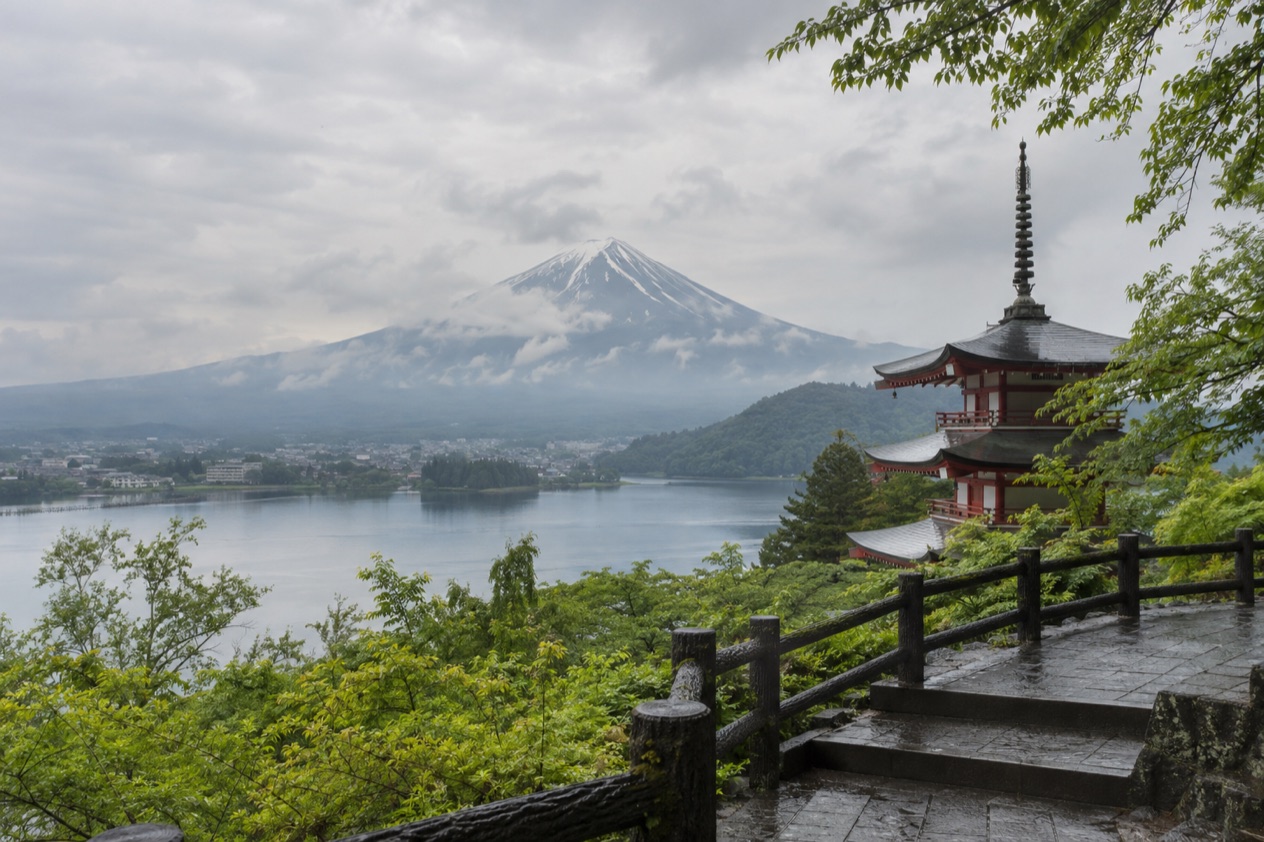
What is the weather like in Japan in June?
June is warm and humid across most of Honshu and Kyushu, cooler and drier in Hokkaido, and fully tropical in Okinawa. Rain falls on roughly every third day in the big cities, usually in showers or gray, soft days rather than in a single downpour.
| Place | Average high (°F) | Average low (°F) | Precipitation (in) | Daylight on the 15th (hours and minutes) |
|---|---|---|---|---|
| Tokyo | 79.0 | 65.3 | 6.61 | 14 h 33 min |
| Kyoto | 82.6 | 66.6 | 7.86 | 14 h 30 min |
| Osaka | 82.4 | 68.5 | 7.29 | 14 h 28 min |
| Sapporo | 71.2 | 56.1 | 2.38 | 15 h 21 min |
| Okinawa (Naha) | 85.6 | 77.4 | 11.20 | 13 h 46 min |
| Fukuoka | 81.0 | 68.5 | 9.83 | 14 h 22 min |
| Kanazawa | 78.1 | 65.1 | 6.70 | 14 h 39 min |
| Hiroshima | 81.0 | 67.6 | 8.92 | 14 h 26 min |
Tokyo is the mildest of the big Honshu cities this month, warm in the afternoon and comfortable enough after dark, though the air feels damp with humidity around three quarters. Kyoto and Osaka sit a few degrees higher, and Kyoto collects more rain than Tokyo. Osaka’s nights stay warmer and its skies are sunnier than either neighbor’s.
Sapporo is another climate altogether. Its afternoons stay in the low 70s, the evenings call for a light layer, and it has the fewest rain days of the group and the longest daylight.
Naha in Okinawa is the opposite, with highs in the mid-80s, nights that barely cool and the heaviest rainfall of the eight places. Fukuoka and Hiroshima fall between the two, wetter than Tokyo, while Kanazawa on the Sea of Japan side is a little cooler and gets plenty of sunshine for a June month.
Where to go in Japan in June
June suits travelers who like gardens, temples and food more than big outdoor adventures, and who do not mind a rain jacket in the daypack. The regions below each offer something different, from city hydrangeas to subtropical heat.
Tokyo and the Kanto region
Tokyo in June is a city of small seasonal pleasures. The hydrangeas come into bloom in shrine and temple grounds, and the Bunkyo Hydrangea Festival at Hakusan-jinja Shrine shows off about 3,000 plants along its paths. At Takahata Fudoson Temple, the flowers gather around a five-story pagoda, which makes a fine subject on a gray morning when the colors look saturated.
Iris lovers head for the Katsushika Iris Festival (Shobu Matsuri), held at Horikiri Shobuen Iris Garden and Mizumoto Park. These are garden walks, best matched with a long lunch and a museum or two for the hours when the rain sets in. The afternoons are warm and humid, so cold noodles, shaved ice and iced green tea start to make sense.
Evenings belong to the beer gardens, which are popular in June in Tokyo. One of them is Mt. Takao Beer Mount, west of central Tokyo on Mt. Takao, for those who like a drink with a view of the hillside. Only guests aged 20 and over can drink alcohol, since that is the legal drinking age in Japan.
Kyoto and the Kansai region
Kyoto and Osaka are warmer than Tokyo in June and a little wetter in Kyoto’s case. The rain suits the old capital’s moss gardens, wooden temple halls and stone lanes, which look their greenest and glossiest when wet. Plan your days around covered corridors, tea houses and museums, with the open-air temple stops fitted between showers.
Hydrangeas have a quiet link with the region’s tea culture too. In Japan, ama-cha, meaning sweet tea, is an herbal infusion made from the leaves of Hydrangea serrata, which develop a sweet taste. It is a small thing to look for at a tea shop, and a good reason to look at the flowers more closely.
Osaka brings the appetite. Street food such as takoyaki (octopus dumplings) and okonomiyaki (savory griddle pancakes) tastes better in the evening warmth, and the city sees more sunshine in June than Kyoto or Tokyo. It suits travelers who plan their trip around meals and neighborhood wandering rather than monuments.
Hokkaido
Hokkaido is the escape from the sticky air of the south. The city is comfortable for walking in a light layer.
Sapporo is a place to eat well: miso ramen, soup curry, grilled lamb and, of course, a cold glass of the beer that carries the city’s name. It is a good fit for travelers who want a Japan trip without humidity and long evenings to fill with a stroll and a meal.
Okinawa
Okinawa is already deep in summer. Naha’s afternoons reach the mid-80s, nights stay warm, humidity is the highest of any place here and rain is the heaviest, so showers can be strong and cloudy spells long. The sea near Naha averages about 80°F, which is warm enough for a dip between the showers.
The islands reward a slow pace: Okinawa soba, goya champuru (a stir-fry with bitter melon), sweet potato tarts and a glass of awamori, the local spirit. It fits travelers who want warm weather and are happy to rearrange plans around the rain.
What to do in Japan in June
Hydrangea festivals in Tokyo
The flower of the month is the hydrangea (ajisai), and Tokyo stages festivals around it. The Bunkyo Hydrangea Festival at Hakusan-jinja Shrine gathers about 3,000 plants in a shrine garden, so a visit is part flower walk, part shrine stop. Walk slowly and look closely, because the heads come in blue, pink and violet.
Takahata Fudoson Temple offers a different setting, with hydrangeas surrounding a five-story pagoda. The pairing of soft flowers and a tall wooden tower is the classic early-summer image of Japan. Rain tends to improve the photographs here, since the petals and roof tiles darken and shine.
Iris gardens and the Katsushika festival
The Katsushika Iris Festival (Shobu Matsuri) takes place at Horikiri Shobuen Iris Garden and Mizumoto Park in Tokyo. Irises (shobu) are a long-loved flower of early summer, planted in beds and along water so that their purple and white blooms are reflected in ponds.
The two sites give you a choice of mood, a formal iris garden in one case and a broader park in the other.
Beer gardens and summer evenings
Beer gardens are popular in Tokyo in June, when the evenings turn warm. Rooftops, hotel terraces and hillside spots such as Mt. Takao Beer Mount put tables outside and serve grilled skewers, edamame and fried chicken with cold beer. Guests must be 20 or older to drink alcohol.
What June does not offer
June falls between the great seasonal draws. Cherry blossom belongs to spring, and autumn colors arrive from mid-November to early December. Mount Fuji’s climbing season typically runs from the beginning of July to about the first week of September, so it has not yet opened in June. The month is for gardens, rain-washed temples, food and the first beers of summer.
Is Japan busy in June?
June is the month of flower festivals and beer gardens, not of the great seasonal rushes that follow cherry blossom in spring or the leaf color of late autumn. The draws are specific: hydrangea gardens, iris gardens and Tokyo’s evening terraces.
Hakusan-jinja Shrine, Takahata Fudoson Temple, Horikiri Shobuen and Mizumoto Park are the places that gather festival visitors in Tokyo, so they are where you will find company among the flowers. Mount Fuji’s climbing season has not started, which means the mountain is not yet a summer destination. Elsewhere, the cities simply go about their business in the warm, damp air.
Travelers who prefer to be outdoors and dry will find Sapporo and Hokkaido the best fit, with fewer rain days and cooler temperatures. Those who prefer to be among gardens and museums, with a rain jacket in hand, will find the main cities fine.
What to pack for Japan in June
Pack for warmth and rain on Honshu, Kyushu and Okinawa, and for a cooler evening in Hokkaido. Light layers do most of the work, and one compact umbrella or rain jacket will see you through the showers.
- A light rain jacket or compact umbrella, because showers fall on roughly every third day in the big cities.
- Breathable cotton or linen clothes, since the air is humid in Tokyo, Kyoto, Osaka and Fukuoka.
- Shoes that handle wet pavement and temple stones, for garden walks after rain.
- A light sweater for Sapporo, where evenings are noticeably cooler than in the south.
- Sunscreen and a hat for Okinawa and Hokkaido, where sunshine hours run high.
- A swimsuit if Okinawa is on the route, with the sea near Naha around 80°F.
Good to know before you go
June is damp across most of the country, and the figures bear that out: Naha receives the most rain, with Fukuoka, Hiroshima and Kyoto next, while Sapporo stays comparatively dry. Honshu and Kyushu are humid, hot and sultry in summer, and June is the start of that stretch.
Is June a good time to visit Japan?
June is a good month for travelers who enjoy gardens, flowers, food and a slower pace, and who treat rain as part of the scenery. Hokkaido is the best region for anyone who wants cooler air and fewer rainy days, and Tokyo is the place for the hydrangea and iris festivals.
Compared with May, June is warmer and wetter. Tokyo’s afternoons climb from the mid-70s toward the upper 70s, and Sapporo goes from cool spring air into the low 70s. Compared with July, June is gentler. Tokyo’s highs move into the mid-80s and Kyoto’s reach the upper 80s in July, so June sits between the fresh weather of late spring and the heat of high summer.
What is special about June is the combination of rain-washed color, with hydrangeas around a pagoda in Tokyo, irises beside ponds in Katsushika and the green hush of Kyoto’s gardens, and the first cold beers on a warm evening.
Sources
- Japan Meteorological Agency (JMA), Normal values 1991-2020, monthly (https://www.data.jma.go.jp/stats/etrn/view/nml_sfc_ym.php?prec_no=44&block_no=47662), station Tokyo, elevation 25 m, checked October 11, 2026
- Computed from the date and the latitude of the place (sunrise equation, solar elevation -0.833 degrees), October 11, 2026
- Japan Meteorological Agency (JMA), Normal values 1991-2020, monthly (https://www.data.jma.go.jp/stats/etrn/view/nml_sfc_ym.php?prec_no=61&block_no=47759), station Kyoto, elevation 41 m, checked October 11, 2026
- Japan Meteorological Agency (JMA), Normal values 1991-2020, monthly (https://www.data.jma.go.jp/stats/etrn/view/nml_sfc_ym.php?prec_no=62&block_no=47772), station Osaka, elevation 23 m, checked October 11, 2026
- Japan Meteorological Agency (JMA), Normal values 1991-2020, monthly (https://www.data.jma.go.jp/stats/etrn/view/nml_sfc_ym.php?prec_no=14&block_no=47412), station Sapporo, elevation 17 m, checked October 11, 2026
- Japan Meteorological Agency (JMA), Normal values 1991-2020, monthly (https://www.data.jma.go.jp/stats/etrn/view/nml_sfc_ym.php?prec_no=91&block_no=47936), station Naha, elevation 28 m, checked October 11, 2026
- Open-Meteo Marine API, average 2015-2024, checked October 11, 2026
- Japan Meteorological Agency (JMA), Normal values 1991-2020, monthly (https://www.data.jma.go.jp/stats/etrn/view/nml_sfc_ym.php?prec_no=82&block_no=47807), station Fukuoka, elevation 2 m, checked October 11, 2026
- Japan Meteorological Agency (JMA), Normal values 1991-2020, monthly (https://www.data.jma.go.jp/stats/etrn/view/nml_sfc_ym.php?prec_no=56&block_no=47605), station Kanazawa, elevation 6 m, checked October 11, 2026
- Japan Meteorological Agency (JMA), Normal values 1991-2020, monthly (https://www.data.jma.go.jp/stats/etrn/view/nml_sfc_ym.php?prec_no=67&block_no=47765), station Hiroshima, elevation 4 m, checked October 11, 2026
- Japan National Tourism Organization, weather and seasons in Japan (https://www.japan.travel/en/plan/weather/), checked October 11, 2026
- Wikipedia, Climate of Japan (https://en.wikipedia.org/wiki/Climate_of_Japan), checked October 11, 2026
- Japan National Tourism Organization, flowers by season: cherry blossom, plum, wisteria, hydrangea, where and when (https://www.japan.travel/en/see-and-do/flowers/), checked October 11, 2026
- Wikipedia, Hydrangea (https://en.wikipedia.org/wiki/Hydrangea), checked October 11, 2026
- Japan National Tourism Organization, summer in Japan (https://www.japan.travel/en/guide/summer-guide/), checked October 11, 2026
- GO TOKYO, best things to do and see in Tokyo in June (https://www.gotokyo.org/en/story/guide/june/index.html), checked October 11, 2026
- Japan Meteorological Agency, Emergency Warnings (https://www.jma.go.jp/jma/en/Emergency_Warning/ew_index.html), checked October 11, 2026
- Japan National Tourism Organization, autumn in Japan (https://www.japan.travel/en/guide/autumn-guide/), checked October 11, 2026
- Japan National Tourism Organization, spring in Japan (https://www.japan.travel/en/guide/spring-guide/), checked October 11, 2026
- Wikipedia, Japan (https://en.wikipedia.org/wiki/Japan), checked October 11, 2026
To plan your stay
- Things to Do in Japan: Kyoto Temples, Onsen, Street Food and Day Trips
- Where to Stay in Japan: Ryokan, Temple Stays, Capsule Hotels and the Best Cities to Base In
- Sending Luggage from the Airport in Japan: Hands-Free Travel, Hotel Delivery and Coin Lockers
- Know Before You Go to Japan: Entry, Money, Etiquette and Getting Around