
A traveler stands under the white walls of Himeji Castle, then flips to a map of Kyoto’s temples, then to a photo of thatched farmhouses in the mountains, and wonders how many of these places share the same World Heritage label. They do, and the list is wider than most people expect. It takes in temples and shrines, castles, a burial-mound landscape, old villages, a volcano and some remote islands.
Which UNESCO sites are in Japan?
Japan has 27 UNESCO World Heritage Sites, spread from a national park in Hokkaido to castles in Okinawa, and they mix cultural and natural properties of outstanding value. Three more places wait on the tentative list. Some of the 27 are a single building or mountain, while others are a family of separate places bundled under one name, which is why a single entry can fill several days of walking.
The list is easiest to grasp by sorting it into three kinds of place: the religious and historic buildings of the central regions, the villages and industrial landscapes, and the wild or far-flung islands and mountains.
Temples, shrines and castles
The temple complexes sit in the central regions of Kyoto, Nara and Nikko. Kyoto’s entry gathers several of its best-loved places, among them Kinkaku-ji, Ginkaku-ji, Ryoan-ji and Kiyomizu-dera, so one listing means a string of separate visits across the city.
In Nara, the Buddhist monuments of the Horyu-ji area spread across two temple precincts, Horyu-ji and Hokki-ji. Nikko’s sacred mountains hold Buddhist and Shinto buildings in great numbers, so the visit is as much about the forested setting as about any single hall.
Himeji Castle in Hyogo Prefecture is described as the best example of early 17th century Japanese castle architecture. In Okinawa, the southernmost islands of Japan, the listed castles are the colorful ones, a different look from the white and dark timber of the mainland.
Villages, mines and burial mounds
Shirakawa-go and Gokayama are historic villages in a remote mountain region, known for their pointed thatched roofs. Iwami Ginzan, a silver mine, lies buried in the mountains, which makes it a site of paths, tunnels and hillsides more than of grand buildings.
The Mozu-Furuichi Kofungun is a group of burial mounds called kofun. Many of them are best read as green, wooded hills rather than monuments, so expect to look at shapes in the landscape more than at carved stone or painted halls.
Hiroshima’s Peace Memorial, the Genbaku Dome, began life in 1914 as the Hiroshima Prefectural Industrial Promotional Hall. Its skeletal structure now stands as a symbol of peace.
Mountains, forests and islands
Shiretoko National Park is on the island of Hokkaido in northern Japan. The Kii Mountains hold sacred sites and pilgrimage routes in western Japan, and Mount Fuji is a solitary volcano that rises on its own rather than in a range.
Yakushima is an island about 37 miles south of Kyushu. The Ogasawara Archipelago, with its unique ecosystem, lies around 620 miles off the mainland. Okinoshima is worshiped as a sacred island and sits off the north-western coast of Kyushu at the same distance out as Yakushima lies to the south.
| Site | Made up of |
|---|---|
| Historic Monuments of Ancient Kyoto | 17 properties |
| Buddhist Monuments in the Horyu-ji Area | 48 Buddhist monuments |
| Mozu-Furuichi Kofungun | 49 kofun |
| Historic Villages of Shirakawa-go and Gokayama | 3 villages |
| Sacred mountains of Nikko | More than a hundred Buddhist and Shinto buildings |
Which are best known?
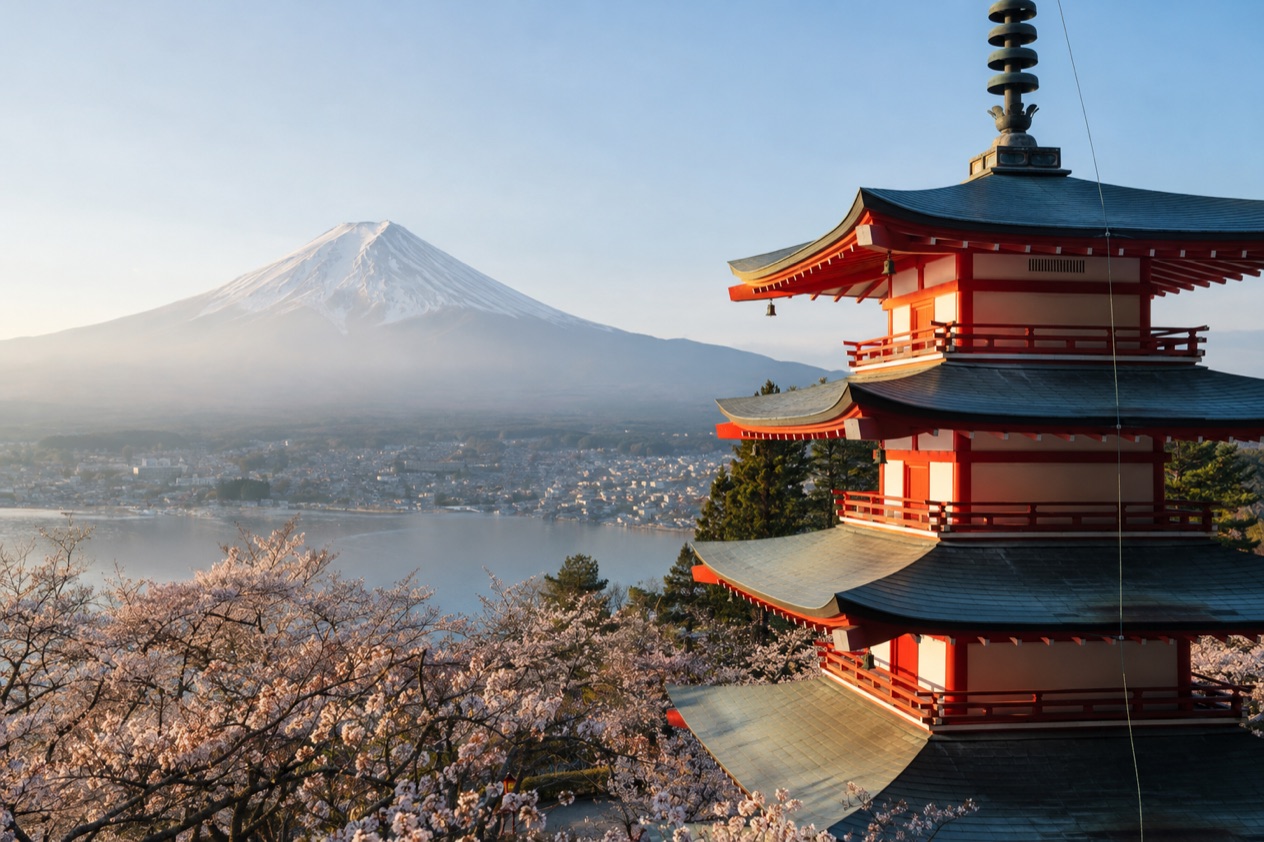
Mount Fuji is the best known, and the Japan National Tourism Organization calls it the most iconic of Japan’s UNESCO World Heritage sites. Around it, a handful of other names come up again and again in conversations about Japan: Kyoto’s temples, Himeji Castle, the Hiroshima Peace Memorial and the thatched villages of Shirakawa-go.
Each of these answers a different question a traveler might bring, whether it is a mountain to look at, a castle to walk through, a place of remembrance or a village that looks like a painting. Picking by that question works better than trying to rank them.
Mount Fuji
Fuji is a solitary stratovolcano that reaches 12,388 feet. Standing alone, it dominates whatever view it appears in, and it is the image many people carry with them before they ever book a flight to Japan.
Seeing it is a matter of luck with the sky, as with any mountain, and clouds can hide it entirely. It is worth treating it as a pleasure you may get rather than a guarantee, and planning the rest of the day so that nothing hangs on a clear view.
Kyoto’s temples and Himeji Castle
Kyoto’s listing is the one most travelers meet first. Kinkaku-ji, the pavilion known for its gilded look, Ginkaku-ji, the stone and moss garden of Ryoan-ji and the hillside stage of Kiyomizu-dera are all part of it. Because they are separate places, a day in Kyoto can sample several of them, each with a different character.
Himeji Castle stands in Hyogo Prefecture and is the example people point to when they want to see what a Japanese castle looked like in the early 17th century. Its white walls and layered roofs reward a slow walk around the grounds as well as a trip inside.
Hiroshima and Shirakawa-go
The Genbaku Dome in Hiroshima is a ruined frame of a building that was once a prefectural hall. It is a place for standing and reading and thinking, and many visitors pair it with the nearby memorial grounds, in the manner of a visit to any site of remembrance, with a quiet and respectful pace.
Shirakawa-go and Gokayama give a very different picture, with farmhouses topped by steep thatched roofs in a remote mountain region. The listing covers three villages, so there is more than one place to wander, and the roofs are the feature that photographs and memories keep returning to.
How do you plan visits?
Plan by region, because the sites cluster into a few groups and a few places that sit far from everything else. Choosing the regions you want first, and the individual sites second, keeps a trip from becoming a checklist.
A World Heritage label says little about how long a place takes or how it is run. Each site has its own hours, admission and rules, so those are worth looking up one by one rather than assuming they match another site.
Central Japan and the Kyoto, Nara and Hyogo area
The densest concentration of listed places is in the central regions. Kyoto, Nara and Nikko hold the temple complexes, and Hyogo Prefecture holds Himeji Castle. The Kii Mountains, with their sacred sites and pilgrimage routes, belong to western Japan, so a traveler drawn to walking old routes can put them on the same wider map as the temples.
Mozu-Furuichi’s burial mounds and Iwami Ginzan’s silver mine suit someone who likes landscapes with a story behind them. Shirakawa-go and Gokayama sit in a remote mountain region, which makes them a place to build a day or an overnight around rather than a stop to squeeze in.
Far north, far south and far out
Shiretoko in Hokkaido, the Okinawa castles in the southernmost islands, Yakushima south of Kyushu, Okinoshima off Kyushu’s north-western coast and the Ogasawara Archipelago far off the mainland are the places that ask for their own plan. Each lies away from the main run of temples, and some are islands, so they usually shape a whole trip rather than fit into a spare afternoon.
Okinoshima is worshiped as a sacred island, which is reason enough to read about it before deciding what the place means for your itinerary. Ogasawara is valued for its unique ecosystem, so a visit there is a nature trip first. Yakushima and Shiretoko work the same way, as natural places that reward time outdoors.
Matching sites to your interests
- For temples and shrines: Kyoto, Nara and Nikko, with the Kii Mountains for pilgrimage routes.
- For castles: Himeji in Hyogo and the colorful castles of Okinawa.
- For villages and history on the land: Shirakawa-go and Gokayama, Iwami Ginzan and the kofun of Mozu-Furuichi.
- For remembrance: the Hiroshima Peace Memorial.
- For nature: Mount Fuji, Shiretoko, Yakushima and the Ogasawara Archipelago.
Mixing two or three of these kinds in one trip keeps the pace varied, a day of stone and timber followed by a day among mountains or on an island.
Good to know before you go
Many of these sites are active places of worship or places of remembrance, so the usual habits apply: shoes come off at the entrance of many temple halls, voices drop around shrines and memorials, and photographs are taken with some care for the people nearby. Because the sites run from a northern national park to far southern islands, the weather and the season differ a lot from one to the next, so look at the place you are going to rather than at Japan as a whole. Admission and opening times belong to each site and are best checked for the ones on your list.
Sources
- Japan National Tourism Organization, World Heritage sites in Japan (https://www.japan.travel/en/world-heritage/), checked October 11, 2026
- Wikipedia, List of World Heritage Sites in Japan (https://en.wikipedia.org/wiki/List_of_World_Heritage_Sites_in_Japan), checked October 11, 2026
To plan your stay
- Best Time to Visit Japan: Cherry Blossoms, Autumn Colors, Weather and Festivals
- Where to Stay in Japan: Ryokan, Temple Stays, Capsule Hotels and the Best Cities to Base In
- Sending Luggage from the Airport in Japan: Hands-Free Travel, Hotel Delivery and Coin Lockers
- Know Before You Go to Japan: Entry, Money, Etiquette and Getting Around