
Somewhere over the Pacific, with the cabin lights dimmed and a second meal service rattling down the aisle, travelers start wondering what day it is in Tokyo. The question of how long the trip takes comes up again at the arrivals hall, when the clock on the wall no longer matches the one on your phone. The short answer is that the flight crosses an ocean, takes most of a day of your life, and lands you in a country whose clocks run well ahead of America’s.
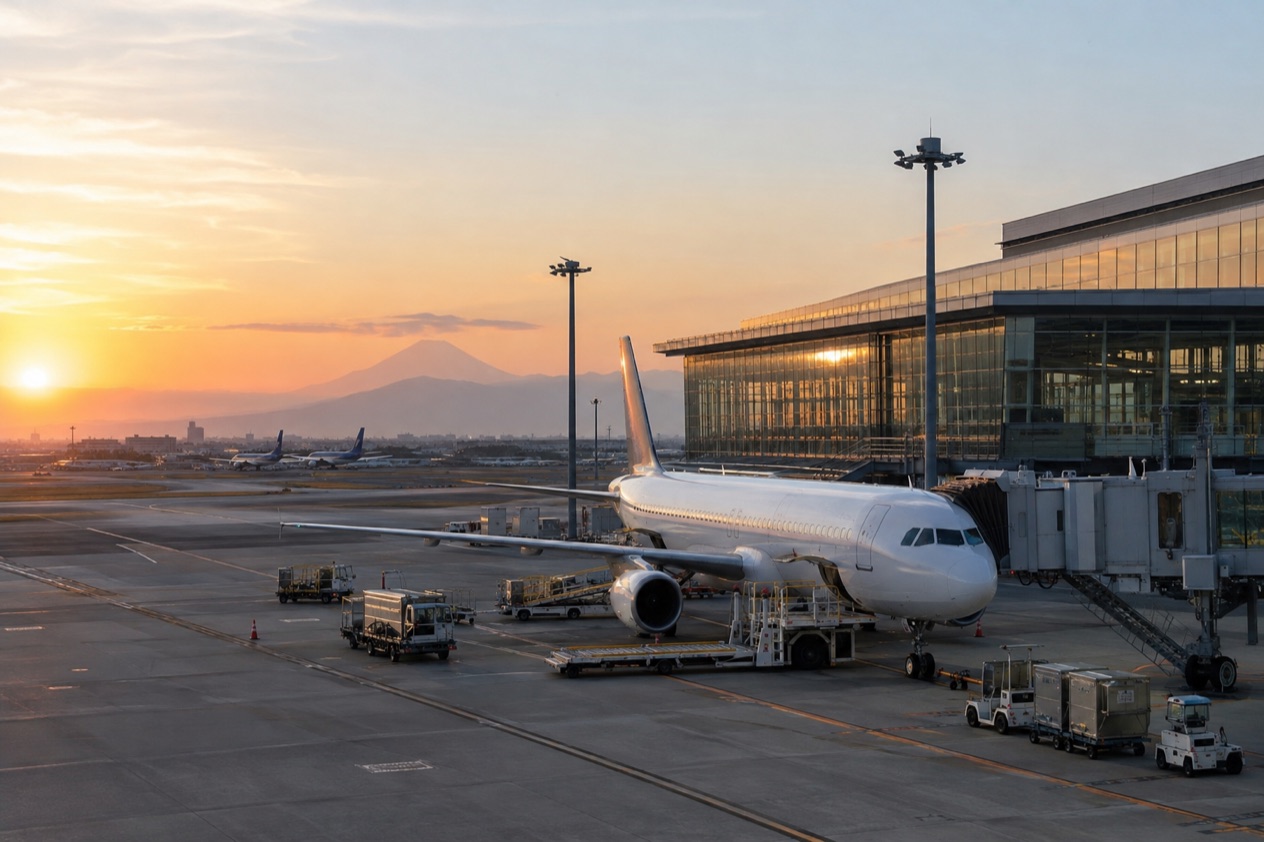
How long is the flight from the United States to Japan?
It is a long-haul flight, long enough that you plan around it rather than simply endure it, and the exact length depends on where you leave from and which Japanese airport you head for. Japan has a wide network of airports, stretching from Hokkaido in the north to Okinawa in the south, and that choice of landing point shapes your first day as much as the hours in the air.
Many international flights land at airports across the country, including Tokyo, Osaka, Fukuoka and Naha on Okinawa Island. Nagoya, in central Honshu, belongs to the same network. Because the airline market is crowded, ticket prices to Japan have continued to decrease, which is one reason the country has become a regular long-haul choice for American travelers.
Landing near Tokyo
Narita Airport sits in Chiba Prefecture and serves most major international destinations as well as many domestic airports. From there, an express train reaches Tokyo in 1 hour, so the transfer is a real part of the day and worth counting when you add up the total journey from your front door to your hotel.
Think of the arrival as a second leg. After the long flight you pass through the terminal, ride into the city, and watch suburbs of Chiba give way to the dense blocks of Tokyo. Travelers are tired but wide awake in that train window, taking in rooftops, vending machines and the first convenience-store signs of the trip.
Landing near Kyoto and Osaka
Kansai International Airport (KIX) is the gateway to western Japan, serving Kyoto, Osaka, Nara and Wakayama. It is about 50 minutes from Shin-Osaka high-speed train station and 1 hour 15 minutes from Kyoto Station, so a traveler heading for the old capital can plan a single arrival day without crossing the country first.
This matters if your trip is built around temples, castles and the food of Osaka. Landing in the west means your first evening can already be spent in the city where you will sleep, rather than on another long ride after the flight. Pick the airport that matches the first night you want, then work backward to the flight.
Flying in at Fukuoka or Okinawa
Fukuoka and Naha appear among the airports where international flights land, which opens up trips that start in Kyushu or on the islands of Okinawa. Starting there changes the mood of the whole vacation: a first meal of ramen in Fukuoka, or a first look at the southern light in Naha, instead of a first night among the towers of Tokyo.
Some itineraries even arrive at one airport and leave from another, since the network of domestic and international airports reaches the length of the country. Flying into one end and out of the other lets a route run in a line instead of doubling back, and it keeps the long flight from being the only fixed point in the plan.
Arriving by sea instead
A few travelers reach Japan by water, usually as part of a longer trip around Asia. High-speed ferries connect Hakata to Busan in 3 hours 40 minutes, costing about 16,000 yen. Kampu ferries, which are slower, reach Osaka in 12 hours and cost less than 10,000 yen, and ticket prices depend on the length of the crossing.
Ferries from Shanghai depart once a week and take about three days to reach the Japanese ports of Osaka, Kobe, Nagasaki and Fukuoka. These crossings are for people already in Asia, not a replacement for the flight from the United States, but they show how many doors the country has.
| Route | Time |
|---|---|
| Hakata to Busan (high-speed ferry) | 3 hours 40 minutes |
| Kampu ferry to Osaka | 12 hours |
| Shanghai to Osaka, Kobe, Nagasaki or Fukuoka | About three days |
Why do westbound flights take longer?
Flights from America to Japan head west against the prevailing winds, so they feel heavier than the trip home, which rides the same winds in your favor. High above the Pacific, a river of fast air flows from west to east, and an aircraft flying into it spends longer covering the same ground.
You rarely notice this from your seat. What you notice is that the outbound journey seems to stretch, with a long daylight stretch outside the window, a meal, a film, another meal, then a sky that never quite turns to night. Airlines plan for the route accordingly, and the cabin settles into a rhythm built for a very long day.
What the long day feels like
On a westbound crossing you often chase the sun. Because you are flying toward a place where it is already tomorrow, the light outside can feel wrong for the hour your body expects. Cabin crews dim the windows and serve food on a schedule that tries to bridge the two time zones, but the first few hours after landing still feel slightly unreal.
Travelers deal with it in familiar ways. Some sleep as soon as the cabin darkens, some keep their watch on home time and try to stay awake until a sensible bedtime in Japan, and many simply carry a book and accept the odd hours. None of it is dramatic, and the reward is a landing in one of the world’s most absorbing countries.
Why the return trip feels different
Flying home, you travel with the winds and arrive in the United States, in clock terms, sometimes earlier in the day than you left.
That odd sense of time travel is part of the charm for visitors. The last night in Japan, the last convenience-store breakfast and the train ride out to the airport all happen on one date, and the arrival at home belongs to what feels like the same day, even though your body knows better.
Choosing the airport and planning the arrival
Since the flight is the longest single stretch of the trip, it pays to make the second stretch short. Narita serves most major international destinations and sits an hour by express train from Tokyo, while Kansai is the doorway to Kyoto, Osaka and Nara. Landing close to where you will sleep keeps the day from stretching on and on.
If you have a choice, look at where your first night is. A traveler bound for Kyoto lands at Kansai, a traveler bound for Tokyo lands at Narita, and a traveler beginning on Okinawa lands at Naha. The right gateway turns a long flight into the first chapter of the trip instead of an obstacle before it.
What about the time difference?
You cross the international date line on the way, which is why a departure on one day becomes an arrival on the next.
The practical effect is simple to describe. Your morning at home is the evening of the day before in Japan, and your midday is Japan’s middle of the night. Calls home, messages to family and bookings with people in America all have to be fitted around that gap, so travelers settle on a short window in Japan’s morning or evening.
The first days after landing
Jet lag in Japan has its own flavor. You wake before dawn, hungry, in a hotel where the vending machine in the hall sells hot canned coffee, and the city outside is just stirring. Early walks through quiet shrine grounds and neighborhood streets become a gift of the time difference, because you are up and out while the day is only beginning.
By the afternoon, the heaviness arrives. Travelers plan a light first day, a stroll, a bowl of noodles, an early night, and save the big sights for the second or third morning. Letting the body adjust slowly makes the temples and markets of the following days more enjoyable than pushing hard on arrival.
Living on Japan’s clock
Once you adjust, the time difference becomes part of the pleasure. Breakfast arrives while your friends at home are still in the previous evening, and photographs of your day land in their messages like postcards from tomorrow.
A few habits help. Eat meals when the locals do, step into daylight as soon as you can, and let the evening come naturally with an izakaya dinner, a late soak or a walk under paper lanterns. By the end of the first week, the long flight and the date line are mostly forgotten.
Travelers who move around the country
One welcome detail is that the whole country shares the same clock. Moving from Tokyo to Kyoto, from Osaka to Fukuoka, or south to Okinawa does not add another adjustment, because the airports of the network, from Hokkaido to Naha, all sit on the same time. The only big change comes when you land from the United States.
That makes planning a loop around Japan straightforward in this one respect. Once your body has caught up with the first morning, you can hop between regions without recalculating anything, and the time difference becomes a single fact to remember when you call home instead of a daily puzzle.
Good to know before you go
The U.S. State Department rates Japan Level 1: Exercise Normal Precautions.
Payment, weather and the season of your trip all deserve a thought, but the flight itself is the main fixed point. Airfares to Japan have kept falling as airlines compete for the route, so it is worth watching prices while you decide on an airport. Pick your gateway by where you want to sleep the first night, then let the rest of the itinerary unfold from there.
Sources
- Japan National Tourism Organization, how to get to Japan, airports, airlines (https://www.japan.travel/en/plan/getting-to-japan/), checked October 11, 2026
- U.S. Department of State, Japan travel advisory (https://travel.state.gov/content/travel/en/traveladvisories/traveladvisories/japan-travel-advisory.html)
To plan your stay
- Best Time to Visit Japan: Cherry Blossoms, Autumn Colors, Weather and Festivals
- Things to Do in Japan: Kyoto Temples, Onsen, Street Food and Day Trips
- Where to Stay in Japan: Ryokan, Temple Stays, Capsule Hotels and the Best Cities to Base In
- Know Before You Go to Japan: Entry, Money, Etiquette and Getting Around