
On a back road in Hokkaido or along the coast of Okinawa, the train map thins out and the idea of a car starts to make sense. A rental gives you the freedom to stop wherever a view or a roadside stall catches your eye. U.S. visitors can rent one in Japan, provided they arrive with the right paper permit in hand and are ready to drive on the left.
How do you rent a car in Japan?
You rent from a car rental company, showing your home license, a valid international driving permit and proof of when you entered the country, and you pay a daily rate for each 24-hour period. The paperwork is the part that takes preparation, because the permit must be in your hands before you leave the United States. The counter itself is a matter of choosing a car size and signing for it.
What a day behind the wheel costs
A compact car is the size most travelers picture for a couple of people and their bags, and a standard car sits in a much higher price bracket.
| Car class | Engine size (cm³) | Average rate per 24 hours (yen) |
|---|---|---|
| Compact | 1500-1800 | 9,000 to 13,500 |
| Standard | 3000 | 29,500 to 31,000 |
Fuel is a separate line in the budget. In 2022 it cost about 170 yen per liter, and that figure is a snapshot of that year rather than a promise for today. Tolls, covered further down, can add a good deal more on long drives, so the daily rate is only part of what a road trip costs.
Reaching a rental company
Budget car rental can be contacted at 0570-054-317. A phone call or a reservation made before you travel lets you settle the car size and the pickup place while you are still at home, and it is also the moment to ask the company about anything specific to your trip, such as a route over mountain passes.
At the counter, the staff will look over your permit and your license together with the entry stamp in your passport. A missing stamp or the wrong kind of permit cannot be fixed at the counter, so it is worth checking each piece before you fly.
Where a car makes the most sense
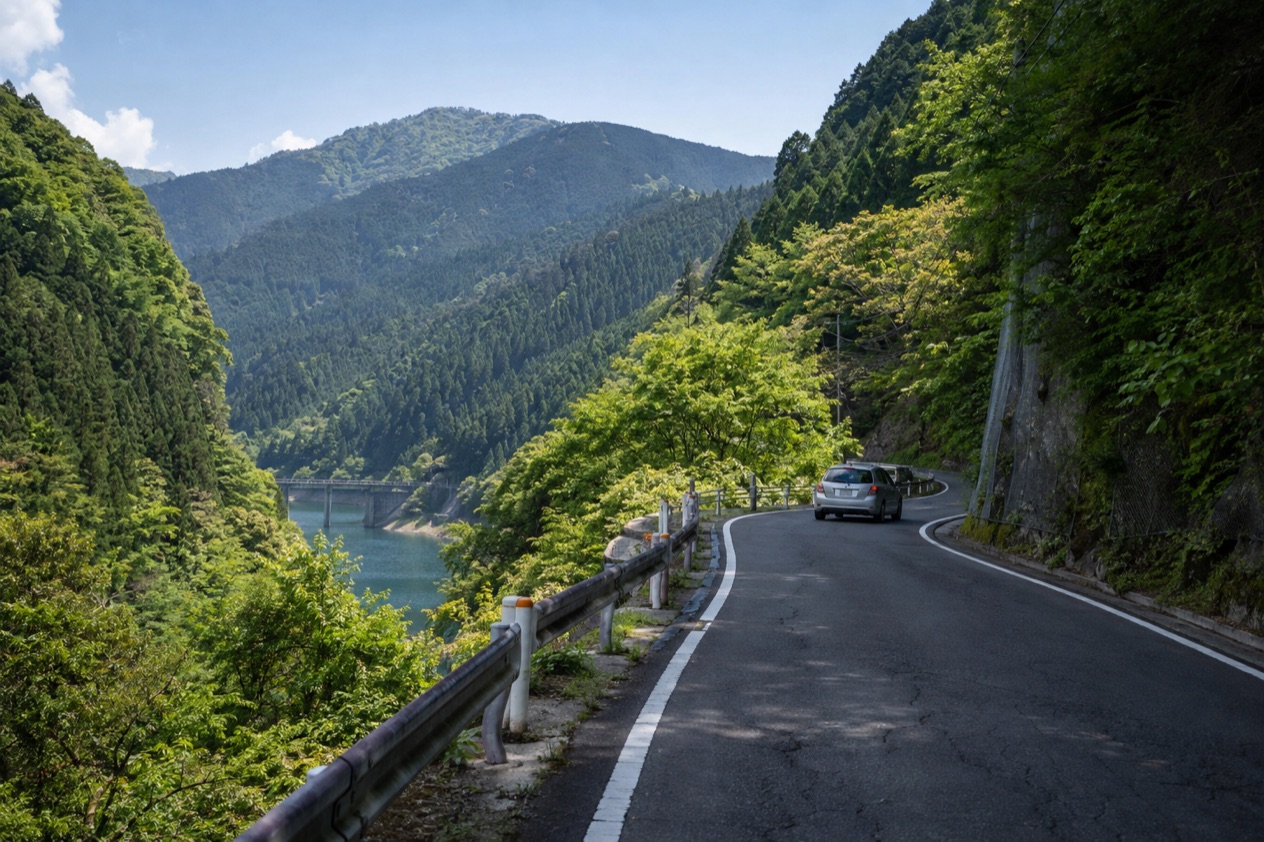
Hokkaido and Okinawa are notably more accessible by car, with generally pleasant roads to drive. Both are islands where a pace set by your own schedule fits the landscape, whether that means fields and lakes in the north or a coastline and small beaches in the south.
Big cities are another story. City traffic in Japan is often very congested, and there is virtually no legal roadside or curbside parking, even though cars are commonly seen blocking part of a street where they have stopped illegally. Many travelers keep the car for the countryside and let the cities be explored without one.
What do you need?
You need your U.S. license, an international driving permit from the American Automobile Association (AAA) obtained before you arrive in Japan, and an entry stamp in your passport. The U.S. State Department says short-term visitors driving in Japan must have the permit, and the Japan National Tourism Organization says the same, adding that it is valid only if issued by the competent authority of your country.
The right kind of permit
Not every international driving permit works. Japan accepts permits issued under the 1949 Geneva Convention on Road Traffic, in the form of a cardboard booklet. A permit issued under the 1968 Vienna Convention is not accepted, and neither are card-sized or digital versions, even when the card was issued under the 1949 convention.
The permit is valid for one year from the date of issue and also for one year from the date of arrival in Japan, which is confirmed by the entry stamp in your passport. A Geneva permit also ends when your home license expires, whichever comes first. Carry the booklet together with your own license, since the two work as a pair.
The entry stamp
If you want to rent a car, use a non-automated gate at immigration to get an entry stamp in your passport. If you went through an automated gate instead, go to the customs inspection office to have a stamp affixed. Because the permit’s validity is tied to that date, the stamp is the evidence rental companies look to.
Licenses from other countries
A few countries have a different arrangement. Visitors from Switzerland, Germany, France, Belgium, Monaco and Taiwan can drive for up to one year from arrival with their original license and an accredited Japanese translation. If you are traveling with someone from one of those places, their paperwork will look different from yours.
A license is required for a car, a motorcycle or a moped on public roads. The minimum age for an ordinary vehicle license in Japan is 18, though that applies to people getting a Japanese license rather than visitors with a permit. A moped means any motorcycle of 50cc or less in engine size.
Rules of the road
Traffic moves on the left side of the road. Turning right or left on a red light is not permitted, which surprises many American drivers used to the right-on-red habit. All passengers are required to wear seat belts. Roads are much narrower than those in the United States, and if you do not know Japanese, road signs can be hard to understand.
Japan has a national 0.03% blood-alcohol standard for driving. A DUI, speeding or reckless driving that injures another person can bring up to 15 years in prison. Traffic laws also apply to cyclists, who can be arrested for using a cellphone while riding or for riding under the influence of alcohol.
| Setting | Speed limit (km/h) |
|---|---|
| Towns | 40 |
| Countryside | 50 to 60 (60 if unmarked) |
| Expressways | 100, with some sections at 110 or 120 |
Winter and the mountains
In mountainous areas, roads are often closed during the winter, and cars should be equipped with tire chains. That matters for anyone planning a snowy drive in the Alps of central Honshu or in Hokkaido, where a route on your map may simply not be open. Plan for a closed pass by keeping a second way through in mind.
What about tolls?
Tolls are a real part of the cost of driving in Japan, since highway tolls can be very high according to the U.S. State Department. A route from Tokyo to Kyoto costs about 10,070 yen in tolls, which is a useful sense of scale before you decide whether to take expressways or slower roads for a long leg.
How the toll is worked out
When there are two or more possible routes between the entrance and the exit of an expressway, the toll is calculated on the shortest route. That means the price depends on where you get on and where you get off, not on the winding detour you might choose along the way.
The system has a long history. The first section of the Meishin Expressway, linking Nagoya and Kobe, opened to traffic in 1963, and the national network grew from there. All national expressways are expected to be fully repaid by 2050, 45 years after privatization, which explains why the tolls are still being collected.
Speed on the expressway
On divided national expressways the speed limit is set at the highest level unless a lower limit is posted. The default on a two-lane expressway is 43 miles/h, rising to 50 miles/h where the road is divided by a cable barrier. The limits on a given stretch are posted, so reading the signs matters more than assuming.
Because signs may be in Japanese, a driver who does not read the language should watch the symbols and the numbers. Pairing a driver with a navigator who can follow the route and the speed limits makes the long stretches calmer.
Weighing tolls against the plan
A long expressway leg adds up quickly, so it helps to treat the toll as a line in the budget next to the daily rental rate and the fuel. For a trip between big cities, the cost of the road is a fair part of the decision. For a loop around Hokkaido or Okinawa, where driving is the point of the trip, the tolls are only one piece of a larger picture.
Expressways around Tokyo and Osaka are part of dense urban networks, and city traffic there is often very congested. A highway exit does not end the effort, since narrow streets and the lack of curbside parking take over once you arrive.
Good to know before you go
Count your money in yen and keep a margin in the budget for fuel, tolls and the daily rate, since the three together make a rental trip. Drive as the locals do, in a calm and unhurried way, with seat belts fastened by everyone and no alcohol at all before you get behind the wheel.
Narrow roads and the left-hand lane reward patience, and a planned pause every so often keeps a long day on the road enjoyable. In winter, check the mountain roads before you set out, and carry tire chains where you expect snow.
Sources
- U.S. Department of State, Japan travel information, travel and transportation (https://travel.state.gov/content/travel/en/international-travel/International-Travel-Country-Information-Pages/Japan.html), checked October 11, 2026
- Japan National Tourism Organization, driving, car rental, permit, tolls (https://www.japan.travel/en/plan/getting-around/cars/), checked October 11, 2026
- Wikipedia, Driving license in Japan (https://en.wikipedia.org/wiki/Driving_license_in_Japan), checked October 11, 2026
- Wikipedia, Expressways of Japan (https://en.wikipedia.org/wiki/Expressways_of_Japan), checked October 11, 2026
- Wikivoyage, Driving in Japan (https://en.wikivoyage.org/wiki/Driving_in_Japan), checked October 11, 2026
To plan your stay
- Best Time to Visit Japan: Cherry Blossoms, Autumn Colors, Weather and Festivals
- Where to Stay in Japan: Ryokan, Temple Stays, Capsule Hotels and the Best Cities to Base In
- Sending Luggage from the Airport in Japan: Hands-Free Travel, Hotel Delivery and Coin Lockers
- Know Before You Go to Japan: Entry, Money, Etiquette and Getting Around