
You arrive at a ryokan after a day of travel, slide open the door of your room, and find a folded yukata (a light cotton robe) waiting beside a map of the baths. Somewhere down the corridor, steam is rising from a pool of mineral water. An onsen is a Japanese hot spring bath, and using one comes down to a few habits that are easy to learn before you go.
What is an onsen?
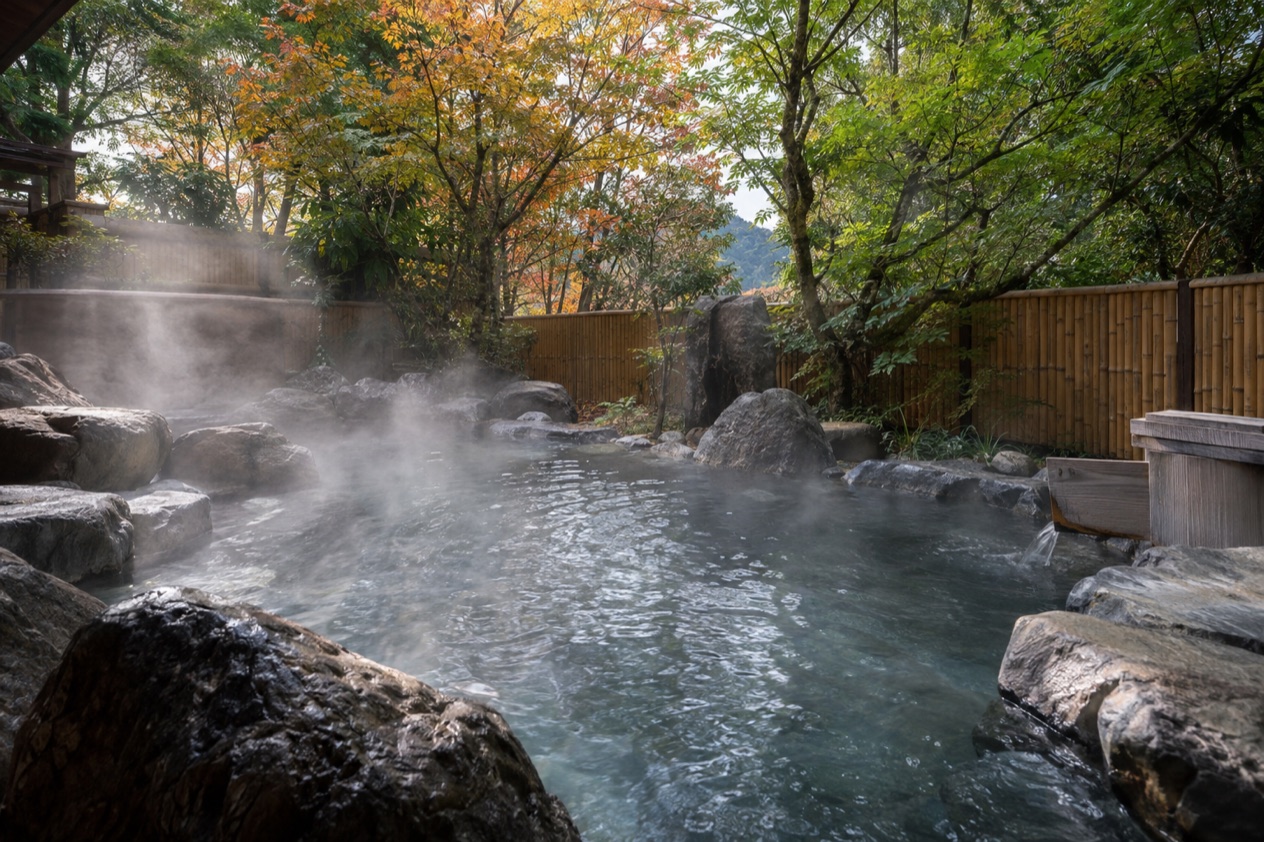
An onsen is a hot spring and, by extension, any bath that uses hot spring water. The word covers both the natural source and the bathing facilities built around it, from a stone pool on a hillside to a tiled bath inside a hotel. Japan sits west of the Pacific Ring of Fire and is one of the most tectonically active places in the world, which is why hot water comes out of the ground in so many places.
The scale is large. There are approximately 25,000 hot spring sources across the country, and approximately 3,000 onsen establishments use naturally hot water from them.
Under the Japanese Hot Springs Act, mineralized water feeding an onsen must be at least 77°F and come from a depth of at least 0.93 miles. The composition of the water changes from region to region, so a bath in one town can feel quite different from a bath in the next.
Kinds of baths you may meet
Onsen come in many forms. Some are indoor tubs, some are open-air baths called rotenburo, and many of those look out over mountains, forests or a river. You will also find cypress-scented tubs, sand baths where you are buried in warm sand, and public foot baths for people who do not want to immerse fully.
Foot baths, called ashiyu, are usually separate from the main facilities and are typically free. Only the feet and lower legs go in the water, so you stay fully clothed, which makes them an easy way to feel the heat and the mineral water on a walk through a town. In remote areas there are also free, publicly maintained baths with minimal facilities and often stunning views.
Some baths announce themselves by smell and color. A whiff of rotten egg and a milky white tint point to sulfur in the water. Electric baths (denki-buro) run a small current, and they should be avoided by anyone with a pacemaker or a heart condition.
Onsen, ryokan and sento
A ryokan is a traditional Japanese inn, and most have an onsen and build the stay around it. Many luxury ryokan offer private baths in the rooms, a favorite for couples. Staying in one also lets you taste local cuisine and visit nearby sights at your own pace.
Onsen inside ryokan or hotels are typically for guests only, though some set aside certain hours when outsiders can buy a day pass. They are generally open around the clock or close only briefly each day for cleaning.
A sento is a different thing: a communal bathhouse where customers pay for entrance, with ordinary heated water rather than a hot spring. In a sento, shoes go into a locker that is usually free, and some bathhouses charge extra for the sauna and hand you a wristband as proof.
Japan has long treated hot spring bathing as medicine too, a practice called toji that goes back centuries, and bathing is generally believed to give wellbeing a real boost. Onsen are also said to ease sore muscles, help sleep and improve circulation.
Where are the best-known onsen towns?
Three of the oldest onsen in Japan are Dogo Onsen in Ehime Prefecture, Shirahama Onsen in Wakayama Prefecture and Arima Onsen in Hyogo Prefecture. They are a good place to start if you like your hot springs with history attached. Beyond them, hot water runs through the whole archipelago, so a town with a bath is rarely far from wherever you are staying.
Towns with tattoo-friendly baths
Two towns stand out for travelers with tattoos. Kinosaki Onsen in Hyogo and Beppu Onsen in Oita both have many onsen that do not require guests to cover their tattoos.
Beppu is also a place to meet the variety of onsen bathing, since the country’s baths range from public foot baths to sand baths. Kinosaki, by contrast, is a town where the baths and the ryokan are part of the same experience, so you can settle in, change into a yukata and make bathing the center of the day.
Old names and extreme heat
Dogo, Shirahama and Arima carry the weight of long use. They sit in three different prefectures, and each one gives you a different regional setting for the same ritual. Water composition changes from region to region, so visiting more than one is a way to compare.
At the other end of the scale is Obama Onsen in Nagasaki Prefecture, the hottest Japanese hot spring at 221°F. That is the temperature of the spring itself, not of a bath you would step into. It shows how much heat the ground holds in this part of the world.
Wellness trips beyond the bath
Travelers pair hot springs with other quiet pursuits. Zenkoji Temple in the mountainous region of Nagano offers zazen meditation sessions led by a monk. Shinanomachi in Nagano is a good place for beginners to try forest bathing with a forest care trainer, and forests cover 67% of Japan.
Aso, one of the country’s most interesting volcanic regions, has morning yoga sessions with panoramic views of the peaks. At the Tottori Sand Dunes, in Japan’s only desert-like area, visitors can try stand-up paddle yoga. Any of these can sit beside a soak in the evening.
How do you use an onsen?
You wash first, rinse off every trace of soap, and then slip into the bath completely nude. Public baths in Japan are generally used naked, and onsen are no exception. Following the etiquette keeps the experience pleasant for everyone, and the idea behind most of it is to stay aware of the people around you.
From the entrance to the water
Look for the curtain or sign at the entrance. The hiragana character ゆ marks a bath, and so does an emoji of a semicircle with three curved vertical lines for steam. Inside, there is usually one section for men and another for women, marked with the kanji 男 for man and 女 for woman.
Before you enter the bath, wash yourself and rinse off all foam, because the water is reused by the next person. Swimsuits are not allowed in the baths or the showers, so you go in with nothing. Towels are not allowed in the bath either, and it is against the rules to dip a towel in the water, so the small towel stays on the side or rests on your head.
Tattoos
Some onsen and sento prohibit tattoos, a rule that began as a way to keep out yakuza gangsters. By 2015, around 56% of onsen operators had banned bathers with tattoos, but more onsen now allow them than before. You may be able to enter a no-tattoo onsen if you cover the tattoo with a sticker or patch, and the advice is to check with the facility beforehand.
At some public baths, a sign refuses entry to people with tattoos, though you may be let in if they are not too obvious. Publicly owned baths must let all tax-paying citizens in. Towns such as Kinosaki and Beppu are the ones with many tattoo-friendly onsen that need no covering at all.
Families, mixed bathing and private baths
Young children can go with a parent of the opposite gender, but older children, around 5 years old or elementary school age, use the correct side. In Tokyo, girls 13 or younger and boys 8 or younger are usually permitted in the baths of either gender. In Hokkaido the cutoff can be as high as 16, and in Hyogo as low as 5.
If you would rather bathe as a group, private family baths called kazokuburo can be found in many locations and reserved for mixed bathing. Some ryokan have reservable family baths, and some of those allow bathing suits. Commercial mixed-gender (kon’yoku) onsen tend to enforce suits for both sexes, and in those specific modern pools swimsuits are allowed and required. In Okinawa, where the climate is warmer, sento usually have no separation between the changing room and the bathing area, or only a small wall with an opening to pass through.
Good to know before you go
Bring the habits more than the gear: wash thoroughly, keep towels out of the water, and ask about tattoos before you pay. Ryokan baths are generally open around the clock, so a soak before breakfast is as possible as one after dinner. A sento may add a sauna fee, so ask what the wristband covers before you head in.
Sources
- Japan National Tourism Organization, wellness and onsen (https://www.japan.travel/en/guide/wellness-travel-in-japan/), checked October 11, 2026
- Japan National Tourism Organization, onsen: what it is, etiquette, famous areas (https://www.japan.travel/en/see-and-do/onsen/), checked October 11, 2026
- Wikipedia, Onsen (https://en.wikipedia.org/wiki/Onsen), checked October 11, 2026
- Wikipedia, Sentō (https://en.wikipedia.org/wiki/Sent%C5%8D), checked October 11, 2026
- Wikivoyage, Onsen (https://en.wikivoyage.org/wiki/Onsen), checked October 11, 2026
To plan your stay
- Best Time to Visit Japan: Cherry Blossoms, Autumn Colors, Weather and Festivals
- Where to Stay in Japan: Ryokan, Temple Stays, Capsule Hotels and the Best Cities to Base In
- Sending Luggage from the Airport in Japan: Hands-Free Travel, Hotel Delivery and Coin Lockers
- Know Before You Go to Japan: Entry, Money, Etiquette and Getting Around