
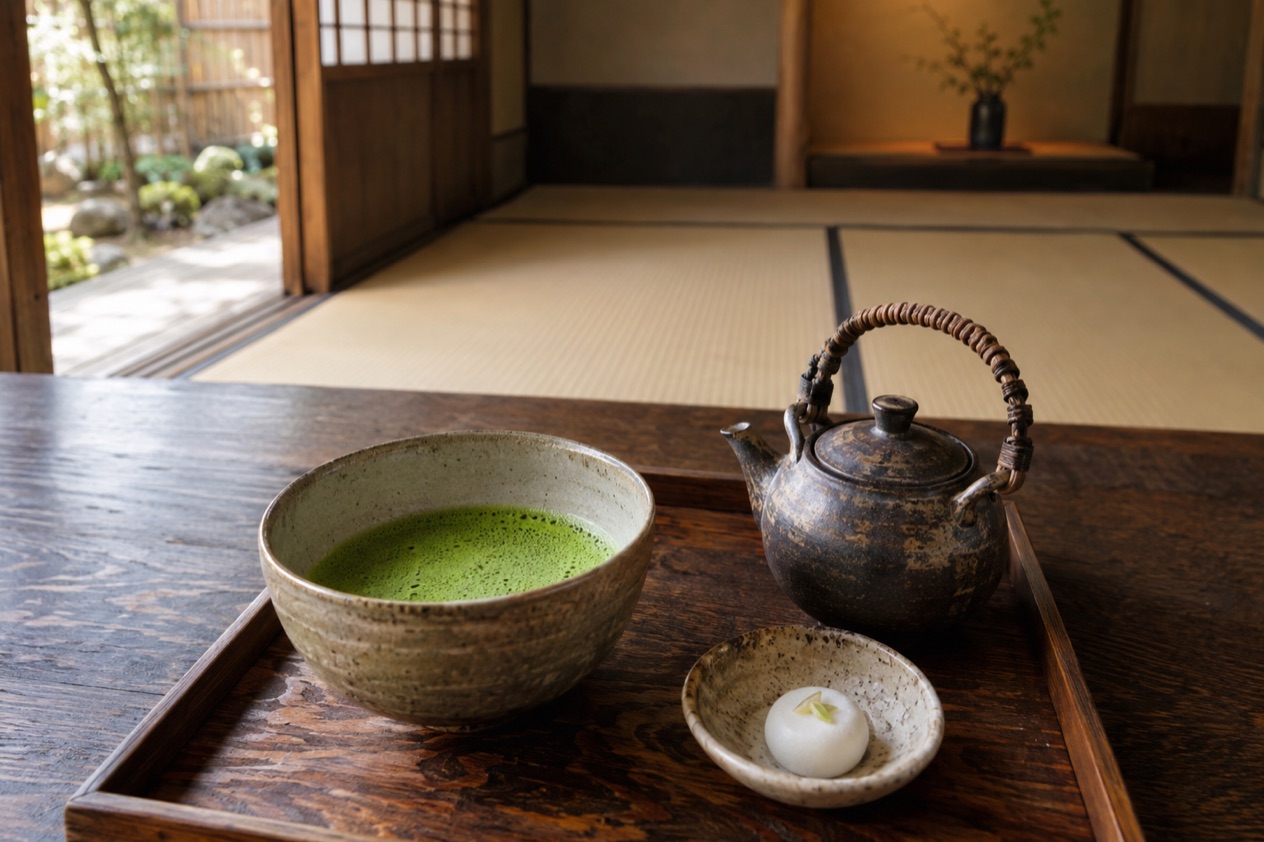
A bamboo whisk clicks against the side of a wide bowl, and a bright green foam rises while the room goes quiet. Guests sitting on tatami wait for the sweet to be eaten, the bowl to be turned, the first bitter and creamy sip to land. This is matcha in Japan, drunk slowly and with attention, from the tea ceremony to the regions that grow the leaf.
What is matcha?
Matcha is powdered green tea, whisked with hot water into a frothy drink, and it sits at the center of the Japanese tea ceremony. The ceremony has roots in Zen Buddhism and in a tea culture that came from China, then became something distinctly Japanese. When you drink it, you swallow the finely ground leaf itself, which is why the color is so vivid and the taste so full.
The tea has a long story behind it. The tea ceremony dates back to the year 815, when the monk Eichu, home from China, prepared sencha for Emperor Saga. The emperor then ordered tea plants to be put in the ground in the Kinki region of western Japan. Kyoto later became known for the best tea, from seeds a monk had brought over from China.
Thick tea and thin tea
Matcha comes in two styles. Koicha, thick tea, is made from the best quality leaves and has a dense, almost syrupy body. Usucha, thin tea, is lighter and frothier, and it is the bowl most visitors are served. Koicha uses 4 g of matcha with 30 ml of water at 80 °C (176 °F), while usucha uses half the powder in twice the water at 90 °C (194 °F).
In a formal gathering the difference shows in how the bowls travel. The host serves thin tea to each guest in an individual bowl, while one bowl of thick tea is shared among several guests. A sweet comes first, so its sugar softens the bitterness of the tea that follows.
Uji and the regional brands
Uji, in Kyoto, became Japan’s foremost tea-producing region after the monk Myoe established tea plantations there. Japanese producers promote high-quality matcha under regional brands, particularly from Uji, Nishio and Shizuoka Prefecture, so those three names are worth looking for on a tin.
Demand for the best leaf is strong. Some Kyoto-based tea companies have set purchase limits on premium matcha because of supply constraints, particularly of first-flush matcha. If a shop offers one small tin per customer, that is the reason. Matcha first reached the U.S. through Japanese grocery stores in cities with large Japanese communities, particularly Los Angeles and San Francisco, and it is now far more familiar at home than it once was.
The other tea: sencha
Not all Japanese tea practice uses powder. A less common variant uses tea leaves instead, primarily sencha, and it is called senchado. It is the style behind the tea Eichu is said to have served the emperor. If you meet a tea room that serves steeped leaf rather than whisked powder, this is the tradition you are in.
Where can you try it?
You can try matcha in Kyoto, in the tea-growing town of Uji, and in any place that offers a tea ceremony, whether in a purpose-built tea room or a more relaxed setting. The ceremony itself traditionally takes place in a chashitsu, a tea pavilion with tatami flooring and a built-in hearth. The ideal size for a wabi-style room is 4.5 tatami mats, which makes for a small, close space where the host and guests sit within arm’s reach.
Kyoto and Uji
Kyoto is the place the old stories point to when they talk about the finest tea, and Uji, within the Kyoto area, is the region that grew into Japan’s foremost tea-producing land. Visiting both lets you pair the drinking with the source: a bowl in a tea room, then a look at where the leaf comes from.
Matcha shows up in many forms in tea rooms and shops, from a simple whisked bowl with a sweet to powder sold in tins. Because first-flush matcha can be limited in Kyoto, do not be surprised if the finest grade is sold in small quantities.
Informal gatherings and formal ones
Tea gatherings come in two kinds. An informal chakai may include confections, thin tea and a light meal. A formal chaji includes a full-course kaiseki meal followed by confections, thick tea and thin tea, and it may last up to four hours.
The noon gathering of one host and a maximum of five guests is considered the most formal chaji. For most travelers, the chakai is the gathering that fits a day of sightseeing, while the chaji is an occasion in itself.
Matcha beyond the tea room
Matcha is also something you bring home. Look for tins carrying the regional names of Uji, Nishio or Shizuoka, and for the powder in the grade that suits what you plan to make. Since the U.S. put new 15% tariffs on Japanese imports in August 2025, matcha bought at home is affected, which is one more reason travelers pick up a tin in Japan.
How do you take part in a tea ceremony?
You take part as a guest: you sit on the tatami, receive a sweet and then a bowl of tea, and follow the host’s lead in how you hold and drink it. The ceremony is called chanoyu, sado or chado, and the art of preparing and presenting the tea is called otemae, or temae. It expresses omotenashi, the Japanese idea of profound hospitality, so the whole afternoon is shaped around caring for the guest.
The four principles
Sen no Rikyu, the most iconic figure in Japanese tea history, named four fundamental principles: harmony, respect, purity and tranquility. They explain the feel of the room more than any set of rules does. Guests move slowly, speak softly and pay attention to the bowl, the scroll on the wall and the arrangement of the room.
The tea ceremony is one of the three traditional refined arts of Japan, alongside kodo, the appreciation of incense, and ikebana, flower arranging. You may notice a few flowers and a hanging scroll in the alcove, which belong to the same world.
What happens in the room
The host prepares the tea in front of you, measuring the powder, adding hot water and whisking it into foam. A sweet is eaten first. Then the bowl is passed or placed before you, and you drink it. In a shared thick tea, one bowl moves among several guests, while thin tea comes to each person in an individual bowl.
Practitioners divide the year into two seasons: the sunken hearth season, traditionally November to April, and the brazier season, traditionally May to October. The change shapes how the room is set, so a ceremony in winter feels different from one in summer.
Doing it well as a first-timer
Come curious and unhurried. Sit as the host shows you, eat the sweet before the tea, and take your time over the bowl. Questions about the tools and the scroll are part of the pleasure, and hosts are often glad to explain them. The point is attention, not perfection.
Good to know before you go
Matcha is something to savor slowly, so give a tea session its own slot in the day rather than squeezing it between sights. If you plan a formal chaji, keep in mind that it may last up to four hours. Carry home tins from Uji, Nishio or Shizuoka if you want regional matcha, and remember that premium Kyoto leaf can be limited in quantity.
Sources
- Japan National Tourism Organization, tea ceremony (https://www.japan.travel/en/guide/tea-ceremony/), checked October 11, 2026
- Wikipedia, Japanese tea ceremony (https://en.wikipedia.org/wiki/Japanese_tea_ceremony), checked October 11, 2026
- Wikipedia, Matcha (https://en.wikipedia.org/wiki/Matcha), checked October 11, 2026
To plan your stay
- Best Time to Visit Japan: Cherry Blossoms, Autumn Colors, Weather and Festivals
- Where to Stay in Japan: Ryokan, Temple Stays, Capsule Hotels and the Best Cities to Base In
- Sending Luggage from the Airport in Japan: Hands-Free Travel, Hotel Delivery and Coin Lockers
- Know Before You Go to Japan: Entry, Money, Etiquette and Getting Around