
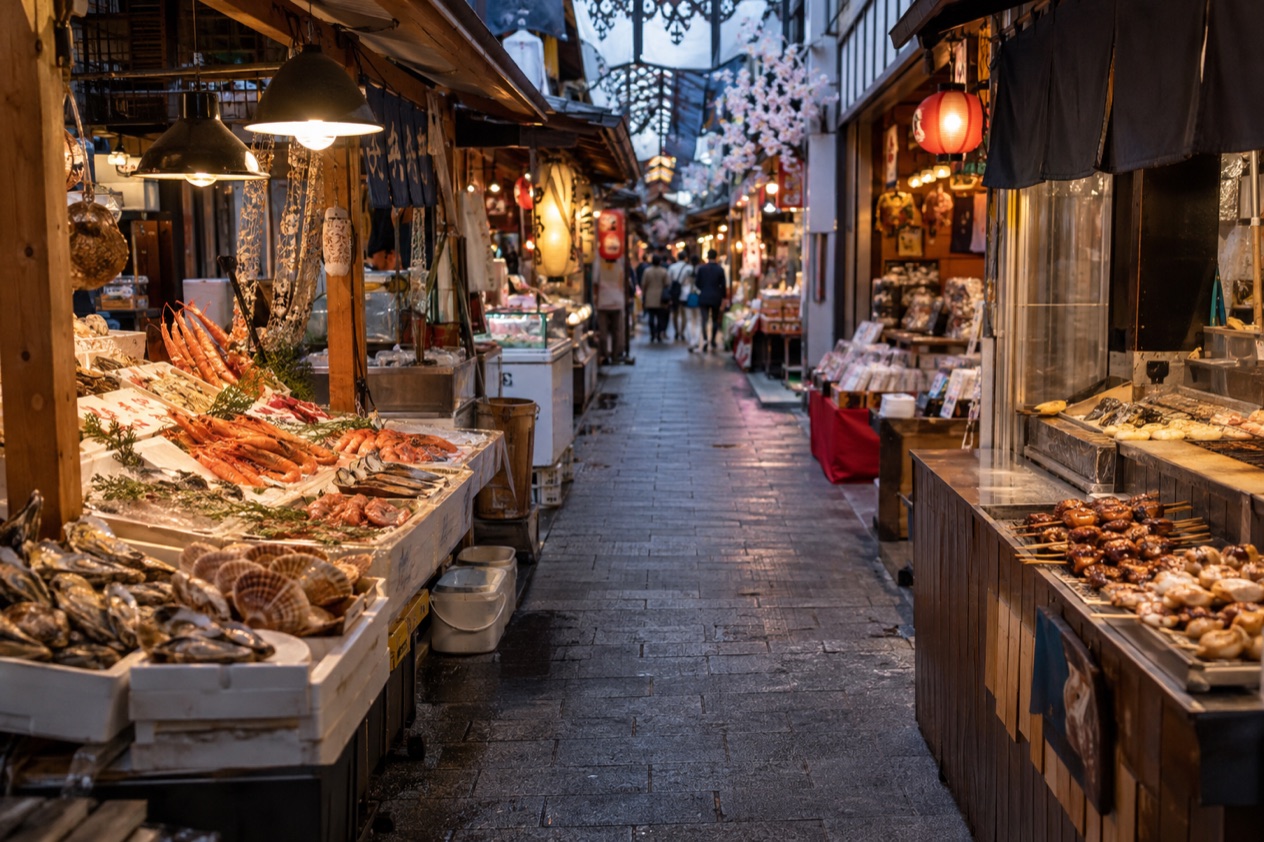
A cook flips a row of takoyaki with two thin picks, the batter hissing as the octopus balls turn golden, and the smell of soy and grilled seafood hangs under the covered roof. Down the lane, someone hands over a skewer, a bowl of noodles, a sweet wrapped in paper. Japan’s food markets, from the seafood halls of Osaka and Tokyo to the stalls of Kyoto and Kanazawa, are places to eat as much as to look.
Which food markets can you visit in Japan?
Japan has food markets in cities all over the country, and the Japan National Tourism Organization names Kuromon Market, Nishiki Market, Miyagawa Morning Market, Omicho Market, Tsukiji Market and Toyosu Market as typical ones. Beyond those, you meet the same spirit in shopping arcades, at festivals and in the evening stall districts of port cities. Each region cooks its own specialties, so the same idea of a market tastes different from one place to the next.
What you find on the counters depends on where you stand. Seafood markets sell fresh and grilled fish and shellfish that you can eat on the spot. Others lean toward pickles, sweets, skewers and small hot snacks. The point is to graze: a bite here, a skewer there, rather than one big sit-down meal.
Street food you will meet again and again
Japan offers a wide range of inexpensive street foods and sweets, among them ramen, takoyaki, taiyaki, okonomiyaki, yakitori, tonkatsu, croquettes, gyoza and udon. Takoyaki began in Osaka and is now found in almost every shopping arcade and at festivals across the country. Taiyaki, the fish-shaped cake, is the sweet half of the picture, usually eaten warm from the mold.
Okonomiyaki is a savory pancake cooked on a griddle, and yakitori is chicken grilled on skewers over charcoal. Tonkatsu is a breaded pork cutlet, and croquettes turn up in butcher shops and market lanes alike. Together they make a lunch you can assemble stall by stall, with no menu to study.
Yatai: food stalls at festivals and by the river
Outdoor food stands called yatai are common at Japanese festivals. They sell takoyaki, okonomiyaki, yakisoba and other freshly prepared takeaway foods, and the smoke from the grills is half the atmosphere. If a matsuri (a local festival) falls during your trip, the stalls around the shrine grounds are a market of their own.
Fukuoka, on the island of Kyushu, has the Hakata yatai, a famous set of stands with makeshift counters. You sit close to the cook, enjoy a drink with your food, and some stalls specialize in ramen. Fukuoka is one of the cities Japan’s tourism board singles out for good food, and the stalls are a large part of why.
Food cities beyond the big markets
Several cities are known for what they eat. Utsunomiya is associated with gyoza, and Kobe, Otaru, Sapporo, Nagasaki, Kyoto, Matsusaka and Kitakata also appear among the places known for good food. If your route passes through one of them, ask what the town is proud of and let that decide the next stop.
Station food is a separate pleasure. Ekiben are traditional boxed meals sold at stations, and each region packs its own local flavors into the box. Eating one on the train, watching the landscape change, is a small ritual in itself.
Which are best known?
The names that come up first are Kuromon Market, Nishiki Market, Omicho Market, Miyagawa Morning Market, Tsukiji Market and Toyosu Market, each tied to a different city and a different style of eating. Two of them, Nishiki and Kuromon, are specifically described as offering an abundance of street food, including fresh and grilled seafood.
Kuromon Market in Osaka
Kuromon is an Osaka market where seafood is the draw. Stalls grill shellfish and fish to order, and you eat from a tray or a skewer beside the counter. Osaka is also the home of takoyaki, so the octopus balls here have a good claim to being the real thing.
It suits travelers who like to taste widely and decide as they walk. A sensible plan is to treat the market as lunch: pick two or three stalls, share plates, and leave room for something sweet. Rules about eating while walking can apply at markets like this, so look for the signs at each stall.
Nishiki Market in Kyoto
Nishiki is Kyoto’s market lane, narrow and lined with shops selling fresh and grilled seafood and other street food. Kyoto is also a city of kaiseki, the multi-course meal served in ryotei, traditional restaurants. After the elegance of a kaiseki dinner, the casual snacking at Nishiki feels like the other side of the same cuisine.
It works well as a first taste of the city, since the stalls give a quick sense of what Kyoto cooks and sells. Vegetarians and vegans, who can expect refined dishes across Japan, may want to look past the seafood counters for pickles, tofu and sweets.
Omicho in Kanazawa and Miyagawa in Takayama
Omicho Market belongs to Kanazawa, and Miyagawa Morning Market to Takayama, both smaller cities that offer a calmer alternative to the big-city halls. Their names alone tell you the character: a working market in one, a morning market in the other. Regional specialties show up here more clearly than in the capital, since stalls lean on local ingredients.
They reward travelers who are already visiting those cities rather than making a special trip. Wander slowly, ask what is local, and pair a stall snack with a cup of tea or a taste of sake from a local brewery.
Tsukiji and Toyosu in Tokyo
Tsukiji Market and Toyosu Market are both Tokyo names, and both are listed as typical markets. They are tied to Tokyo’s seafood and its sushi tradition, and sushi is among the dishes that the national tourism board puts at the center of Japanese cuisine.
For travelers, the idea is simple: Tokyo is where you taste sushi and fresh seafood at a market counter, then move on to the rest of the city’s food. Beyond the seafood, the capital gives access to everything else on the list, from ramen to yakitori.
How do you visit?
You visit a Japanese food market by walking slowly, tasting stall by stall, and following the local rules posted at each place. At some markets you may be asked not to eat and drink while walking, so you eat at the stall or beside it, then move on. Visitors must follow those local rules, and the rule is part of how the lanes stay pleasant for everyone.
Eating at the counter
A market meal is built from small things. Order a skewer or a tray, stand where the stall indicates, finish, and then go on to the next one. A shared plate lets two people taste far more than one person could alone.
Japan has a guide to dining etiquette and customs for visitors, and the habits are mostly about courtesy: thank the cook, keep your waste to the stall, and take your time. Sake from a local brewery is a natural companion to a seafood meal when a stall or restaurant pours it.
Beyond the market: noodle shops, izakaya and konbini
Not every meal happens in a market. At soba or udon noodle shops in or around train stations, you may need to buy a meal ticket from a vending machine first, then hand it over at the counter. It looks puzzling once and routine the second time.
Many izakaya, the casual pubs where food comes in small dishes with drinks, now have touch-screen ordering with illustrated menus. Most konbini, the convenience stores, are open 24 hours a day and sell hot food such as kara-age fried chicken, onigiri rice balls, bento boxes, snacks and drinks. They are a handy fallback when the markets are closed or you are hungry at an odd hour.
Tea, sweets and a slower finish
A market day can end with something quieter. The Japanese tea ceremony is a culinary-related cultural activity, and a sweet such as taiyaki with a hot drink makes a gentler close than another round of grilled seafood.
If you want to plan around street food and budget restaurants more widely, the tourism board publishes a guide to the local street food and inexpensive places to eat. Use it to connect the market stops with the neighborhoods around them.
Good to know before you go
Food markets in Japan are places of small, inexpensive bites, so the most useful habit is to follow what each stall and market posts, especially the rule about eating while walking. Vegans and vegetarians can find refined dishes across the country, though seafood dominates many market counters, so look at what is on offer before you line. Keep your plans flexible, since the markets, stalls and festivals described here are separate places that each run on their own rhythm.
Sources
- Japan National Tourism Organization, Japanese gastronomy (https://www.japan.travel/en/gastronomy/), checked October 11, 2026
- Japan National Tourism Organization, street food and budget restaurants (https://www.japan.travel/en/gastronomy/local-street-food-favorites-budget-restaurant-japan/), checked October 11, 2026
To plan your stay
- Best Time to Visit Japan: Cherry Blossoms, Autumn Colors, Weather and Festivals
- Where to Stay in Japan: Ryokan, Temple Stays, Capsule Hotels and the Best Cities to Base In
- Sending Luggage from the Airport in Japan: Hands-Free Travel, Hotel Delivery and Coin Lockers
- Know Before You Go to Japan: Entry, Money, Etiquette and Getting Around