
Somewhere between the ticket gate and the stairs of a small station, a large suitcase starts to feel like a mistake. Japan has an answer that locals have used for years: send the bag ahead and travel with a daypack.
What is luggage forwarding in Japan?
Luggage forwarding is a door-to-door delivery service in which you hand a bag to a counter, a hotel or a store and it travels separately to the place where you sleep next, so you move through trains and streets without it. In Japanese it is called takkyubin, and the word has become part of everyday speech for sending a parcel or a suitcase from one address to another.
For visitors, the idea is simple to picture. You spend the morning at a temple or a market with nothing heavier than a camera, and your suitcase is already waiting at the hotel when you arrive. The service exists for exactly this kind of travel, and Japan’s national tourism organization promotes it as a way to travel without heavy bags.
Takkyubin and the black cat
TA-Q-BIN is the trademarked name Yamato Transport gives to its express door-to-door delivery service, and the company’s head office is in Ginza, Tokyo. Because the word takkyubin is sometimes used across Japan for any express home delivery, Yamato defends its trademark so that the name does not become a generic term for everyone’s service.
You will recognize the company by its logo, a yellow oval with a black cat carrying her kitten in her mouth. The picture is a promise: items entrusted to the company are looked after as though they were family. That is why Yamato is often called Kuroneko, which means black cat in Japanese, and why the animal appears on the trucks and counters you see in Japanese cities.
Hands-Free Travel
Hands-Free Travel is the name of the program that lets visitors have luggage transported and stored securely. Counters that display the Hands-Free Travel logo are certified to provide luggage delivery and storage, so the logo is the sign to look for when you are not sure where to go.
The program comes with a few promises worth knowing. Delivery can happen the same day or at a date and time you specify, the service can be used in several languages, and there is compensation for items that are lost or damaged. For a traveler who does not read Japanese, that multilingual access matters as much as the delivery itself.
Where you can hand over a bag
Airports are the clearest starting point. Narita, Haneda, Kansai International, Chubu Centrair, Shin Chitose, Fukuoka and Naha airports all offer luggage delivery to your hotel. Landing with a suitcase and leaving the terminal with only a small bag is an option at each of them.
Away from the airports, two other doors are open. Most major hotels can arrange delivery between hotels, and you ask at the front desk. If you are not staying at a major hotel, you can still drop luggage at a designated convenience store for shipping. Between them, a bag can leave from a lobby, a corner store or an airport hall.
How does it work?
At participating Hands-Free Travel counters, delivery may be available the same day or for a specified date and time. The sequence is the same whether the bag starts at an airport or in a hotel lobby.
From the airport to your hotel
At the airports that offer the service, you bring the suitcase to the delivery counter after arriving, give the name and address of your hotel, and walk out with only what you need for the day.
The logic suits a long first day. Instead of dragging a case through a train transfer, you keep your hands free for tickets, a map and a first bowl of noodles. Delivery can be set for the same day or for a date and time you name, so the bag meets you when you want it to.
From hotel to hotel
When you are moving on to another city, the front desk is the place to start. Most major hotels in Japan can arrange luggage delivery between hotels, and you simply ask when you check out. You give the name of the next hotel and the day you arrive there.
This is the form of forwarding that fits a trip with several bases. You leave with a small bag while the larger suitcase travels separately to your next hotel. The compensation for lost or damaged items that comes with Hands-Free Travel applies to services under that program.
From a convenience store
Not every traveler sleeps in a large hotel, and the service does not depend on it. Even if you are not staying at a major hotel, you can drop luggage at a designated convenience store for shipping. That gives travelers who are not staying at a major hotel another place to drop off their luggage.
The word designated matters. Only some stores take part, so look for the one that offers the service rather than assuming any store will do. The logo of Hands-Free Travel marks counters certified for luggage delivery and storage.
What the services will carry
Delivery and storage services set limits on the bag itself, in size and in weight. Both limits apply together, so a suitcase that is within one but over the other will not qualify.
| Limit | Value |
|---|---|
| Size | No more than 160 linear centimeters |
| Weight | No more than 25 to 30 kg |
Coin lockers for the hours in between
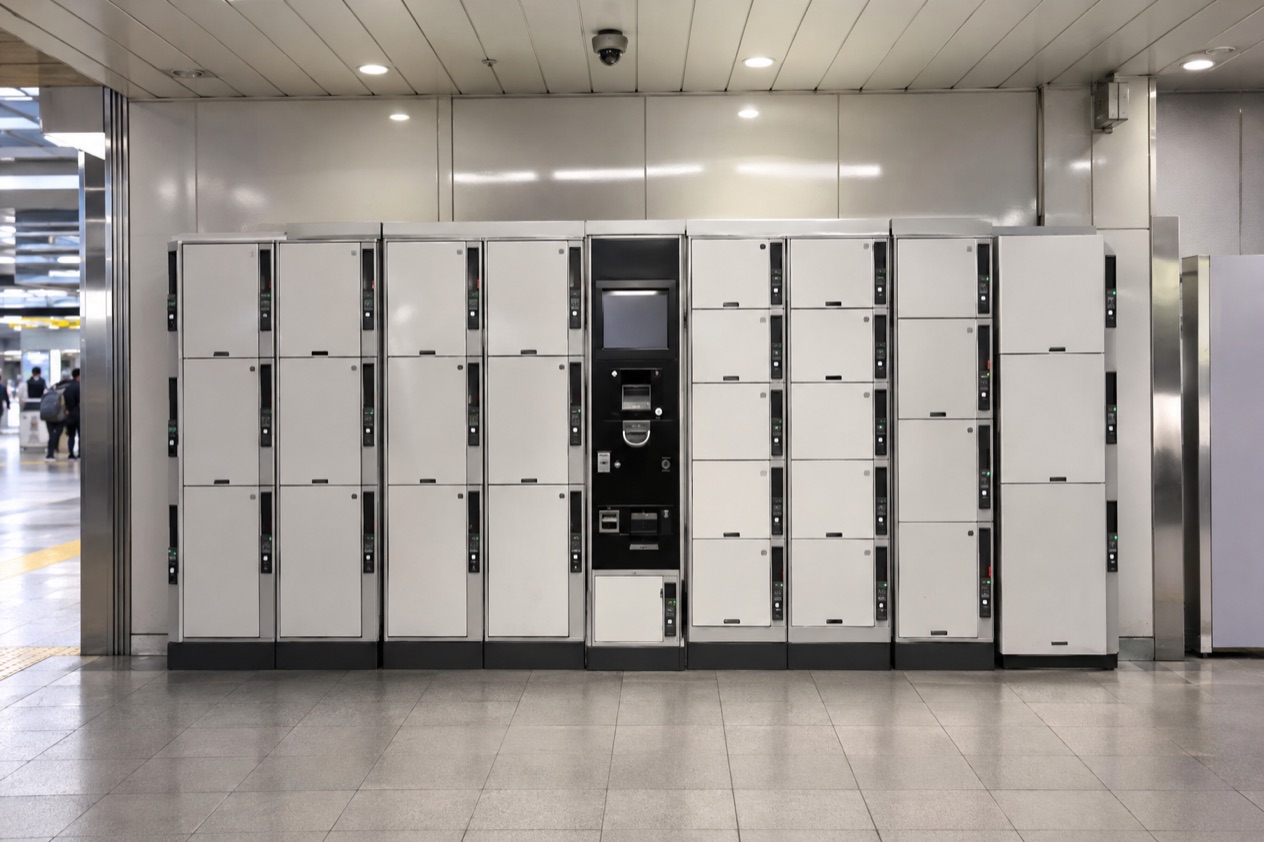
Forwarding moves a bag to another place, and a coin locker simply holds it where you are. Coin lockers of various sizes are available at most train stations and tourist sites in Japan, which makes them useful for the gap between checking out and boarding a train.
Many modern coin lockers accept payment by IC transportation cards, the same rechargeable cards used for trains. In busy locations, lockers fill up very quickly, so a station with heavy traffic may have none free when you arrive with your bag.
What does it cost?
The cost that comes with a stated range is the coin locker, which is priced by size, while delivery by a counter, a hotel or a convenience store is a separate service paid to the provider you use. Knowing which of the two you need is the first step in budgeting.
Coin locker fees
Coin locker fees depend on the size of the locker. A small one costs less and a large one more, and the range runs across the whole set of sizes you find at stations and tourist sites. Payment by an IC transportation card is accepted at many modern lockers, which spares you a pocket of coins.
| Service | Fee |
|---|---|
| Coin locker, by size | 300 to 600 yen |
Because lockers fill up quickly in busy places, the price is only one part of the picture. A locker at a quiet stop may be free when a locker at a crowded hub is not, and that difference can matter more than the fee.
What you get with delivery
With delivery, the value is in what the service promises. Hands-Free Travel counters offer delivery the same day or at a date and time you specify, access in several languages, and compensation for items that are lost or damaged. A counter certified under the program displays the logo, so you can see what you are paying for before you hand the bag over.
The size and weight limits also shape the bill in a practical way. A bag over the limit does not qualify for these services, so a traveler with an oversized case has to plan for that before arriving at the counter.
Choosing between a locker and forwarding
A locker answers a question of hours. You leave a bag at a station while you visit a site, and you pick it up when you return. Forwarding answers a question of days, because the bag goes to the next hotel while you travel without it.
The two work well together. You might forward the large suitcase to the next city and keep a small bag in a locker for the afternoon, using an IC card to pay. Each service has its own cost and its own limits, and the sizes of the luggage determine which one fits.
Good to know before you go
Look for the Hands-Free Travel logo when you want a counter certified for delivery and storage, and keep a charged IC card in your pocket for lockers that take it. Check the size and weight of your bag before you line, since the limits apply to delivery and storage alike. Takkyubin is a word you will hear and see often, and the black cat on a yellow oval is the sign that visitors learn to spot.
Sources
- Japan National Tourism Organization, coin lockers, luggage storage, forwarding (https://www.japan.travel/en/plan/getting-around/luggage-storage/), checked October 11, 2026
- Wikipedia, Yamato Transport (https://en.wikipedia.org/wiki/Yamato_Transport), checked October 11, 2026
To plan your stay
- Best Time to Visit Japan: Cherry Blossoms, Autumn Colors, Weather and Festivals
- Where to Stay in Japan: Ryokan, Temple Stays, Capsule Hotels and the Best Cities to Base In
- Sending Luggage from the Airport in Japan: Hands-Free Travel, Hotel Delivery and Coin Lockers
- Know Before You Go to Japan: Entry, Money, Etiquette and Getting Around