
A server kneels at the edge of the tatami, sets down a small lacquer bowl, and lifts the lid to let the steam rise. Inside, a single piece of fish sits in a clear broth with one green leaf, placed as if by a painter.
This is kaiseki, the multi-course dinner that Japan treats as a quiet performance. You find it in ryokan dining rooms and small restaurants, with Kyoto as its best-known home.
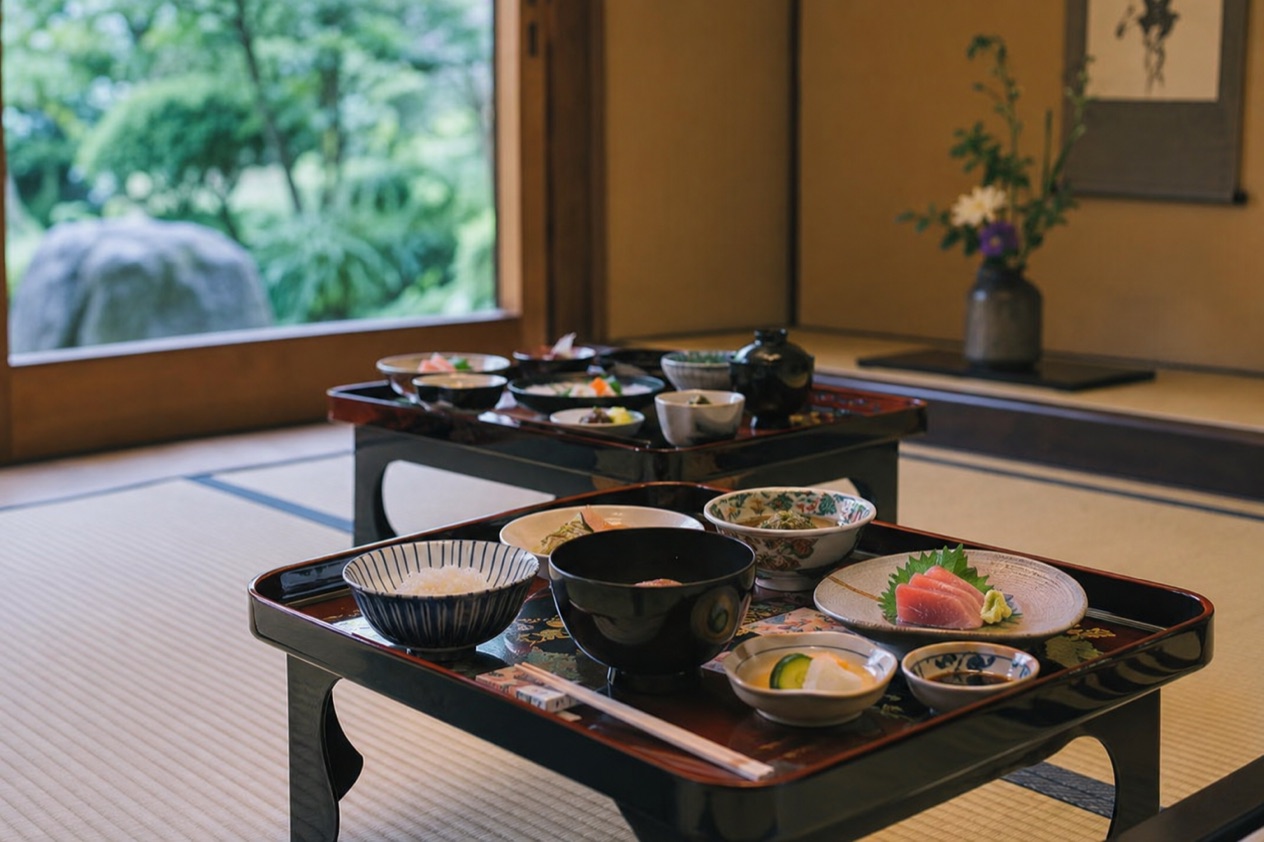
What is kaiseki?
Kaiseki is a traditional multi-course Japanese dinner, often compared to Western haute cuisine. Dishes arrive one at a time, in a sequence the kitchen has planned from first bite to last, and each is small enough that you notice every detail. Nothing is meant to overwhelm. The point is balance, and the way one course prepares you for the next.
What you see on the table matters as much as what you taste. Bowls, plates and cups change from course to course, chosen to suit the food and the moment. A dish of cool, glossy vegetables may come in glass, while something warm arrives in a heavy, dark bowl with a lid. You eat slowly, and the evening has a rhythm that rewards paying attention.
Seasons on the plate
Kaiseki uses only fresh seasonal ingredients, prepared in ways that aim to bring out their flavor rather than hide it. That is why the same restaurant serves a quite different dinner in spring than in autumn. A menu is a kind of calendar, and the garnishes, the colors and even the leaf under a piece of fish quietly tell you what time of year it is.
Summer has a course of its own. Hiyashi-bachi is served only in that season and consists of chilled, lightly cooked vegetables, a cooling dish for hot evenings. Local ingredients also appear often, so a dinner in one region can taste of the hills, rivers or coast around it.
Kyoto cooking and the court
Kyoto is well known for its kaiseki because the city was home to the imperial court and the nobility for over a millennium. A refined table grew up around that long history, and kaiseki-style cooking there is sometimes called kyo-ryori, or Kyoto cooking. If you want to understand where the tradition’s elegance comes from, a dinner in Kyoto is the clearest lesson.
The experience suits travelers who like to eat slowly and talk quietly, and anyone curious about how Japanese cooks think about season and presentation. It is a dinner to settle into rather than a quick meal between sights, so leave the evening free and arrive hungry but patient.
Pine, bamboo and plum
Traditional menus often come at three levels named Sho Chiku Bai, which means pine, bamboo and plum. The names are a graceful way of describing the same idea at different scales, so choosing plum does not mean a lesser meal in spirit, only a smaller or simpler one.
Where can you try it?
You can try kaiseki in two main kinds of places: ryokan, the traditional inns, and small restaurants known as ryotei. Both serve the same style of multi-course dinner, but the feel of the evening differs, and it helps to pick the one that matches the night you want.
At a ryokan
Kaiseki is often served in ryokan across Japan, which makes the inn itself part of the experience. You change into a yukata, the light cotton robe, perhaps after a soak in the onsen, and dinner follows in a dining room or sometimes your own tatami room. The meal ends the day naturally, without anywhere else to go afterward.
Arrangements vary from inn to inn. At a ryokan the meals may be included in the price of the room or optional, and they may be available only to guests or served to the general public too. That means a ryokan can be a place to sleep and dine, or sometimes just a place to eat, depending on the house.
At a ryotei
A ryotei is a small restaurant devoted to this style of cooking. The dinner is the whole evening, with no bath or bed attached, and the cooks can concentrate on the meal alone. Many travelers like it for exactly that focus, and it fits a night in a city when your hotel is elsewhere.
Seating changes the experience. In some cases counter seating is cheaper than private rooms. At the counter you can watch the cooks work and see each dish finished, while a private room gives you a closed, unhurried space for a group or a special occasion.
Kyoto and beyond
Kyoto is the obvious place to start for anyone who wants the tradition at its source, since its cooking is so closely tied to the old court. But because kaiseki uses local ingredients, a dinner at a ryokan in a mountain town or a coastal village can show you something Kyoto cannot: the particular flavors of that region in that season.
If you are building a trip around eating, consider one dinner in Kyoto and one at a ryokan elsewhere. The contrast between city refinement and local produce makes the two meals feel like different chapters of the same book.
How do you book?
Booking kaiseki starts with deciding where you want to eat, since the route differs between a ryokan and a ryotei. At a ryokan, the dinner is often tied to your stay, and the question is whether the meal is part of the room price or an option you add. At a ryotei, you are booking a table for the evening.
Reserving through a ryokan
When you book a room, ask whether dinner is included, because at a ryokan the meals may be part of the room price or optional. Some inns serve the general public as well as guests, while others keep their dining room for those who are staying. Knowing which kind you are dealing with saves confusion when you plan your evenings.
If dinner is included, your evening is set, so it makes sense to plan the rest of the day around being back at the inn. A meal that is a centerpiece of the stay deserves an unrushed arrival and time to bathe and change first.
Choosing a menu and a seat
This gives you a simple way to choose a level that suits your appetite and the occasion. Each follows the same seasonal logic, so you are not giving up the essence of the meal by choosing the lighter one.
Seating is another choice. Counter seating can be cheaper than a private room in some cases, so if you are happy to sit beside other diners and watch the kitchen, it may suit you well. If you want privacy for a family dinner or a celebration, a private room is the way to go.
Matching the season
Because the menu follows the calendar, the time of year you eat shapes what lands on your table. A summer dinner may include hiyashi-bachi, the chilled vegetable course served only in that season. Other months bring their own produce, and local ingredients often add a regional note to each dinner.
Good to know before you go
Kaiseki is a leisurely meal, so it works best when you give it a whole evening and let the courses set the pace. Menus are tied to the seasons, which means no two visits taste quite the same. Choose the level that fits your appetite, whether pine, bamboo or plum, and take your time with each small dish.
Sources
- Wikipedia, Kaiseki (https://en.wikipedia.org/wiki/Kaiseki), checked October 11, 2026
To plan your stay
- Best Time to Visit Japan: Cherry Blossoms, Autumn Colors, Weather and Festivals
- Where to Stay in Japan: Ryokan, Temple Stays, Capsule Hotels and the Best Cities to Base In
- Sending Luggage from the Airport in Japan: Hands-Free Travel, Hotel Delivery and Coin Lockers
- Know Before You Go to Japan: Entry, Money, Etiquette and Getting Around