
A wooden clapper cracks, the striped curtain slides away, and an actor in bold red and white face paint strides down a walkway that cuts straight through the audience, close enough that you catch the rustle of his silk. A few streets away, in a different hall, a masked figure glides across polished cypress boards with barely a sound. Japan keeps several stage traditions alive, and you can watch kabuki, noh and bunraku in Tokyo, Kyoto, Osaka and beyond.
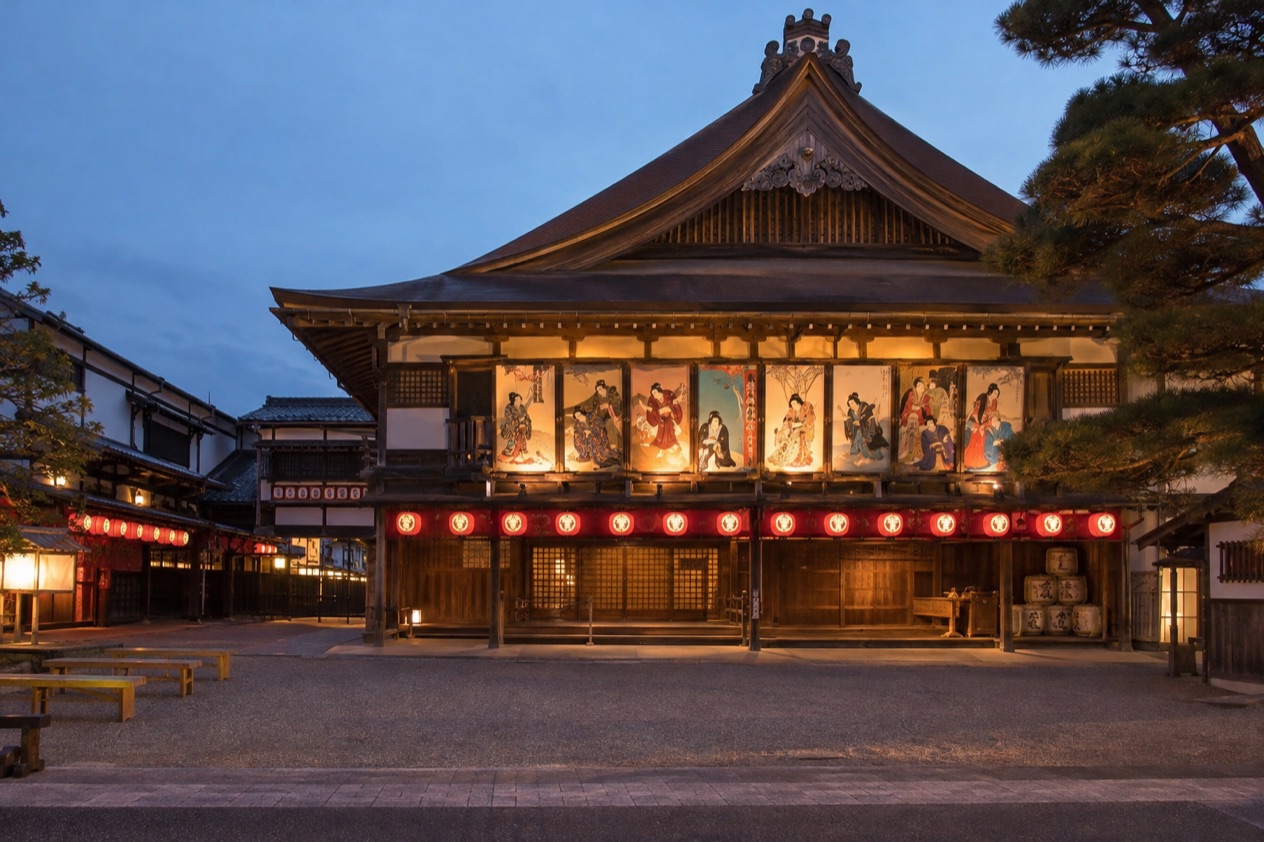
What is kabuki?
Kabuki is Japanese dance theater built on stylized acting, elaborate costume, live music and spectacle, and it is the form most visitors reach for first. It began in the early 17th century in Kyoto, where, according to legend, a young woman from the Izumo Grand Shrine started performing a new kind of dance drama. Women were later banned from the stage, and since 1629 kabuki has been performed by all-male troupes.
The art has been recognized well beyond Japan. UNESCO proclaimed it an intangible heritage of outstanding universal value in 2005 and placed it on its Representative List in 2008. That status says something about how seriously the craft is kept: families of actors pass roles and stage names down the generations, and the repertoire is treated as a living tradition rather than a museum piece.
The stage and the actors
The most striking piece of the kabuki stage is the hanamichi, a raised walkway that runs out into the audience. Heroes, lovers and ghosts use it for dramatic entrances and exits, so a character can pause a few feet from your seat, and the whole house turns its head to follow. Major theaters such as the National Theatre, the Kabuki-za and the Minami-za are also equipped with installations for flying actors above the stage.
Because all roles are played by men, female characters belong to a specialty called onnagata. These actors train for a lifetime in posture, voice and the small movements of a sleeve or a fan. Alongside them you see the painted faces of the warrior roles, with lines of red and black drawn to show courage, jealousy or cruelty before a single word is spoken.
What a performance feels like
A kabuki afternoon is rarely one tight story. Programs often mix a scene from a long historical drama, a dance piece and a domestic tale, so the mood shifts from solemn to comic to lyrical. Wooden clappers mark the beats, a shamisen (a three-stringed instrument) and chanted narration carry the action, and at the peak of a scene an actor freezes in a held pose while regulars in the audience call out his name.
You do not need to understand classical Japanese to follow the thread. The Kabuki-za, the National Theatre of Japan and the Minami-za provide devices with plot information and commentary in English, so the story and the stage conventions are explained as they unfold. Many first-timers find the costume, color and music carry them even in the moments when the words slip by.
Noh and bunraku, the quieter relatives
Noh is the oldest form of Japanese theater, and its protagonist wears a mask that helps interpret the story. It first appeared in the 8th century, and its current form took shape in the 14th century under the performer and playwright Kannami and his son Zeami. Movement is slow and deliberate, and a tilt of the mask is enough to signal grief or joy.
Bunraku, the puppet theater, began in Osaka in 1684. The main puppet is handled by three puppeteers: the most experienced works the head, face and right hand, another takes the left hand, and a third moves the legs. Alongside them sit the narrator and the shamisen player, and after a few minutes you stop watching the black-clad handlers and see only the puppet breathe.
Where can you see a performance?
Tokyo, Kyoto and Osaka hold the major houses, and smaller theaters are scattered across the Japanese countryside. Kabuki has its major theaters in all three cities, while noh has a network of stages across the country and bunraku has its two national homes. The table gathers the main houses named for visitors.
| Theater | City | Form | Language help |
|---|---|---|---|
| Kabuki-za | Tokyo | Kabuki | Devices with plot information and commentary in English |
| National Theatre of Japan | Tokyo | Kabuki and bunraku | Devices in English for kabuki, audio guides for bunraku |
| Minami-za | Kyoto | Kabuki | Devices with plot information and commentary in English |
| National Bunraku Theatre | Osaka | Bunraku | Audio guides translating dialogue and songs in several languages |
| National Noh Theatre | Tokyo | Noh | Libretto followed by some audience members |
Kabuki houses in Tokyo and Kyoto
The Kabuki-za in Tokyo is the house most travelers have in mind, and it began year-round performances in 1991. The National Theatre of Japan, also in Tokyo, stages kabuki too, so the city offers two different rooms in which to see the same art. Kyoto has the Minami-za, a fitting setting given that the art itself began in that city.
All three provide English commentary on a device, which matters for a first visit. Pairing a kabuki afternoon with a walk through the neighborhood around the theater turns it into a day rather than a single ticket, and Kyoto’s version suits anyone already spending time among its temples and old streets.
Noh theaters across the country
Noh is staged in more than 70 theaters throughout Japan, presenting both professional and amateur productions. Public houses include the National Noh Theatre in Tokyo, the Nagoya Noh Theater, the Ishikawa Prefectural Noh Theater and the Fukuoka Noh Theater. The National Noh Theatre stages regular performances and also organizes courses that train actors in the leading roles.
Each noh school keeps its own permanent stage. In Tokyo these include the Kanze, Hosho and Kita theaters, while Kyoto has the Kongo Noh Theater, Nara the Nara Komparu Noh Theater, and Fukuoka the Taka no Kai. Seeing noh in a school’s own house shows how deeply the form is tied to families and lineages, and it lets you compare cities through a single art.
Bunraku in Osaka and Tokyo
The National Bunraku Theatre in Osaka is the place to see the puppets in the city where the art began, and the National Theatre of Japan in Tokyo also stages bunraku. Both provide audio guides that translate the dialogue and songs of certain performances into several languages for foreign spectators.
Watch the music as much as the puppets. A bunraku score generally combines a shamisen, an orchestra of shakuhachi flutes, a koto (a long zither) and taiko drums. The training behind the puppeteers is almost a story of its own, since it takes fifteen years of intense practice to make a puppet’s feet look truly human, and fifteen more to handle the left hand properly.
Outdoor noh and village kagura
Some of the most atmospheric stagings leave the theater altogether. Takigi Noh, noh by firelight, is held at Kofukuji temple in Nara and at Heian-jingu shrine in Kyoto, so a temple precinct or shrine ground becomes the stage. Kagura, a ritual dance-drama, is performed in Takachiho in Miyazaki Prefecture.
These events suit travelers who care as much about the setting as the script. Dates for these events are set by the organizers and change from one year to the next, so look at the temple or shrine program for the season you plan to travel.
How do you book?
Booking begins with choosing the form and the house, because each theater offers a different kind of performance and a different kind of help for foreign visitors. Kabuki and bunraku both come with translation tools, while noh asks a little more of the audience. Settling that first makes every later decision simpler.
Choosing between kabuki, noh and bunraku
Kabuki is the most colorful choice and the easiest to enjoy without any background, thanks to its music, costumes and the hanamichi entrances. Bunraku rewards people who like craft, since the interplay of puppeteers, narrator and shamisen player is the attraction. Noh suits those who enjoy stillness and symbolism, where a mask and a slow step carry the drama.
Noh programs have a traditional shape. A full day begins with an Okina-Sanbaso piece, then one play from each of the five categories of noh plays (gods, warriors, beautiful women, various beings and demons), with a kyogen comic interlude between each.
The repertoire holds 250 stories, many written by Kannami and Zeami. Okina is also frequently placed at the very start of a program, especially at New Year, on holidays and on other special occasions.
Language help in the hall
Think about language before you pick a seat. At the Kabuki-za, the National Theatre of Japan and the Minami-za, devices carry plot information and commentary in English. At the National Bunraku Theatre in Osaka and the National Theatre of Japan in Tokyo, audio guides translate dialogue and songs of certain performances into several languages.
Noh works differently. Surtitles are rarely used, and some audience members follow along in a libretto, as at the National Noh Theatre in Tokyo. Reading the story of the play beforehand gives you the thread, so the masks and movement can be taken in as they come.
Manners in the audience
Noh has its own audience habits. When the actors file out slowly along the hashigakari, the bridge leading from the stage, the audience claps in a restrained way. Between one actor and the next the clapping stops, then begins again as the next leaves. There is no bowing at the end, and the actors do not return to the stage once they have left.
The interval has a pleasant ritual too. At a noh performance, tea, coffee and wagashi, Japanese sweets, may be served in the lobby, which makes the break feel like part of the occasion. At kabuki, the energy runs the other way, with spectators calling out to favorite actors at the great moments.
Good to know before you go
A theater visit fits easily around a day of sightseeing, since the major houses sit in cities you are likely to be visiting anyway. Choose the form that matches your mood, take the English device or audio guide if one is offered, and read the plot summary beforehand if you are heading to noh. Programs change from one season to the next, so the schedule of the theater you pick is the final word on what is on stage.
Sources
- Japan National Tourism Organization, kabuki, noh, bunraku (https://www.japan.travel/en/guide/theater/), checked October 11, 2026
- Japan National Tourism Organization, performing arts (https://www.japan.travel/en/things-to-do/art-and-design/performing-arts/), checked October 11, 2026
- Wikipedia, Kabuki (https://en.wikipedia.org/wiki/Kabuki), checked October 11, 2026
- Wikipedia, Noh (https://en.wikipedia.org/wiki/Noh), checked October 11, 2026
To plan your stay
- Best Time to Visit Japan: Cherry Blossoms, Autumn Colors, Weather and Festivals
- Where to Stay in Japan: Ryokan, Temple Stays, Capsule Hotels and the Best Cities to Base In
- Sending Luggage from the Airport in Japan: Hands-Free Travel, Hotel Delivery and Coin Lockers
- Know Before You Go to Japan: Entry, Money, Etiquette and Getting Around