
In spring, families spread blue tarps under cherry trees, pour tea or something stronger, and watch petals drift onto the picnic. In autumn, the same parks and temple grounds turn red, orange and gold, and the air carries the smell of roasting chestnuts and sweet potatoes. Japan gives you two seasons of color, one pink and soft, the other fiery and slow to unfold, and the choice comes down to what you want to be doing under those trees.
Which is better, spring or autumn?
Spring suits travelers who want the blossom ritual, the festive mood of hanami parties and a light jacket for the whole trip, while autumn suits those who want mild walking weather, maple color and a table full of harvest food. Neither season is a mistake.
| Category | Spring | Autumn |
|---|---|---|
| Sights | Cherry trees in parks, along rivers and around castles and shrines | Maple and ginkgo color in temple gardens, parks and mountain valleys |
| Vibe | Festive, with picnics under the trees and a country on vacation at the end of April | Reflective and unhurried, built around walks and lingering over views |
| Things to do | Hanami picnics, evening viewing, following the bloom north | Leaf-viewing walks, garden visits, following the color south |
| Food | Sakura sweets and spring vegetables | Chestnuts, sweet potatoes, persimmons, mushrooms and autumn fish |
| Weather | Cool to mild, a light jacket or a sweater is enough | Gradually milder after summer, pleasant on Honshu and Kyushu in October and November, a coat in Hokkaido |
| Getting around | The bloom front moves from south to north, Golden Week brings peak travel times | The color front moves from north to south, from eastern Hokkaido in mid-October to southern Kyushu in December |
| Best for | Blossom lovers, picnickers, festival-goers | Walkers, garden lovers, food-minded travelers, anyone sensitive to pollen |
Sights and food
Spring is about trees in bloom and what stands behind them. Cherry blossoms frame castle walls, shrine gates, canal banks and temple halls, and a single street can change character within a week as the petals open and then fall.
The Somei-Yoshino, the variety most often watched, gives that pale, almost white pink, and in places where it does not grow other cherries take over, such as the Ezo-yamazakura in Hokkaido. A garden you might walk through in any season becomes a different place when its branches are heavy with flowers.
Spring food follows the same soft palette. Sakura mochi, a pink rice cake wrapped in a salted cherry leaf, appears in sweet shops, and sakura-flavored sweets and drinks turn up in cafés and convenience stores. Spring vegetables arrive on the table, bamboo shoots among them, and a bento eaten on a tarp under the trees is as much a part of the season as any temple visit.
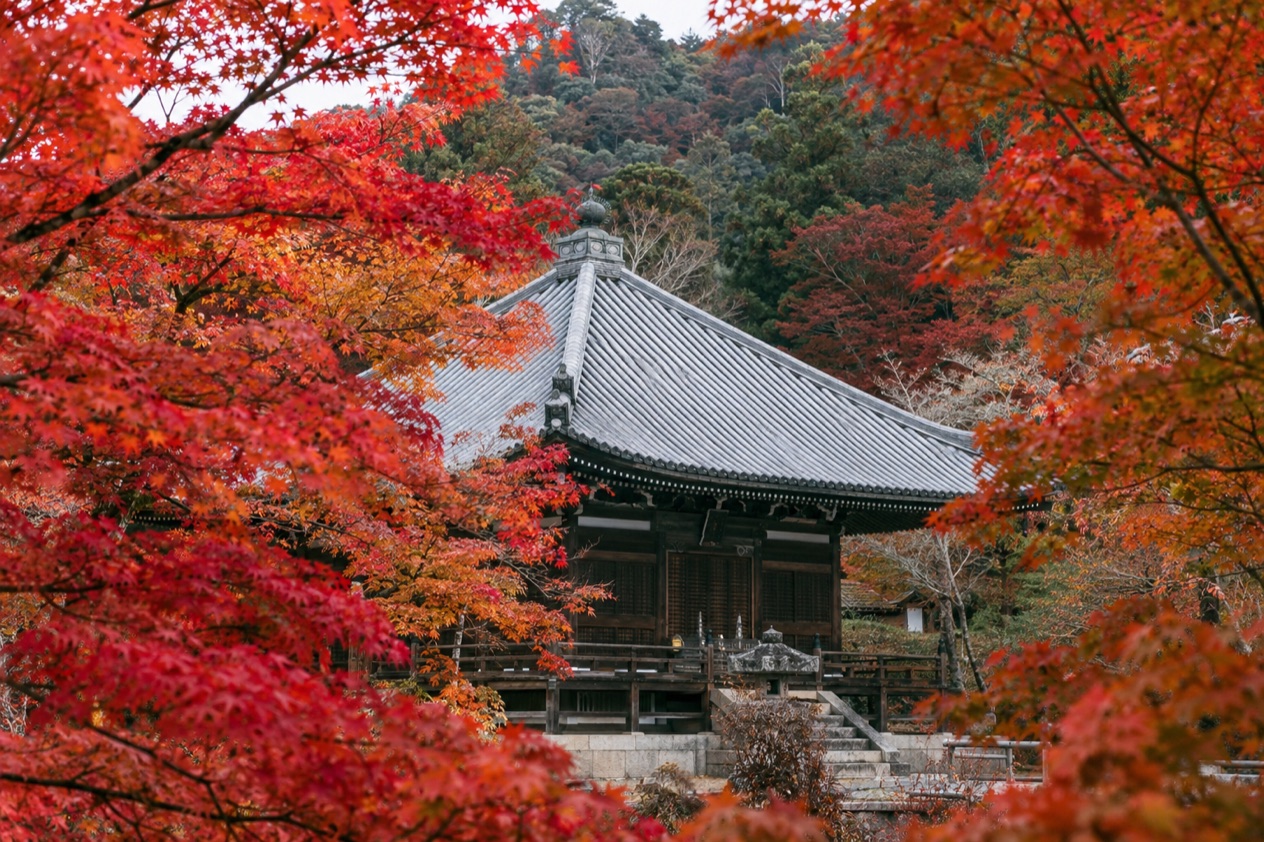
Autumn trades pastel for saturation. The maple, called momiji or kaede, turns red in temple gardens, around ponds and on hillsides, and ginkgo trees add stripes of yellow along avenues.
Stone lanterns, moss and wooden halls are the same as in spring, but the color is warm rather than pale, and a walk through a garden feels slower. Maple leaves are a sight for the eyes and for the plate too, since leaf shapes appear on sweets and trays.
Autumn is the season of harvest cooking. Roasted chestnuts and kuri sweets, baked sweet potatoes, persimmons, mushroom dishes and grilled autumn fish all come to the table, and warm bowls of nabe (a communal hot pot) start to make sense as the days cool. Sake lovers will find seasonal bottles to match.
Who wins? For sheer spectacle that changes the mood of whole neighborhoods, spring has the more festive pull. For the table and for a garden visit with more time to stand and look, autumn has the edge. If you travel for food, autumn gives you more to eat. If you travel for the feeling of a city in celebration, spring does.
Things to do
In spring, the main activity is hanami, flower viewing, which in practice means sitting under the trees with food and company. Parks fill with groups on tarps, and some places keep the viewing going after dark with lit trees, a custom known as yozakura, night cherry blossoms. Between picnics, you can wander shrine and temple grounds, castle parks and river paths where the trees line the water.
Spring also invites you to follow the bloom across the map. It begins in the south and works its way north, so a trip can be built around catching it more than once.
Kyushu, Shikoku, Kinki, Tokai and Kanto see the flowers in late March, and Hokuriku and the southern part of Tohoku follow around April 10. Northern Tohoku comes later, and the Somei-Yoshino reach northern and eastern Hokkaido in mid-May. Down in Okinawa and Amami, a different cherry, the Hikan-zakura, starts to bloom around mid-January, well before the rest of the country.
Autumn is a season for walking. Garden paths, temple grounds and hillsides call for time on foot, and the moderate temperatures are, in the words of the Japan National Tourism Organization, ideal for walking.
The day is built around a loop through a garden or a park, a pause for tea and sweets, and then dinner, which in autumn often means a warm, hearty meal. Evening illuminations of maples exist as well, and a night visit to a lit garden can be an alternative to the spring yozakura.
Autumn also has its own moving front, but in the opposite direction. The color begins in eastern Hokkaido in mid-October, then spreads south through the country, so a trip can start in the north and end in warmer regions as the leaves turn there. Day trips from a base city fit either season.
Nightlife is a matter of mood more than season, with izakaya (casual pubs) open to warm you in autumn and to toast the blossoms in spring.
Weather and the best time to go
Spring is cool and gentle, and autumn is a slow cooling after summer.
Autumn begins milder, since the country gradually comes down from the heat of summer, and in October and November Honshu and Kyushu enjoy pleasant temperatures. In Hokkaido, a coat is comfortable for much of the autumn.
The timing of the flowers and the leaves is where the two seasons really differ. The Japan Meteorological Agency counts first bloom as the first day on which five or six or more flowers are open on a sample tree, and full bloom as the day when about 80 percent of the buds are open.
At Aomori, first bloom usually falls around April 22 and full bloom around April 26. In recent years the first flowers there have opened anywhere from April 7 to April 17, so the dates move from one spring to the next, and any trip built around them is a matter of chance.
Autumn color arrives later in the year and moves more slowly. For maples, the agency counts the day when most of a sample tree’s leaves have turned red. At Aomori that usually comes around November 13, and in 2025 it came on November 10.
Elsewhere, the color change reaches Tohoku and eastern Hokuriku around November 20, then Kanto, Hokuriku, Tokai, Chugoku, Shikoku and northern Kyushu around November 30. The Pacific coasts of Kanto and Tokai, the Kinki region and southern Kyushu get their red from early to mid December. The tourism organization describes the colors, from red to yellow and orange, as running from mid-November to early December.
Spring has two things to weigh besides the weather. The first is pollen, since cherry blossom season produces a lot of it and causes many allergic reactions, which matters if you are sensitive.
The second is Golden Week, a string of consecutive public holidays beginning at the end of April when much of the country goes on vacation, and visitors are advised to plan around the peak times. Autumn brings neither of these, though it does depend on how the leaves turn that year.
Getting there and getting around
Where you arrive matters less than where you go next, because in both seasons the best sights follow a line across the map. Spring moves from south to north, starting from the southern islands and working up through Kyushu, Shikoku, the main island of Honshu and then Hokkaido. Autumn does the reverse, starting from eastern Hokkaido in mid-October and heading south through Tohoku and central Honshu before reaching the south coasts in December.
That shape suggests different itineraries. A spring trip that begins in the south of Honshu or in Kyushu in late March can edge north as the weeks pass, meeting the flowers again around April 10 in Hokuriku and southern Tohoku.
An autumn trip does the opposite, beginning in the north while the trees there are turning and moving toward the Kanto, Kinki and southern Kyushu regions as the leaves catch up. Each approach lets you meet the season more than once, and either lets you look at a city or a garden in a different light.
Once you are in a city, the way you move is the same in both seasons. What changes is what you wear: a light jacket or sweater in spring, and in autumn something warmer as the cooler days arrive, with a coat in Hokkaido.
Who should choose which
Pick spring if the picture in your head is a tarp under a cherry tree, a pink-white canopy over a castle moat and a festive crowd around you. It suits travelers who like a lively mood and who are happy to wear a light jacket from morning to evening, and who do not mind that the exact week of the bloom changes from one year to the next. Allergy sufferers should think twice, because the season carries a lot of pollen, and anyone who dislikes holiday crowds should plan around Golden Week at the end of April.
Pick autumn if you would rather walk through red maples with a warm drink, then sit down to chestnuts, persimmons, mushrooms and a steaming hot pot. It suits people who want pleasant temperatures for long days on foot and who like to follow the color down the country as it moves. Honshu and Kyushu are comfortable in October and November, and Hokkaido calls for a coat, so a northern leg needs more layers than a southern one.
Can you combine them? Not in one trip, since the seasons sit half a year apart, but two trips make a pleasing pair: the same garden or the same castle park seen first in blossom and later in red tells you more about it than either visit alone. If you have time for only one, let your appetite decide, the blossom picnic or the harvest table.
Good to know before you go
Japan prices things in yen, and a trip in either season is easier to plan once you remember that the dates for blossoms and leaves are averages and shift from year to year, so build in some room rather than fixing a day to a single tree. Spring brings pollen and the Golden Week holidays at the end of April, while autumn calls for a warmer layer as the weeks pass, and a coat if Hokkaido is on the route. Whichever season you choose, plan your days around the places you want to see rather than a fixed date for the flowers or the leaves.
Sources
- Japan Meteorological Agency, cherry blossom first-bloom dates 2021-2026 and 1991-2020 normal (https://www.data.jma.go.jp/sakura/data/sakura003_07.html), checked October 11, 2026
- Japan Meteorological Agency, cherry blossom full-bloom dates 2021-2026 and 1991-2020 normal (https://www.data.jma.go.jp/sakura/data/sakura004_07.html), checked October 11, 2026
- Japan Meteorological Agency, sakura2020.pdf (https://www.data.jma.go.jp/sakura/data/sakura2020.pdf), checked October 11, 2026
- Japan Meteorological Agency, maple color-change dates 2025-2026 with difference from the 1991-2020 normal (https://www.data.jma.go.jp/sakura/data/phn_014.html), checked October 11, 2026
- Japan Meteorological Agency, kaede2020.pdf (https://www.data.jma.go.jp/sakura/data/kaede2020.pdf), checked October 11, 2026
- Japan National Tourism Organization, autumn in Japan (https://www.japan.travel/en/guide/autumn-guide/), checked October 11, 2026
- Japan National Tourism Organization, spring in Japan (https://www.japan.travel/en/guide/spring-guide/), checked October 11, 2026
To plan your stay
- Best Time to Visit Japan: Cherry Blossoms, Autumn Colors, Weather and Festivals
- Things to Do in Japan: Kyoto Temples, Onsen, Street Food and Day Trips
- Where to Stay in Japan: Ryokan, Temple Stays, Capsule Hotels and the Best Cities to Base In
- Sending Luggage from the Airport in Japan: Hands-Free Travel, Hotel Delivery and Coin Lockers