
At the entrance of a ryokan, a traditional inn, your shoes come off before anything else, and a pair of slippers is set down where your feet will land. A few doors away, a business hotel hands over a key card at a small desk and points to an elevator. Japanese hotels range from tatami-floored inns to tightly planned city rooms, and knowing which kind you have booked explains most of what happens next.
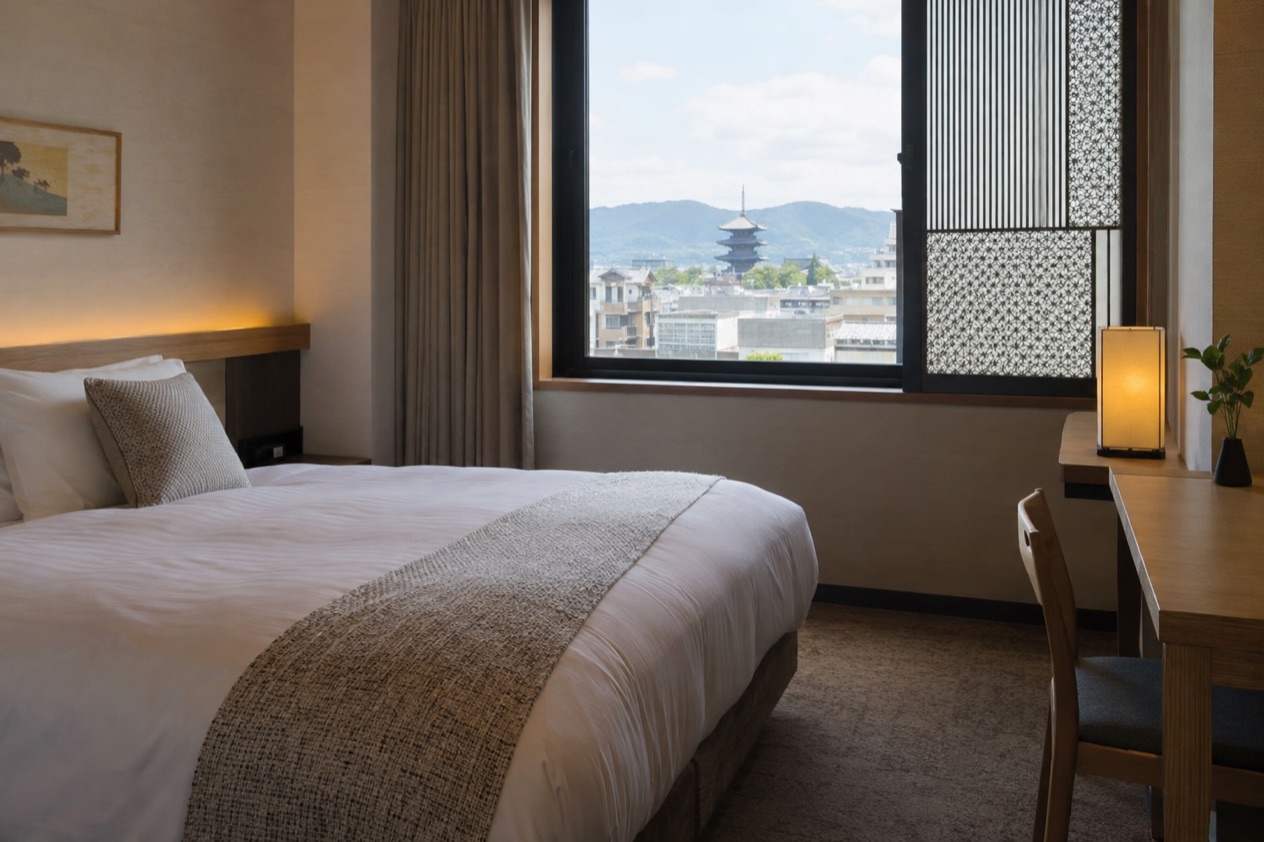
What are Japanese hotel rooms like?
Japanese hotel rooms come in a few distinct styles, and the style tells you more than the star rating: Western-style rooms with beds, Japanese-style rooms with tatami floors and futons, and a mix of the two in many resort and ryokan properties. The word on the booking page is worth reading closely, because it decides whether you sleep on a mattress or on bedding laid over woven straw mats.
Across all styles, one habit holds: the floor is treated as a clean place. Slippers wait at the door of many hotels, and in a tatami room even slippers come off at the edge of the mats, so you walk in socks or bare feet.
Business hotels and city rooms
In Tokyo, Osaka, Kyoto and other cities, the business hotel is the everyday format. Rooms tend to be planned down to the last shelf, with a bed, a narrow desk, a television, a kettle and a bathroom that arrives as a single molded unit with a deep tub, a shower and a toilet.
Travelers find the details thoughtful. A key card often slots into a wall holder to switch on the lights, a pair of pajamas may be folded on the bed, and the toilet may have a control panel with more buttons than you expected. Read the labels, or simply press the one with the picture you recognize.
These hotels suit travelers who use the room mostly for sleeping and spend the day out. If you plan to unpack for a week, look at the room photos on the booking page and notice how much floor is visible.
Ryokan and Japanese-style rooms
A ryokan is the Japanese inn at its fullest. The room has tatami floors, low tables and sliding paper doors, and in the evening staff or the room attendant lay out futon bedding where you were sitting a short while before. You are often given a yukata, a light cotton robe, to wear around the building, and in an onsen town many guests walk to the bath in it.
Meals are part of the tradition. Dinner is commonly a kaiseki spread, a series of small seasonal dishes, brought to the room or served in a dining room, followed by breakfast built around rice, grilled fish, pickles and miso soup. Because the kitchen plans around your stay, the evening has a set rhythm, and it rewards arriving with time to settle in.
Baths in a ryokan are often shared, with washing done seated at a tap before you enter the hot water. Whether tattoos are accepted varies by property, so read the policy of the specific inn.
Capsule hotels, guesthouses and other styles
Beyond those two poles, Japan has capsule hotels, where a sleeping pod stands in place of a room and the washing and lockers are shared. There are minshuku, family-run guesthouses with a homelier feel than a ryokan, and larger resort hotels near hot springs and ski areas that often offer both bed and futon rooms under one roof.
Pick by what you want from the night. A capsule suits a single traveler passing through a city, a minshuku suits someone curious about everyday Japan, and a resort hotel suits a group that wants a bath, a buffet and a view in one building. Each type puts the shared spaces in a slightly different place, so look at the layout before you commit.
What are the check-in rules?
Check-in at a Japanese hotel is a short, polite exchange at the front desk, and each hotel sets its own arrival window, which appears in your confirmation. The details are the property’s to give, so the confirmation message from the hotel or the booking site is the document to rely on.
The tone is quiet and formal. Staff greet you with a bow, you give your name, and the desk completes the registration with you. At a larger city hotel, a machine in the lobby may take the place of a person, with screens that switch to English.
At a business or city hotel
At a business hotel the routine is quick. Give your name, fill in the registration card, receive a key card and a short explanation of the breakfast room and the bath if there is one. Lobbies at these hotels often hold a rack of toiletries, extra pillows or small amenities that guests may pick up for themselves.
If you arrive before the room is ready, the staff will usually hold your bags at the desk, and travelers use the wait to explore the neighborhood. A practical note on the building itself: many hotels put the elevator behind a key card reader, so keep the card with you each time you go up.
At a ryokan or a hot spring inn
A ryokan check-in is slower and more ceremonial. A staff member welcomes you at the entrance, you change into slippers, and you are led to a lounge or straight to the room, often with tea and a small sweet waiting on the table. This is when the evening is arranged: the time of dinner, the time of breakfast and when the baths are available.
Because the kitchen is cooking for your party, the habit is to tell the inn if your plans change, and to arrive in good time so the schedule holds.
Small habits at the front desk
A few customs shape the exchange. Handing over a card or a document with both hands is courteous, a payment tray at the register is where cash and cards are placed rather than passed hand to hand, and tipping is not part of the culture, so the desk will not expect it.
Names are written in the order the hotel asks for, so match them to what you entered on the booking. If a hotel’s address is only in Japanese, keep it in a form a taxi driver can read, since the booking page often gives it that way.
What should you know before you book?
Before booking, decide which style of room you want, which city or town you will use as a base, and which booking site suits you, because a Japanese hotel listing is only as clear as its room descriptions. The Japan National Tourism Organization runs a page of online reservation sites for planning a trip, and its website is available in English for the United States.
Reading the listing carefully
Look first at the bed type and the room description. Words such as Western, Japanese-style or Japanese-Western tell you whether to expect a bed, futon bedding on tatami, or both in one suite. Photos usually show the bathroom, and a unit bath with a tub and shower in one molded space is normal in city hotels.
Then check what the rate includes. At a ryokan, dinner and breakfast are often part of the plan, while a business hotel may sell the room alone with breakfast as an option. Reading this line avoids surprises at the desk and helps you compare two listings fairly.
Choosing where to stay
Japan’s cities are linked by rail, and the Japan National Tourism Organization’s site mentions both the Japan Rail Pass and the Shinkansen bullet train among the ways to get around. When you pick a hotel, think about how you will arrive and leave, and look at the listing’s description of its surroundings and access.
If your trip includes a night in an onsen town or a mountain inn, you may want a different property from your city base, with a night or two in each. Matching the type of hotel to the place is often the most satisfying choice: a city room where the city is the attraction, and a ryokan where the setting and the bath are.
Events that shape a trip
Some dates in Japan draw more visitors to a single city. The Japan National Tourism Organization’s site mentions the GREEN×EXPO 2027 in Yokohama, which is worth knowing if your plans take you to the Tokyo region around that event. Check the dates of any festival or exhibition that overlaps your stay before you settle on a hotel.
Seasonal moments such as cherry blossoms, autumn leaves and local matsuri, the neighborhood festivals, also change how a city feels. Look at the calendar of the place you are visiting and choose your hotel with it in mind.
Good to know before you go
Japan is a country where the yen is the currency, and hotel desks, ryokan and small guesthouses each have their own way of taking payment, so keep the details from your confirmation handy. Carry your confirmation and the hotel’s name and address in Japanese, and keep your key card and any room instructions with you when you step out. In a ryokan, follow the rhythm of the house, with its bath times and meal times, and the stay tends to go smoothly.
Sources
- Japan National Tourism Organization, online reservations (https://www.japan.travel/en/plan/online-reservation-sites/), checked October 11, 2026
To plan your stay
- Best Time to Visit Japan: Cherry Blossoms, Autumn Colors, Weather and Festivals
- Things to Do in Japan: Kyoto Temples, Onsen, Street Food and Day Trips
- Sending Luggage from the Airport in Japan: Hands-Free Travel, Hotel Delivery and Coin Lockers
- Know Before You Go to Japan: Entry, Money, Etiquette and Getting Around