
A trail through Japanese forest has its own sounds: the knock of a walking stick on a wooden step, a bell tied to a rucksack, the hush of cedar trunks closing in overhead. Then the trees open and a ridge appears, with a hut, a thermos of tea and mountains folding away into haze. Japan’s walking country runs from the high ranges of central Honshu to forests in the far south, and it can be walked through the changing seasons.
Where can you hike in Japan?
You can hike across much of the country, but the high ground is concentrated in the Japanese Alps, the mountain ranges that cut across the main island of Honshu, with sacred forests on the Kii Peninsula and giant trees on Yakushima as other destinations. The Alps are reachable from Tokyo, which is why so many trips begin there. The ranges stretch through Niigata, Toyama, Yamanashi, Nagano, Gifu and Shizuoka prefectures, and they are divided into three parts, each with its own character.
What you find depends on where you point yourself. Some walks are about summit views and rock, others about moss and filtered light, others about following a trail from one temple or village to the next. Japan treats all of these as hiking, and you can choose among them by mood as much as by fitness.
The Japanese Alps
The Northern Alps, also called the Hida Mountains, run through Nagano, Toyama and Gifu, with a small part reaching into Niigata. This is the range for people who want a real mountain day: ridgelines, rocky summits and alpine meadows. The Central Alps, known as the Kiso Mountains, sit entirely in Nagano Prefecture, while the Southern Alps, the Akaishi Mountains, span Nagano, Yamanashi and Shizuoka.
Cable cars and ropeways have opened the high country to walkers who want to start already among the peaks. The Komagatake Ropeway opened in 1967 and the Shinhotaka Ropeway in 1970, and the Tateyama Kurobe Alpine Route, a line of mountain transport across the range, fully opened in 1971. At Kamikochi, a mountain destination known for its alpine climate, a memorial plaque honors Reverend Walter Weston, called the Father of the Japanese Alps, who helped introduce mountaineering to the wider world.
Mount Ontake, in the Alps, is an active volcano and erupted most recently in 2014. Its presence is a reminder that these mountains are alive, and that a hike here is a walk on volcanic ground.
| Peak | Height (meters) |
|---|---|
| Mount Kita | 3,193 |
| Mount Hotaka | 3,190 |
Sacred forests of the Kii Peninsula
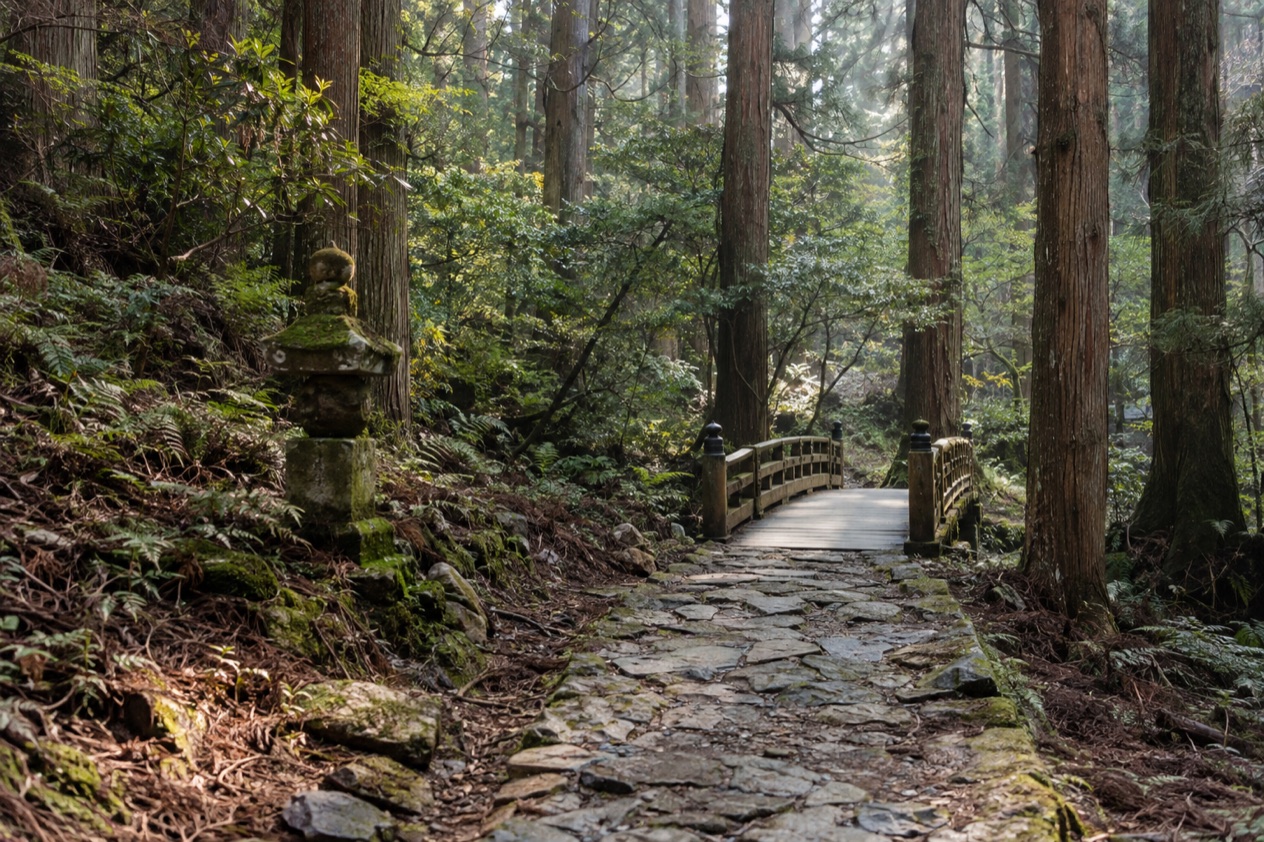
South of Osaka, the Kii Peninsula holds the sacred forests of Yoshino-Kumano National Park. Here hiking and pilgrimage blur together: the paths pass through old woodland where the trees seem to hold the light and the ground is soft underfoot. It is a different kind of day from the Alps, built around atmosphere rather than altitude.
Walkers who like to move at a gentle rhythm, stopping to look at a root-wrapped stone or a shrine gate half hidden in green, tend to get the most from places like this. Rain, which the forest takes in stride, only deepens the colors of the moss.
Yakushima and the forest of giant trees
Yakushima National Park, in the south, is known for its giant trees, fed by the sea for over a thousand years. The island suits walkers who want to feel small beneath a canopy, with trunks as wide as rooms and a forest floor that glistens with moisture.
Think of it as a destination in its own right rather than a stop on the way to somewhere else.
Forest bathing
Not every walk in Japan is about distance. Forest bathing, or shinrin-yoku, is a therapeutic Japanese practice of simply spending time in a forest, and it began as a medicinal practice in the 1980s. Studies in Japan have shown benefits for sleep quality, mood, concentration and stress levels.
Specialized centers throughout Japan offer organized forest bathing tours adapted to visitors’ needs, and some end the day with a tea ceremony. It is a way to see a forest at the pace of a conversation, with time to sit, listen and breathe.
Which trails are best known?
The routes that the Japan National Tourism Organization lists for hikers are a good starting set, and they spread across the country from Hokkaido-style volcanic scenery to Honshu’s alpine ridges. Beyond them lies a network of long-distance nature trails planned by the Ministry of the Environment, which cross many prefectures and are maintained by each prefecture.
Mountain routes on the tourism board’s list
The hiking routes named include the Senjojiki Cirque route to Mount Kiso-Komagatake, Mount Ishizuchi, Mount Daisen, Mount Hakkoda, Mount Unzen, Mount Minobu, Mount Asahi, Mount Tsubakuro, the Ozegahara loop from Hatomachi Pass, and Mount Tanigawa. The list is a map of the country in itself, taking in volcanic peaks, a high cirque, a marshland loop and mountains with temples and shrines on their slopes.
Kiso-Komagatake belongs to the Central Alps, and its Senjojiki Cirque route is a walk through a bowl in the mountain. Ozegahara, reached by a loop from Hatomachi Pass, is the name to look for if you want to walk among wetlands rather than rock. Mount Unzen has a link to a darker chapter: the Mount Unzen Disaster Memorial stands in Shimabara, Nagasaki Prefecture, and recalls what the volcano has done.
Mount Daisen appears twice in the sources, once as a hiking route and once among the mountain biking excursions, along with Nozawa Onsen. If you ride as well as walk, those two places keep both options open.
Long-distance nature trails
These trails exist so people can experience the richness of nature, history and culture, refresh mind and body, and deepen their understanding of conservation, walking on their own feet throughout the four seasons. Once completed, the whole network will total about 16777 miles. Several regional trails have nicknames: the Kyushu trail is also known as Yamabiko-san, the Shikoku trail as Shikoku no michi, and the Capital Region trail as Kanto fureai no michi.
The Tokai Nature Trail links Meiji no Mori Takao Quasi-National Park in Tokyo with Meiji no Mori Mino Quasi-National Park in Osaka Prefecture, so it is a route that begins in the metropolis and ends in another large city, with mountain country in between.
| Trail | Prefectures | Length |
|---|---|---|
| Tokai Nature Trail | Tokyo, Kanagawa, Yamanashi, Shizuoka, Aichi, Gifu, Mie, Shiga, Nara, Kyoto, Osaka | 1,734 km (1,077 mi) |
| Kyushu Nature Trail | Fukuoka, Saga, Nagasaki, Kumamoto, Oita, Miyazaki, Kagoshima | 2,932 km (1,822 mi) |
| Chugoku Nature Trail | Yamaguchi, Shimane, Tottori, Okayama, Hiroshima | 2,295 km (1,426 mi) |
| Shikoku Nature Trail | Tokushima, Kochi, Ehime, Kagawa | 1,647 km (1,023 mi) |
| Capital Region Nature Trail | Kanagawa, Tokyo, Saitama, Gunma, Tochigi, Ibaraki, Chiba | 1,794 km (1,115 mi) |
Landscapes beside the trails
Some of Japan’s most unusual terrain sits near walking routes. The Tottori Sand Dunes lie in Tottori Prefecture, in the Chugoku region, and the Chugoku Nature Trail passes through that prefecture. In Hokkaido, Hell Valley (Jigokudani) in Noboribetsu is a volcanic landscape of steam and sulfur, and drift ice cruises operate from Abashiri.
Winter has its own spectacles in the mountains: the Zao Snow Monsters in Zao, Yamagata Prefecture, and the Tateyama Snow Walls in Tateyama, Toyama Prefecture. Angel Road, a sandbar in Tonosho on Shodo Island, Kagawa Prefecture, adds a coastal curiosity near the Shikoku trail’s region.
What should you know before you go?
Choose your hike by the kind of day you want, because Japan offers summits, marshes, old forests and pilgrim routes, and each asks something different of you. The long-distance trails are designed for walking across the seasons, so there is no single moment when hiking begins or ends in Japan, and each place has its own character through the year.
Choosing a style of hike
If you want mountain views and rock underfoot, the Northern Alps and the peaks on the tourism board’s list are the places to look. If you prefer shade, moss and tall trees, turn to the Kii Peninsula or Yakushima. If you like to walk a line on the map for days, the regional nature trails give you that, each stretching across many prefectures.
A third option is to pair a walk with something else. Mount Hakkoda, Mount Daisen and Nozawa Onsen appear in lists that cover mountain biking, so a hiking trip can share a region with other outdoor activities. Cycling routes such as the Biwaichi, the Awaichi around Awaji Island, the Toyama Bay road, the Pacific cycling road and the Tsukuba Kasumigaura Ring Ring Road sit on the same tourism page.
Mountains with a volcanic past
Several peaks on the hiking list are volcanoes, and Mount Ontake in the Alps erupted most recently in 2014. Mount Unzen is also volcanic. Many Japanese mountains are therefore a lesson in how land is made, with steaming valleys, crater rims and bare slopes where the forest is still catching up.
Hell Valley in Noboribetsu shows the same forces from another angle, as a place where the earth gives off steam. It is a landscape to look at and walk beside rather than a summit to conquer.
Guided and slower options
If you would rather not plan a route, organized forest bathing tours at specialized centers are adapted to visitors, and some close with a tea ceremony. The idea is to leave the pace of the city behind. In the words of Dr.
Dr. Li’s book on the subject carries the French title Shinrin Yoku, L’art et la science du bain de forêt, and the tourism board’s pages on adventure sports are also available in French. That tells you something about the audience: this is a practice meant to travel.
Good to know before you go
Japan’s long-distance trails are maintained by each prefecture, so the character of the path can change as you cross a boundary, and the regional nicknames are a handy way to find the right route on a map or a sign. A mountain such as Ontake, which has erupted, is a reminder to respect the terrain. Choose the places you want to see, whether alpine ridge or old forest, and let the walk set its own pace.
Sources
- Japan National Tourism Organization, forest bathing (https://www.japan.travel/en/guide/forest-bathing/), checked October 11, 2026
- Japan National Tourism Organization, adventure sports (https://www.japan.travel/en/sports/adventure/), checked October 11, 2026
- Japan National Tourism Organization, natural wonders (https://www.japan.travel/en/things-to-do/attraction/natural-wonder/), checked October 11, 2026
- Wikipedia, Japanese Alps (https://en.wikipedia.org/wiki/Japanese_Alps), checked October 11, 2026
- Wikipedia, List of Long-distance Nature Trails (Japan) (https://en.wikipedia.org/wiki/List_of_Long-distance_Nature_Trails_(Japan)), checked October 11, 2026
To plan your stay
- Best Time to Visit Japan: Cherry Blossoms, Autumn Colors, Weather and Festivals
- Where to Stay in Japan: Ryokan, Temple Stays, Capsule Hotels and the Best Cities to Base In
- Sending Luggage from the Airport in Japan: Hands-Free Travel, Hotel Delivery and Coin Lockers
- Know Before You Go to Japan: Entry, Money, Etiquette and Getting Around