
A person sits on a wooden veranda in Kyoto, shoes left at the entrance, looking at raked sand and a handful of rocks. Nothing moves, yet the eye keeps travelling, and somewhere nearby water drips into a stone basin. This is the Japanese garden at its most concentrated, and Kyoto, with its temples and old villas, is where you meet it most often on a trip to Japan.
What are the types of Japanese gardens?
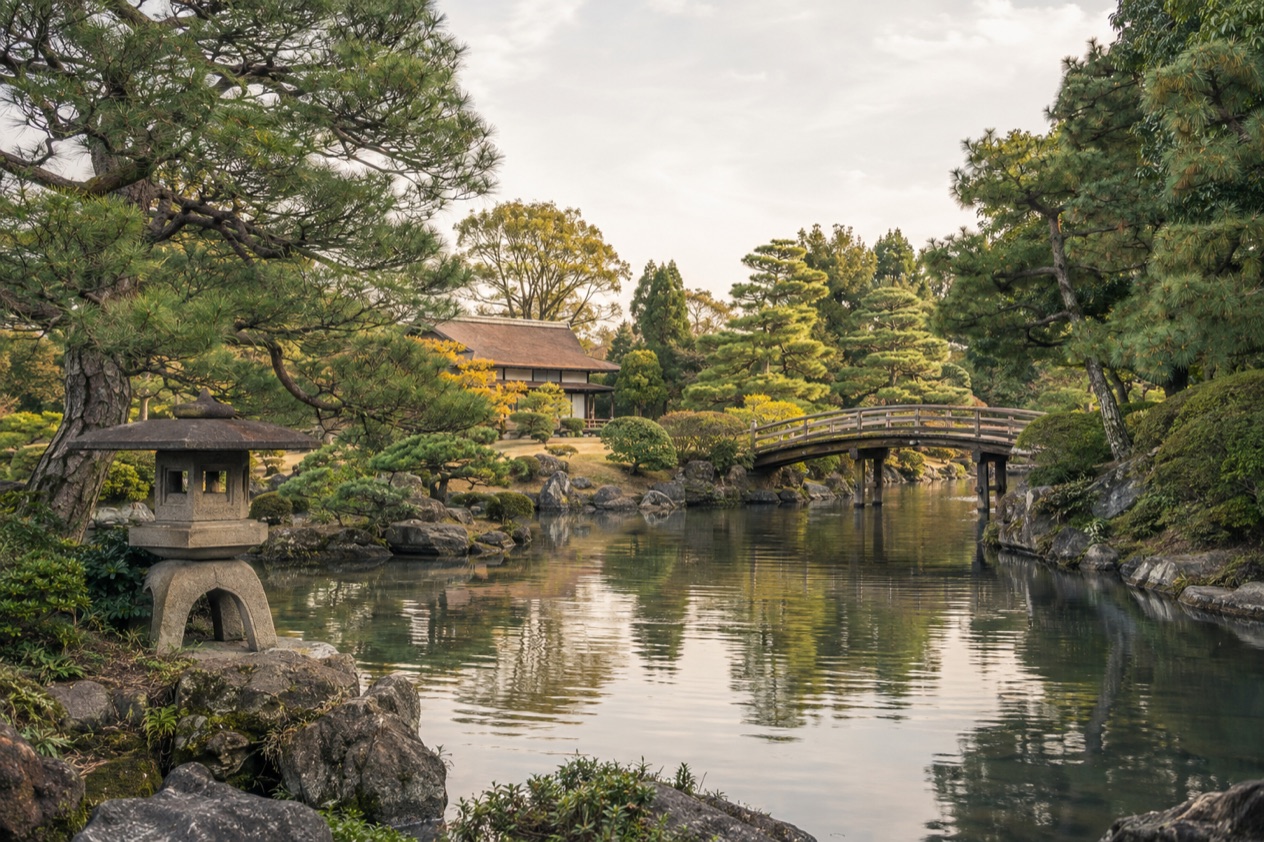
Japanese gardens fall into a few broad families, the most distinctive being the dry landscape garden of sand and stone, the pond garden built around flowing water, and the moss garden, with tea gardens and courtyard gardens adding smaller variations. What they share is a design that avoids artificial ornament and puts the natural landscape forward, shaped by Japanese aesthetics and philosophical ideas.
The tradition is old. Japanese garden culture has been appreciated for over 1,000 years, and many of the best-loved gardens stand in Kyoto, which was the cultural and political center of that era. Gardens were also stages: guests were once invited to them for poetry and Noh performances, so a garden was never only something to look at.
Dry landscape gardens (karesansui)
A karesansui garden uses sand and stones to express the movement of water, with no water at all. Raked lines in white sand read as waves or currents, and a rock becomes an island or a mountain. Buddhist monks created these gardens to calm the mind and aid meditation, and that purpose still shapes how you are meant to look at them.
The stone garden at Ryoan-ji in Kyoto is a perfect example, and it is inscribed on the UNESCO World Heritage list. Its surface is small and bare, white sand with a scattering of rocks, and the whole point is what your imagination does with so little. It suits anyone who likes to sit with a view rather than walk through it, and it works best if you give it more than a glance.
Because the design is so spare, the experience is more about attention than about sights. Notice how the rocks are grouped, where the raked lines stop, and what lies beyond the garden wall. Visitors who arrive expecting flowers sometimes find these gardens austere at first, and then find that the austerity is exactly what holds them there.
Pond and stroll gardens
Water is often the central element of a Japanese garden’s structure and atmosphere. Many gardens have a complex water flow path, and others build the whole composition around a prominent pond or a waterfall. A path leads you around the water, and each turn gives you a new view, with bridges, islands, stepping stones and pavilions placed to be seen from several angles.
These gardens are designed to seem larger than they are. Sudden changes in the direction or width of a path, and layered perspectives in which one view is partly hidden by another, make a modest plot feel like a landscape. You walk slowly because the garden asks you to, and the pleasure comes from the reveal around each corner.
At Tokushima Castle on the island of Shikoku, the garden includes a bridge made of two natural stones, a span that shows how much character a single carefully chosen material can carry. Gardens like this suit walkers who enjoy detail, such as the edge of a pond, the way a stone is set, and how a view is framed through a gap.
Moss gardens and tea gardens
The moss garden at Saiho-ji temple in Kyoto was started in 1339, which makes it one of the oldest living examples of the form you can read about. Moss gardens replace sand and flowers with a green, soft carpet that covers the ground beneath the trees and around the ponds, and they ask you to look at texture and shade.
Tea gardens bring a quieter ritual. Stone basins called tsukubai stand outside tea ceremony rooms, where guests wash their hands before entering, and the sound of water filling them is part of the preparation. It is a small detail, easily missed, and one of the best examples of how Japanese gardens work on the ears as well as the eyes.
Which are best known?
Kyoto holds most of the best-known gardens in Japan, among them Ryoan-ji, Sanbo-in, Kinkaku-ji, Ginkaku-ji and Katsura Imperial Villa, with Byodo-in in nearby Uji and Tokushima Castle on Shikoku rounding out a wider list. Each shows a different side of the tradition, from bare stone to gold-leaf pavilions reflected in a pond.
| Garden | Where | Year |
|---|---|---|
| Byodo-in Phoenix Hall | Uji, near Kyoto | 1053 (built) |
| Saiho-ji moss garden | Kyoto | 1339 (started) |
| Kinkaku-ji, the Golden Pavilion | Kyoto | 1398 (built) |
| Ginkaku-ji, the Silver Pavilion | Kyoto | 1482 (built) |
| Sanbo-in at Daigo-ji | Kyoto Prefecture | 1598 (rebuilt) |
| Katsura Imperial Villa | Kyoto | 1641 to 1662 (created) |
Ryoan-ji, the rock garden
The Zen rock garden at Ryoan-ji is just 30 feet wide and 79 feet long, made of white sand and fifteen rocks. That is all, and it is among the most talked-about gardens in Japan. Its fame rests on how much a rectangle of gravel can ask of you.
The garden is meant to be seen from a seated position on the porch of the abbot’s residence. Sitting changes the way you look. Your eye level drops, the rocks sit against the wall and sand, and you start to read the arrangement as a whole instead of counting stones. It suits travelers who like to take their time, and it is an easy place to share with someone who is skeptical of gardens.
Sanbo-in at Daigo-ji
Sanbo-in is a famous example known for its 800 stones, combined with beautiful ponds and a majestic waterfall. Toyotomi Hideyoshi rebuilt the garden at Daigo-ji in 1598, and it was designed to be seen from the veranda of the main pavilion or from the Hall of the Pure View, which stands on higher ground.
That second vantage point is the interesting one. From above, the stones, the ponds and the waterfall read as a composition, a picture arranged for a viewer rather than a path to wander. Water and stone play against each other here, and it makes a good contrast with the dry sand at Ryoan-ji if you see both on the same trip.
Kinkaku-ji and Ginkaku-ji
Kinkaku-ji, the Golden Pavilion, and Ginkaku-ji, the Silver Pavilion, are two Kyoto landmarks where a building and a garden are inseparable. Kinkaku-ji was built in 1398 and Ginkaku-ji in 1482, and each pavilion is placed so that the garden around it becomes part of the picture.
Seen together, they give you two moods from the same city, one bright with gold and one more restrained. Both are rewarding for visitors who like architecture as much as planting, since the pavilions are the focus and the garden is the frame.
Byodo-in, Katsura and Tokushima
The Phoenix Hall of Byodo-in in Uji, near Kyoto, was built in 1053 on an island in the lake, in the traditional style of a Chinese Song dynasty temple. Inside is a gilded statue of the Amitabha Buddha. The hall sits on the water, so the pond is not scenery but the setting that gives the building its meaning.
The garden of Katsura Imperial Villa in Kyoto was created between 1641 and 1662, an imperial retreat designed as a landscape of its own. Farther afield, Tokushima Castle on Shikoku shows that the tradition is not limited to Kyoto, with its bridge of two natural stones measuring 34 feet long. If your route takes you beyond Kyoto, a garden like this is worth adding.
When are they best?
A Japanese garden is best when you slow down enough to let it work, more than on any particular date. These gardens were designed around quiet looking, listening and sitting, so the way you visit shapes the experience as much as the calendar does.
Sit down and look
At Ryoan-ji the view is meant to be taken from the porch of the abbot’s residence, and at Sanbo-in from a veranda or from the Hall of the Pure View on higher ground. Plan time to sit, not just to photograph, and the composition will make sense in a way it does not when you pass through quickly.
The designers also played with space. Paths that turn suddenly, change width or reveal a second layer of the view make a small garden feel larger, so a slow pace is the only one that pays off. If you walk quickly, you see the garden as a flat picture, and if you pause at each bend, you see how it was built.
Listen as well as look
Sound is part of the design. Flowing water and rustling leaves are often integral to a Japanese garden, and the tsukubai outside a tea room fills with water that makes a soothing noise before the ceremony begins. Stop for a minute at a waterfall, a stream or a stone basin and close your eyes, and you will understand why the sound was planned.
This is also why a visit rewards patience over speed. A garden with a pond and a waterfall, like Sanbo-in, offers a layer of sound that a dry garden does not, while a dry garden at Ryoan-ji offers a stillness you can sit inside. Visiting both gives you the full range of what the form can do.
Plan around what each garden does
Think of your visits as a sequence of moods. Start with a dry garden for stillness, move to a pond garden for movement, and add a moss garden such as Saiho-ji for texture and shade. Pairing a pavilion garden like Kinkaku-ji or Ginkaku-ji with a villa garden like Katsura adds architecture to the mix, so no two gardens in a day feel alike.
Because the long history of these gardens means they were used for poetry and Noh performances, it can help to treat each visit as a small occasion instead of a checklist item. Bring a patient mood, choose a spot with a view, and stay long enough to notice what changes while you sit.
Good to know before you go
Most of what makes these gardens worth the trip is free to appreciate once you are there: the arrangement of stone and water, the framing of a view, and the sounds that drift in. Leave room in the day for sitting, because a garden like Ryoan-ji, just a small rectangle of sand, can take longer to absorb than its size suggests. Kyoto holds the greatest concentration of the gardens described here, with Byodo-in a short step from the city in Uji and Tokushima Castle waiting on Shikoku for those who travel further.
Sources
- Japan National Tourism Organization, Japanese gardens (https://www.japan.travel/en/see-and-do/japanese-garden/), checked October 11, 2026
- Wikipedia, Japanese garden (https://en.wikipedia.org/wiki/Japanese_garden), checked October 11, 2026
To plan your stay
- Best Time to Visit Japan: Cherry Blossoms, Autumn Colors, Weather and Festivals
- Where to Stay in Japan: Ryokan, Temple Stays, Capsule Hotels and the Best Cities to Base In
- Sending Luggage from the Airport in Japan: Hands-Free Travel, Hotel Delivery and Coin Lockers
- Know Before You Go to Japan: Entry, Money, Etiquette and Getting Around