
In a Kyoto tea house, a bowl of frothy green matcha arrives with a small sweet shaped like a maple leaf, and nobody is hurrying you. Across Japan, the day tends to be built around moments like this one: a garden path, a long lunch, a hot bath at the end of the afternoon.
Is Japan good for older travelers?
Japan can be a very good fit for older travelers, because so much of the country is organized around unhurried pleasures: gardens, seasonal food, bathing and sitting down over tea. An island nation divided into 47 prefectures, it gives you plenty of ways to shape a trip around what you enjoy rather than around a checklist.
The rhythm that works best is a few things a day, with room between them. The seasons give the trip its character. Spring brings cherry blossoms and autumn turns the maples red and gold, and both are worth planning around if the idea appeals to you.
Temples, shrines and gardens at your own pace
Temples and shrines are where visitors start. You pass under a torii gate, rinse your hands at a water basin, and walk toward a hall where incense drifts out of a large burner.
Kyoto holds a great many of them, from the gold pavilion of Kinkaku-ji to the wooden stage of Kiyomizu-dera, and Nara has Todai-ji with its enormous Buddha hall. Tokyo has Senso-ji in Asakusa and the forested grounds of Meiji Jingu.
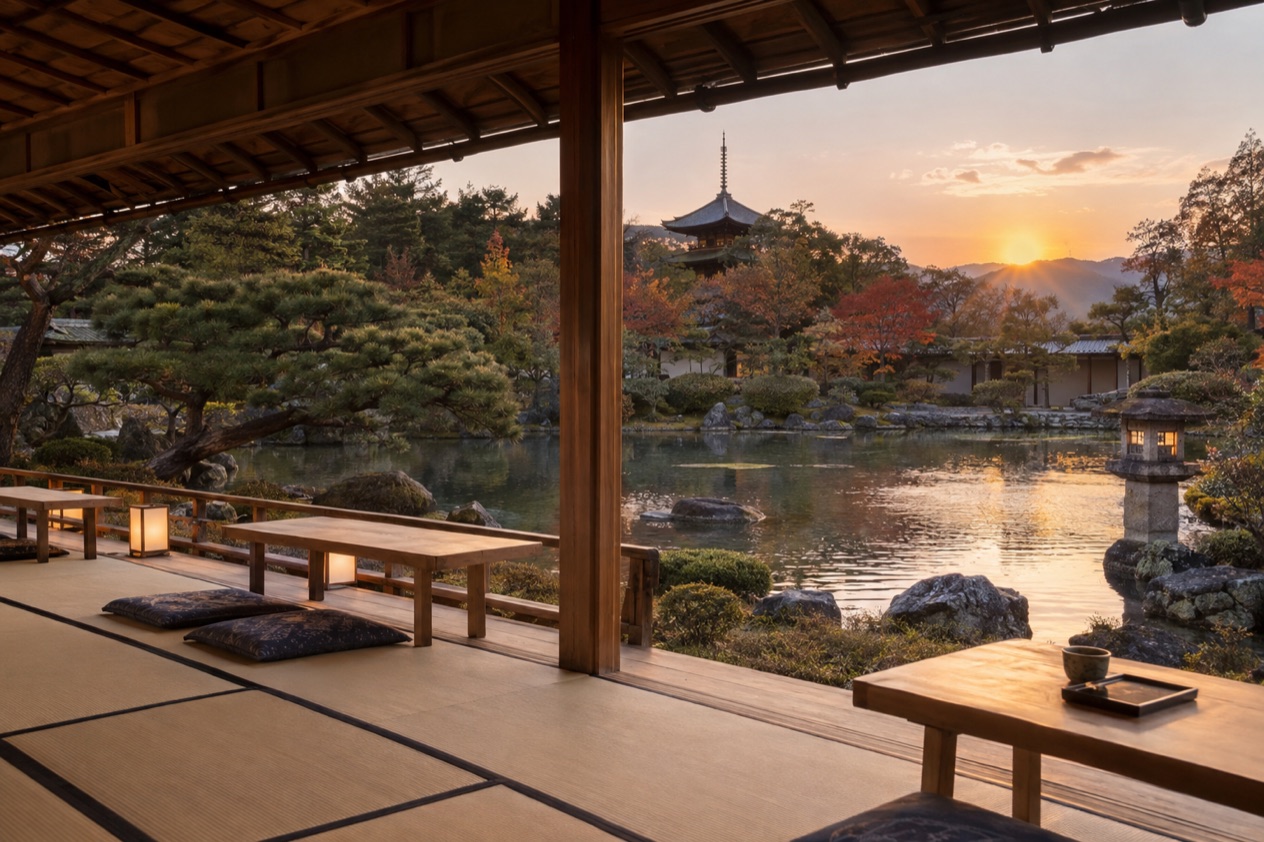
Gardens reward a slow pace even more. A Japanese stroll garden is designed to be seen in stages, with a pond, a bridge, a stone lantern and a moss-covered corner each revealed in turn.
Kenrokuen in Kanazawa is one of the best known, and many gardens have a tea house where you can sit with a bowl of matcha and look at the view. Plan one site in the morning and one in the afternoon, and leave the rest of the day open.
Food that rewards a long, slow meal
Japanese food is a pleasure in itself, and it is served in portions and formats that suit a slow appetite. Soba and udon noodles come in a steaming broth, tempura arrives crisp and light, and a bento box lays out rice, fish, pickles and a little of everything in neat compartments. Kaiseki, the multi-course meal of small seasonal dishes, is a way to taste a region in one sitting.
Department store food halls, with their counters of sweets, pickles and prepared dishes, are good places to browse. An izakaya, the Japanese pub, serves small plates meant for sharing, with a glass of sake, beer or tea. Breakfast at a ryokan is its own small ritual, with grilled fish, miso soup, rice and egg arranged on a tray.
Onsen and ryokan, the Japanese way to rest
An onsen is a hot spring bath, and soaking in one is as much a part of Japan as any temple. The habit is to wash thoroughly before you step into the shared bath, and to sit in the water for as long as it feels good. Travelers like to arrive at a hot spring town and let the bath, dinner and sleep fill the evening.
A ryokan, the traditional inn, adds to the experience. Shoes come off at the entrance, you change into a yukata, a light cotton robe, and meals are brought to you. Rooms are laid with tatami mats, and the bedding is a futon spread on the floor in the evening. Hakone, known for its hot spring inns, is one place to try this.
Which places and transport suit them?
The places that suit older travelers are the ones where you can base yourself for a few nights and let the days unfold: Kyoto, Nara, Kanazawa, Hiroshima and a hot spring town such as Hakone. Between them runs the Shinkansen, the world’s first high-speed rail line, which gives the trip its backbone.
The Shinkansen and Japan’s rail network
The Shinkansen links Tokyo with cities such as Kyoto, Osaka and Hiroshima along the Tokaido line and beyond. A long-distance trip becomes a sit-down affair with a window seat, and travelers buy a bento box and a cup of tea at the station to enjoy on board. Watching the landscape go by is part of the appeal.
Beyond the bullet trains, JR and private railways reach most places travelers want to visit, and stations carry signs in English as well as Japanese. Suica, Pasmo and ICOCA are the rechargeable cards that work on trains and buses in the big cities. Tap one at the gate, and the fare is taken for you.
Kyoto and Nara for temples, tea and gardens
Kyoto is the place for temples, gardens, tea houses and old wooden streets such as the lanes of Gion. You can spend several days moving between Fushimi Inari, with its tunnel of red torii gates, Kinkaku-ji, Kiyomizu-dera and smaller temples whose gardens are worth a stop for themselves. Evenings suit a kaiseki dinner or a stroll through the lantern-lit lanes.
Nara is the place for Todai-ji and for the deer that wander the park around it, and they will nudge you for crackers if you have them. Pair Nara with Kyoto as a day outing or give it a night of its own, depending on how much you like to move around.
Kanazawa, Hiroshima and Hakone
Kanazawa offers Kenrokuen, one of Japan’s great gardens, along with old samurai and tea house districts and a market where seafood and seasonal produce are on display. It rewards a stay of a couple of nights, with the garden and the markets as the anchors.
Hiroshima is a city of memory and of good eating, with the Peace Memorial Park at its heart and okonomiyaki, a layered savory pancake, on many menus. Hakone is the place to settle into an onsen inn, with hot spring baths, a bowl of local food and a view toward the hills as the evening ends. Each of these places gives you something to sink into rather than rush through.
What should you know before you go?
A few practical details make the trip smoother, and most of them are small. Japan is in the Japan Standard Time zone, UTC+09:00, so jet lag can be real after the flight from the United States. Travelers build a quiet first day into the plan, with a walk, a meal and an early night to settle in.
Power, devices and everyday details
Electricity in Japan is 100 volts, and both 50 hertz and 60 hertz are in use. If you travel with a phone, a camera or anything that plugs in, it is worth looking at the label on each charger before you leave home. The same goes for any personal medical device that needs an outlet.
The emergency numbers are simple to carry in your head or on a card. Police is 110, and fire is 119. The Japan Coast Guard has its own number, 118, which matters if you are on a ferry or along the coast.
Habits that make daily life go smoothly
Many small customs are about quiet courtesy. Shoes come off at the entrance of a ryokan, a temple hall or a home, and slippers are often waiting. At a table, people say itadakimasu before eating, a small phrase of thanks. In a bath, you wash first and soak afterward, and the towel stays out of the water.
Smiling and a small bow are returned. When you do not speak the language, pointing at a menu or showing a note on your phone works well in practice.
Shaping a trip to your own energy
Choose a few bases and stay a few nights in each, rather than changing hotels every day. A ryokan night in the middle of a trip is a way to rest while still feeling you are doing something. Let the season guide you toward blossoms in spring or maples in autumn, and plan fewer sights per day than you think you want.
Leaving a free afternoon in each city lets you follow what catches your eye: a small shrine on a side street, a pottery shop, a counter of freshly grilled skewers. These unplanned stops are often what people remember best.
Good to know before you go
Pack for the season and for a trip that mixes city streets with temple grounds and hot spring towns, and bring shoes that slip on and off easily since you will remove them often. Keep a note of the emergency numbers and of your hotel’s name in Japanese. In the rainy season and in the typhoon season, follow the local forecast and adjust your plans as the weather requires.
Sources
- Wikivoyage, Japan (https://en.wikivoyage.org/wiki/Japan), checked October 11, 2026
To plan your stay
- Best Time to Visit Japan: Cherry Blossoms, Autumn Colors, Weather and Festivals
- Where to Stay in Japan: Ryokan, Temple Stays, Capsule Hotels and the Best Cities to Base In
- Sending Luggage from the Airport in Japan: Hands-Free Travel, Hotel Delivery and Coin Lockers
- Know Before You Go to Japan: Entry, Money, Etiquette and Getting Around