
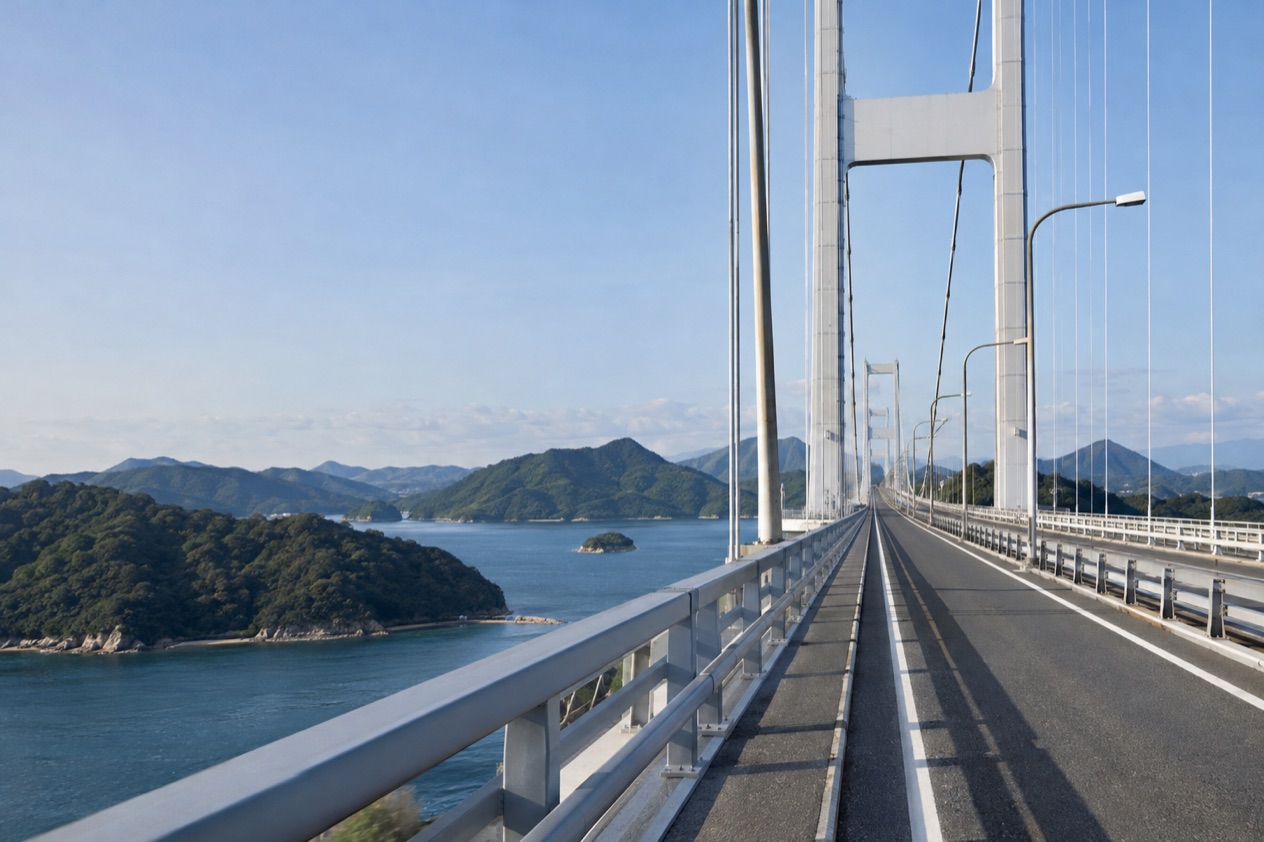
A rider pauses on a long bridge between two islands, the strait spread out below, and the next stretch of road runs on toward a small harbor town. Japan puts cycling into everyday life and into ambitious long-distance routes alike. It suits travelers who want to see the country at the pace of a bicycle, on island bridges, river embankments, bay paths and mountain trails.
Where can you cycle in Japan?
You can cycle in almost every part of Japan, from the island-hopping bikeways of the Seto Inland Sea to river roads near Tokyo, bay paths in Toyama and mountain trails in the Alps and western Honshu. The country treats the bicycle as ordinary transport, which is why so many towns have a rhythm that suits two wheels: cycling is a major way of making trips up to 1.9 miles, and a significant share of trips within 6.2 miles.
For a visitor this shows in the landscape. Riders share space with commuters, students and shoppers, and the routes built for leisure sit alongside that daily world. The Japan National Tourism Organization keeps a dedicated cycling page, which gives a sense of how many regions now promote riding as a reason to visit.
Islands, bays and lakes
Awaji Island has its own loop, the Awaichi, a cycling tour around the island. In Toyama Prefecture a cycling path follows Toyama Bay, and Ehime Prefecture promotes cycling as part of its identity. Near Tokyo, the Tsukuba Kasumigaura Ring Ring Road is a route built around a lake landscape.
These routes suit riders who like to look up and around: harbors, fishing boats, bridges and the changing light on the water. Stopping in small towns for a bowl of noodles or a plate of local seafood is part of the pleasure, and each coast offers its own seafood in its own way.
Mountain biking
Riders who prefer dirt to pavement can go to Nozawa Onsen, where mountain biking is available. The village is also known for its hot springs, so a ride and a soak in an onsen (a hot spring bath) make a natural pair for those who like to finish a day that way.
Mount Daisen is the other named mountain-biking destination. Between the two you can match your trip to the kind of scenery you want: a hot-spring village in the mountains, or a volcano-flanked setting in western Honshu. Both are for riders who are comfortable off the road and who enjoy a day that turns on terrain rather than distance.
Cities and everyday cycling
In the cities you see the bicycle as a tool. The largest bicycle sharing system in Japan operates in Edogawa ward of Tokyo, and around the country about 85 automated bicycle tree systems store bikes at train stations, using IC cards for storage and retrieval. Together they show how naturally bike and rail fit into one daily routine.
One shared habit deserves mention: children are required by law to wear helmets when cycling. Pedestrians and cyclists also share many sidewalks and paths, and the number of bicycle-pedestrian accidents rose by 30% from 2002 to 2012, so riding with attention to people on foot is part of riding well here.
Which routes are best known?
It runs 43 miles (43 mi) from Onomichi on Honshu to Imabari on Shikoku, crossing 6 islands and 7 bridges.
Shimanami Kaido
The ride links islands by bridge, so the scenery changes every few miles: citrus slopes, small ports, shipyards and long spans above the strait. Onomichi sits at one end on Honshu and Imabari at the other on Shikoku, which lets you shape the trip as a one-way crossing between two islands of the country.
The islands are worth lingering on, with their small beaches of stone, seaside cafés and the pleasure of eating something local between bridges. Pair it with an overnight stay on an island to make the days feel unhurried.
Pacific Cycling Road and Tonegawa
For a bigger undertaking there is the Pacific Cycling Road, which runs 746 miles (750 mi) along the Pacific coast and was completed in 2021. Its stages are described on the national tourism page, so riders can take it in pieces rather than all at once. It is a route for those who like long coastlines and the sense of following a shoreline for days.
The Tonegawa Cycling Road follows a river instead, 106 miles (110 mi) from Gunma Prefecture through Saitama Prefecture to the Pacific Ocean. The idea is simple and appealing: you ride with the current of a great river from inland country down to the sea.
Biwaichi, Akinada Tobishima and other named routes
The Biwaichi itinerary is one of the featured routes on the national tourism page, and the Akinada Tobishima Kaido adds another island-hopping option, 29 miles (29 mi) from Kure to Okamura. Aomori Prefecture has its own set of best cycling routes, and the Tokapuchi 400 is another named route for riders who like a defined challenge.
Taken together, these routes let you choose by mood: bridges and islands, a lakeshore loop, a river, a bay or a far northern prefecture. Starting with one that has a clear beginning and end, such as the Shimanami Kaido or the Akinada Tobishima Kaido, gives the trip a shape from the first morning.
| Route | Length | From | To |
|---|---|---|---|
| Shimanami Kaido | 70 km (43 mi) | Onomichi | Imabari |
| Akinada Tobishima Kaido | 46 km (29 mi) | Kure | Okamura |
| Tonegawa Cycling Road | 170 km (110 mi) | Gunma Prefecture | Pacific Ocean |
| Pacific Cycling Road | 1,200 km (750 mi) | Pacific coast | Pacific coast |
Can you bring a bike on trains?
What they do show is how closely bikes and stations are tied together across the country, which shapes how you plan a ride.
Buses and the rule to plan around
Bicycles are not allowed on buses in Japan, and buses are not fitted with bicycle carriers. That matters for a trip that mixes riding with regional transport, because a bus will not carry you and your bike over a gap in the route. Plan each day so the bike stays with you on the road you ride, from one town to the next.
It also means that long point-to-point routes such as the Shimanami Kaido are best thought of as crossings with a clear start and finish, rather than loops you can shortcut by bus. Choose your starting town and your ending town with that in mind.
Bikes at the station
Stations are where bicycles and rail meet in daily life. About 85 automated bicycle tree systems stand around Japan, often at train stations, and they store and retrieve bikes with IC cards. Edogawa ward in Tokyo runs the largest bicycle sharing system in the country, a reminder that people ride to a station rather than carry a bike aboard.
For a visitor, this suggests thinking of the station as a start or end point for a ride, with the route itself doing the traveling. Combine a ride along a named route with the rail network in the way that suits your plan, and rely on each operator for its own rules about bikes aboard.
Other wheels on the road
Electric bikes in Japan are restricted to pedal assist only, with a top speed of 15 miles/h (15 mph), so the motor helps while you pedal rather than replacing it. Scooters up to 50cc may not exceed 19 miles/h (19 mph) and cannot turn right except in specific situations.
Those limits give the road its pace: a steady, moderate speed shared by bikes, e-bikes and small scooters. Riders who keep to it find the roads and paths of towns and countryside easy to read, and the routes above are built around that same unhurried rhythm.
Good to know before you go
Children are required by law to wear helmets when cycling in Japan, and sidewalks and paths are often shared with pedestrians, so a steady pace and a little courtesy go a long way. Buses do not take bicycles, which is worth remembering when you plan the end of a day. Rain can interrupt a ride on any coast or island, so keep each day flexible and let the route, the villages and the food along it set the pace.
Sources
- Japan National Tourism Organization, cycling (https://www.japan.travel/en/sports/cycling/), checked October 11, 2026
- Wikipedia, Cycling in Japan (https://en.wikipedia.org/wiki/Cycling_in_Japan), checked October 11, 2026
- Wikivoyage, Cycling in Japan (https://en.wikivoyage.org/wiki/Cycling_in_Japan), checked October 11, 2026
To plan your stay
- Best Time to Visit Japan: Cherry Blossoms, Autumn Colors, Weather and Festivals
- Where to Stay in Japan: Ryokan, Temple Stays, Capsule Hotels and the Best Cities to Base In
- Sending Luggage from the Airport in Japan: Hands-Free Travel, Hotel Delivery and Coin Lockers
- Know Before You Go to Japan: Entry, Money, Etiquette and Getting Around