
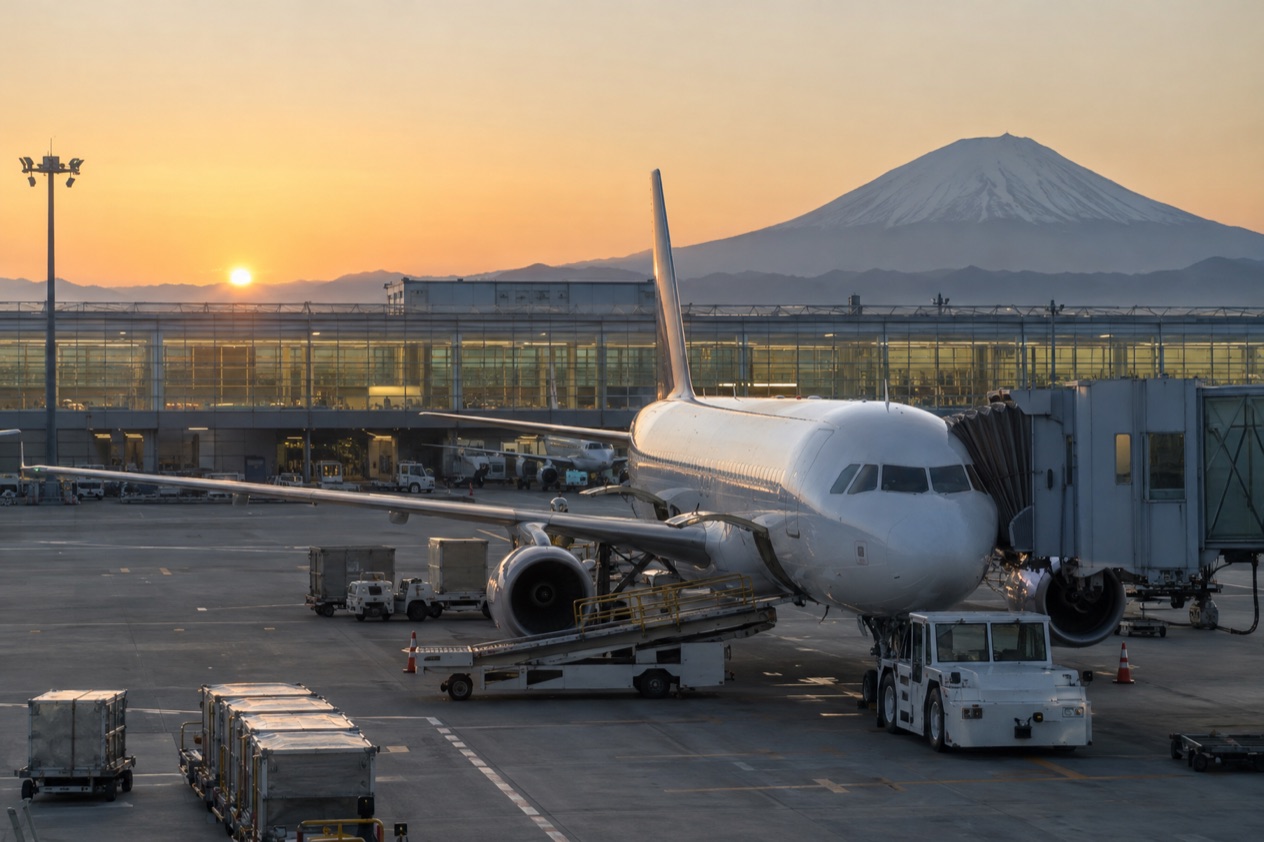
At a gate in Tokyo, the red crane on a white tail fin turns slowly toward the jet bridge while the boarding announcement rolls out in Japanese, then in English. That crane belongs to Japan Airlines, the carrier most Americans simply call JAL, and it is the airline travelers weigh when they plan a flight to Japan. It is based in Tokyo, flies from Tokyo and Osaka airports, and sits inside the Oneworld alliance.
Which U.S. cities does Japan Airlines serve?
Japan Airlines reaches 39 international destinations, and every one of them is stitched together through its Tokyo and Osaka airports, so a trip from the United States is a trip to a Japanese hub first and onward from there. The airline is a member of the Oneworld alliance, which matters if you collect miles with a partner airline or want a single journey that links several carriers.
Where you begin in the U.S. depends on the route map you see when you search, and the airline’s schedules change from one season to the next. What stays fixed is the shape of the network: the long flights end in Tokyo or Osaka, and the connections then fan out across a large domestic system.
What the Oneworld membership means for your itinerary
Oneworld is a group of airlines that cooperate on tickets, connections and frequent flyer programs. For a traveler leaving a U.S. city, this means a flight can start on one member airline and finish on Japan Airlines, with the legs sold together as one journey. Miles earned in a Oneworld program from an American carrier can often be tied to the same trip.
It also shapes how you think about the departure city. If your home airport is served by a Oneworld partner rather than by Japan Airlines itself, the alliance is the thread that can still lead you onto a JAL aircraft for the Japanese part of the trip.
A network that reaches well beyond Tokyo
Alongside its international flights, the airline serves 60 domestic destinations. Together with its subsidiaries it operates over 4,500 international flights every month, and its domestic flights number over 26,000 in the same span.
For a visitor, the practical meaning is that an arrival in Tokyo or Osaka can lead to an onward flight inside Japan without changing airline. Travelers who like the idea of seeing a northern city, a southern island or a regional castle town on the same ticket find the domestic side of JAL worth a look when they sketch an itinerary.
Where the airline calls home
Japan Airlines is headquartered in Shinagawa, a Tokyo district of office towers and rail lines. The company’s identity is tied to the capital, and that shows up in the way the network is built, with Tokyo’s two big airports carrying the main traffic and Osaka’s airports adding a western anchor.
Staff, signage and in-flight announcements all carry that Tokyo origin, and travelers find the first hours of the trip begin on board rather than at the arrival hall.
Which airports in Japan does it connect to?
Japan Airlines is built around four airports: Narita and Haneda in Tokyo as the main hubs, and Kansai and Itami in Osaka as the secondary ones.
| Airport | City | Role for JAL |
|---|---|---|
| Narita | Tokyo | Main hub |
| Haneda | Tokyo | Main hub |
| Kansai | Osaka | Secondary hub |
| Itami | Osaka | Secondary hub |
Narita and Haneda, the Tokyo pair
Tokyo is served by two airports, and Japan Airlines uses both as its main hubs. Narita and Haneda are the gateways to the capital, and an itinerary that begins in the United States may land at either one depending on the flight. The names appear in every booking screen, so it helps to know that both lead to the same city.
From there the trip opens onto the capital’s neighborhoods, the Shinkansen platforms and the regional flights that leave from the same hubs. Travelers planning to see Tokyo first, then move on toward Kyoto, Hiroshima or farther afield, often treat these airports as the first page of a longer story.
Kansai and Itami, the Osaka pair
In the west, Japan Airlines has secondary hubs at Osaka’s Kansai and Itami airports. Osaka is a city known for its street food, its castle and its cheerful, talkative restaurants, so landing there can set the tone of a trip very differently from landing in Tokyo.
Having two airports in the Osaka area gives the airline a second base for its network. For a traveler who wants to begin in the Kansai region, with Osaka, Kyoto, Nara and Kobe in reach, this second pair of hubs is the reason to look at JAL’s schedule from the west rather than from Tokyo.
Using the hubs to plan an open-jaw trip
Because the airline has hubs in both Tokyo and Osaka, a traveler can imagine arriving in one city and leaving from the other. You might land in Tokyo, spend your days among temples and department stores, travel through the country, and fly home from Osaka. The idea suits anyone who prefers a line across the map to a round trip.
This is a matter of how the hubs are placed rather than a rule about fares or schedules. When you sketch such an itinerary, the four airports above are the points that Japan Airlines itself treats as its anchors, and each has a different atmosphere on arrival.
What else should you know before you book?
The main thing to know is what the seat will be like, because on the Boeing 777-300ER the Business Class cabin is built around Sky Suite seats. They sit in a staggered 2-3-2 setup with direct aisle access, which means each passenger can reach the aisle without stepping over a neighbor.
The Sky Suite seat in Business Class
A staggered layout places seats at slightly different angles and positions so that each one has its own corner of the cabin. With direct aisle access, getting up during a long night flight does not mean waking anyone. For travelers who sleep lightly, or who share the trip with a partner or a friend and want to sit nearby, that arrangement is part of the appeal.
This description applies to JAL’s Boeing 777-300ER aircraft. On other aircraft in the fleet the cabin can look different, so the aircraft type shown in a booking is worth reading before you choose a fare. The seat is the part of the experience you will live with the longest, and it deserves a moment of attention.
Miles, partners and the Oneworld network
Because Japan Airlines belongs to Oneworld, the airline sits inside a wider web of partners. A trip that mixes a U.S. carrier for one leg and JAL for another can be planned as a single journey. This is a useful way to think about long itineraries that include a connection at home before the flight across the Pacific.
If you already hold status or miles with a Oneworld airline, it is natural to look at Japan Airlines first. Whether a given fare earns miles in your program depends on the program itself, so the airline’s own pages and your loyalty account are where those details live.
Choosing between Tokyo and Osaka on arrival
The airline’s pairs of hubs make the first big choice of a Japan trip a question of mood. Tokyo offers a city of neighborhoods that each feel like a small town, from the lanterns of Asakusa to the glass towers of Shinjuku. Osaka offers a looser, noisier, food-driven welcome, with takoyaki and okonomiyaki stalls close to the canal.
Since JAL serves both regions, you can let the first days decide the rest. Many itineraries pair the two cities with Kyoto and Nara in between, and the airline’s hubs mean you are not forced to return to the airport where you started.
Good to know before you go
The U.S. State Department rates Japan Level 1: Exercise Normal Precautions.
A Japanese airport is a place where lines form without prompting and announcements come in two languages, so the first hour on the ground tends to feel orderly. Carry some patience for the walk between the gate and the baggage hall, and let the first meal be something simple, such as an onigiri rice ball or a bowl of udon, to ease into the country. On the page of your own trip, JAL’s Tokyo roots mean that the airline’s rhythm and the city’s rhythm begin to match the moment you land.
Sources
- Wikipedia, Japan Airlines (https://en.wikipedia.org/wiki/Japan_Airlines), checked October 11, 2026
- U.S. Department of State, Japan travel advisory (https://travel.state.gov/content/travel/en/traveladvisories/traveladvisories/japan-travel-advisory.html)
To plan your stay
- Best Time to Visit Japan: Cherry Blossoms, Autumn Colors, Weather and Festivals
- Where to Stay in Japan: Ryokan, Temple Stays, Capsule Hotels and the Best Cities to Base In
- Sending Luggage from the Airport in Japan: Hands-Free Travel, Hotel Delivery and Coin Lockers
- Know Before You Go to Japan: Entry, Money, Etiquette and Getting Around