
Walk toward Izumo Taisha and the sound changes: gravel under your shoes, the rustle of pines along the approach, and then the sharp, doubled clap of people praying at the shrine. In Izumo, the old stories of the gods are not kept in a museum.
They are part of the ordinary rhythm of the town. It is a place for travelers who like their trips built around a shrine, a bowl of soba and the pace of western Honshu.
Where is Izumo and what is it like?
Izumo is a city in Shimane Prefecture, in the Chugoku region on the island of Honshu, close to Matsue, the prefectural city. It is home to around 150,000 people, which makes it a working regional city rather than a tourist resort, with rice fields, rivers, a rail station and a sea coast all within its borders.
Its character comes from mythology. In the old stories, Izumo is the land where the gods gather, and the city wears that lightly but never forgets it.
Shrines turn up in neighborhoods and along country roads, and the most important of them, Izumo Taisha, sits in the district of Taisha-machi. Visitors arrive with the shrine in mind and then discover that the town around it has its own habits, from the way people talk about luck in love to the way they serve noodles.
The pace is unhurried and the scale is human. You will not find a skyline or a nightlife district to rival Osaka or Tokyo. What you get instead is a place where a day is shaped by a shrine visit, a meal and a walk, and where evenings are a matter of a good dinner and an early night.
Izumo suits travelers who enjoy Shinto culture, regional food and slow exploring, and who are happy to build a trip around a few places rather than a long checklist. It is a lesser fit for anyone who wants a packed schedule of museums, shopping and big-city entertainment. Pairing it with Matsue next door gives the region more variety, and the climate, humid and green with rain through the year, helps explain why the countryside looks as lush as it does.
The climate is humid subtropical, with very warm summers and cool winters. Rain falls in every season, so the landscape stays green and an umbrella earns its place in the bag. The shrine grounds and the small streets around them look good under gray skies, with wet stone and dark wood.
What is there to do in Izumo?
What sets Izumo apart from its neighbors is that the shrine is the point of the trip, not a stop on the way to something else.
Izumo Taisha and the approach to it
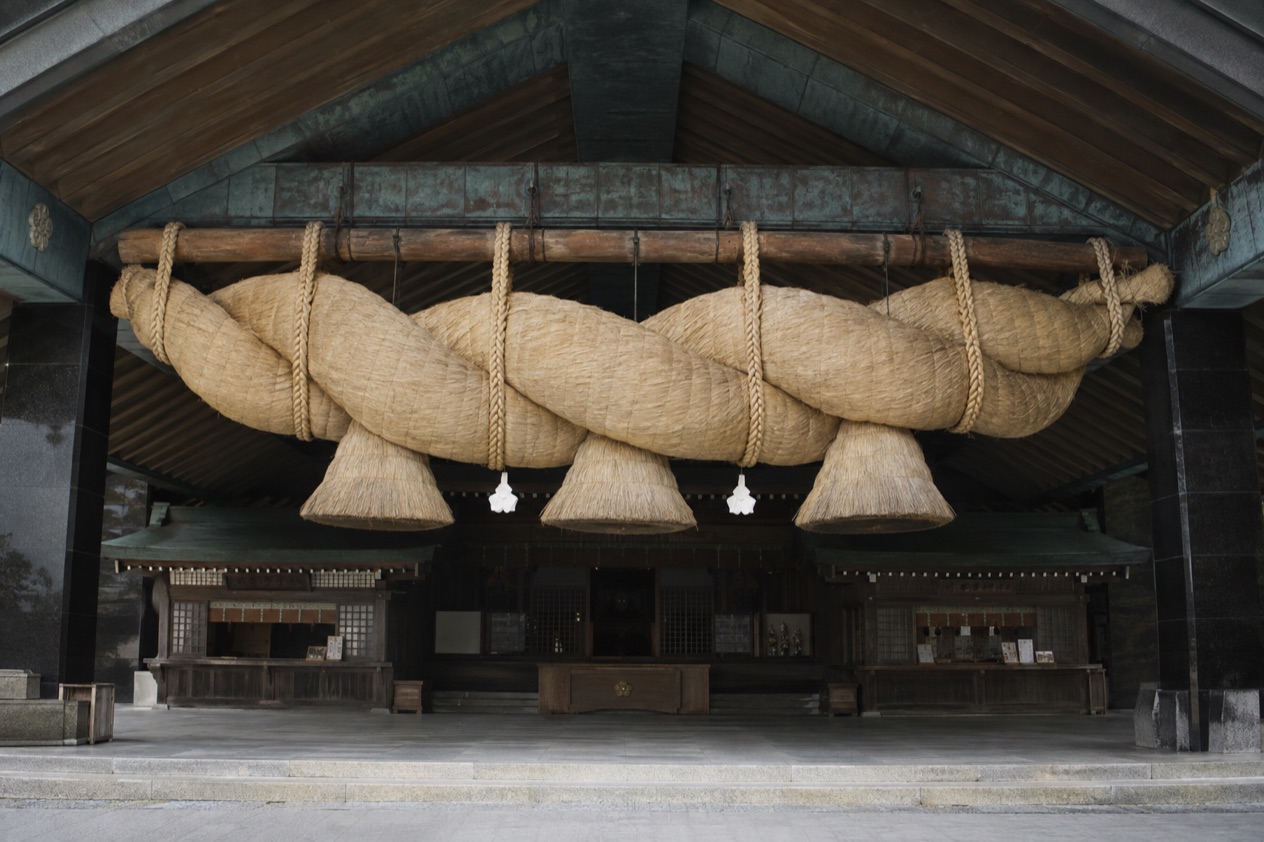
Izumo Taisha is the oldest Shinto shrine in Japan, and it is the reason people visit. You reach it along a tree-lined approach, pass beneath torii gates and move from the outer grounds toward the main hall in stages, each one a little more formal than the last. The buildings are of dark timber with deep, heavy roofs, and the sense of scale comes from the sky and the trees as much as from the architecture.
One custom sets the shrine apart. Instead of the usual two claps when praying, it is customary here to clap four times, because one prays for oneself and for one’s partner.
Watching other visitors do it, one pair of hands after another, is part of the experience. The shrine is linked in the popular mind with good relationships and bonds between people, which is why couples, friends and solo travelers come with the same hope.
The shrine suits anyone with an interest in Japanese religion, architecture or simply in how a living sacred place feels. Give it time to walk the grounds without hurrying, and bring shoes that cope with gravel and wet paths.
Izumo soba and the local table
Food is the second reason to come. The local specialty is Izumo soba, buckwheat noodles that are often darker and more rustic than the pale soba of other regions, since the buckwheat is ground with more of the husk. A classic way to eat it is warigo style, with noodles stacked in round lacquered boxes, where you pour the dipping broth over each tier in turn.
Travelers make a soba lunch part of the shrine visit, and the noodle shops in the town around it suit that rhythm well. Beyond soba, the Shimane coast and the nearby lakes supply seafood, and a meal here usually leans on what is local and in season. Eating in Izumo is a quiet pleasure rather than a spectacle, and it rewards curiosity about the small dishes alongside the main one.
Matsue and the wider region
Izumo sits near Matsue, and the two cities make a natural pair for travelers who want more than the shrine. Matsue brings a castle town and a lakeside setting, a different mood from Izumo’s shrine-centered one. The two can be combined in a single stay, and doing so gives a fuller sense of Shimane Prefecture.
Within Izumo itself, the countryside and the coast reward a slower look. Drive or ride out of the center and the scenery turns to paddies, farmhouses with heavy tiled roofs and small local shrines tucked among trees. These are the things that make Izumo feel lived-in, and they are the part that package itineraries tend to skip.
How many days do you need in Izumo?
A long weekend is enough to see Izumo well, and two nights gives the shrine, the food and a little wandering room without feeling rushed. If you are coming only for Izumo Taisha, a night or two will cover it, especially if you travel in on an earlier train or flight.
With a short stay, the plan is simple. Spend one generous stretch at Izumo Taisha, walking the approach, the grounds and the surrounding streets. Add a soba meal and a slow evening in town. Rain does not wreck this itinerary, since shrines and noodle shops are both pleasant in wet weather.
With more time, start adding the rest of the region. Matsue is the obvious partner, and a day there works well from an Izumo base. A longer stay lets you wander the countryside and coast around Izumo itself, with no fixed list, and see what you find. Travelers who like a measured pace will find that a few unplanned hours often become the part they remember.
If Izumo is one stop on a longer trip through western Japan, it fits between larger cities. The Yakumo limited express links the city with Okayama, which opens the way to the San’yo Shinkansen and the cities along it. That makes Izumo an easy addition to a loop through the region rather than a separate expedition.
Where to stay in Izumo
The main choice is between staying in the city near Izumo Station, staying in Taisha-machi close to the shrine, or basing yourself in Matsue and visiting Izumo from there. Each suits a different kind of trip.
Near Izumo Station you are close to the Yakumo trains, and the bus that links with the airport also runs to the station. This is the practical base for travelers who arrive by rail or air, who want a choice of places to eat and who plan to move around the area. It feels like a regional city, with everyday shops and restaurants rather than a tourist strip.
In Taisha-machi you are next to Izumo Taisha itself, which changes the feel of the visit. You are within the shrine’s own district, and the streets around the approach are part of your stay.
This suits travelers who want to be near the shrine and who care more about atmosphere than variety. The trade-off is that you will have fewer choices of what to do in the evening than in the city center.
Matsue, near Izumo, is the alternative for those who want to see both cities and prefer to settle in one place. It makes sense for a longer regional stay, and it suits travelers who like a castle town as a base. Whichever you choose, think about how you are arriving and how much of your time you want to spend in transit.
How do you get to Izumo and get around?
You can reach Izumo by air, by limited express train from Okayama, or by overnight train from Tokyo. Each route has its own feel, and the right one depends on where you start and how you like to travel.
By air
From Tokyo’s Haneda Airport there are five flights per day to Izumo Airport, and the flight takes 80 minutes. From the airport, a 30-minute bus ride brings you to Izumo Station.
Flying suits travelers who start in Tokyo and want to reach Shimane without a long day on the rails. It also lets you arrive on a schedule, with a bus link straight to the main station and onward connections from there.
By train
The Yakumo limited express serves Izumo hourly, running to Okayama station, where it connects directly with the San’yo Shinkansen. The trip to Okayama takes 3 hours. For travelers coming through western Japan, that makes Izumo reachable as part of a rail trip along the Shinkansen line and then onward on the Yakumo.
There is also the Sunrise Izumo, an overnight train that leaves Tokyo Station every night at 22:00 and reaches Izumo twelve hours later. Japan Rail Pass holders can book a carpeted floor space at no charge. It is a trip for those who enjoy the journey as part of the adventure, and it puts you in Izumo with the day ahead of you.
Getting around
Within the center, Izumo Station is the hub, and the shrine district of Taisha-machi is the main destination for visitors. Once there, you explore the approach and grounds on foot.
Beyond that, local transport and taxis tie the area together, and travelers who want to see the countryside and the coast at their own pace will want to plan how they move between places. The shrine itself is at Kitsukihigashi in Taisha-machi, which is the address to give a driver.
When is the best time to visit Izumo?
Autumn is a strong choice for Izumo, and it carries a special meaning here. In the old calendar the tenth month is called Kamiarizuki, the month when the gods are said to gather at Izumo, while the rest of Japan calls it the month without gods.
It falls in late autumn, and the shrine is an especially fitting place to be at that time. Spring is another good option, with milder weather for walking the grounds.
Summer is very warm, and July is the wettest month. The climate is humid subtropical, with abundant precipitation throughout the year, and the annual total comes to about 66 inches. Rain is part of every season here, so the practical answer is not to find a dry month but to travel with a light rain layer and a flexible plan. Shrines and soba shops are both comfortable in wet weather.
Winters are cool, and travelers who come then find the shrine grounds in a bare, sharp light. It is a good season for those who prefer thinner company at sacred places and do not mind a jacket. Whichever month you choose, plan for rain at some point, since that is how this part of Japan keeps its greens.
Good to know before you go
At a shrine, small habits go a long way. Bow at the gate, keep your voice low on the approach, and remember the four claps at Izumo Taisha. Rain falls in every season, with July the wettest month, so an umbrella and shoes that handle wet gravel belong in your bag. When you arrive in Izumo, take your time, because the place gives the most to those who walk it slowly.
Sources
- Wikipedia, Izumo, Shimane (https://en.wikipedia.org/wiki/Izumo,_Shimane), checked October 11, 2026
- Wikivoyage, Izumo (https://en.wikivoyage.org/wiki/Izumo), checked October 11, 2026
- Wikipedia, Izumo-taisha (https://en.wikipedia.org/wiki/Izumo-taisha), checked October 11, 2026
To plan your stay
- Best Time to Visit Japan: Cherry Blossoms, Autumn Colors, Weather and Festivals
- Where to Stay in Japan: Ryokan, Temple Stays, Capsule Hotels and the Best Cities to Base In
- Sending Luggage from the Airport in Japan: Hands-Free Travel, Hotel Delivery and Coin Lockers
- Know Before You Go to Japan: Entry, Money, Etiquette and Getting Around