
Under tall cedars at Ise, gravel crunches underfoot, and the plain wooden gates stand in front of a sanctuary you will never see in full. White cloth hangs from the shrine entrances and the trees seem to close in around the paths. Ise Grand Shrine in Mie Prefecture is a pilgrimage more than a sightseeing stop: you walk, you wash your hands, you bow, and you take in the forest and the thatched rooflines that appear above the fences.
Is visiting Ise Grand Shrine worth it?
Yes, if you like places that reward attention more than spectacle, and if a walk through an old forest to a sacred site sounds like a good way to spend a day. Ise suits travelers curious about Shinto, Japan’s native religion, and anyone who enjoys understanding why a place matters as much as looking at it. It asks for little in the way of sightseeing checklists and gives back a lot in atmosphere.
What sets Ise apart from the temples and shrines in other Japanese cities is how little of it you actually see. The central buildings sit behind layers of wooden fencing, and visitors look at thatched roofs from outside.
There are no gilded halls to photograph up close. Instead the experience is built from the approach: the gravel paths, the water basin for purification, the enormous trees and the sense that the whole site is arranged for ritual rather than for viewing.
The shrine is dedicated to the solar goddess Amaterasu Omikami and, at its second main part, to the grain goddess Toyouke-hime. Ise is described as the most sacred Shinto shrine in Japan, and that weight is felt in how people behave here: they pause at the gates, bow, and move at an unhurried pace.
The other reason to come is time itself. The buildings are dismantled and rebuilt on a fixed cycle, so what stands today is both new and a copy of something very old. Few places in Japan offer that idea so directly, and it is worth the trip on its own.
What to see at Ise Grand Shrine
Ise Grand Shrine is not one building but two main parts, the Outer Shrine (Gekū) and the Inner Shrine (Naikū), set apart from each other in the city of Ise. Between and around them are forest paths, ornamental walkways and a sequence of smaller structures. Pilgrimage custom gives the visit its order, and following it is part of the experience.
The Outer Shrine (Gekū)
Custom says you begin at Gekū, and that is where the visit starts to make sense. The Outer Shrine honors Toyouke-hime, the grain goddess, a figure associated with food, harvest and the offerings that sustain the deity worshipped at the Inner Shrine. The setting is wooded, with broad gravel paths running beneath big trees and the main sanctuary, the honden, placed deeper in.
At the honden you can only go as far as the first gate, because the sacred area is enclosed by four rows of fences. You stand at the gate, bow, and look at the thatched roof over the top.
The restriction is the point: the shrine is meant to be approached, not entered. Take time with the paths around the sanctuary as well, where the trunks of the cedars and the pale gravel make the walk itself part of the visit.
The Inner Shrine (Naikū)
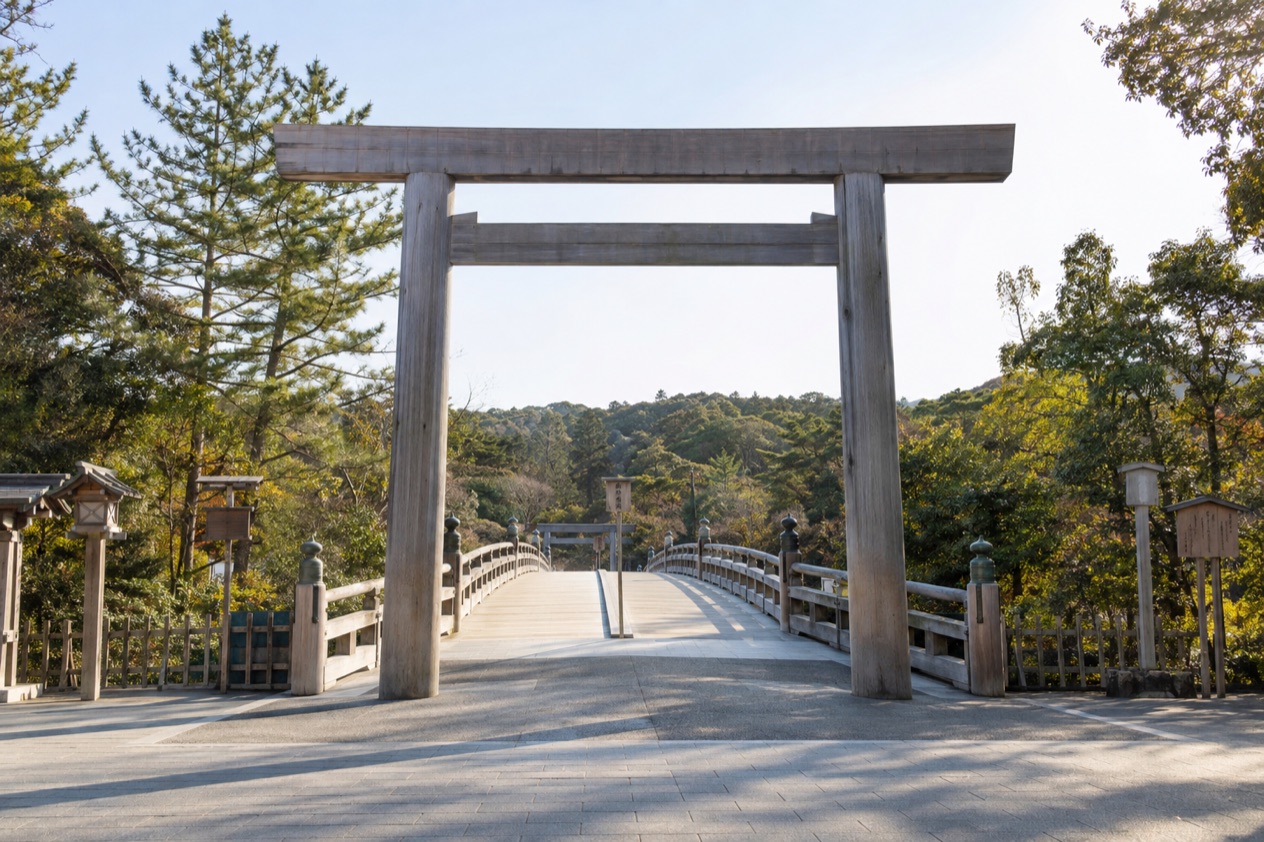
Naikū is dedicated to Amaterasu Omikami, the solar goddess, and it is the part of Ise people picture when they think of the shrine. It is reached after Gekū, following the traditional order of the pilgrimage. The approach crosses the Isuzu River, whose banks and the bridge over it are part of the setting, before the path continues into the trees.
At the Temizusha water basin, visitors are encouraged to wash their hands and rinse their mouths as a symbolic purification before going further. It is a small ritual that sets the tone: you slow down, you do what the people around you are doing, and you arrive at the sanctuary in the right frame of mind. As at Gekū, the main buildings remain out of sight beyond the fences, and what you see is the thatch and the timber of the outer structures.
Forest paths and the Meiji-era walkways
Visitors are free to walk through the forest and along ornamental walkways that date back to the Meiji period. These paths are more than a way of getting from one structure to the next. They are where the shrine’s character shows most clearly: tall trees, pale gravel, wooden bridges and gates, and no hurry. Wandering them lets you take in the scale of the grounds without trying to fit everything in.
Look for the details that repeat across the site: the unpainted wood, the clean lines of the gates, the white cloth at the entrances and the thatch laid thick on the roofs. They belong to a style of Shinto architecture that Ise has kept for centuries, and the rebuilding cycle is how it stays so exact.
How to get to Ise Grand Shrine
Ise Grand Shrine stands in the city of Ise, in central Mie Prefecture, on the island of Honshu, and that city is the destination to aim for. The shrine is not a single entrance at the end of a road. It is divided into the Inner Shrine and the Outer Shrine, which lie apart from each other within the city, so you are really planning a visit to two places in one town.
The order matters more than the route. Pilgrimage custom has visitors go to the Outer Shrine first and then continue to the Inner Shrine, which lies to the south of it.
Planning around that sequence gives the day its shape: you arrive in Ise, begin at Gekū, then make your way on to Naikū, and finish there. Anyone who goes straight to the Inner Shrine skips the traditional start, and the order is part of what makes the visit feel like a pilgrimage rather than a series of stops.
Because the two parts are separated, think of the visit as a journey within the city rather than a stroll around a single compound. Each shrine has its own approach, its own gravel paths, and its own gate where the public stops.
The forest and the walkways connect the experience, and the town of Ise around them gives the pilgrimage a base for food and rest. Since you will be moving between two sites, build the day around the shrines themselves and leave room for the paths, which are free to walk and reward a slow pace.
When to visit Ise Grand Shrine
The trees, the gravel and the thatch set the mood in any season, and the experience depends more on your pace than on the calendar.
There is one date worth planning around. The Okihiki Festival, in which people drag wooden logs through the streets of Ise to Naikū and Gekū, is held in the spring over two consecutive years in the period leading up to the shrine rebuilding.
The sight of the whole town hauling timber toward the shrines is one of the most vivid ways to see how living the tradition is, and it makes a spring visit in those years especially memorable.
The longer calendar is set by the rebuilding. The shrines are dismantled and rebuilt to exacting specifications every two decades. The present buildings date from 2013, the 62nd iteration, and the next rebuilding is scheduled for 2033.
A visit in the years between gives you the chance to see the current buildings as they stand, and the festival years before a rebuilding add a layer of ceremony to the town. Either way, the rhythm of renewal is built into the place.
As for the hour of the day, let the paths decide. The forest walkways are free to explore, and the experience of washing your hands at the Temizusha basin, bowing at the gates and looking up at the thatched roofs does not depend on a particular moment. Give yourself time for both shrines and the walk between them, and the visit will unfold on its own.
Tips for your visit
Go in the traditional order, Outer Shrine first and Inner Shrine second, and treat the visit as a walk rather than a checklist. The pilgrimage sequence gives the day a natural arc: a wooded approach at Gekū, a gate where the public stops, then the longer, river-crossing approach to Naikū. Leaving room between the two is better than hurrying.
Expect to see the roofs, not the sanctuaries. Public access beyond the gates is strictly limited, and what you can see from outside the fences is the thatched roofs of the central structures.
If you go with that expectation, the visit becomes about the setting, the gravel, the cedar trunks, the gates and the purification at the water basin, and it is more satisfying for it. Photographs of the sanctuary are not the goal here. Looking up at the thatch and the timber, and standing where pilgrims have stood, is.
Take part in the small rituals. At Naikū, washing your hands and rinsing your mouth at the Temizusha basin is encouraged as a symbolic purification, and doing it alongside other visitors is a good way to feel part of the place. Wear shoes that suit gravel and forest paths, since you will spend most of the visit walking among trees and along the Meiji-era walkways.
Combine the shrines with the city of Ise around them. After the walk, the town is the place for a meal, and a bowl of Ise udon, thick soft noodles in a dark, sweet soy sauce, is the local dish to look for. Akafuku, a rice cake covered in smooth sweet red bean paste, is the traditional pilgrim’s sweet. Neither needs a plan, and both fit the slow rhythm of the day.
For families and anyone thinking about mobility, the main thing to know is that the visit is a long walk on gravel through forest, with the paths free to explore and no entry into the sanctuaries. Each part of the shrine can be enjoyed at its own pace, and nothing demands that you see it all.
Good to know before you go
Ise Grand Shrine is a place of worship, so the habits that fit it are simple ones: walk calmly, bow at the gates, wash your hands and rinse your mouth at the basin at Naikū, and accept that the sanctuaries themselves stay out of view. Treat the forest paths as part of the shrine rather than a park around it, and keep your voice low among the trees. The visit rewards patience, and the thatched roofs above the fences are the reward for coming this far.
Sources
- Wikipedia, Ise Grand Shrine (https://en.wikipedia.org/wiki/Ise_Grand_Shrine), checked October 11, 2026
- Wikipedia, Ise, Mie (https://en.wikipedia.org/wiki/Ise,_Mie), checked October 11, 2026
- Wikivoyage, Ise (https://en.wikivoyage.org/wiki/Ise), checked October 11, 2026
To plan your stay
- Best Time to Visit Japan: Cherry Blossoms, Autumn Colors, Weather and Festivals
- Where to Stay in Japan: Ryokan, Temple Stays, Capsule Hotels and the Best Cities to Base In
- Sending Luggage from the Airport in Japan: Hands-Free Travel, Hotel Delivery and Coin Lockers
- Know Before You Go to Japan: Entry, Money, Etiquette and Getting Around